
This chapter studies how materials respond to applied forces: how solids deform elastically according to Hooke's law, how density describes how tightly matter is packed, and how pressure is transmitted through solids, liquids, and gases.
It covers pressure in liquids and the atmosphere, instruments for measuring pressure (barometer, manometer), and Pascal's law, which explains how hydraulic systems like car lifts and vehicle brakes multiply force.
Learning Objectives
- Explain that forces can change the size and shape of an object, and distinguish elastic from inelastic materials
- State Hooke's law and use k = F/x to solve problems involving springs, identifying the limit of proportionality on a load-extension graph
- Describe real-world applications of Hooke's law such as spring scales, galvanometers, and clock balance wheels
- Define density, use Density = Mass/Volume, and describe how density is measured for regular and irregular solids
- Define pressure, use P = F/A, and explain how pressure depends on both force and contact area in everyday situations
- Derive and apply P = ρgh for pressure in a liquid at a given depth
- Describe atmospheric pressure, how it varies with height, how it is measured using a barometer and manometer, and how it relates to weather
- State Pascal's law and explain how it is applied in hydraulic presses and hydraulic brakes
Key Concepts
6.1 Deformation of Solids
A force applied to an object that changes its size or shape is called a deforming force — for example, a spring stretches (extension) or compresses under an applied force, and a tennis ball flattens briefly when struck by a racket. A material is said to be elastic if it regains its original size and shape once the deforming force is removed; this property is called elasticity. Most materials are elastic only up to a certain point called the elastic limit — beyond this limit, the deformation becomes permanent and the material does not return to its original shape even after the force is removed. Materials such as clay dough or plasticine that do not spring back at all are called inelastic materials.
6.2 Hooke's Law
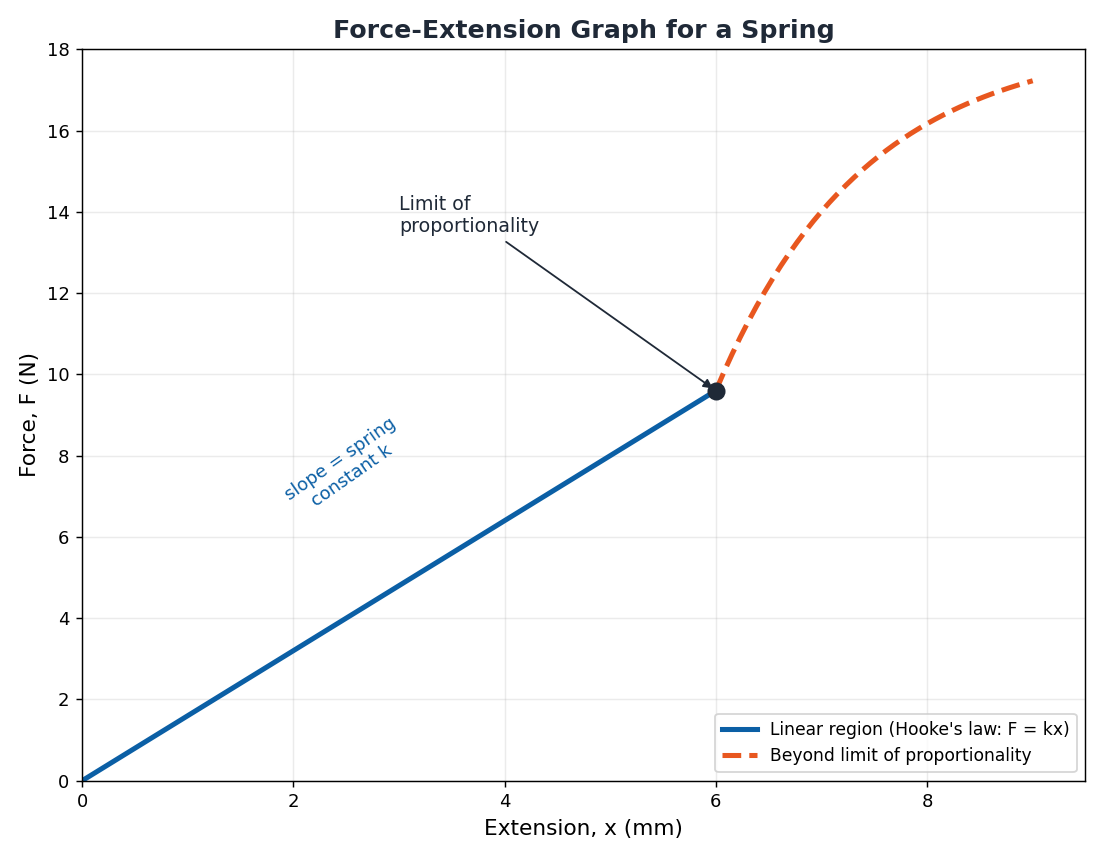
Hooke's law states that within the elastic limit, the extension or compression x of a spring is directly proportional to the applied force F: F ∝ x, or F = kx, where k is the spring constant (a measure of the spring's stiffness), given by k = F/x with SI unit N m⁻¹. A graph of force against extension is a straight line through the origin as long as the elastic limit is not exceeded — the point at which the graph stops being a straight line is called the limit of proportionality. Beyond this point the spring is permanently deformed and the graph is no longer linear. The slope (gradient) of the linear part of a force-extension graph equals the spring constant.
Hooke's law underlies many everyday devices: spring scales use the extension (or compression) of a spring to measure weight; the balance wheel of a mechanical clock uses a spring to regulate the back-and-forth motion that keeps time; and a galvanometer (a current-detecting instrument) uses a tiny 'hair spring' to return its pointer to zero and to provide electrical connections to its coil, with the pointer's deflection proportional to the current flowing through it.
6.3 Density
Different substances of equal volume generally have different masses, because their molecules differ in size, mass, and how closely they are packed. Density is defined as mass per unit volume: Density = Mass/Volume, with SI unit kg m⁻³ (also commonly expressed in g cm⁻³). Denser substances (like iron or steel) pack more, heavier molecules into the same volume than less dense substances (like wood or packing foam). Engineers and architects account for the density of building materials when designing roads, bridges, and buildings, since it affects the strength needed in foundations and supporting pillars.
The density of a regularly shaped solid is found by measuring its mass (with a balance) and calculating its volume from its dimensions. For an irregularly shaped solid, the volume is found by submerging it in a liquid (in which it does not dissolve) inside a measuring cylinder and noting the rise in liquid level, which equals the object's volume.
6.4 Pressure
Pressure is defined as the force acting normally (at right angles) on unit area of a surface: P = F/A, where F is the force and A is the contact area. Its SI unit is the pascal (Pa), equal to one newton per square metre (N m⁻²). For a given force, pressure increases as the contact area decreases — this is why a sharp knife edge, a pointed pin, or football studs concentrate force onto a small area to cut, pierce, or grip more effectively, while wide, flat surfaces (like an elephant's large feet or snowshoes) spread force over a larger area to reduce pressure.
6.5 Pressure in Liquids
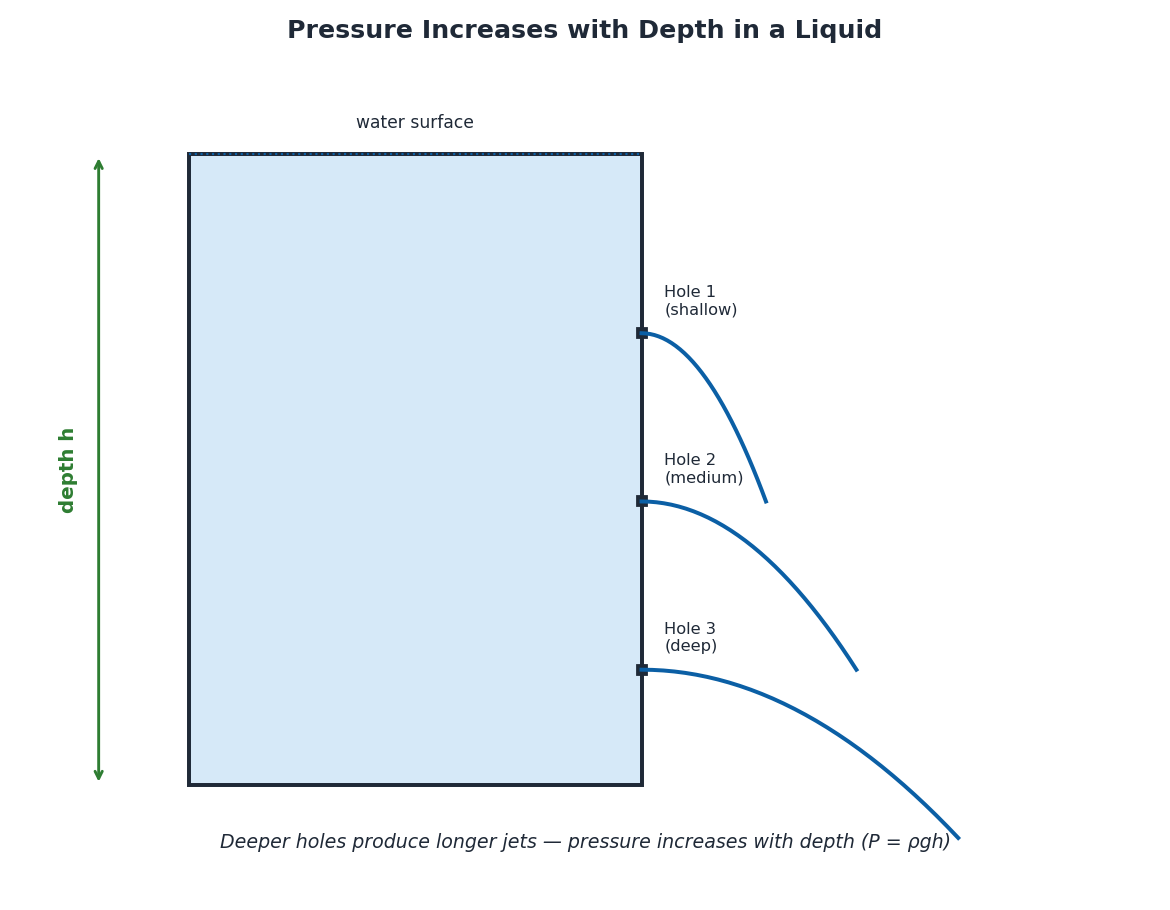
The pressure at depth h in a liquid of density ρ can be derived by considering a horizontal area A at that depth: the liquid column above it has volume V = Ah, mass m = ρAh, and weight F = mg = ρAhg. Since pressure is force per unit area, P = F/A = ρAhg/A, giving P = ρgh. This shows that liquid pressure increases with both depth and density, and does not depend on the shape or area of the container. Pressure in a liquid acts at right angles (normal) to any surface it touches — if a hole is made in a container, the liquid spurts out perpendicular to the surface before curving downward under gravity, and a lower hole produces a stream that travels farther, showing that pressure increases with depth.
6.6 Atmospheric Pressure
The atmosphere is the layer of air surrounding the Earth; its constantly moving molecules collide with surfaces and exert a force per unit area called atmospheric pressure, which acts equally in all directions because air molecules move randomly. At sea level, standard atmospheric pressure is about 1.013 × 10⁵ Pa — an enormous pressure that goes unnoticed because it is balanced by air pressure inside our bodies. The atmosphere extends to roughly 100 km, and its density (and hence pressure) decreases continuously with altitude: pressure falls to about 55 kPa at 5 km altitude and about 1 kPa at 30 km, so measuring atmospheric pressure at a point can reveal its altitude — the lower the pressure, the greater the altitude. Because atmospheric pressure also falls when air becomes less dense due to increased water vapour, a drop in atmospheric pressure often signals approaching rain clouds, which is why meteorologists use pressure changes to forecast weather.
6.7 Measurement of Atmospheric Pressure: The Barometer
A barometer is an instrument that measures atmospheric pressure using the height of a supported mercury column. A simple mercury barometer is made from a glass tube about one metre long, closed at one end, completely filled with mercury, and inverted into a dish of mercury; the nearly empty (vacuum) space above the mercury in the tube has almost zero pressure. The pressure at the base of the mercury column inside the tube equals the atmospheric pressure pushing down on the mercury surface in the open dish, since both points are at the same level: P = ρgh. At standard atmospheric pressure (1.013×10⁵ Pa) with mercury density 13.6×10³ kg m⁻³, this height works out to 760 mm — the traditional 'mm of mercury' reference for atmospheric pressure.
6.8 Measurement of Pressure by Manometer
A manometer is a simple U-shaped glass tube containing mercury, used to measure the pressure of an enclosed gas. When both ends of the tube are open to the atmosphere, the mercury levels in the two arms are equal. When one arm is connected to a gas supply (with the other arm left open), if the mercury level in the connected (short) arm is lower than in the open (long) arm, the gas pressure is greater than atmospheric pressure; if the mercury level in the connected arm is higher, the gas pressure is less than atmospheric pressure.
6.9 Pascal's Law
When a balloon or a tyre is inflated, pressure applied at one point is felt uniformly throughout the object — this demonstrates that a fluid transmits applied pressure equally in all directions. Pascal's law states that when pressure is applied at one point in an enclosed fluid, it is transmitted equally to all parts of the fluid without loss. This principle underlies hydraulic systems, which can move heavy loads and generate large forces because liquids are incompressible and do not absorb the energy applied to them.
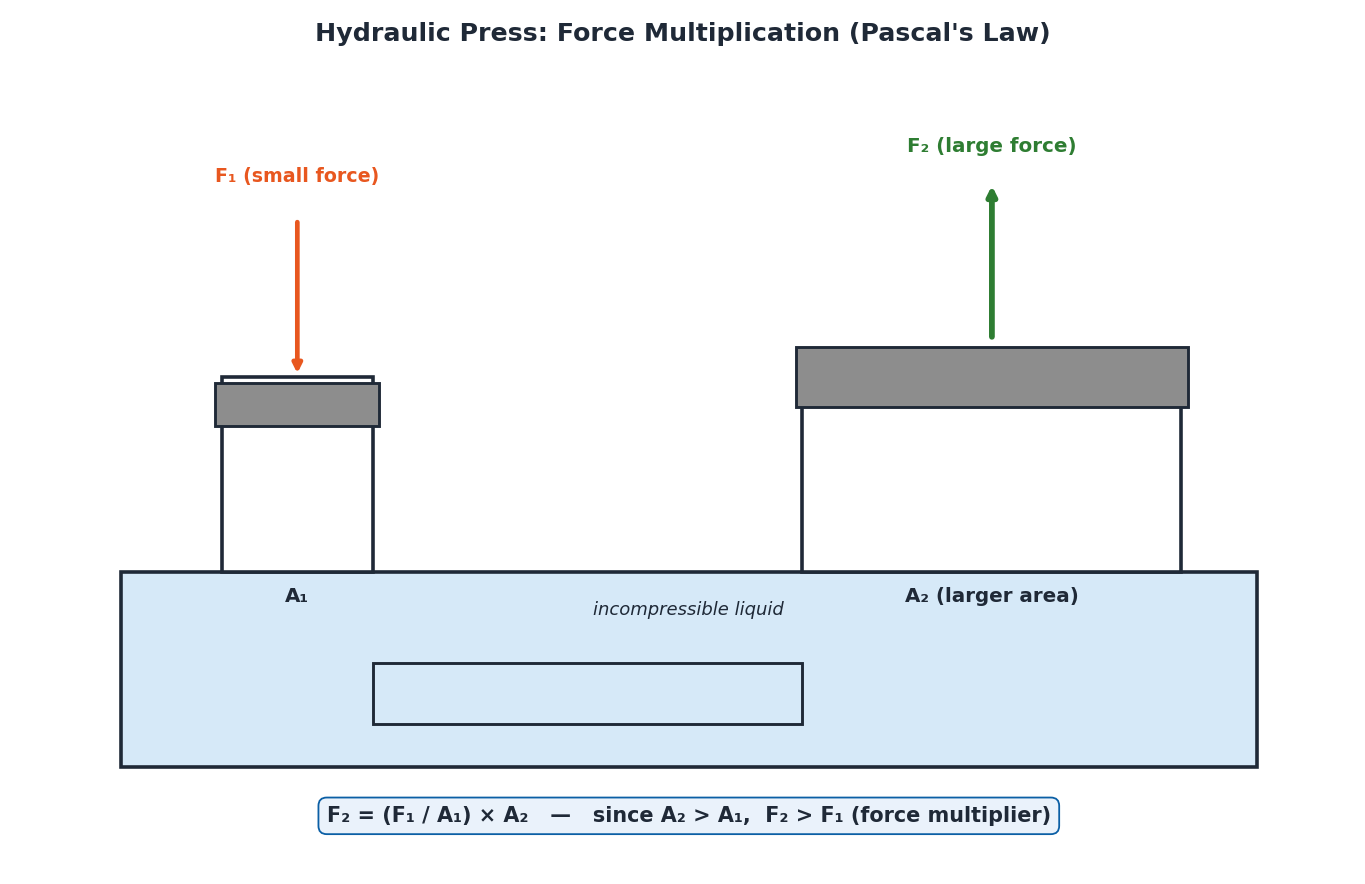
In a hydraulic press, a small piston of area A₁ and a large piston of area A₂ are connected by a liquid-filled pipe. A force F₁ applied to the small piston creates pressure P = F₁/A₁, which is transmitted equally to the large piston, producing a much larger force F₂ = P × A₂ = (F₁/A₁) × A₂. Since A₂ > A₁, it follows that F₂ > F₁ — a small force on the small piston produces a much larger force on the large piston, making the system a force multiplier. This principle is used in hydraulic presses (for compressing cotton bales), car lifts at service stations, and hydraulic brakes, where pressing the brake pedal transmits liquid pressure from a small master cylinder to larger cylinders at each wheel, pushing brake pads against discs or drums to slow the vehicle.
Important Definitions
What is a deforming force, and what is elasticity?
A deforming force is a force that changes the size or shape of an object; elasticity is the property by which a material returns to its original size and shape once the deforming force is removed.
State Hooke's law.
Within the elastic limit, the extension or compression of a spring is directly proportional to the applied force: F = kx, where k is the spring constant.
Define spring constant and give its unit.
The spring constant k is the force needed to produce unit extension in a spring (k = F/x); its SI unit is newton per metre (N m⁻¹).
Define density.
Density is the mass of a substance per unit volume: Density = Mass/Volume, measured in kg m⁻³.
Define pressure and state its SI unit.
Pressure is the force acting normally on unit area of a surface: P = F/A; its SI unit is the pascal (Pa), equal to 1 N m⁻².
What is atmospheric pressure?
The force per unit area exerted by the weight and molecular collisions of the atmosphere on the Earth's surface and on all objects within it; standard value at sea level is 1.013 × 10⁵ Pa.
State Pascal's law.
When pressure is applied at one point in an enclosed fluid, it is transmitted equally to all parts of the fluid without loss.
Why is a hydraulic press called a force multiplier?
Because a small force applied on its smaller piston produces, via a larger piston area, a much greater output force, following F₂ = (F₁/A₁) × A₂.
Key Formulas
| Topic | Formula |
|---|---|
| Hooke's law / spring constant | F = kx, k = F/x |
| Density | Density = Mass / Volume |
| Pressure | P = F/A |
| Pressure in a liquid at depth h | P = ρ g h |
| Hydraulic press force multiplication | F₂ = (F₁/A₁) × A₂ |
| Standard atmospheric pressure | P₀ ≈ 1.013 × 10⁵ Pa (≈ 760 mm of mercury) |
Diagrams
Force-Extension Graph (Hooke's Law): A load-extension graph showing the linear region where Hooke's law holds, and the limit of proportionality beyond which the spring is permanently deformed
Pressure Increases with Depth in a Liquid: Water streams from three holes at different heights in a container, showing that pressure (and jet distance) increases with depth
Hydraulic Press: Force Multiplication: A small force F1 on a small piston (area A1) produces a much larger force F2 on a large piston (area A2), following Pascal's law
Short Questions & Answers
Why do heavy animals like elephants have large, flat feet?
A large contact area spreads their weight over a bigger surface, reducing the pressure exerted on the ground so their legs and the ground can bear it comfortably.
Why is it painful to walk barefoot on pebbles but not on flat ground?
Pebbles reduce the contact area between the foot and the ground, so the same reaction force produces much higher pressure, which is felt as pain.
Distinguish between force and pressure.
Force is a push or pull measured in newtons, while pressure is the force acting normally per unit area (P=F/A), measured in pascals — the same force can produce very different pressures depending on the contact area.
What is the relationship between liquid pressure and depth?
Liquid pressure increases directly with depth, following P = ρgh — the deeper a point is below the surface, the greater the pressure at that point.
Does an object remain elastic beyond its elastic limit? Explain.
No — beyond the elastic limit, the deformation becomes permanent and the object no longer returns to its original size and shape even when the deforming force is removed.
What is the basic principle used in a hydraulic brake system?
Pascal's law: pressure applied at the brake pedal's master cylinder is transmitted equally through the brake fluid to the larger pistons at each wheel, producing a much larger braking force.
Give one application of Pascal's law from daily life.
Hydraulic car lifts at service stations use a small applied force on a narrow piston to lift the much greater weight of a car, because pressure is transmitted equally throughout the enclosed hydraulic fluid.
Why does atmospheric pressure decrease with altitude?
At higher altitudes the air is less dense (fewer air molecules above a given point), so there is a smaller weight of air pressing down, resulting in lower atmospheric pressure.
Long Questions & Answers
State Hooke's law and describe, with reference to a load-extension graph, how the spring constant is found and what happens beyond the elastic limit.
Hooke's law states that within the elastic limit, the extension x produced in a spring is directly proportional to the applied force F, i.e. F = kx, where k is the spring constant (a measure of the spring's stiffness) given by k = F/x with unit N m⁻¹. If force is plotted against extension, this relationship appears as a straight line passing through the origin, and the gradient (slope) of this line equals the spring constant. This straight-line behaviour continues only up to the limit of proportionality; beyond this point on the graph, equal increases in force no longer produce equal increases in extension, the spring is permanently deformed, and the graph curves and no longer follows Hooke's law.
Derive the expression for the pressure at depth h in a liquid, and explain why pressure increases with depth.
Consider a horizontal area A at depth h within a liquid of density ρ. The volume of liquid directly above this area is V = Ah, so its mass is m = ρV = ρAh, and its weight (the force pressing down on area A) is F = mg = ρAhg. Since pressure is force per unit area, P = F/A = (ρAhg)/A = ρgh. This shows that pressure increases with depth h because a deeper point has a taller, heavier column of liquid above it exerting greater downward force on the same area; pressure also increases with the liquid's density ρ, since denser liquid weighs more for the same volume.
Describe the construction and working of a simple mercury barometer, and explain how it measures atmospheric pressure.
A simple mercury barometer consists of a glass tube about one metre long, closed at one end, completely filled with mercury, and then inverted vertically into an open dish of mercury, with a metre scale placed alongside to measure the height of the mercury column. The space above the mercury inside the closed end of the tube is nearly a vacuum, with pressure close to zero. The pressure at a point inside the tube at the level of the mercury surface in the open dish equals the pressure at the corresponding point in the dish (since both are at the same level in a connected liquid), and this equals the atmospheric pressure pushing down on the open mercury surface, given by P = ρgh. At standard atmospheric pressure, this supports a mercury column of height 760 mm, so the height of the mercury column directly indicates the atmospheric pressure — a taller column means higher atmospheric pressure, and a shorter column means lower atmospheric pressure (e.g. at higher altitude).
Explain Pascal's law and describe how it is applied in a hydraulic press to multiply force.
Pascal's law states that when pressure is applied at any point in an enclosed fluid, it is transmitted equally, without loss, to every part of the fluid and to the walls of its container. A hydraulic press applies this principle using two connected cylinders of different cross-sectional areas, A₁ (small) and A₂ (large), filled with an incompressible liquid. When a force F₁ is applied to the small piston, it creates pressure P = F₁/A₁ in the liquid; by Pascal's law, this same pressure acts on the large piston, producing an output force F₂ = P × A₂ = (F₁/A₁) × A₂. Since A₂ is much greater than A₁, F₂ is much greater than F₁ — a modest input force on the small piston is converted into a much larger output force on the large piston, making the system a force multiplier used in hydraulic presses, car lifts, and hydraulic brakes.
Multiple Choice Questions (MCQs)
The SI unit of spring constant is: (A) N m (B) N m⁻¹ (C) N m⁻² (D) N s⁻¹
Correct answer: (B) N m⁻¹. Spring constant k = F/x, so its unit is newton per metre, N m⁻¹.
A material that returns to its original shape after a deforming force is removed is called: (A) Plastic (B) Elastic (C) Rigid (D) Malleable
Correct answer: (B) Elastic. This property of returning to original shape and size is called elasticity, and such a material is elastic.
Pressure is defined as: (A) Force × Area (B) Force / Area (C) Mass / Volume (D) Force × Volume
Correct answer: (B) Force / Area. Pressure P = F/A, force acting normally per unit area.
The SI unit of pressure, the pascal, is equivalent to: (A) 1 N m (B) 1 N m⁻¹ (C) 1 N m⁻² (D) 1 kg m⁻³
Correct answer: (C) 1 N m⁻². 1 pascal (Pa) = 1 N m⁻², one newton of force per square metre of area.
Pressure at a depth h in a liquid of density ρ is given by: (A) P = ρ/gh (B) P = ρgh (C) P = gh/ρ (D) P = ρg/h
Correct answer: (B) P = ρgh. The standard relation for liquid pressure at depth is P = ρgh.
Standard atmospheric pressure at sea level is approximately: (A) 1.013 × 10³ Pa (B) 1.013 × 10⁴ Pa (C) 1.013 × 10⁵ Pa (D) 1.013 × 10⁶ Pa
Correct answer: (C) 1.013 × 10⁵ Pa. Standard atmospheric pressure at sea level is about 1.013 × 10⁵ Pa, equivalent to 760 mm of mercury.
A barometer measures: (A) Density of liquids (B) Spring constant (C) Atmospheric pressure (D) Force on a piston
Correct answer: (C) Atmospheric pressure. A barometer is an instrument used specifically to measure atmospheric pressure via a supported mercury column.
In a hydraulic press, if A₂ is much greater than A₁, then compared to F₁, the output force F₂ is: (A) Much smaller (B) Equal (C) Much greater (D) Zero
Correct answer: (C) Much greater. Since F₂ = (F₁/A₁) × A₂ and A₂ > A₁, the output force F₂ is much greater than the input force F₁ — the system multiplies force.
A block of density 8000 kg m⁻³ and volume 60 cm³ (= 60×10⁻⁶ m³) has a mass of: (A) 0.048 kg (B) 0.48 kg (C) 4.8 kg (D) 48 kg
Correct answer: (B) 0.48 kg. Mass = Density × Volume = 8000 kg m⁻³ × 60×10⁻⁶ m³ = 0.48 kg.
Which principle explains why hydraulic car brakes apply equal pressure to all wheel cylinders? (A) Hooke's law (B) Archimedes' principle (C) Pascal's law (D) Law of conservation of momentum
Correct answer: (C) Pascal's law. Pascal's law states pressure applied to an enclosed fluid is transmitted equally to every part of the fluid, which is exactly how hydraulic brake systems work.
Quick Revision Summary
- Deforming force changes size/shape; elastic materials regain shape, inelastic ones do not
- Hooke's law: F = kx (within elastic limit); k = spring constant = slope of force-extension graph
- Density = Mass/Volume; SI unit kg m⁻³
- Pressure P = F/A; SI unit pascal (Pa) = N m⁻²; smaller area → larger pressure for same force
- Pressure in a liquid: P = ρgh — increases with depth and density
- Standard atmospheric pressure ≈ 1.013 × 10⁵ Pa ≈ 760 mm of mercury; decreases with altitude
- Barometer measures atmospheric pressure; manometer measures gas pressure relative to atmosphere
- Pascal's law: pressure in an enclosed fluid is transmitted equally in all directions
- Hydraulic press: F₂ = (F₁/A₁) × A₂ — small input force produces large output force (force multiplier)
Exam Tips
- Always convert cm and mm to metres before substituting into P = ρgh or P = F/A formulas
- Remember diameter vs radius when calculating piston areas in hydraulic press problems (A = πr²)
- In load-extension graph questions, identify the straight-line (Hooke's law) region before reading off the spring constant as the slope
- For pressure problems on irregular objects, remember volume can be found by water displacement
- Practice distinguishing 'force' from 'pressure' explicitly in short-answer responses — a common source of lost marks
- Memorise the standard values: atmospheric pressure ≈ 1.013×10⁵ Pa, mercury density = 13.6×10³ kg m⁻³, water density = 1000 kg m⁻³