A force does not only produce straight-line acceleration; it can also turn a rigid body about a point, as when opening a door or a tap. This chapter studies the turning (rotational) effect of a force, called torque, along with related concepts of moment arm, couple, and resolution of forces into rectangular components.
It then covers the principle of moments, centre of gravity and centre of mass, equilibrium and its two conditions, the three states of equilibrium (stable, unstable, neutral) and how to improve stability, and finally circular motion and centripetal force.
Learning Objectives
- Differentiate between like and unlike parallel forces
- Calculate the moment (torque) of a force as force × perpendicular distance from the pivot
- Resolve a force into its rectangular (perpendicular) components and recombine them
- Apply the principle of moments to balanced systems
- Define centre of mass and centre of gravity, and locate the centre of gravity of a lamina
- State and apply the two conditions of equilibrium
- Identify stable, unstable and neutral equilibrium, and propose ways to improve stability
- Describe circular motion qualitatively and calculate centripetal force using Fc = mv²/r
Key Concepts
4.1 Parallel Forces and Their Addition
Forces acting parallel to one another are called parallel forces. If they act in the same direction, they are like parallel forces; if in opposite directions, they are unlike parallel forces. Since force is a vector, two or more forces acting in a plane can be added using the head-to-tail rule (as with any vectors) to find their resultant force, both in magnitude and direction.
4.2 Turning Effect of a Force (Torque)
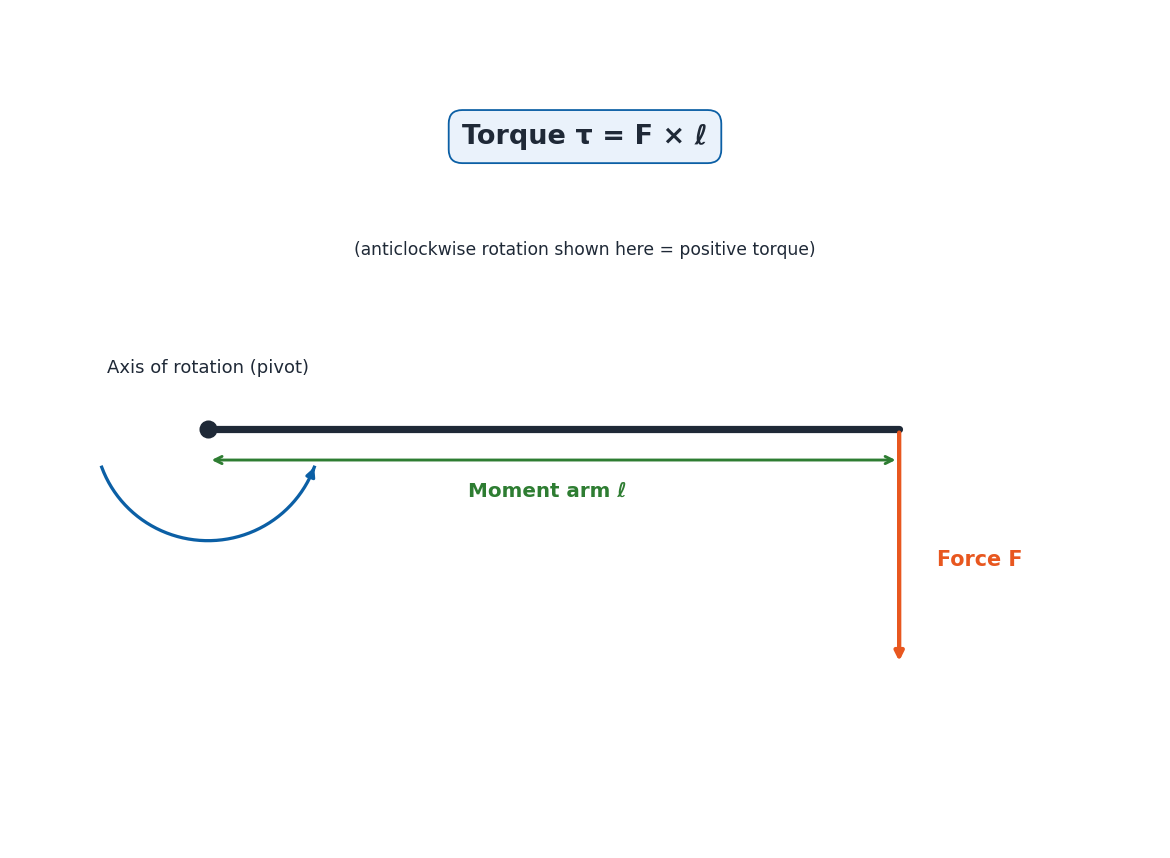
A rigid body is one in which the distance between any two of its points stays constant under an applied force. During rotation, all particles of a rigid body move along fixed circles centred on a common straight line called the axis of rotation. The line along which a force acts is its line of action; the perpendicular distance from the axis of rotation to this line of action is called the moment arm (or lever arm) of the force. The turning effect of a force depends both on its magnitude and on the length of its moment arm — a larger force or a larger moment arm produces a greater turning effect (this is why door handles are placed far from the hinge, and spanners are held at their far end).
Moment of force, or torque (τ), is defined as the product of the force and its moment arm: τ = F × ℓ. Its SI unit is newton metre (N m). Torque is taken as positive if it tends to produce anticlockwise rotation, and negative if it tends to produce clockwise rotation; torque is zero when the line of action of the force passes through the axis of rotation (moment arm = 0). A couple is formed when two equal and opposite parallel forces act at two different points of the same body (e.g. turning a steering wheel, key, or tap); a couple produces a net torque even though the net force is zero.
4.3 Resolution of Vectors
Just as vectors can be combined into a resultant, a single vector can be resolved (broken down) into two or more components whose combined effect equals the original vector. A force is usually resolved into two perpendicular (rectangular) components. For a force F acting at angle θ with the x-axis, the x-component is Fx = F cos θ and the y-component is Fy = F sin θ. Conversely, given the components, the magnitude of the original force can be found using the Pythagorean theorem, F = √(Fx² + Fy²), and its direction from tan θ = Fy/Fx.
4.4 Principle of Moments
The principle of moments states that when a body is in a balanced position, the sum of clockwise moments about any point equals the sum of anticlockwise moments about that same point. For weights w₁ and w₂ at distances ℓ₁ and ℓ₂ on one side of a pivot, balanced by weight w₃ at distance ℓ₃ on the other side: w₁ℓ₁ + w₂ℓ₂ = w₃ℓ₃. This principle is applied in balances, see-saws, and tools like crowbars and spanners.
4.5 Centre of Gravity and Centre of Mass
The centre of gravity of a body is the point where its total weight appears to act; a body supported exactly at its centre of gravity remains balanced without rotating. For regular shapes, the centre of gravity lies at the geometric centre (e.g. the intersection of the diagonals of a rectangle, or the intersection of the medians of a triangle). For an irregular plane lamina, the centre of gravity is found experimentally by suspending it freely from different points and using a plumb line; the point where the plumb lines from different suspension points intersect is the centre of gravity.
The centre of mass is the point where the entire mass of a body or system is assumed to be concentrated, and where Newton's second law can be applied to describe the overall motion of the system even if its parts move differently. On the surface of the Earth, where gravitational field strength g is essentially uniform over an object's size, the centre of mass coincides with the centre of gravity.
4.6 Equilibrium and Its Conditions
A body is in equilibrium if it has no acceleration. Static equilibrium describes a body at rest (e.g. a book on a table); dynamic equilibrium describes a body moving with uniform velocity (e.g. a parachutist descending at constant speed). The first condition of equilibrium (translational equilibrium) requires the vector sum of all external forces on the body to be zero: ΣFx = 0 and ΣFy = 0. The second condition of equilibrium (rotational equilibrium) requires the vector sum of all torques about any point to be zero: Στ = 0. A body is in complete equilibrium only when both conditions are satisfied simultaneously — satisfying the first condition alone still allows an unbalanced couple to rotate the body.
4.7 States of Equilibrium and Stability
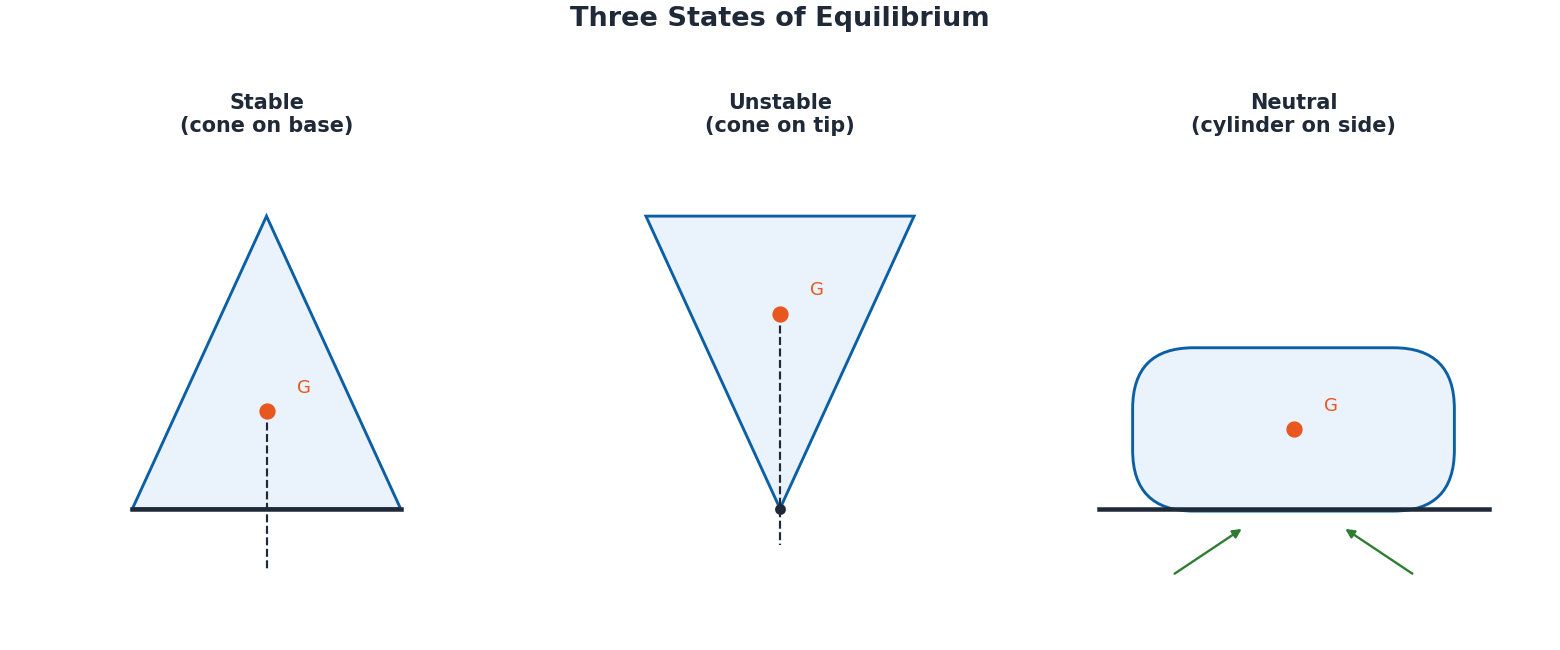
There are three states of equilibrium for a balanced body. In stable equilibrium, a body returns to its original position after a slight tilt, because the resulting torque pushes it back (e.g. a cone resting on its base) — this occurs as long as the centre of mass stays above the base. In unstable equilibrium, a body moves further away from its original position after a slight tilt and does not return (e.g. a cone balanced on its tip), because the centre of mass falls outside the base once tilted. In neutral equilibrium, a body settles into a new position after being disturbed, with no change in the height of its centre of mass, and neither returns nor moves further away (e.g. a cylinder or ball resting on a flat surface).
Stability of an object can be improved by lowering its centre of gravity and/or widening its base of support — for example, loading heavy cargo low in a bus or ship, or designing racing cars with a low centre of mass and wheels set outside the main body. Balancing toys stay stable because their centre of gravity remains below the pivot point at all times, so any disturbance is automatically corrected as the centre of gravity is pulled back down.
4.8 Circular Motion and Centripetal Force
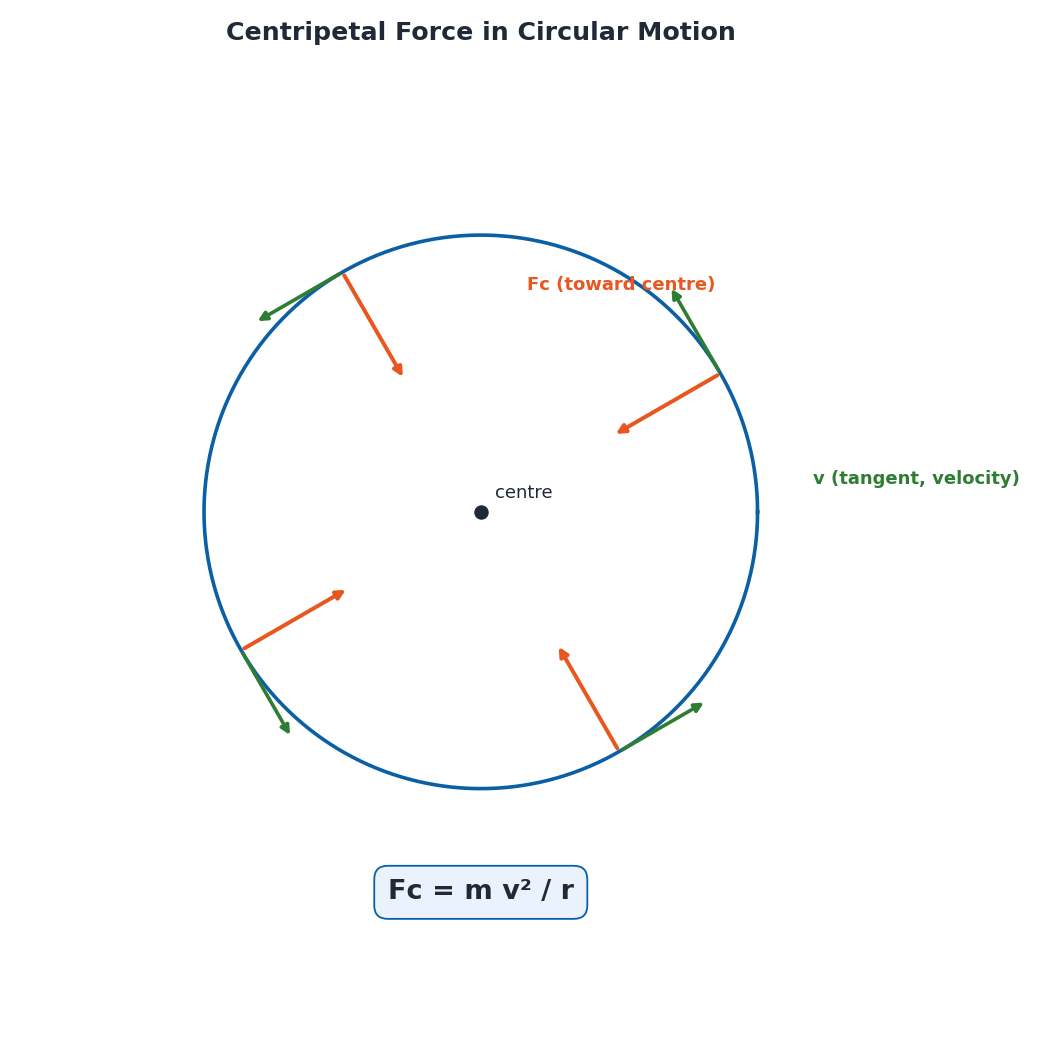
An object moving in a circle at uniform speed continuously changes direction, so its velocity (a vector) is always changing even though its speed is constant; this requires a constant force directed toward the centre of the circle, perpendicular to the velocity at every instant. This force is called centripetal force, and its magnitude is given by Fc = mv²/r, where m is the mass, v is the speed, and r is the radius of the circular path. Real-life sources of centripetal force include: tension in a string for a whirled stone, gravity for the Moon orbiting Earth or a satellite orbiting Earth, and friction between wet clothes and the drum in a washing machine spin cycle (allowing water, which lacks sufficient centripetal force, to escape through the holes).
Important Definitions
What are like and unlike parallel forces?
Parallel forces acting in the same direction are like parallel forces; those acting in opposite directions are unlike parallel forces.
What is the moment arm of a force?
The perpendicular distance from the axis of rotation to the line of action of the force.
Define torque (moment of force).
The product of a force and its moment arm: τ = F × ℓ, measured in newton metres (N m).
What is a couple?
Two equal and opposite parallel forces acting at two different points of the same body, producing a net torque with zero net force.
Define centre of gravity.
The point of a body where its total weight is considered to act.
Define centre of mass.
The point of a body or system where the whole mass is assumed to be concentrated for analysing overall motion.
State the first condition of equilibrium.
The vector sum of all external forces acting on a body must be zero (ΣFx = 0 and ΣFy = 0).
What is centripetal force?
The force directed toward the centre of a circular path that keeps an object moving in that circle at constant speed, given by Fc = mv²/r.
Key Formulas
| Topic | Formula |
|---|---|
| Torque (moment of force) | τ = F × ℓ (ℓ = moment arm, unit: N m) |
| x-component of a force | Fx = F cos θ |
| y-component of a force | Fy = F sin θ |
| Magnitude from components | F = √(Fx² + Fy²) |
| Direction from components | θ = tan⁻¹(Fy / Fx) |
| Principle of moments | Sum of clockwise moments = Sum of anticlockwise moments |
| 1st condition of equilibrium | ΣFx = 0 and ΣFy = 0 |
| 2nd condition of equilibrium | Στ = 0 |
| Centripetal force | Fc = mv² / r |
Diagrams
Torque and Moment Arm: The relationship between force, moment arm and torque about a pivot
Three States of Equilibrium: Stable, unstable and neutral equilibrium compared using a cone on its base, tip, and side
Centripetal Force in Circular Motion: Velocity tangent to the circle and centripetal force directed toward the centre
Short Questions & Answers
Define like and unlike parallel forces.
Like parallel forces act in the same direction; unlike parallel forces act in opposite directions, while remaining parallel to each other.
What are rectangular components of a vector?
The two mutually perpendicular components (usually along the x and y axes) into which a vector can be resolved, given by Fx = F cos θ and Fy = F sin θ.
What is the line of action of a force?
The straight line along which a force acts.
Give an example of a body which is moving yet in equilibrium.
A parachutist descending at constant (terminal) velocity is in dynamic equilibrium, since the net force on them is zero even though they are moving.
Define centre of mass and centre of gravity of a body.
Centre of mass is the point where the whole mass of a body is assumed concentrated; centre of gravity is the point where the whole weight of a body is considered to act. On Earth's surface, where g is uniform, the two coincide.
What are the two basic principles used to improve stability?
Lowering the centre of gravity and increasing (widening) the base area of support.
Why is a cylinder resting on its curved surface in neutral equilibrium?
Because when it is rolled slightly, its centre of mass stays at the same height and there is no torque pulling it back or pushing it further, so it simply settles in its new position.
How can you prove that centripetal force always acts perpendicular to velocity?
If the force had a component along the direction of velocity, it would change the object's speed; since the object moves at constant speed in a circle, the force must have zero component along v, meaning it acts exactly perpendicular to v, i.e. F cos 90° = 0.
Long Questions & Answers
Explain the principle of moments with an example, and state the conditions of equilibrium.
The principle of moments states that when a body is balanced, the sum of clockwise moments about any point equals the sum of anticlockwise moments about that point. For example, when two weights w₁ and w₂ at distances ℓ₁ and ℓ₂ on one side of a pivoted metre rule balance a third weight w₃ at distance ℓ₃ on the other side, w₁ℓ₁ + w₂ℓ₂ = w₃ℓ₃. A body is in complete equilibrium only when both conditions of equilibrium hold: the first condition requires the vector sum of all external forces to be zero (ΣFx = 0, ΣFy = 0), ensuring no linear acceleration; the second condition requires the vector sum of all torques about any point to be zero (Στ = 0), ensuring no rotational acceleration.
Describe how the centre of gravity of an irregular-shaped lamina can be determined experimentally.
The lamina is suspended freely from a point near its edge, allowing it to hang and settle; a plumb line is hung from the same suspension point, and a straight line is marked on the lamina along the plumb line's path — the centre of gravity must lie somewhere on this line. The lamina is then suspended from a different point, and the process is repeated to mark a second line. The point where the two marked lines intersect is the centre of gravity of the lamina.
Differentiate between stable, unstable and neutral equilibrium with examples.
In stable equilibrium, a body returns to its original position after a small tilt because the resulting torque restores it, as long as its centre of mass stays above its base — e.g. a cone resting on its flat base. In unstable equilibrium, a body moves further away from its original position after a small tilt because its centre of mass falls outside the base, and the torque continues to move it away — e.g. a cone balanced precariously on its tip. In neutral equilibrium, a body settles into its new position after being disturbed, with no change in the height of its centre of mass and no torque pulling it back or pushing it further — e.g. a ball or cylinder resting on a flat, level surface.
Explain centripetal force and describe two real-life sources of it.
An object moving in a circle at constant speed continuously changes direction, so a resultant force perpendicular to its velocity must act on it at all times, directed toward the centre of the circle; this is called centripetal force, given by Fc = mv²/r. One real-life source is the tension in a string when a stone is whirled in a horizontal circle — the string pulls the stone toward the centre, and if released, the stone flies off along a straight tangent line since the centripetal force disappears. Another source is Earth's gravity acting on the Moon or an orbiting satellite — the gravitational pull continuously curves their motion toward Earth's centre, keeping them in a roughly circular orbit instead of moving off in a straight line.
Multiple Choice Questions (MCQs)
A particle is acted upon simultaneously by two forces of 4 N and 3 N. The net force on the particle is: (A) 1 N (B) between 1 N and 7 N (C) 5 N (D) 7 N
Correct answer: (B) between 1 N and 7 N. Depending on the angle between the two forces, the resultant can range from |4−3|=1 N (opposite directions) to 4+3=7 N (same direction), so it lies between 1 N and 7 N.
A force F makes an angle of 60° with the x-axis. Its y-component equals: (A) F (B) F sin60° (C) F cos60° (D) F tan60°
Correct answer: (B) F sin60°. The y-component of a force is Fy = F sin θ, so here it equals F sin60°.
Moment of a force is also called: (A) moment arm (B) couple (C) couple arm (D) torque
Correct answer: (D) torque. The moment of a force is also known as torque.
A body is completely in equilibrium when: (A) ΣF = 0 and Στ = 0 (B) ΣF = 0 and Στ ≠ 0 (C) ΣF ≠ 0 and Στ = 0 (D) ΣF ≠ 0 and Στ ≠ 0
Correct answer: (A) ΣF = 0 and Στ = 0. Complete equilibrium requires both the first condition (ΣF = 0) and the second condition (Στ = 0) to hold simultaneously.
A tightrope walker balances using a long bamboo stick. This applies the: (A) law of conservation of momentum (B) Newton's second law of motion (C) principle of moments (D) Newton's third law of motion
Correct answer: (C) principle of moments. Adjusting the stick shifts the combined centre of gravity and balances torques, applying the principle of moments.
In stable equilibrium, the centre of gravity of a body lies: (A) at the highest position (B) at the lowest position (C) at any position (D) outside the body
Correct answer: (B) at the lowest position. A body in stable equilibrium typically has its centre of gravity as low as possible, increasing resistance to toppling.
The centre of mass of a body: (A) lies always inside the body (B) lies always outside the body (C) lies always on the surface of the body (D) may lie within, outside, or on the surface
Correct answer: (D) may lie within, outside, or on the surface. Depending on the shape of the body (e.g. a ring or a cup), the centre of mass can be inside, outside, or on the surface of the body.
A cylinder resting on its circular (curved) base is in: (A) stable equilibrium (B) unstable equilibrium (C) neutral equilibrium (D) none of these
Correct answer: (C) neutral equilibrium. As a cylinder rolls slightly, its centre of mass height does not change, so it is in neutral equilibrium.
Centripetal force is given by: (A) rF (B) rF cosθ (C) mv²/r (D) mv/r²
Correct answer: (C) mv²/r. The formula for centripetal force is Fc = mv²/r.
Torque is zero when the line of action of a force: (A) is perpendicular to the moment arm (B) passes through the axis of rotation (C) is parallel to the axis of rotation (D) is at 45° to the axis of rotation
Correct answer: (B) passes through the axis of rotation. If the line of action passes through the axis of rotation, the moment arm is zero, making the torque zero.
Quick Revision Summary
- Like parallel forces: same direction; Unlike parallel forces: opposite direction
- Torque τ = F × moment arm; anticlockwise = positive, clockwise = negative
- Couple = two equal, opposite, parallel forces at different points → produces torque, zero net force
- Fx = F cosθ, Fy = F sinθ; F = √(Fx²+Fy²), θ = tan⁻¹(Fy/Fx)
- Principle of moments: sum of clockwise moments = sum of anticlockwise moments
- Centre of gravity = point where weight acts; Centre of mass = point where mass is concentrated
- 1st condition of equilibrium: ΣF = 0; 2nd condition: Στ = 0
- Stable: returns after tilt; Unstable: moves away after tilt; Neutral: stays in new position, no height change
- Improve stability: lower centre of gravity + widen base
- Centripetal force Fc = mv²/r, always directed toward the centre, perpendicular to velocity
Exam Tips
- Practice resolving forces into Fx and Fy components — this skill underlies torque, equilibrium, and inclined-force numericals
- Memorise both conditions of equilibrium precisely and know when each alone is insufficient
- Use the cone examples (on base, on tip, on side) to remember stable/unstable/neutral equilibrium quickly
- Practice principle-of-moments numericals (see-saws, metre rules, crowbars) — identify clockwise vs anticlockwise moments carefully
- Remember Fc = mv²/r and identify the real-world source of centripetal force (tension, gravity, friction, normal force) in each scenario
- Draw clear diagrams labelling force, moment arm, and pivot point for torque questions — partial credit is often given for correct diagrams