This chapter covers Heat and Thermodynamics from the 1st Year (FSc Part-I) Physics syllabus of the Punjab Curriculum and Textbook Board (PTB/PCTB). It treats the kinetic theory of gases, internal energy, the first law of thermodynamics, isothermal and adiabatic processes, molar specific heats, the second law and the Carnot engine. These notes are prepared by freebooks.pk.
Thermodynamics is the study of heat and its transformation into work and other forms of energy. It underlies engines, refrigerators and much of modern technology.
Learning Objectives
- State the postulates of the kinetic theory of gases.
- Explain internal energy and the first law of thermodynamics.
- Distinguish isothermal and adiabatic processes.
- Define the molar specific heats of a gas.
- State the second law of thermodynamics.
- Describe the Carnot engine and its efficiency.
Key Concepts
Kinetic Theory of Gases
According to the kinetic theory, a gas consists of a very large number of tiny molecules in rapid, random motion. The molecules are far apart compared with their size, they exert no force on one another except during collisions, and their collisions with each other and with the walls of the container are perfectly elastic. The pressure of a gas is produced by these molecules striking the walls, and the absolute temperature of the gas is a measure of the average kinetic energy of its molecules.
Internal Energy
The internal energy of a system is the total energy of all its molecules, that is, the sum of their kinetic and potential energies. For an ideal gas the internal energy depends only on the temperature, so heating a gas raises its internal energy. Internal energy is a state function: it depends only on the state of the system, not on how that state was reached.
First Law of Thermodynamics
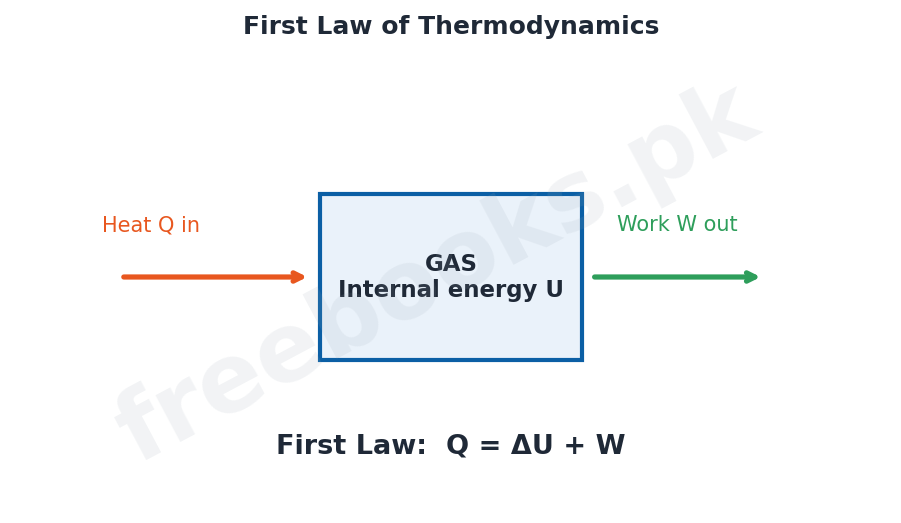
The first law of thermodynamics is the law of conservation of energy applied to heat. It states that the heat Q supplied to a system is used partly to increase the internal energy of the system (delta U) and partly to do external work W: Q = delta U + W. This law tells us that energy can be transferred as heat or work but can never be created or destroyed.
Isothermal and Adiabatic Processes
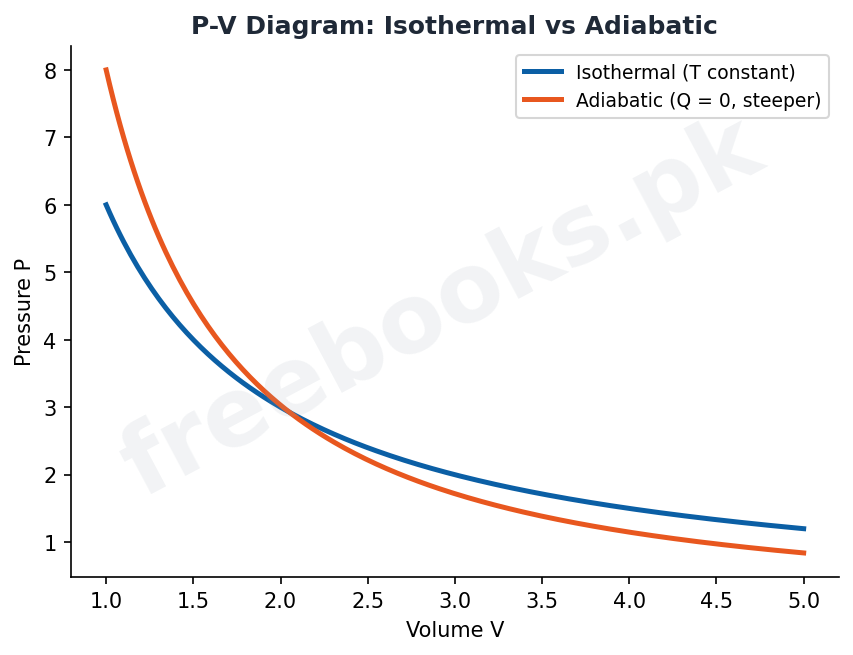
In an isothermal process the temperature is kept constant (the system is in good thermal contact with its surroundings and changes slowly), so for an ideal gas the internal energy does not change and all the heat supplied is converted into work. In an adiabatic process no heat enters or leaves the system (Q = 0, the system is well insulated or the change is very rapid), so any work done by the gas is at the expense of its internal energy, and the gas cools when it expands.
Molar Specific Heats
A gas has two principal molar specific heats: the molar specific heat at constant volume, C_v, and the molar specific heat at constant pressure, C_p. C_p is always greater than C_v, because when a gas is heated at constant pressure some of the heat supplied is used to do work in expanding the gas, in addition to raising its internal energy. The two are related by C_p – C_v = R, where R is the general gas constant.
Second Law and the Carnot Engine
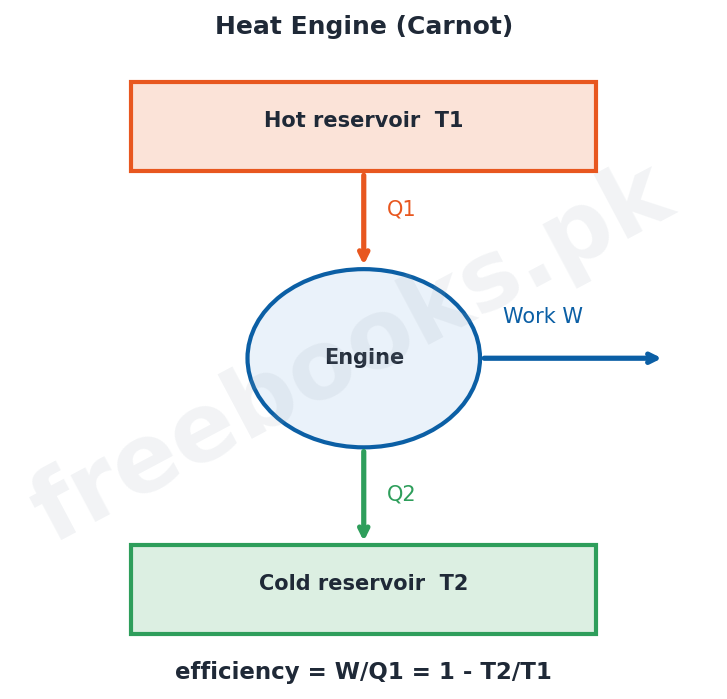
The second law of thermodynamics recognises that heat flows naturally from a hot body to a cold body and that no heat engine can convert all the heat it takes in into work; some heat must always be rejected to a cold reservoir. A heat engine takes heat Q1 from a hot reservoir, converts part of it into work W and rejects the rest Q2 to a cold reservoir. The most efficient possible engine is the ideal Carnot engine, whose efficiency depends only on the temperatures of the two reservoirs: efficiency = 1 – T2/T1, where the temperatures are on the absolute (kelvin) scale.
Important Definitions
Kinetic theory of gases
The model that treats a gas as many tiny molecules in rapid random motion.
Internal energy
The total kinetic and potential energy of all the molecules of a system.
First law of thermodynamics
Q = delta U + W; conservation of energy for heat.
Isothermal process
A change at constant temperature.
Adiabatic process
A change in which no heat enters or leaves the system (Q = 0).
Molar specific heat
The heat needed to raise the temperature of one mole of gas by one kelvin.
Second law of thermodynamics
Heat cannot be completely converted into work; some is always rejected.
Carnot engine
An ideal heat engine of maximum possible efficiency 1 – T2/T1.
Formulas & Rules
| Item | Fact |
|---|---|
| First law | Q = delta U + W |
| Molar specific heats | C_p – C_v = R |
| Isothermal process | delta U = 0, so Q = W |
| Adiabatic process | Q = 0, so delta U = -W |
| Carnot efficiency | 1 – T2/T1 (T in kelvin) |
Diagrams & Illustrations
First law of thermodynamics: heat Q entering a gas, part raising its internal energy U and part leaving as work W, illustrating Q = delta U + W.
Heat engine: a heat engine taking heat Q1 from a hot reservoir, doing work W and rejecting Q2 to a cold reservoir, with efficiency 1 – T2/T1.
Isothermal and adiabatic curves: a P-V diagram comparing the gentler isothermal curve with the steeper adiabatic curve.
Solved Examples & Numericals
First law
A gas absorbs 200 J of heat and does 80 J of work. The increase in its internal energy is delta U = Q – W = 200 – 80 = 120 J.
Isothermal process
In an isothermal expansion delta U = 0, so if a gas absorbs 150 J of heat it does 150 J of work.
Carnot efficiency
An engine works between 400 K and 300 K. Its maximum efficiency is 1 – 300/400 = 1 – 0.75 = 0.25 or 25%.
Specific heats
For a gas C_p = 29 J/mol K and R = 8.3 J/mol K, so C_v = C_p – R = 29 – 8.3 = 20.7 J/mol K.
Short Questions & Answers
State the first law of thermodynamics.
The heat supplied to a system equals the increase in its internal energy plus the work done by it: Q = delta U + W.
What is an isothermal process?
A process carried out at constant temperature; for an ideal gas delta U = 0 and Q = W.
What is an adiabatic process?
A process in which no heat enters or leaves the system (Q = 0), so delta U = -W.
Why is C_p greater than C_v?
Because at constant pressure some heat is used to do work in expanding the gas, as well as to raise its internal energy.
State the second law of thermodynamics.
Heat cannot be completely converted into work; some heat must always be rejected to a cold reservoir.
Write the efficiency of a Carnot engine.
efficiency = 1 – T2/T1, where T1 and T2 are the absolute temperatures of the hot and cold reservoirs.
Long Questions & Answers
Q1: State and explain the first law of thermodynamics and apply it to isothermal and adiabatic processes.
The first law of thermodynamics is simply the principle of conservation of energy applied to systems in which heat is involved. It states that when an amount of heat Q is supplied to a system, part of it is used to increase the internal energy of the system by an amount delta U and the remainder is used by the system to do external work W on its surroundings, so that Q = delta U + W. Energy is therefore neither created nor destroyed, only transferred between heat, internal energy and work. The law takes simple forms in two important cases. In an isothermal process the temperature, and hence for an ideal gas the internal energy, stays constant, so delta U = 0 and the whole of the heat supplied appears as work, Q = W. In an adiabatic process the system is thermally insulated so that no heat enters or leaves it, giving Q = 0; then delta U = -W, which means that when the gas does work by expanding it does so at the cost of its internal energy and therefore cools, while compressing it warms it up.
Q2: Distinguish between the two molar specific heats of a gas and derive the relation C_p – C_v = R.
A gas can be heated in two different ways, and these lead to two distinct molar specific heats. The molar specific heat at constant volume, C_v, is the heat required to raise the temperature of one mole of the gas by one kelvin while its volume is held fixed; since the gas does no external work in this case, all the heat goes to increase the internal energy. The molar specific heat at constant pressure, C_p, is the heat required to raise the temperature of one mole by one kelvin while the pressure is kept constant; now the gas expands and does external work as well as gaining internal energy. Because heating at constant pressure has to supply this extra work in addition to the same rise in internal energy, C_p is always larger than C_v. Applying the first law to one mole heated at constant pressure, the extra heat compared with the constant-volume case equals the work of expansion, which for one mole and a one-kelvin rise is equal to the general gas constant R; hence C_p – C_v = R. This important result links the two specific heats to the gas constant.
Q3: State the second law of thermodynamics and describe the Carnot engine and its efficiency.
The second law of thermodynamics expresses the one-way nature of heat flow and the limits on converting heat into work. In one common form it states that heat flows of its own accord only from a hotter body to a colder body, and in another (Kelvin’s form) that it is impossible to build an engine that, working in a cycle, converts all the heat it takes in completely into work; some heat must always be discharged to a cold reservoir. A heat engine works between two reservoirs: it absorbs heat Q1 from a hot reservoir at temperature T1, converts a part of it into useful work W, and rejects the remaining heat Q2 to a cold reservoir at temperature T2, its efficiency being W/Q1. The French engineer Carnot devised an ideal engine, working through a reversible cycle of two isothermal and two adiabatic changes, which has the greatest efficiency any engine working between the two temperatures can have. This Carnot efficiency depends only on the two absolute temperatures and is given by efficiency = 1 – T2/T1. It shows that no engine can be perfectly efficient unless the cold reservoir is at absolute zero, which is unattainable, and that a larger temperature difference gives a higher efficiency.
MCQs with Answers
The pressure of a gas is due to molecules striking the: (a) each other (b) walls (c) light (d) nothing
Correct Answer: (b) walls.
The absolute temperature measures the average ___ of molecules: (a) mass (b) kinetic energy (c) charge (d) size
Correct Answer: (b) kinetic energy.
The first law of thermodynamics is: (a) Q = delta U + W (b) Q = W – U (c) F = ma (d) PV = nRT
Correct Answer: (a) Q = delta U + W.
In an isothermal process: (a) Q = 0 (b) delta U = 0 (c) W = 0 (d) T changes
Correct Answer: (b) delta U = 0.
In an adiabatic process: (a) Q = 0 (b) delta U = 0 (c) T constant (d) W = 0
Correct Answer: (a) Q = 0.
For a gas, C_p is ___ C_v: (a) less than (b) equal to (c) greater than (d) zero
Correct Answer: (c) greater than.
C_p – C_v equals: (a) R (b) zero (c) 2R (d) R/2
Correct Answer: (a) R.
No engine can convert all heat into work is the: (a) first law (b) second law (c) zeroth law (d) third law
Correct Answer: (b) second law.
Carnot efficiency is: (a) 1 – T2/T1 (b) T2/T1 (c) 1 – T1/T2 (d) T1 – T2
Correct Answer: (a) 1 – T2/T1.
The internal energy of an ideal gas depends only on its: (a) pressure (b) volume (c) temperature (d) shape
Correct Answer: (c) temperature.
Quick Revision Summary
- Kinetic theory: gas = many molecules in random motion; pressure from wall collisions; T = average KE.
- Internal energy = total molecular energy; for ideal gas depends only on temperature.
- First law: Q = delta U + W (conservation of energy).
- Isothermal: delta U = 0, Q = W. Adiabatic: Q = 0, delta U = -W.
- Specific heats: C_p > C_v; C_p – C_v = R.
- Second law: heat not fully convertible to work; Carnot efficiency = 1 – T2/T1. Notes by freebooks.pk.
Exam Tips
- Memorise the first law Q = delta U + W and its sign convention.
- Isothermal: temperature constant. Adiabatic: no heat exchange.
- Explain why C_p > C_v (extra work at constant pressure).
- Learn C_p – C_v = R.
- State the second law in words.
- Use kelvin temperatures in the Carnot efficiency formula.