
This chapter covers Waves from the 1st Year (FSc Part-I) Physics syllabus of the Punjab Curriculum and Textbook Board (PTB/PCTB). It studies progressive waves, transverse and longitudinal waves, the wave equation v = f lambda, the speed of sound, the principle of superposition, interference, beats, stationary waves and the Doppler effect. These notes are prepared by freebooks.pk.
Waves carry energy from one place to another without carrying matter with them. Sound, light and ripples on water are all examples, and this chapter explains how they behave.
Learning Objectives
- Distinguish transverse and longitudinal (progressive) waves.
- Apply the wave equation v = f lambda.
- State the factors affecting the speed of sound.
- State the principle of superposition and explain interference and beats.
- Describe stationary waves, nodes and antinodes.
- Explain the Doppler effect.
Key Concepts
Progressive Waves
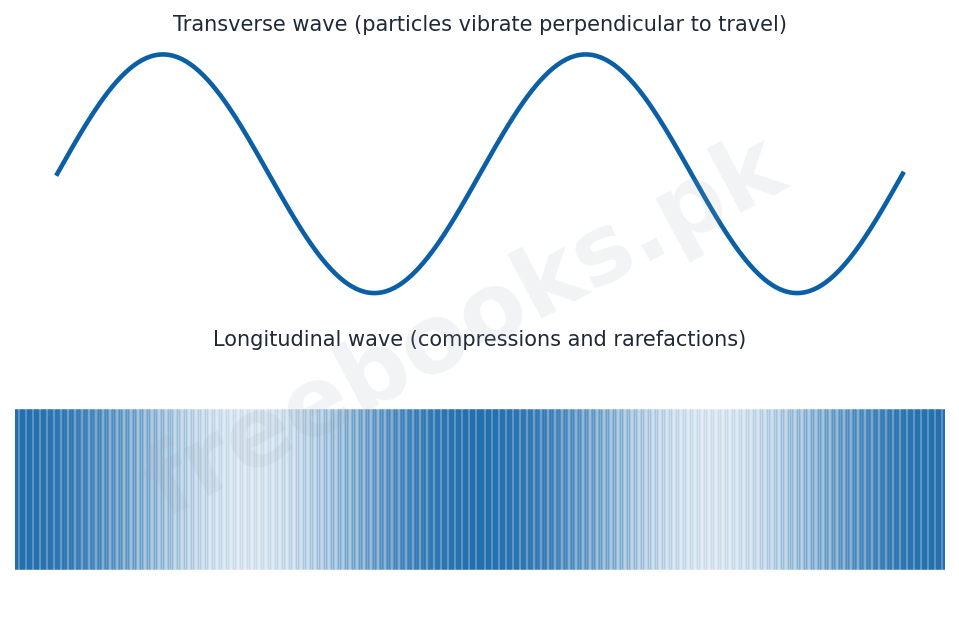
A progressive (or travelling) wave is a disturbance that moves through a medium, carrying energy from one place to another without any net movement of the medium itself. In a transverse wave the particles of the medium vibrate at right angles to the direction in which the wave travels (for example waves on a string or water ripples), while in a longitudinal wave the particles vibrate along the direction of travel, producing compressions and rarefactions (for example sound waves in air).
The Wave Equation
The speed of a wave is related to its frequency and wavelength by v = f lambda, where v is the speed, f the frequency (number of waves per second) and lambda the wavelength (distance between two consecutive crests or compressions). Since the period T = 1/f, the wave also moves one wavelength in one period.
Speed of Sound
Sound is a longitudinal wave and needs a material medium to travel; it cannot pass through a vacuum. Its speed depends on the properties of the medium: it is greatest in solids, less in liquids and least in gases. In air the speed of sound increases with temperature (roughly 0.6 m/s for each degree Celsius) and is essentially independent of pressure. At 0 degrees Celsius the speed of sound in air is about 332 m/s.
Principle of Superposition
When two or more waves pass through the same region at the same time, the resultant displacement at any point is the vector sum of the displacements due to the individual waves. This principle of superposition explains interference, beats and stationary waves.
Interference and Beats
Interference occurs when two waves of the same frequency overlap: where they arrive in phase they reinforce (constructive interference) and where they arrive out of phase they cancel (destructive interference). Beats are the periodic rise and fall in loudness heard when two sound waves of slightly different frequencies are sounded together; the number of beats per second equals the difference of the two frequencies.
Stationary Waves
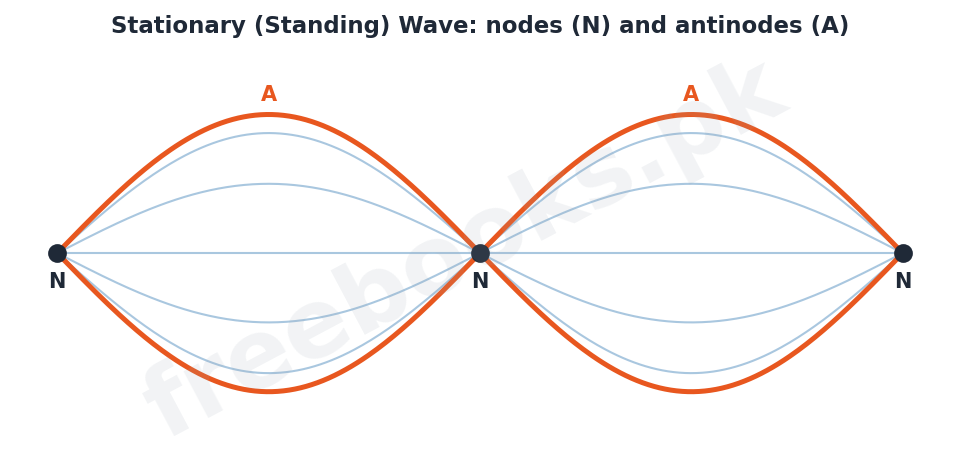
A stationary (or standing) wave is formed when two identical waves travelling in opposite directions superpose, for example a wave and its reflection. The wave appears to stand still: certain points called nodes stay permanently at rest, while points midway between them called antinodes vibrate with the largest amplitude. Stationary waves are set up in stretched strings and in air columns and are the basis of musical instruments.
The Doppler Effect
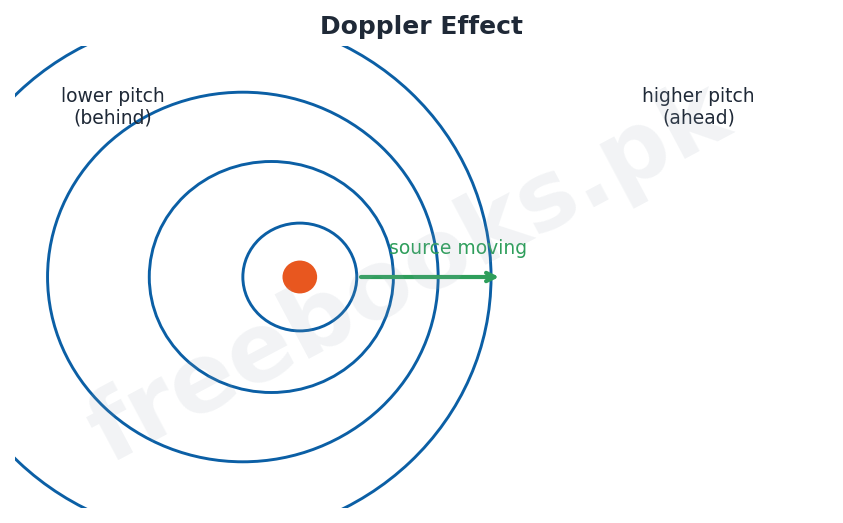
The Doppler effect is the apparent change in the frequency (pitch) of a wave when there is relative motion between the source and the observer. When the source moves towards the observer the pitch heard is higher, and when it moves away the pitch is lower; a familiar example is the changing pitch of a siren on a passing ambulance.
Important Definitions
Progressive wave
A wave that travels through a medium carrying energy without net movement of matter.
Transverse wave
A wave in which particles vibrate perpendicular to the direction of travel.
Longitudinal wave
A wave in which particles vibrate along the direction of travel.
Wavelength
The distance between two consecutive crests or compressions, lambda.
Interference
The superposition of two waves giving reinforcement or cancellation.
Beats
The periodic variation in loudness from two waves of slightly different frequency.
Node
A point on a stationary wave that stays permanently at rest.
Doppler effect
The apparent change in frequency due to relative motion of source and observer.
Formulas & Rules
| Item | Fact |
|---|---|
| Wave equation | v = f lambda |
| Frequency and period | f = 1/T |
| Number of beats | beats per second = f1 – f2 |
| Speed of sound in air | about 332 m/s at 0 C |
| Speed of sound v_t | v_t = v_0 + 0.6 t (t in C) |
Diagrams & Illustrations
Transverse and longitudinal waves: a transverse wave shown as a sine curve above a longitudinal wave shown as compressions and rarefactions, comparing the two types.
Stationary wave: a stationary wave showing fixed nodes (N) where the string is at rest and antinodes (A) where the amplitude is largest.
Doppler effect: a moving sound source with bunched-up wavefronts ahead (higher pitch) and spread-out wavefronts behind (lower pitch).
Solved Examples & Numericals
Wave equation
A wave has frequency 50 Hz and wavelength 4 m. Its speed is v = f lambda = 50 x 4 = 200 m/s.
Finding wavelength
Sound of frequency 340 Hz travels at 340 m/s. Its wavelength is lambda = v/f = 340/340 = 1 m.
Beats
Two tuning forks of 256 Hz and 260 Hz are sounded together. The number of beats per second is 260 – 256 = 4.
Speed of sound with temperature
If the speed of sound is 332 m/s at 0 C, at 20 C it is about 332 + 0.6 x 20 = 344 m/s.
Short Questions & Answers
Differentiate transverse and longitudinal waves.
In a transverse wave particles vibrate perpendicular to the direction of travel; in a longitudinal wave they vibrate along the direction of travel.
Write the wave equation.
v = f lambda, where v is speed, f frequency and lambda wavelength.
Can sound travel through vacuum?
No. Sound is a mechanical (longitudinal) wave and needs a material medium; it cannot travel through a vacuum.
What are beats?
The periodic rise and fall in loudness heard when two sounds of slightly different frequency are sounded together; beats per second = difference of frequencies.
What is a node?
A point on a stationary wave that always stays at rest (zero amplitude).
State the Doppler effect.
The apparent change in the pitch of a wave due to relative motion between the source and the observer.
Long Questions & Answers
Q1: Distinguish between transverse and longitudinal waves and give examples of each.
A progressive wave transfers energy through a medium without any net movement of the medium. Such waves are of two main kinds. In a transverse wave the particles of the medium vibrate at right angles (perpendicular) to the direction in which the wave travels; the wave then consists of crests and troughs. Waves on a stretched string, ripples on the surface of water and electromagnetic waves such as light are transverse. In a longitudinal wave the particles vibrate back and forth along the same direction in which the wave travels; the wave then consists of regions where the particles are pushed together, called compressions, and regions where they are spread apart, called rarefactions. Sound waves in air are the most important example of longitudinal waves. In both types the speed is given by v = f lambda, but only transverse waves can be polarised, which is one experimental way to tell them apart.
Q2: State the principle of superposition and use it to explain interference and beats.
The principle of superposition states that when two or more waves pass through the same region of a medium at the same time, the resultant displacement at any point is the algebraic (vector) sum of the displacements that each wave would produce on its own. This simple rule explains several important effects. Interference results when two waves of the same frequency overlap: at points where the waves arrive in phase (crest on crest) they reinforce each other to give a large disturbance, called constructive interference, and at points where they arrive exactly out of phase (crest on trough) they cancel, called destructive interference. Beats arise when two sound waves of slightly different frequencies are sounded together; the waves alternately reinforce and cancel, so the loudness rises and falls periodically. The number of beats heard per second is equal to the difference between the two frequencies, a fact used to tune musical instruments.
Q3: Describe stationary waves and explain nodes and antinodes.
A stationary or standing wave is produced when two progressive waves of the same frequency and amplitude travel through a medium in opposite directions and superpose; this commonly happens when a wave is reflected back on itself, for example in a stretched string fixed at both ends or in an air column. By the principle of superposition the two waves combine so that the resultant pattern appears to stay in one place rather than travelling. Certain points, called nodes, are always at rest because the two waves there always cancel; the distance between consecutive nodes is half a wavelength. Midway between the nodes are the antinodes, where the two waves always reinforce and the particles vibrate with the greatest amplitude. Unlike a progressive wave, a stationary wave does not transport energy along the medium; instead the energy stays localised, oscillating between kinetic and potential forms. Stationary waves in strings and air columns are responsible for the notes produced by musical instruments.
MCQs with Answers
A wave that needs no material medium is: (a) sound (b) longitudinal (c) transverse light (d) all
Correct Answer: (c) transverse light.
The wave equation is: (a) v = f/lambda (b) v = f lambda (c) v = lambda/f (d) f = v lambda
Correct Answer: (b) v = f lambda.
Sound waves are: (a) transverse (b) longitudinal (c) stationary (d) electromagnetic
Correct Answer: (b) longitudinal.
Sound cannot travel through: (a) air (b) water (c) steel (d) vacuum
Correct Answer: (d) vacuum.
Beats per second equal the ___ of the two frequencies: (a) sum (b) product (c) difference (d) ratio
Correct Answer: (c) difference.
A point of zero amplitude on a stationary wave is a: (a) antinode (b) node (c) crest (d) trough
Correct Answer: (b) node.
The distance between two consecutive crests is the: (a) amplitude (b) frequency (c) wavelength (d) period
Correct Answer: (c) wavelength.
The apparent change of pitch due to relative motion is the: (a) beat (b) interference (c) Doppler effect (d) echo
Correct Answer: (c) Doppler effect.
The speed of sound in air at 0 C is about: (a) 332 m/s (b) 3×10^8 m/s (c) 1500 m/s (d) air has none
Correct Answer: (a) 332 m/s.
Constructive interference occurs when waves meet: (a) out of phase (b) in phase (c) at nodes (d) never
Correct Answer: (b) in phase.
Quick Revision Summary
- Progressive waves carry energy, not matter; transverse (perpendicular) vs longitudinal (along).
- Wave equation v = f lambda; f = 1/T.
- Sound is longitudinal, needs a medium; ~332 m/s at 0 C, +0.6 m/s per degree C.
- Superposition: interference (in phase reinforce, out of phase cancel); beats = |f1 – f2|.
- Stationary waves: nodes at rest, antinodes maximum; no net energy transport.
- Doppler effect: pitch higher approaching, lower receding. Notes by freebooks.pk.
Exam Tips
- Learn the difference between transverse and longitudinal with examples.
- Memorise v = f lambda and be ready to rearrange it.
- State that sound cannot travel through vacuum.
- Beats per second = difference of frequencies.
- Define node and antinode precisely.
- Give the ambulance siren as a Doppler example.