
This chapter covers Oscillations from the 1st Year (FSc Part-I) Physics syllabus of the Punjab Curriculum and Textbook Board (PTB/PCTB). It studies simple harmonic motion (SHM), the simple pendulum and mass-spring system, energy in SHM, and free and forced oscillations with resonance. These notes are prepared by freebooks.pk.
Many things in nature vibrate back and forth: a pendulum, a spring, a guitar string. The simplest and most important such motion is simple harmonic motion, which this chapter explains.
Learning Objectives
- Define simple harmonic motion and state its characteristics.
- Relate SHM to circular motion.
- Find the time period of a simple pendulum and a mass-spring system.
- Describe the interchange of kinetic and potential energy in SHM.
- Distinguish free and forced oscillations and explain resonance.
- Explain damping.
Key Concepts
Simple Harmonic Motion
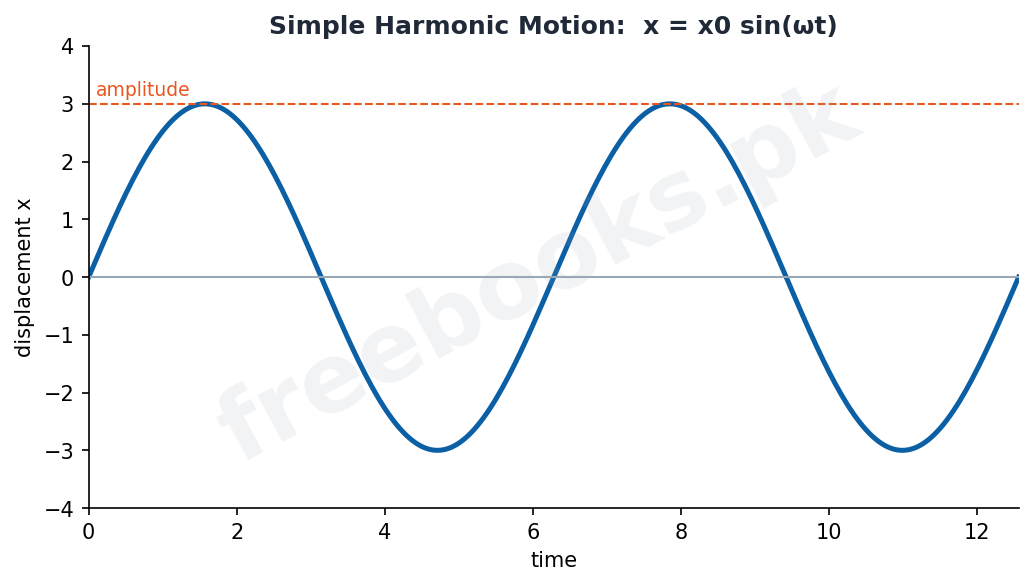
Simple harmonic motion (SHM) is a to-and-fro motion in which the acceleration of the body is always directed towards a fixed point (the mean position) and is directly proportional to the displacement from that point: a = -omega^2 x, where omega is the angular frequency. The minus sign shows that the acceleration is opposite to the displacement. The maximum displacement from the mean position is the amplitude, the time for one complete oscillation is the time period T, and the number of oscillations per second is the frequency f = 1/T.
SHM and Circular Motion
SHM can be regarded as the projection of uniform circular motion onto a diameter. If a point moves in a circle at constant angular speed omega, the foot of the perpendicular from that point onto a diameter moves back and forth in SHM. This link gives the useful result omega = 2 pi f and helps derive the equations for displacement, velocity and acceleration.
The Simple Pendulum
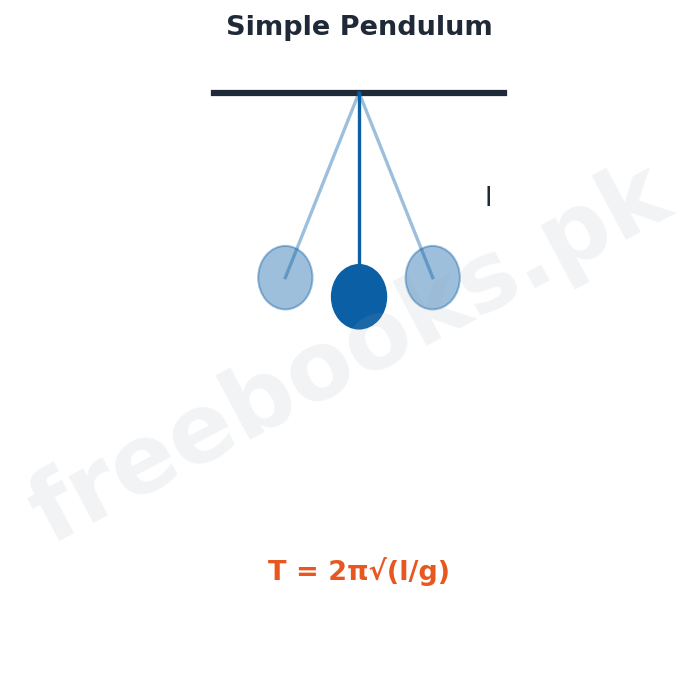
A simple pendulum is a small heavy bob suspended by a light, inextensible string. For small angles its motion is SHM, and its time period is T = 2 pi sqrt(l/g), where l is the length of the pendulum and g the acceleration due to gravity. Notably, the period does not depend on the mass of the bob or on the amplitude (for small swings).
The Mass-Spring System
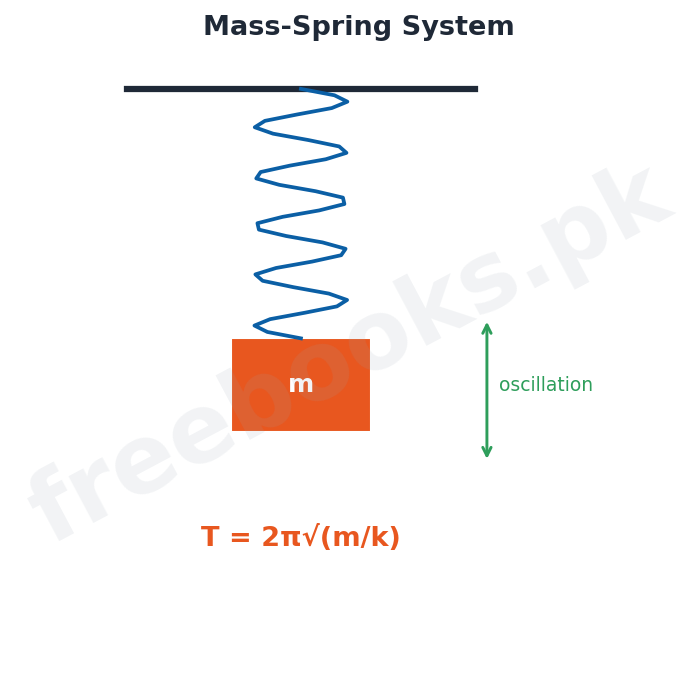
A mass attached to a spring and set oscillating also performs SHM. Its time period is T = 2 pi sqrt(m/k), where m is the mass and k the spring constant (the force needed to stretch the spring by unit length). A stiffer spring (larger k) or a smaller mass gives a shorter period.
Energy in SHM
During SHM energy is continually interchanged between kinetic and potential forms. At the mean position the speed is maximum, so the kinetic energy is maximum and the potential energy is zero; at the extreme positions the body is momentarily at rest, so the kinetic energy is zero and the potential energy is maximum. In the absence of friction the total energy remains constant throughout the motion.
Free and Forced Oscillations, Resonance and Damping
A body oscillating on its own at its natural frequency performs free oscillations. When an external periodic force drives a body, it performs forced oscillations at the frequency of the driving force. Resonance occurs when the driving frequency equals the natural frequency of the body, causing a very large amplitude; examples include pushing a swing at the right moments and the shattering of a glass by sound. Damping is the gradual loss of energy (usually to friction or air resistance) that makes the amplitude of an oscillation die away with time.
Important Definitions
Simple harmonic motion
Motion in which acceleration is proportional to displacement and directed towards the mean position, a = -omega^2 x.
Amplitude
The maximum displacement of a body from its mean position.
Time period
The time taken for one complete oscillation, T.
Frequency
The number of oscillations per second, f = 1/T.
Angular frequency
omega = 2 pi f, related to the rate of oscillation.
Resonance
The large-amplitude response when the driving frequency equals the natural frequency.
Damping
The gradual loss of energy that reduces the amplitude of an oscillation.
Spring constant
The force required to stretch a spring by unit length, k.
Formulas & Rules
| Item | Fact |
|---|---|
| SHM condition | a = -omega^2 x |
| Angular frequency | omega = 2 pi f = 2 pi / T |
| Simple pendulum | T = 2 pi sqrt(l/g) |
| Mass-spring system | T = 2 pi sqrt(m/k) |
| Frequency | f = 1/T |
| Velocity in SHM | v = omega sqrt(x0^2 – x^2) |
Diagrams & Illustrations
Simple harmonic motion: a displacement-time graph of SHM in the form of a sine curve, with the amplitude marked as the maximum displacement.
Simple pendulum: a simple pendulum swinging about its mean position, with its length l marked and the time period T = 2 pi sqrt(l/g).
Mass-spring system: a mass hanging from a spring and oscillating up and down, with the time period T = 2 pi sqrt(m/k).
Solved Examples & Numericals
Simple pendulum
A pendulum has length 1 m (g = 10 m/s^2). Its period is T = 2 pi sqrt(l/g) = 2 pi sqrt(0.1) = 2 pi x 0.316 = 1.99 s, about 2 s.
Frequency
A body completes 20 oscillations in 10 s. Its frequency is f = 20/10 = 2 Hz and its period is T = 1/f = 0.5 s.
Mass-spring
A 0.5 kg mass on a spring of constant 50 N/m has period T = 2 pi sqrt(m/k) = 2 pi sqrt(0.01) = 2 pi x 0.1 = 0.63 s.
Energy in SHM
At the mean position of an oscillation the kinetic energy is maximum and the potential energy is zero; at the extreme position the reverse is true, while the total energy stays the same.
Short Questions & Answers
Define simple harmonic motion.
A to-and-fro motion in which the acceleration is proportional to the displacement and directed towards the mean position, a = -omega^2 x.
On what does the period of a simple pendulum depend?
On its length and the acceleration due to gravity, T = 2 pi sqrt(l/g); it does not depend on the mass or (for small swings) the amplitude.
Write the time period of a mass-spring system.
T = 2 pi sqrt(m/k), where m is the mass and k the spring constant.
Where is the kinetic energy maximum in SHM?
At the mean position, where the speed is maximum.
What is resonance?
The large-amplitude oscillation that occurs when the driving frequency equals the natural frequency of the body.
What is damping?
The gradual loss of energy that causes the amplitude of an oscillation to decrease with time.
Long Questions & Answers
Q1: Define simple harmonic motion and describe its characteristics using the example of a mass on a spring.
Simple harmonic motion is a to-and-fro (oscillatory) motion in which the acceleration of the body is always directed towards a fixed mean position and is directly proportional to the displacement from that position, expressed as a = -omega^2 x, where the minus sign shows that the acceleration opposes the displacement. A mass attached to a spring illustrates this well: when the mass is pulled from its rest position and released, the spring exerts a restoring force proportional to the displacement (by Hooke’s law), so the acceleration is proportional to the displacement and directed back towards the rest position, which is exactly the condition for SHM. The mass therefore oscillates about the mean position with a fixed amplitude (its maximum displacement), a fixed time period T (the time for one complete oscillation), and a frequency f = 1/T. Its period is T = 2 pi sqrt(m/k), showing that a heavier mass or a weaker spring gives a slower oscillation.
Q2: Describe the time period of a simple pendulum and state the factors on which it depends.
A simple pendulum consists of a small heavy bob suspended by a light, inextensible string from a fixed point. When the bob is displaced through a small angle and released, gravity provides a restoring force that is directed back towards the mean position and, for small angles, is proportional to the displacement; this makes the motion simple harmonic. Analysis of this restoring force shows that the time period of the pendulum is T = 2 pi sqrt(l/g), where l is the length of the pendulum and g the acceleration due to gravity. An important feature of this result is that the period depends only on the length and on g; it does not depend on the mass of the bob or, provided the swings are small, on the amplitude. This is why a pendulum keeps steady time and can be used in clocks and to measure g.
Q3: Explain the interchange of energy in SHM and describe free and forced oscillations and resonance.
In simple harmonic motion energy is continually exchanged between kinetic and potential forms while, in the absence of friction, the total energy stays constant. At the mean position the speed is greatest, so the kinetic energy is maximum and the potential energy is zero; as the body moves towards an extreme position it slows down, its kinetic energy falls and its potential energy rises, until at the extreme position it is momentarily at rest with maximum potential energy and zero kinetic energy. A body left to oscillate on its own vibrates at its natural frequency and performs free oscillations. If an external periodic force is applied, the body performs forced oscillations at the frequency of that force. When the driving frequency equals the natural frequency, the amplitude becomes very large: this is resonance, seen when a swing is pushed at just the right moments or when a loud note shatters a glass. In real systems friction and air resistance cause damping, which gradually reduces the amplitude.
MCQs with Answers
In SHM the acceleration is: (a) constant (b) proportional to displacement (c) zero (d) proportional to time
Correct Answer: (b) proportional to displacement.
The maximum displacement of a body in SHM is the: (a) frequency (b) amplitude (c) period (d) phase
Correct Answer: (b) amplitude.
The time period of a simple pendulum is: (a) 2 pi sqrt(m/k) (b) 2 pi sqrt(l/g) (c) 2 pi sqrt(g/l) (d) 2 pi l g
Correct Answer: (b) 2 pi sqrt(l/g).
The period of a simple pendulum does NOT depend on: (a) length (b) gravity (c) mass of bob (d) none
Correct Answer: (c) mass of bob.
The time period of a mass-spring system is: (a) 2 pi sqrt(m/k) (b) 2 pi sqrt(k/m) (c) 2 pi m k (d) 2 pi sqrt(l/g)
Correct Answer: (a) 2 pi sqrt(m/k).
In SHM the kinetic energy is maximum at the: (a) extreme position (b) mean position (c) top (d) string
Correct Answer: (b) mean position.
The number of oscillations per second is the: (a) period (b) amplitude (c) frequency (d) phase
Correct Answer: (c) frequency.
Resonance occurs when the driving frequency equals the ___ frequency: (a) double (b) natural (c) half (d) zero
Correct Answer: (b) natural.
The gradual decrease of amplitude due to friction is called: (a) resonance (b) damping (c) forcing (d) phase
Correct Answer: (b) damping.
The angular frequency omega is equal to: (a) 2 pi f (b) f/2 pi (c) pi f (d) f
Correct Answer: (a) 2 pi f.
Quick Revision Summary
- SHM: a = -omega^2 x (acceleration towards mean position, proportional to displacement).
- Amplitude = maximum displacement; period T; frequency f = 1/T; omega = 2 pi f.
- Simple pendulum: T = 2 pi sqrt(l/g) (independent of mass and small-angle amplitude).
- Mass-spring: T = 2 pi sqrt(m/k).
- Energy: KE maximum at mean position, PE maximum at extremes; total constant.
- Resonance: driving frequency = natural frequency; damping reduces amplitude. Notes by freebooks.pk.
Exam Tips
- State the SHM condition a = -omega^2 x clearly.
- Remember pendulum period is independent of mass.
- Learn both period formulas: pendulum and mass-spring.
- In energy questions, KE and PE swap; total stays constant.
- Resonance = matching frequencies; give an example.
- Keep units consistent when using g in the pendulum formula.