This chapter covers Motion and Force from the 1st Year (FSc Part-I) Physics syllabus of the Punjab Curriculum and Textbook Board (PTB/PCTB). It studies how objects move, the equations of motion, Newton’s laws, momentum and its conservation, and projectile motion. These notes are prepared by freebooks.pk.
Motion and force are at the heart of mechanics. You will learn the equations that link displacement, velocity and acceleration, Newton’s three laws, the very important law of conservation of momentum, and how projectiles move.
Learning Objectives
- Define displacement, velocity and acceleration and use the equations of motion.
- State and explain Newton’s three laws of motion.
- Define momentum and impulse and relate force to the rate of change of momentum.
- State and apply the law of conservation of momentum.
- Distinguish elastic and inelastic collisions.
- Describe projectile motion and find its range, height and time of flight.
Key Concepts
Motion and the Equations of Motion
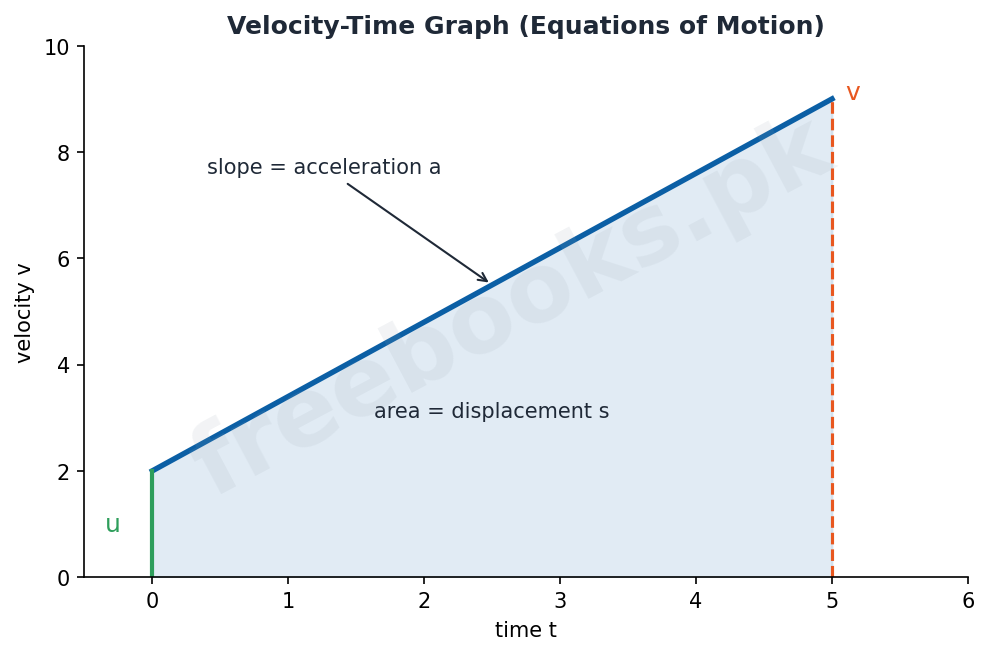
Displacement is the change in position of a body in a particular direction; velocity is the rate of change of displacement and acceleration is the rate of change of velocity. For uniformly accelerated motion in a straight line, three equations of motion are used: v = u + at, s = ut + (1/2)at^2 and v^2 = u^2 + 2as, where u is the initial velocity, v the final velocity, a the acceleration, t the time and s the displacement.
Newton’s Laws of Motion
Newton’s first law (the law of inertia) states that a body remains at rest or in uniform motion unless acted upon by a net external force. The second law states that the rate of change of momentum of a body is proportional to the applied force and takes place in the direction of the force, giving F = ma. The third law states that to every action there is an equal and opposite reaction.
Momentum and Impulse
The linear momentum of a body is the product of its mass and velocity, p = mv, and is a vector. Newton’s second law can be written as force equals the rate of change of momentum, F = (change in p)/(time). The impulse of a force is the product of the force and the time for which it acts, and equals the change in momentum: impulse = F t = change in p.
Law of Conservation of Momentum
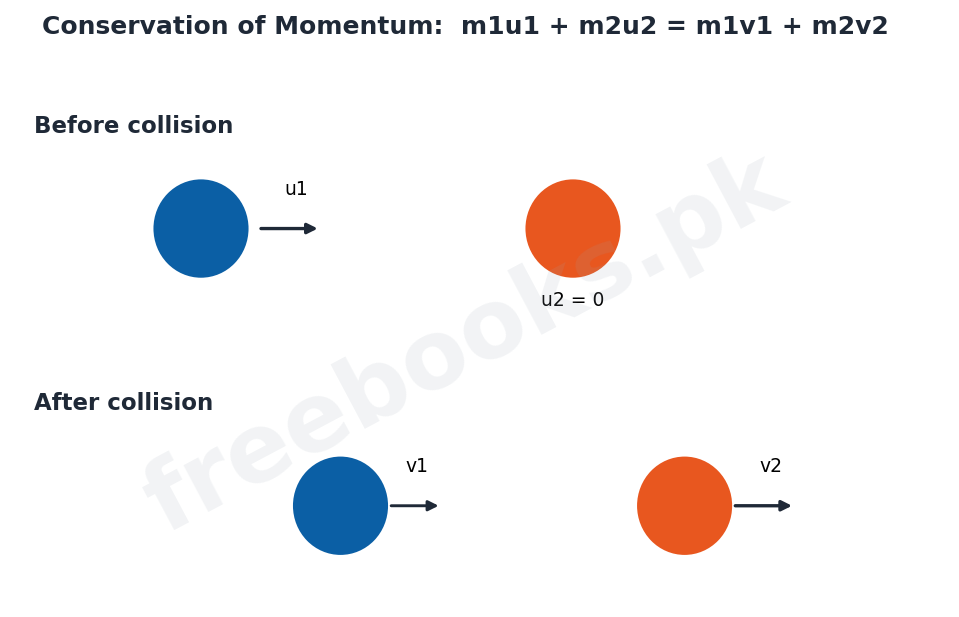
The law of conservation of momentum states that if no external force acts on a system, its total momentum remains constant. For two bodies colliding, m1u1 + m2u2 = m1v1 + m2v2. This law follows directly from Newton’s third law and is one of the most important principles in physics, used to analyse collisions and explosions.
Elastic and Inelastic Collisions
In an elastic collision both momentum and kinetic energy are conserved, and the bodies separate after impact. In an inelastic collision momentum is conserved but some kinetic energy is lost (converted to heat, sound or deformation); in a perfectly inelastic collision the bodies stick together after impact.
Projectile Motion
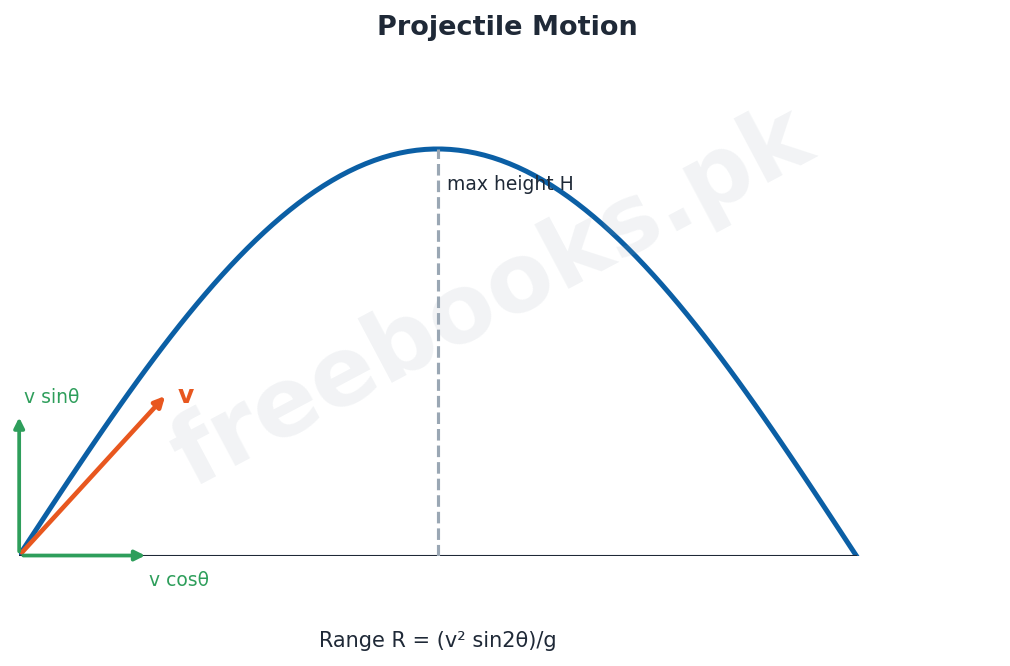
A projectile is a body thrown into the air that moves under gravity alone. Its motion has two independent parts: a constant horizontal velocity and a vertical motion with acceleration g. For a projectile launched with speed v at angle theta, the time of flight is (2 v sin theta)/g, the maximum height is (v^2 sin^2 theta)/(2g) and the horizontal range is (v^2 sin 2theta)/g. The range is maximum when theta is 45 degrees.
Important Definitions
Displacement
The change in position of a body in a specified direction.
Velocity
The rate of change of displacement; a vector.
Acceleration
The rate of change of velocity; a vector.
Momentum
The product of mass and velocity, p = mv; a vector.
Impulse
The product of force and the time for which it acts; equals the change in momentum.
Newton’s first law
A body stays at rest or in uniform motion unless acted on by a net force.
Conservation of momentum
If no external force acts, the total momentum of a system stays constant.
Projectile
A body moving through the air under the action of gravity only.
Formulas & Rules
| Item | Fact |
|---|---|
| Equations of motion | v = u + at; s = ut + (1/2)at^2; v^2 = u^2 + 2as |
| Newton’s second law | F = ma = (change in momentum)/(time) |
| Momentum | p = mv |
| Impulse | impulse = F t = change in momentum |
| Conservation of momentum | m1u1 + m2u2 = m1v1 + m2v2 |
| Time of flight | (2 v sin theta)/g |
| Maximum height | (v^2 sin^2 theta)/(2g) |
| Range | (v^2 sin 2theta)/g; maximum at theta = 45 degrees |
Diagrams & Illustrations
Velocity-time graph: a velocity-time graph in which the slope of the line gives the acceleration and the area under the line gives the displacement, illustrating the equations of motion.
Projectile motion: the parabolic path of a projectile launched at an angle, with the horizontal component (v cos theta), vertical component (v sin theta), maximum height and horizontal range marked.
Conservation of momentum: a collision between two bodies before and after impact, showing that the total momentum m1u1 + m2u2 before equals m1v1 + m2v2 after.
Solved Examples & Numericals
Equation of motion
A car starts from rest and accelerates at 2 m/s^2 for 5 s. Its final velocity is v = u + at = 0 + 2 x 5 = 10 m/s, and the distance is s = ut + (1/2)at^2 = 0 + (1/2)(2)(25) = 25 m.
Momentum
A ball of mass 0.5 kg moves at 4 m/s. Its momentum is p = mv = 0.5 x 4 = 2 kg m/s.
Conservation of momentum
A 2 kg trolley moving at 3 m/s hits a stationary 1 kg trolley and they stick together. By conservation of momentum, 2 x 3 = (2 + 1) v, so v = 2 m/s.
Projectile range
A ball is thrown at 20 m/s at 45 degrees (g = 10 m/s^2). Its range is (v^2 sin 2theta)/g = (400 x 1)/10 = 40 m.
Short Questions & Answers
State Newton’s first law of motion.
A body remains at rest or in uniform motion in a straight line unless acted upon by a net external force.
Define momentum.
The product of the mass and velocity of a body, p = mv; it is a vector quantity.
What is impulse?
The product of a force and the time for which it acts; it equals the change in momentum.
State the law of conservation of momentum.
If no external force acts on a system, its total momentum remains constant.
Differentiate elastic and inelastic collisions.
In an elastic collision both momentum and kinetic energy are conserved; in an inelastic collision momentum is conserved but some kinetic energy is lost.
At what angle is the range of a projectile maximum?
At 45 degrees, because sin 2theta is maximum (equal to 1) at that angle.
Long Questions & Answers
Q1: State and explain Newton’s three laws of motion.
Newton’s laws describe how forces affect motion. The first law, or law of inertia, states that a body remains at rest or continues to move with uniform velocity in a straight line unless a net external force acts on it; this defines force as the agent that changes a body’s state of motion. The second law states that the rate of change of momentum of a body is directly proportional to the applied force and occurs in the direction of the force; for constant mass this gives the familiar equation F = ma, so a given force produces a smaller acceleration in a more massive body. The third law states that to every action there is an equal and opposite reaction; the two forces act on different bodies, which is why they do not cancel and why, for example, a gun recoils when a bullet is fired.
Q2: State and prove the law of conservation of momentum for two colliding bodies.
The law of conservation of momentum states that in the absence of an external force, the total momentum of a system remains constant. Consider two bodies of masses m1 and m2 moving with velocities u1 and u2 that collide and afterwards move with velocities v1 and v2. During the collision each exerts a force on the other; by Newton’s third law these forces are equal and opposite and act for the same time, so the impulses are equal and opposite and the changes in momentum are equal and opposite. Therefore the momentum gained by one body equals the momentum lost by the other, and the total momentum before the collision equals the total momentum after it: m1u1 + m2u2 = m1v1 + m2v2. This law is used to analyse collisions, explosions and rocket propulsion.
Q3: Describe projectile motion and derive expressions for its time of flight, maximum height and range.
A projectile is a body that moves through the air under gravity alone, and its motion is treated as two independent motions: a uniform horizontal velocity v cos theta and a vertical motion with initial velocity v sin theta and downward acceleration g. The time of flight is found from the vertical motion: the projectile rises, stops momentarily and falls back, giving a total time of (2 v sin theta)/g. The maximum height is reached when the vertical velocity becomes zero, giving H = (v^2 sin^2 theta)/(2g). The horizontal range is the horizontal velocity multiplied by the time of flight, R = v cos theta x (2 v sin theta)/g = (v^2 sin 2theta)/g. Since sin 2theta is greatest at theta = 45 degrees, the range is maximum at that angle.
MCQs with Answers
Which equation of motion does NOT contain time? (a) v = u + at (b) s = ut + (1/2)at^2 (c) v^2 = u^2 + 2as (d) s = vt
Correct Answer: (c) v^2 = u^2 + 2as.
Newton’s second law gives the equation: (a) F = mv (b) F = ma (c) F = m/a (d) F = m + a
Correct Answer: (b) F = ma.
The momentum of a body is: (a) mv (b) ma (c) m/v (d) mgh
Correct Answer: (a) mv.
Impulse is equal to the change in: (a) velocity (b) momentum (c) energy (d) force
Correct Answer: (b) momentum.
In an elastic collision, the quantity conserved besides momentum is: (a) mass (b) kinetic energy (c) charge (d) volume
Correct Answer: (b) kinetic energy.
The law of conservation of momentum follows from Newton’s ___ law: (a) first (b) second (c) third (d) law of gravitation
Correct Answer: (c) third.
The range of a projectile is maximum at an angle of: (a) 30 degrees (b) 45 degrees (c) 60 degrees (d) 90 degrees
Correct Answer: (b) 45 degrees.
The horizontal component of a projectile’s velocity: (a) increases (b) decreases (c) remains constant (d) becomes zero
Correct Answer: (c) remains constant.
The SI unit of momentum is: (a) N (b) J (c) kg m/s (d) m/s
Correct Answer: (c) kg m/s.
A body moving with uniform velocity has: (a) increasing momentum (b) zero acceleration (c) increasing force (d) zero velocity
Correct Answer: (b) zero acceleration.
Quick Revision Summary
- Equations of motion: v = u + at; s = ut + (1/2)at^2; v^2 = u^2 + 2as.
- Newton: 1st (inertia), 2nd (F = ma = rate of change of momentum), 3rd (action-reaction).
- Momentum p = mv; impulse = F t = change in momentum.
- Conservation of momentum: m1u1 + m2u2 = m1v1 + m2v2 (no external force).
- Elastic: momentum + kinetic energy conserved; inelastic: only momentum.
- Projectile: range = (v^2 sin 2theta)/g, maximum at 45 degrees. Notes by freebooks.pk.
Exam Tips
- Pick the equation of motion that has the three known quantities plus the unknown.
- State each Newton law precisely and give an example.
- Conservation of momentum questions: total momentum before = total after.
- For projectiles, treat horizontal and vertical motions separately.
- Remember range is maximum at 45 degrees.
- Momentum and impulse are vectors; keep directions consistent.