This chapter covers Vectors and Equilibrium from the 1st Year (FSc Part-I) Physics syllabus of the Punjab Curriculum and Textbook Board (PTB/PCTB). Many physical quantities, such as force and velocity, have both magnitude and direction and are called vectors. This chapter teaches how to resolve, add and multiply vectors, and how to apply the idea of torque and the conditions of equilibrium. These notes are prepared by freebooks.pk.
Mastering vectors is essential because they are used throughout mechanics. You will learn to break a vector into rectangular components, add vectors by components, take scalar and vector products, and decide when a body is in equilibrium.
Learning Objectives
- Distinguish scalars and vectors and represent vectors graphically.
- Resolve a vector into its rectangular components and reconstruct it.
- Add vectors by the method of rectangular components.
- Define unit vectors and the position vector.
- Find the scalar (dot) and vector (cross) products of two vectors.
- Define torque and state the two conditions of equilibrium.
- Distinguish stable, unstable and neutral equilibrium.
Key Concepts
Scalars and Vectors
A scalar quantity has only magnitude, such as mass, time or temperature, and is completely specified by a number with a unit. A vector quantity has both magnitude and direction, such as displacement, velocity, acceleration and force, and must be specified by both. A vector is represented by a directed line segment whose length shows the magnitude and whose arrow shows the direction.
Rectangular Components of a Vector
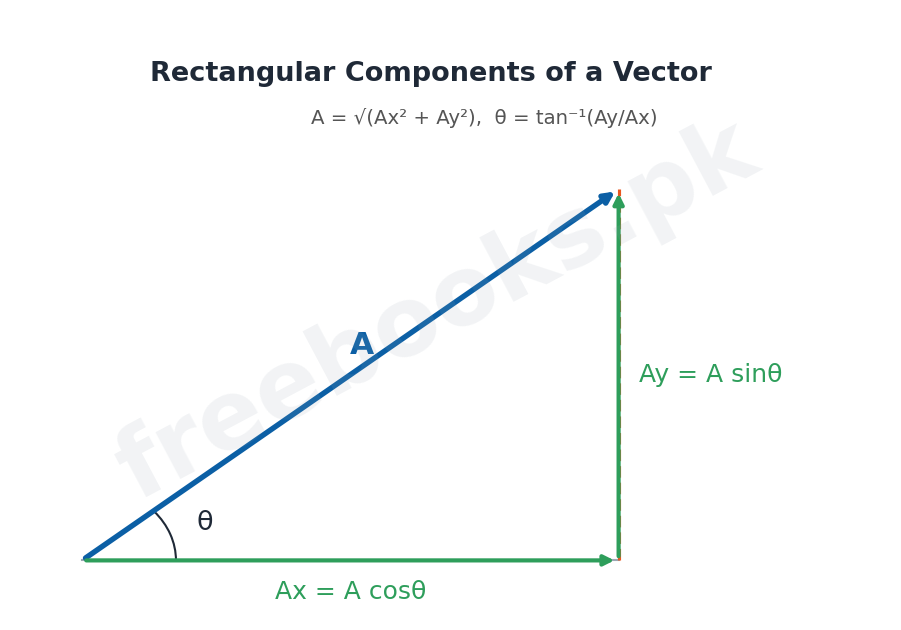
A vector can be resolved (split) into two mutually perpendicular components along the x and y axes. If a vector A makes an angle theta with the x-axis, its components are Ax = A cos(theta) along the x-axis and Ay = A sin(theta) along the y-axis. Conversely, the magnitude is A = sqrt(Ax^2 + Ay^2) and the direction is theta = tan^-1(Ay/Ax).
Addition of Vectors by Rectangular Components
To add several vectors, resolve each into its x and y components, add all the x-components to get Rx and all the y-components to get Ry. The resultant has magnitude R = sqrt(Rx^2 + Ry^2) and direction theta = tan^-1(Ry/Rx). This method is exact and works for any number of vectors.
Unit Vectors and the Position Vector
A unit vector has a magnitude of one and only shows direction; the unit vectors along the x, y and z axes are written i, j and k. Any vector can be written in terms of unit vectors, for example A = Ax i + Ay j. The position vector r locates a point relative to the origin and is written r = x i + y j.
Product of Two Vectors
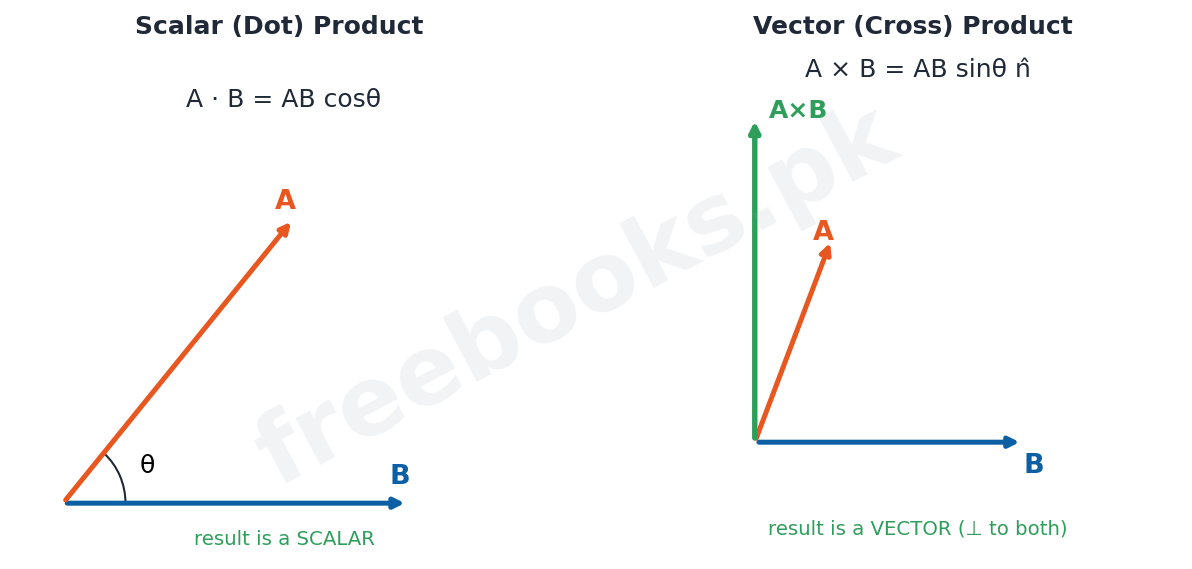
There are two ways to multiply vectors. The scalar or dot product is A . B = AB cos(theta) and gives a scalar; it is maximum when the vectors are parallel and zero when they are perpendicular. The vector or cross product is A x B = AB sin(theta) n, where n is a unit vector perpendicular to both; it gives a vector, is zero for parallel vectors and maximum for perpendicular vectors, and its direction is given by the right-hand rule.
Torque
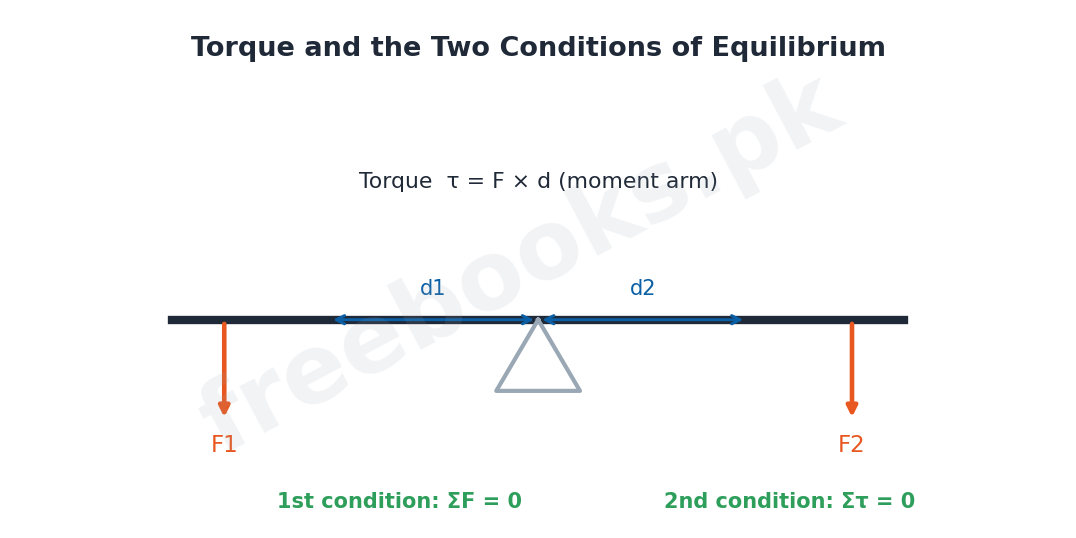
Torque (the moment of a force) measures the turning effect of a force about a point or axis. It is the product of the force and the perpendicular distance (moment arm) from the axis to the line of action of the force: torque = F x d = rF sin(theta). Torque is a vector; a force whose line of action passes through the axis produces no torque.
Conditions of Equilibrium and Its Types
A body is in equilibrium when it is at rest or moving with uniform velocity. There are two conditions. The first condition is that the vector sum of all forces is zero (sum of forces = 0), which prevents linear acceleration. The second condition is that the sum of all torques about any point is zero (sum of torques = 0), which prevents angular acceleration. A body in complete equilibrium satisfies both. Equilibrium is of three kinds: stable (the body returns to its original position when slightly displaced), unstable (it moves further away) and neutral (it stays in its new position).
Important Definitions
Scalar
A quantity that has magnitude only, such as mass or time.
Vector
A quantity that has both magnitude and direction, such as force or velocity.
Unit vector
A vector of magnitude one that shows only direction.
Resultant
The single vector that has the same effect as two or more vectors combined.
Scalar (dot) product
A . B = AB cos(theta); the product of two vectors giving a scalar.
Vector (cross) product
A x B = AB sin(theta) n; the product of two vectors giving a vector perpendicular to both.
Torque
The turning effect of a force, equal to force times moment arm.
Equilibrium
The state of a body at rest or moving with uniform velocity, with zero net force and zero net torque.
Formulas & Rules
| Item | Fact |
|---|---|
| Components | Ax = A cos(theta), Ay = A sin(theta) |
| Magnitude and direction | A = sqrt(Ax^2 + Ay^2), theta = tan^-1(Ay/Ax) |
| Resultant by components | Rx = sum of x-components, Ry = sum of y-components; R = sqrt(Rx^2 + Ry^2) |
| Dot product | A . B = AB cos(theta) (scalar) |
| Cross product | A x B = AB sin(theta) n (vector) |
| Torque | torque = F x d = rF sin(theta) |
| Equilibrium | first: sum of forces = 0; second: sum of torques = 0 |
Diagrams & Illustrations
Rectangular components: a vector A resolved into its x-component (A cos theta) and y-component (A sin theta), with the angle theta shown at the origin.
Scalar and vector products: two panels comparing the dot product (A . B = AB cos theta, a scalar) and the cross product (A x B = AB sin theta n, a vector perpendicular to both).
Torque and equilibrium: a balanced see-saw showing two forces and their moment arms, illustrating torque and the two conditions of equilibrium (sum of forces zero and sum of torques zero).
Solved Examples & Numericals
Resolving a vector
A force of 10 N acts at 30 degrees to the x-axis. Its components are Fx = 10 cos30 = 8.66 N and Fy = 10 sin30 = 5 N.
Dot product
If A = 3 units along x and B = 4 units along x (parallel), then A . B = AB cos0 = 3 x 4 x 1 = 12 (a scalar).
Cross product magnitude
Two perpendicular vectors of magnitudes 3 and 4 give a cross product of magnitude AB sin90 = 3 x 4 x 1 = 12, directed perpendicular to both.
Torque
A force of 20 N acts at the end of a spanner 0.25 m long, perpendicular to it. The torque is F x d = 20 x 0.25 = 5 N m.
Short Questions & Answers
Differentiate between scalars and vectors.
A scalar has magnitude only (such as mass); a vector has both magnitude and direction (such as force).
What is a unit vector?
A vector of magnitude one that only indicates direction, such as i, j and k.
When is the dot product of two vectors zero?
When the vectors are perpendicular, because cos90 = 0.
When is the cross product of two vectors zero?
When the vectors are parallel, because sin0 = 0.
Define torque.
The turning effect of a force about an axis, equal to the force times the perpendicular moment arm.
State the two conditions of equilibrium.
The sum of all forces is zero, and the sum of all torques about any point is zero.
Long Questions & Answers
Q1: Explain how two or more vectors are added by the method of rectangular components.
To add several vectors accurately, each vector is first resolved into its rectangular components along the x and y axes; for a vector A at angle theta these are Ax = A cos(theta) and Ay = A sin(theta). Next, all the x-components are added together to give the x-component of the resultant, Rx, and all the y-components are added to give Ry. The magnitude of the resultant is then found from R = sqrt(Rx^2 + Ry^2), and its direction from theta = tan^-1(Ry/Rx), with the quadrant decided by the signs of Rx and Ry. This method is exact, works for any number of vectors, and is more reliable than graphical methods.
Q2: Distinguish between the scalar and vector products of two vectors and give their properties.
Two vectors can be multiplied in two different ways. The scalar (dot) product is defined as A . B = AB cos(theta) and always gives a scalar; it is commutative (A . B = B . A), is maximum when the vectors are parallel, and is zero when they are perpendicular. Work done by a force is an example of a dot product. The vector (cross) product is defined as A x B = AB sin(theta) n, where n is a unit vector perpendicular to the plane of A and B given by the right-hand rule; it always gives a vector, is not commutative (A x B = -B x A), is zero when the vectors are parallel, and is maximum when they are perpendicular. Torque is an example of a cross product.
Q3: State and explain the two conditions of equilibrium, and describe the types of equilibrium.
A body is in equilibrium if it is at rest or moving with uniform velocity, and this requires two conditions. The first (translational) condition is that the vector sum of all the forces acting on the body is zero, so there is no linear acceleration. The second (rotational) condition is that the sum of all the torques about any point is zero, so there is no angular acceleration. A body in complete equilibrium must satisfy both conditions together. Equilibrium is of three types: in stable equilibrium a body returns to its original position after a small displacement (its centre of gravity rises when displaced); in unstable equilibrium it moves further from its position (its centre of gravity falls); and in neutral equilibrium it remains in its new position (its centre of gravity stays at the same height).
MCQs with Answers
Which of the following is a vector quantity? (a) mass (b) time (c) force (d) temperature
Correct Answer: (c) force. Force has both magnitude and direction.
The x-component of a vector A at angle theta is: (a) A sin(theta) (b) A cos(theta) (c) A tan(theta) (d) A
Correct Answer: (b) A cos(theta).
A unit vector has a magnitude of: (a) zero (b) one (c) two (d) infinity
Correct Answer: (b) one.
The dot product of two perpendicular vectors is: (a) maximum (b) zero (c) negative (d) one
Correct Answer: (b) zero. cos90 = 0.
The cross product of two parallel vectors is: (a) maximum (b) zero (c) AB (d) one
Correct Answer: (b) zero. sin0 = 0.
The dot product A . B is equal to: (a) AB sin(theta) (b) AB cos(theta) (c) AB tan(theta) (d) AB
Correct Answer: (b) AB cos(theta).
Torque is equal to: (a) F/d (b) F + d (c) F x d moment arm (d) F – d
Correct Answer: (c) F x d moment arm.
The result of a cross product is a: (a) scalar (b) vector (c) number (d) unit
Correct Answer: (b) vector.
The first condition of equilibrium states that: (a) sum of torques is zero (b) sum of forces is zero (c) velocity is zero (d) mass is constant
Correct Answer: (b) sum of forces is zero.
A body that returns to its position after a small displacement is in ___ equilibrium: (a) unstable (b) neutral (c) stable (d) dynamic
Correct Answer: (c) stable.
Quick Revision Summary
- Scalars have magnitude only; vectors have magnitude and direction.
- Components: Ax = A cos(theta), Ay = A sin(theta); magnitude A = sqrt(Ax^2 + Ay^2).
- Add vectors by components: Rx = sum of x, Ry = sum of y; R = sqrt(Rx^2 + Ry^2).
- Dot product A . B = AB cos(theta) (scalar); cross product A x B = AB sin(theta) n (vector).
- Torque = force x moment arm; it is the turning effect of a force.
- Equilibrium: sum of forces = 0 (first) and sum of torques = 0 (second).
- Equilibrium types: stable, unstable, neutral. Notes by freebooks.pk.
Exam Tips
- Practise resolving vectors and adding by components; a common numerical.
- Remember: dot product is a scalar, cross product is a vector.
- Dot product zero means perpendicular; cross product zero means parallel.
- State BOTH conditions of equilibrium in equilibrium questions.
- Torque depends on the perpendicular moment arm, not just the force.
- Link the equilibrium types to how the centre of gravity moves.