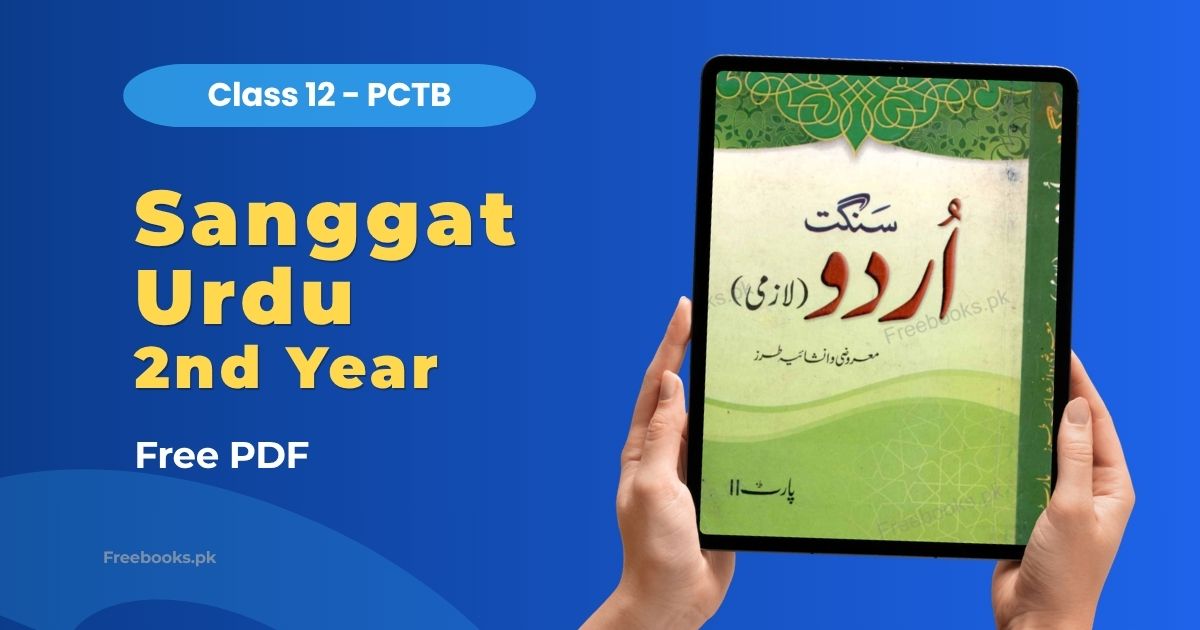
Sangat Urdu (Lazmi) Part 2 is a comprehensive guide for Class 12 students appearing in annual board exams under FA, FSc, ICS, ICOM, and D.Com programs across Punjab. Published by Sangat Publications Faisalabad, this book follows the Punjab Board syllabus for Urdu Compulsory and is widely used in government and private colleges throughout Punjab.
This book covers the complete Urdu (Compulsory) course for 2nd Year, including prose, poetry, ghazals, grammar, essay writing, autobiography, and MCQs with model papers. It is an essential resource for board exam preparation, helping students understand classical and modern Urdu literature and build strong writing and comprehension skills.
Book Overview
- Class: 12 (2nd Year / Part 2)
- Subject: Urdu Lazmi (Compulsory)
- Category: FA, FSc, ICS, ICOM, D.Com
- Board: Punjab Board
- Authors: Prof. Muhammad Masood Akhtar, Prof. Dilshad Ajmal, Prof. Shah Ahmad Alavi, Ghazala Pervez, Prof. Muhammad Afzal Hameed, Prof. Abdul Khaliq Malik, Mirza Khalid Mehmood, Prof. Rubeena Kausar
- Publisher: Sangat Publications, Faisalabad
- Total Sections: 5 (Prose, Poetry, Ghazal, Grammar, Essays)
- Format: PDF
Chapter List
حصہ نثر (Prose Section) – 14 Pieces
1. منالب عمر بن عبدالعزیز – Allama Shibli Nomani
A biographical essay by Allama Shibli Nomani highlighting the virtues and just reign of Umar bin Abdul Aziz, the Umayyad caliph known for his piety and reforms. Includes vocabulary, key excerpts for commentary, and comprehension exercises.
2. تشکیل پاکستان – Mian Bashir Ahmad
This essay traces the historical background and political movement that led to the creation of Pakistan. Students study key vocabulary, important excerpts for explanation, and comprehension questions on the Pakistan movement.
3. نواب حسن علی خاں – Maulvi Abdul Haq
A literary portrait by Maulvi Abdul Haq — the father of Urdu — exploring the cultural contributions of Nawab Hasan Ali Khan through elegant classical prose, with vocabulary and comprehension exercises.
4. محنت پسند خردمند – Maulana Muhammad Husain Azad
A reflective essay by the pioneer of modern Urdu literature, Maulana Muhammad Husain Azad, on the values of hard work and wisdom. Students practice vocabulary, excerpt explanation, and analytical writing.
5. اکبری کی ہمسائیں – Maulvi Nazeer Ahmad
A humorous character sketch from Maulvi Nazeer Ahmad depicting social interactions and personalities of fictional women characters. Includes vocabulary, excerpt commentary, and comprehension questions.
6. پہلی فتح – Hashim Jagazi
A short story capturing the joy of achieving one’s first victory. This narrative by Hashim Jagazi develops understanding of plot, character, and theme through vocabulary and comprehension exercises.
7. وسک – Mirza Adeeb
A prose piece by Mirza Adeeb exploring human emotions and social dynamics through vivid storytelling, with word meanings, important excerpts, and comprehension and critical thinking exercises.
8. ہوائی – Begum Akhtar Riaz ud Din
A literary essay by Begum Akhtar Riaz ud Din reflecting on everyday observations with sensitivity and elegance, introducing students to the distinctive style of female Urdu writers with vocabulary and comprehension exercises.
9. مولانا ظفر علی خاں – Jarah Hassan Hasrat
A biographical and critical essay on the famous journalist and poet Maulana Zafar Ali Khan. Students learn about a key figure in Urdu literature and journalism while practicing vocabulary and comprehension skills.
10. طربگی کا قاضی – Syed Imtiaz Taj
A humorous and satirical piece by the famous dramatist Syed Imtiaz Taj, sharpening students’ appreciation of comic writing and satire in Urdu literature through vocabulary, excerpt commentary, and comprehension exercises.
11. مواصلات کے جدید ذرائع – Dr. Hafeez ur Rehman
An informative essay on modern means of communication by Dr. Hafeez ur Rehman, exploring the development and impact of communication technology with vocabulary, important excerpts, and comprehension questions.
12. یہ مولوی نذیر احمد – Shahid Ahmad Dehlvi
A critical and appreciative essay on the literary contributions of Maulvi Nazeer Ahmad by Shahid Ahmad Dehlvi, developing analytical reading skills through vocabulary, excerpt explanation, and comprehension exercises.
13. ایک زمانہ جو کبھی نہیں ہے – Aman Insha
A reflective and nostalgic essay by Aman Insha on the passage of time and a world that no longer exists, introducing students to Insha’s distinctive prose style with vocabulary, excerpt commentary, and comprehension questions.
14. لائپ ظباسی – Prof. Rasheed Ahmad Siddiqui
A literary portrait by the renowned critic and humorist Prof. Rasheed Ahmad Siddiqui, developing students’ understanding of character writing in Urdu prose through vocabulary, extract commentary, and comprehension exercises.
حصہ نظم (Poetry Section) – 10 Poems
This section contains 10 poems by major Urdu poets: Maulana Zafar Ali Khan, Hafeez Taib, Akbar Allahabadi, Maulana Altaf Husain Hali, Josh Malihabadi, Syed Mir Jafri, Asrar ul Haq Majaz Lakhnavi, and Ehsan Danish. Each poem includes the poet’s introduction, central idea, word meanings, verse-by-verse explanation, and critical questions.
حصہ غزل (Ghazal Section) – 12 Ghazals
This section contains 12 ghazals by the most celebrated names in Urdu poetry: Khwaja Mir Dard (2), Ghulam Hamdani Mushafi (2), Mirza Asadullah Khan Ghalib (2), Allama Iqbal (2), Nasir Kazmi (2), Firaq Gorakhpuri (1), and Tabish Dehlavi (1). Each ghazal includes the poet’s introduction, vocabulary, verse explanation, and comprehension questions.
قواعد (Grammar) and قواعد انشا (Writing Rules)
The grammar section covers error correction in sentences, punctuation (رموز و اوقاف), and auxiliary verbs (امدادی افعال). The writing rules section covers formal letter and application writing with guidance and practice examples for board exams.
مضامین (Essays) – 21 Topics
This section contains 21 essays on diverse topics including Seerat-un-Nabi (ﷺ), Quran, unity of the Muslim world, Allama Iqbal, science and education, rural and urban life, environmental pollution, Kashmir, modern technology, and more. Also includes آپ بیتی (autobiography) writing practice with 8 guided exercises.
معروضی (MCQs) and Model Papers
A dedicated section of objective/multiple choice questions (MCQs) covering all prose, poetry, and ghazal topics for board exam preparation. Model papers are included to help students practice under real exam conditions and improve time management for the annual Urdu paper.
Download Sangat Urdu Class 12 Part 2 PDF
Click the button below to download the Sangat Urdu (Lazmi) Class 12 Part 2 PDF for free.
Who Should Read This Book
This book is for Class 12 (2nd Year) students studying Urdu Compulsory in FA, FSc, ICS, ICOM, and D.Com programs at colleges affiliated with Punjab Board. It covers the complete Urdu syllabus for the annual board exam and is equally useful for students who want to understand classical Urdu literature, improve essay writing, and practice MCQs for exam preparation.
Applicable Boards
This book follows the Punjab Board syllabus for Urdu (Compulsory) Class 12 and is widely used across all Punjab boards including Lahore Board, Faisalabad Board, Multan Board, Gujranwala Board, Rawalpindi Board, Bahawalpur Board, Sahiwal Board, Sargodha Board, and DG Khan Board.
FAQs
Is this for FSc, FA, ICS, and ICOM students?
Yes, this book is for all Class 12 (2nd Year) students studying Urdu Compulsory under FA, FSc, ICS, ICOM, and D.Com programs at Punjab Board-affiliated colleges.
Does this book include MCQs and model papers?
Yes, the book includes a dedicated MCQs section covering prose, poetry, and ghazal topics, along with model papers to help students prepare for their annual board Urdu exam.
How many prose pieces, poems, and ghazals are in this book?
This book contains 14 prose pieces (Hissa Nasr), 10 poems (Hissa Nazm), and 12 ghazals (Hissa Ghazal) by classical and modern Urdu writers and poets.
Which Punjab boards can use this book?
Students from all Punjab boards — including Lahore, Faisalabad, Multan, Gujranwala, Rawalpindi, Bahawalpur, Sahiwal, Sargodha, and DG Khan — studying Urdu Compulsory in Class 12 can use this book for exam preparation.
Related Books
- Urdu 1st Year FA Book
- Akhlaqiat 2nd Year FA Book
- Pak Studies 2nd Year FA Book
- Mutalla Pakistan 2nd Year FA Book
- Civics 2nd Year FA Book
- Economics 2nd Year FA Book
Study Resources for Urdu 2nd Year
Free exam-preparation resources for Urdu 2nd Year from the Freebooks.pk Editorial Team — the free PDF textbook, the latest paper pairing scheme. Study online or download.
© Copyright Policy
Freebooks.pk is an educational resource for students in Pakistan. Textbooks and other books belong to their respective boards, authors and publishers, and all rights remain with them. If you are the copyright holder of any material on this page and want it changed or removed, please contact us or file a request under our DMCA policy. We review every request and remove reported content promptly.