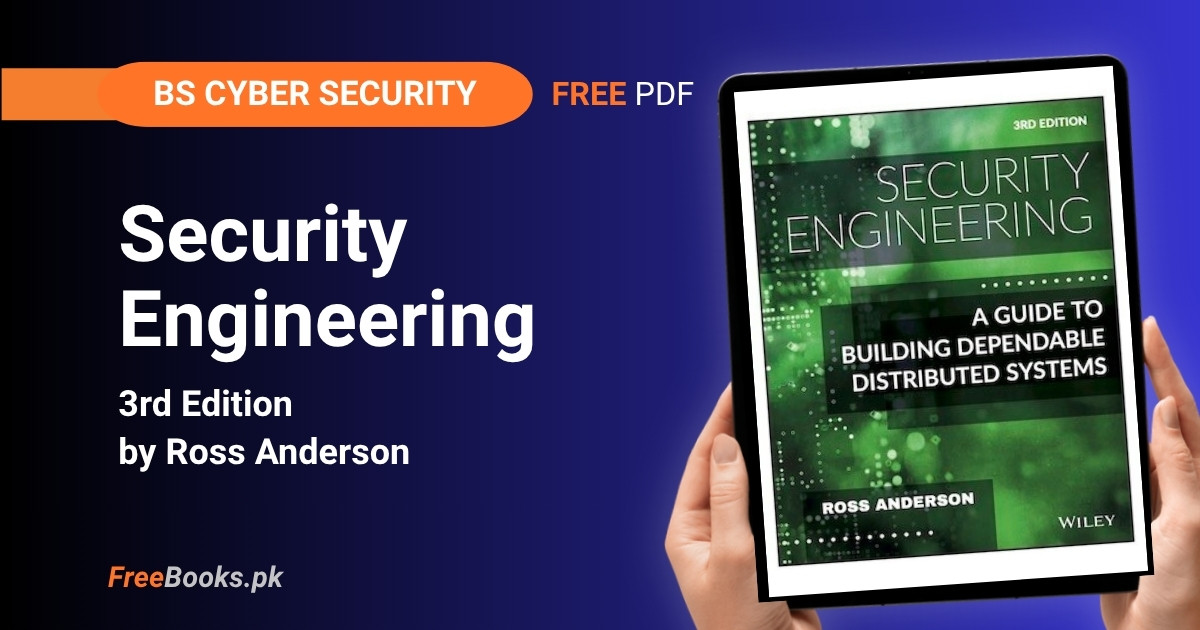
BS Cyber Security and BSCS students can use this guide to study “Security Engineering” by Ross Anderson, a professor of computer security at the University of Cambridge. The Third Edition (Wiley, 2020) is a guide to building systems that stay dependable against attack, error and bad luck. The author offers every chapter as a free PDF on his own web page, and that page also carries the older second edition.
The book is wide rather than narrow. Part I covers the basics: threat actors, psychology, protocols, cryptography, access control, distributed systems and economics. Part II works through real applications such as banking, biometrics, tamper-resistant hardware, side channels, networks and phones, and Part III deals with surveillance, secure development and assurance. It has no exercise sets, but every chapter ends with a summary, research problems and further reading, so it works well for reading before lectures and for revising how real systems fail.
Book Overview
| Course | Information Security / Security Engineering |
| Degree Programs | BS Cyber Security, BSCS |
| Level | University / Advanced undergraduate and postgraduate |
| Edition | Third Edition, 2020 (first edition 2001, second edition 2008) |
| Author | Ross Anderson |
| Publisher | John Wiley & Sons, Inc. |
| Total Chapters | 29 chapters in three parts (Part I: 1–8, Part II: 9–25, Part III: 26–29) |
| Exercises | No exercise sets; Chapters 2 to 28 end with research problems and further reading |
| Language | English |
| Format | PDF — free from the author’s page, one file per chapter or a single PDF of all chapters |
Chapter List
Chapter 1: What Is Security Engineering?
Part I · Difficulty: Easy · Key topics: security engineering, policy, mechanism, assurance, incentive, principals, security policy, security target
The chapter defines security engineering as building systems that stay dependable in the face of malice, error or mischance, and says the job needs skills from cryptography and hardware to economics, psychology and law. It then offers a four-part framework of policy, mechanism, assurance and incentive, illustrated by airport security after 9/11. Four short case studies follow: a bank, a military base, a hospital and the home. A section on definitions sorts out terms such as principal, secrecy, anonymity, integrity, security policy and security target, and the summary warns that the word security means very different things to different people.
Key Points:
- Security engineering is about building systems that remain dependable in the face of malice, error or mischance.
- Four things must come together: policy (what you must achieve), mechanism (ciphers, access controls, tamper resistance), assurance (how far you can rely on the mechanisms) and incentive (the motives of defenders and attackers).
- Software engineering ensures that certain things happen; security must also ensure that other things do not happen.
- In the 9/11 example the weak point was policy and incentives, not only mechanism: billions went on passenger screening while the far cheaper reinforcement of cockpit doors removed most of the risk.
- “Security theatre” means measures designed to produce a feeling of security rather than the reality.
- The same word can mean opposite things: monitoring staff email is security for the company and the loss of privacy for the staff.
Memory Tip: When a system fails, ask four questions in order: was the policy wrong, the mechanism weak, the assurance poor, or the incentive misaligned? Most beginners stop at the second question.
Common Mistake: Treating every security failure as a cryptography or software bug. In the chapter’s own airport example, the mechanism was not the first thing that failed.
Important Questions:
- What four elements make up the security engineering framework? Policy, mechanism, assurance and incentive; all four interact, and a failure in any one can break the system.
- Why is security engineering harder than ordinary software engineering? Ordinary systems must cope with error and mischance, but security systems must also resist an intelligent adversary, so the engineer needs adversarial thinking as well.
Chapter 2: Who Is the Opponent?
Part I · Difficulty: Medium · Key topics: spies, Five Eyes, Snowden disclosures, botnets, cybercrime ecosystem, ransomware, attribution, hate campaigns, abuse
You cannot defend a system until you know who attacks it, so this chapter groups opponents into spies, crooks, geeks and the swamp. The section on spies covers the Five Eyes programs revealed by Edward Snowden, such as Prism, Tempora and Xkeyscore, then China, Russia and the hard problem of attribution. The crooks section describes criminal infrastructure, from botnet herders and malware developers to cashout gangs and ransomware, and attacks on payment systems. The swamp covers hate campaigns, bullying and intimate-partner abuse. The chapter closes by asking designers to think about how abuse of their system could scale.
Key Points:
- Opponents are grouped as spies, crooks, geeks (hackers) and the swamp (bullies and abusers); not all of them are bad, since many hackers report bugs responsibly and many whistleblowers are public-spirited.
- The Snowden disclosures exposed Five Eyes programs including Prism, Tempora, Muscular, Xkeyscore and Quantum.
- From the mid-2000s underground markets let gangs specialise, with one group writing malware, another harvesting bank credentials and another cashing out.
- Spies and crooks both use malware to build botnets; for targeted attacks, spear-phishing is the weapon of choice.
- The Mirai botnets spread through IoT devices such as cameras that had a factory-default password which could not be changed.
- Your systems can also be used to attack others, so think in advance about how crime and abuse could scale.
Memory Tip: For each of the four groups, write down what they want, what they can afford and how their attack would scale. The same technique, such as phishing, usually serves several groups at once.
Common Mistake: Threat-modelling only the most exciting adversary, such as a nation state, while the system is actually exposed to crooks running cheap, opportunistic attacks at mass scale.
Important Questions:
- Who are the main opponents a security engineer must consider? Spies, crooks, geeks (hackers) and the swamp of bullies, haters and abusers; each has different goals, skills and methods.
- Why must designers think about how abuse can scale? Crime evolves where it can scale, and mass attacks, botnets and angry mobs do the most damage, so usability alone is not enough; you must also consider abuse.
Chapter 3: Psychology and Usability
Part I · Difficulty: Medium · Key topics: cognitive psychology, social engineering, phishing, opsec, passwords, password managers, behavioural economics, CAPTCHAs
Many real attacks exploit psychology as much as technology, so the chapter starts with research on cognition, social psychology (authority and the bystander effect), the social-brain theory of deception, and behavioural economics ideas such as prospect theory, present bias, defaults and nudges. It then looks at deception in practice, from the salesman and the scamster to social engineering, phishing and opsec. A long case study on passwords covers recovery, choice, memory, entry, storage and cracking, the use of a password manager and whether passwords can ever be replaced. The chapter ends with CAPTCHAs and a plea to make security easier for programmers too.
Key Points:
- Most real attacks now target the user; phishing is a main national-security threat and a principal means of building cybercrime infrastructure.
- Online fraud is often easier than physical fraud because a bogus bank website that passes a casual look is far cheaper to build than a bogus bank branch.
- Behavioural economics ideas used here include prospect theory, present bias and hyperbolic discounting, defaults and nudges, the affect heuristic, cognitive dissonance and the risk thermostat.
- Password problems are split into recovery, choice, entry, remembering, system issues and attacks on entry and storage (one-way encryption, cracking, remote checking).
- Usability matters for programmers as well: cryptographic APIs with unsafe defaults, and the C language, caused many real security bugs.
- Good use of a system should be easier than bad use, in the way a potato peeler is easier for peeling than a knife and harder to misuse.
Memory Tip: Judge any design by one test from the chapter: is the safe action the easiest action? If the safe path needs extra effort, expect users to take the other path.
Common Mistake: Blaming users for being fooled instead of redesigning the system so that deception is harder.
Important Questions:
- Why is phishing so effective online? Online protection mechanisms are neither as easy to use nor as hard to forge as real-world ones, and our everyday tools for spotting deception work poorly on an email that asks us to do something.
- What are the main difficulties with passwords? People find it hard to enter them reliably and to remember them, designers make errors, attackers go after entry and storage, and recovery mechanisms create new weaknesses.
Chapter 4: Protocols
Part I · Difficulty: Hard · Key topics: security protocols, challenge-response, replay, reflection, MIG-in-the-middle, two-factor authentication, Needham-Schroeder, Kerberos
The book calls protocols the core theme of security engineering: the rules principals follow to establish trust. The chapter begins with password eavesdropping and then builds simple authentication from challenge-response and two-factor schemes. The MIG-in-the-middle story about identify-friend-or-foe systems shows how a challenge can be relayed in real time, and reflection attacks show how a response can be bounced back, with the fix of including both parties’ names. Later sections cover manipulating messages, changing the environment, chosen-protocol attacks and key management, including the resurrecting duckling, Needham-Schroeder and Kerberos.
Key Points:
- A security protocol specifies the steps principals take to authenticate an identity claim, show ownership of a credential or establish a claim on a resource.
- Challenge-response sends a fresh random challenge so that an old response cannot simply be replayed.
- Typical failures are middleperson, modification, reflection and replay attacks, and they can combine with implementation bugs and weak cryptography.
- A reflection attack bounces a challenge back to a friendly party to get a valid response; including the identities of both parties in the reply stops it.
- The resurrecting duckling is a trust-on-first-use (TOFU) approach to key management for Internet of Things devices.
- Protocols often fail because the environment changes after design, and formal verification helps but does not catch every bug.
Memory Tip: For each message in a protocol, ask three things: is it fresh, who is it bound to, and what happens if an attacker relays or reflects it?
Common Mistake: Trusting a protocol because it uses strong cryptography. The chapter shows attacks on protocols whose ciphers were perfectly sound.
Important Questions:
- What is the MIG-in-the-middle attack? A story about identify-friend-or-foe systems showing how an attacker can relay a challenge to the other side and use the genuine response, so challenge-response alone is not enough.
- How can reflection attacks be stopped? Include the names of the two parties in the response, so that a response generated for one party cannot be reused as the answer for another.
Chapter 5: Cryptography
Part I · Difficulty: Hard · Key topics: stream and block ciphers, one-time pad, AES, DES, modes of operation, hash functions, HMAC, RSA, Diffie-Hellman, elliptic curves, TLS
This chapter assumes no background in cryptography and works at three levels: intuition, the mathematics that clarifies it, and cryptographic engineering. It starts with history, from the Vigenere cipher and the one-time pad to Playfair, hash functions and public-key ideas. Security models treat hash functions as random functions, stream ciphers as random generators and block ciphers as random permutations. Practical sections cover SP-networks, AES, Feistel ciphers and DES, then modes of operation, hash functions and asymmetric primitives based on factoring, discrete logarithms and elliptic curves, with certification authorities, TLS 1.3, code signing, PGP and QUIC.
Key Points:
- AES (Rijndael) is an SP-network that acts on 128-bit blocks and uses a key of 128, 192 or 256 bits.
- Electronic codebook mode should not be used; the book notes that Microsoft’s CAPI nudged engineers towards it, and covers CBC, counter mode, message authentication codes, GCM and XTS instead.
- Hash functions are modelled as random functions, and the birthday theorem explains why collisions are found far sooner than most people expect.
- Public-key schemes rest on factoring (RSA) or discrete logarithms (Diffie-Hellman, ElGamal, DSA), with elliptic curves as a third family.
- TLS, certification authorities, code signing, PGP/GPG and QUIC are the protocols that apply these primitives in practice.
- Modern cryptosystems mostly break through implementation badness such as timing and error handling, not through the algorithms themselves.
Practice Tip: Encrypt the same bitmap image with a block cipher in ECB mode and in CBC mode, using any library you like, and compare the outputs. The ECB version leaves the picture’s outline visible, which shows why the mode matters.
Common Mistake: Choosing a strong cipher and then using it badly, for example in the wrong mode, or inventing a home-made construction around it.
Important Questions:
- Why is ECB mode a bad way to use a block cipher? Identical plaintext blocks give identical ciphertext blocks, so patterns in the data show through; use CBC, counter mode or an authenticated mode such as GCM.
- At what three levels does the book approach cryptography? The underlying intuitions, the mathematics that clarifies them, and cryptographic engineering, meaning the tools in common use and what goes wrong with them.
Chapter 6: Access Control
Part I · Difficulty: Hard · Key topics: ACLs, capabilities, DAC and MAC, Unix, Windows, Android, iOS, sandboxing, virtualisation, stack smashing
Access control decides which principals, whether persons, processes or machines, may use which resources, and it has been the centre of computer security since the 1970s. The chapter works from the operating system downwards: groups and roles, access control lists, Unix security, capabilities, DAC and MAC, then macOS, iOS, Android and Windows, middleware such as databases and browsers, sandboxing and virtualisation. It then covers hardware protection on Intel and Arm processors. The last part, on what goes wrong, covers smashing the stack, other technical attacks, user-interface failures, remedies and environmental creep.
Key Points:
- Access control works at several levels, from application and middleware through the operating system to hardware.
- The main job of access control is to limit the damage that particular groups, users and programs can do, through error or malice.
- Higher-level mechanisms are more expressive, but also tend to be more vulnerable because of complexity and implementer skill.
- The chapter compares access control lists, capabilities, groups and roles, and discretionary versus mandatory access control.
- Most attacks opportunistically exploit bugs, and smashing the stack is the classic example; defences make bugs rarer and exploits harder, but overall dependability improves only slowly.
- Sandboxing and virtualisation keep programs that share one machine apart.
Practice Tip: On a Linux machine, run ls -l on a few files and id for your own groups. Read each permission string as a tiny access control list with owner, group and everyone-else entries.
Common Mistake: Treating access control as only an operating-system topic. Applications, browsers and databases enforce their own policies, and each layer can fail separately.
Important Questions:
- What is the difference between an access control list and a capability? An access control list is kept with the resource and says who may use it; a capability is held by the subject and is the token that grants the access.
- What is stack smashing? A technical attack in which a program’s stack is overwritten, typically by an overflow, so that the attacker’s data or code is run; the chapter then lists remedies that make this harder.
Chapter 7: Distributed Systems
Part I · Difficulty: Medium · Key topics: concurrency, locking, deadlock, secure time, fault tolerance, Byzantine failure, service denial, naming
Authentication, access control and cryptography are not enough for a robust distributed system, so this chapter adds concurrency, fault tolerance and naming. The concurrency section covers using old data versus paying to propagate state, locking, the order of updates, deadlock, non-convergent state and secure time. The fault tolerance section covers failure models including Byzantine failure, what resilience is for, the level at which redundancy is applied and service-denial attacks. The naming section presents Needham’s ten naming principles and then what else goes wrong with names, identity, cultural assumptions and uniqueness.
Key Points:
- Many security breaches are concurrency failures: systems use old data, make updates inconsistently or in the wrong order, or assume data are consistent when they are not.
- Using time to order transactions may help, but knowing the right time is harder than it seems.
- Byzantine failure means defective processes conspire rather than failing randomly, and it interacts with the choice of cryptographic tools.
- Replicating data for fault tolerance can increase the risk of data theft.
- For many organisations, recovering from security failures is the main purpose of the protection budget.
- Needham’s first naming principle is that the function of names is to facilitate sharing; many problems come from making a name do too much.
Memory Tip: Every replica you add is one more copy to keep alive and one more copy to protect. Resilience and confidentiality pull in opposite directions.
Common Mistake: Assuming that a name is unique, permanent and carries a fixed meaning. The naming section shows each of these assumptions failing in real systems.
Important Questions:
- Why can concurrency problems become security problems? Using stale data, applying updates in the wrong order or assuming consistency can let an attacker spend, read or change something after it should have been blocked.
- What is Byzantine failure? A failure model in which defective processes do not simply stop or fail randomly but conspire, so fault-tolerance designs must allow for arbitrary hostile behaviour.
Chapter 8: Economics
Part I · Difficulty: Medium · Key topics: incentives, externalities, monopoly, lock-in, asymmetric information, public goods, game theory, auctions, patching, cybercrime economics
Around 2000, researchers realised that many security failures come from wrong incentives rather than technical mistakes: if the people who guard a system are not the people who suffer when it fails, trouble follows. The chapter introduces classical economics and monopoly, information economics with lock-in, asymmetric information and public goods, game theory including the prisoners’ dilemma and evolutionary games, and auction theory. It then applies them to why Windows was so insecure, the patching cycle, structural models of attack and defence, DRM and tying, antitrust, perversely motivated guards, the economics of privacy and the economics of cybercrime.
Key Points:
- If the guard of a system does not pay when it fails, expect trouble; security mechanisms are sometimes designed on purpose to shift liability.
- Network insecurity is like pollution or congestion: people who connect insecure machines do not bear the full cost of their actions.
- Information markets differ from ordinary markets, and lock-in helps explain why the computer industry has been dogged by monopolies.
- Game theory is introduced through the prisoners’ dilemma and repeated and evolutionary games.
- Cybercrime patterns stayed remarkably stable through the 2010s even though technology changed completely.
- The chapter applies the theory to patching, privacy, organisations and human behaviour, and the economics of cybercrime.
Memory Tip: Follow the money. For any mechanism ask who guards it, who pays if it fails, and who profits if it stays weak.
Common Mistake: Assuming insecure products are insecure only because of technical ignorance. Often the incentives make weak security the rational choice for the seller.
Important Questions:
- Why do so many security failures come from incentives? When the party that guards a system is not the one that bears the loss, it under-invests, and the market settles at an equilibrium that nobody designed for safety.
- Why does the prisoners’ dilemma matter to security? It shows how each party acting selfishly can produce an outcome that is worse for everyone, which helps explain weak collective defence.
Chapter 9: Multilevel Security
Part II · Difficulty: Hard · Key topics: security policy models, Bell-LaPadula, Biba, information flow control, mandatory access control, SCOMP, data diodes, SELinux, covert channels, polyinstantiation
Part II opens by explaining what a security policy is: a succinct description of what you are trying to achieve, driven by the bad outcomes you want to avoid. The chapter uses multilevel security, as used in military and intelligence systems with levels such as Confidential, Secret and Top Secret, to explore it in depth. It covers the Anderson report, the Bell-LaPadula model, its standard criticisms, the evolution of MLS policies and the Biba integrity model, then historical examples such as SCOMP and data diodes. It follows mandatory access control into Windows, SELinux and embedded systems, and ends with what goes wrong, including composability, the cascade problem and covert channels.
Key Points:
- A top-down approach usually runs from threat model to security policy to security mechanisms, and the policy step is the one most often neglected.
- Bell-LaPadula has two properties: the simple security property (no read up) and the *-property (no write down).
- The *-property was Bell and LaPadula’s critical innovation, driven by fear of Trojan-horse attacks.
- From about 1980 to 2005 the US Department of Defense spent several billion dollars on multilevel security research.
- Mandatory access control is now used mainly in Android, iOS and Windows to protect the operating system itself from malware.
- MLS treats security as a hedgehog problem with one big idea, but most real problems need fox knowledge of many small things.
- Practical problems covered include composability, the cascade problem, covert channels, malware and polyinstantiation.
Memory Tip: Bell-LaPadula in six words: no read up, no write down. You may read only what you are cleared for, and you may never write secrets into a lower, less protected level.
Common Mistake: Assuming that read and write rules alone stop every leak. Covert channels and the cascade problem let information escape even when the rules are enforced.
Important Questions:
- What are the two properties of the Bell-LaPadula model? The simple security property, no read up, and the *-property, no write down; together they stop information flowing downwards.
- Why does multilevel security still matter outside the military? Its mandatory access control mechanisms now protect Android, iOS and Windows from malware, and commercial systems use multilevel integrity policies such as safety integrity levels.
Chapter 10: Boundaries
Part II · Difficulty: Medium · Key topics: compartments, lattice model, health record privacy, BMA policy, role-based access control, Chinese Wall, data sharing
When sensitive information is restricted, the goal is often to stop it flowing across between smaller groups rather than down a hierarchy. The chapter compares intelligence compartments, wildlife-crime protection, health services, social care and financial firms. It covers compartmentation and the lattice model, then “privacy for tigers” in wildlife conservation. Health record privacy takes most of the chapter, with the threat model, the British Medical Association security policy, first practical steps, what actually goes wrong, the future of confidentiality, ethics and social care, and the section ends with the Chinese Wall policy.
Key Points:
- Centralising sensitive information creates a more valuable asset and gives more people access, and the harms can scale more than linearly.
- Compartments limit each analyst to the material relevant to their own work, as with an analyst who sees only reports on one country.
- Giving too many staff access to central records leads to scandals such as staff looking up celebrities, or a billion medical records being sold to drug companies.
- In direct care, limiting each record to a sensible number of staff is the easy problem, and role-based access control suits it.
- The traditional “consent or anonymise” approach to privacy is undermined by outsourcing, central payment systems, genetic data and social media.
- Financial firms use Chinese walls to keep information in one part of the business away from another.
Memory Tip: Chapter 9 is about secrets flowing down; this chapter is about secrets flowing across. Picture walls between rooms on one floor instead of floors in a tower.
Common Mistake: Giving everyone with a clearance access to everything at that level. The chapter’s own examples are the whistleblower you get if you are lucky and the traitor if you are not.
Important Questions:
- Why is centralising sensitive data dangerous? It makes the data more valuable and more people can see it, so one insider, error or breach exposes far more than before.
- What is a Chinese Wall? A boundary inside a financial firm that stops staff in one part of the business from using confidential information held by another part, for instance about a client’s competitors.
Chapter 11: Inference Control
Part II · Difficulty: Hard · Key topics: anonymisation, census statistics, re-identification, differential privacy, medical data, location data, tactical anonymity
Anonymisation means stripping identifying information so statistics can be studied without leaking facts about individuals, and the chapter traces four waves of research into its limits. The first wave began in the late 1970s with census statistics, the second in the 1990s with computerised medical records, and the third in the mid-2000s when search logs and movie ratings made people identifiable. In 2006 differential privacy gave a theory of how much protection noise can provide, now used in the 2020 US census. The fourth wave concerns social media, genomics and phone location histories, and the closing section looks at the gap between the hype and the practice.
Key Points:
- Removing names and addresses is usually not enough for rich data; re-identification is easy in most cases.
- The four waves are census statistics, computerised medical records, consumer preference data and search logs, and finally social media, genomics and location data.
- Differential privacy, developed by Cynthia Dwork and colleagues in 2006, quantifies how far inferences can be prevented by limiting queries and adding noise.
- Differential privacy works well in well-defined cases like a national census, where there is a solid theory.
- Several countries, including the USA, UK, Germany and Iceland, had tussles over medical data, and there have been repeated scandals from inadequately anonymised data.
- The chapter looks at tactical anonymity and its problems, the incentives involved, alternatives, and the dark side of the technology.
Practice Tip: Invent a small table with age, postcode and sex, remove the names, and count how many rows are unique on just those three columns. The count shows why the book says names alone are not the problem.
Common Mistake: Believing that stripping obvious identifiers such as names makes a dataset anonymous. With rich data the pattern itself identifies the person.
Important Questions:
- What is differential privacy? A theory from 2006 that quantifies how much inference about individuals can be prevented by limiting queries and adding noise to the answers; it is used in the 2020 US census.
- Why does removing names not anonymise medical data? Medical records are so rich that the remaining details can single out a person, which caused several scandals when data were leaked or sold.
Chapter 12: Banking and Bookkeeping
Part II · Difficulty: Hard · Key topics: double-entry bookkeeping, Clark-Wilson model, SWIFT, ATMs, card fraud, EMV, preplay attack, online banking fraud, M-Pesa
This is the longest chapter in the book. It begins with bookkeeping, where integrity and accountability matter more than confidentiality, covering double-entry bookkeeping, the Clark-Wilson policy model, internal controls and insider and executive fraud. Next come interbank payment systems and SWIFT, ATMs, credit cards with 3DS and fraud engines, and EMV chip cards with the preplay attack and contactless payments. Online banking follows, from phishing and malware to SIM swap and authorised push payment fraud, and the chapter ends with non-bank payments such as M-Pesa and open banking.
Key Points:
- Bookkeeping gives a mature model of protection in which the integrity and immutability of records matter far more than confidentiality.
- The Clark-Wilson security policy captures how bookkeeping evolved over centuries and relies on functional separation, with a particular emphasis on insiders.
- The first computer used outside the military and academia was the Leo, which did bookkeeping for the Lyons coffee houses from 1951.
- The preplay attack on EMV cards came to light when a customer disputed ATM debits made while his card was in his possession.
- Online banking attacks came in waves since the mid-2000s: phishing, man-in-the-browser malware, SIM swap against phone second factors, and social engineering of customers into sending money.
- A security engineer should be able to discuss compliance regimes such as Gramm-Leach-Bliley, Sarbanes-Oxley and PCI DSS.
Memory Tip: Banks protect the books. For any sensitive transaction ask who can create it, who can approve it and who can check it, and make sure these are never one person.
Common Mistake: Thinking banking security is mostly about secrecy. The chapter stresses authenticity and accountability, and the evidence must be good enough that nobody can falsely accuse others.
Important Questions:
- What does the Clark-Wilson model describe? A security policy that grew out of bookkeeping practice, built on controlled transactions and the separation of duties so that no single person can corrupt the records.
- What waves of attack hit online banking? Phishing of account credentials, man-in-the-browser malware, SIM swap attacks on phone-based second factors, and social engineering customers to send money to the criminals directly.
Chapter 13: Locks and Alarms
Part II · Difficulty: Medium · Key topics: physical security, threat model, deterrence, mechanical locks, lock bumping, electronic locks, Mifare, burglar alarms, sensor defeats
Physical protection cannot be ignored, because many information security mechanisms are defeated if an attacker gets physical access. The first half covers the threat model, deterrence through architecture, landscaping and lighting, walls and barriers, mechanical locks and electronic locks. Many mechanical locks fall to bumping, and many electronic locks use broken cryptography such as Mifare Classic or poorly joined mechanical and digital parts. The second half studies burglar alarms as a case study, with how not to protect a painting, sensor defeats, feature interactions, attacks on communications and lessons learned.
Key Points:
- Environmental deterrence, such as architecture, landscaping and lighting, can make a real difference to the likelihood of intrusion.
- Many mechanical locks have been compromised by bumping, an easy covert-entry technique, and even expensive high-security locks have been attacked.
- Many electronic locks are easy to compromise, either because the cryptography is broken (Mifare Classic) or because the mechanical and digital parts are badly integrated.
- To defeat a burglar alarm it is enough to make it stop working, or to persuade the guards that it has become unreliable.
- Alarm systems are the classic example of systems that must be dependably available.
- Smart buildings integrate entry control and alarms with energy management, which makes them a job for systems security people.
Memory Tip: An alarm is a chain with three links: the sensor, the communication line and the person who believes it. Breaking or discrediting any one link defeats the whole alarm.
Common Mistake: Buying a lock or card system on the strength of its marketing label without asking how it has been attacked.
Important Questions:
- Why is a burglar alarm a denial-of-service problem? An intruder needs only to disable the alarm or make the guards distrust it, so availability and credibility are as important as detection.
- What is lock bumping? An easy covert-entry technique that opens many mechanical locks, which is why their manufacturers’ claims need independent checking.
Chapter 14: Monitoring and Metering
Part II · Difficulty: Medium · Key topics: prepayment meters, STS tokens, tachographs, curfew tags, postage meters, sealed counters, tamper resistance, smart meters
Many security systems monitor or meter something, and the chapter uses four case studies. Prepayment utility meters cover how the STS token system works, what goes wrong, smart meters and smart grids, and ticketing fraud. Vehicle systems cover tachographs, which record the speed and working hours of truck drivers, through four generations up to smart tachographs. Curfew tags extend GPS monitoring from vehicles to people, and postage meters complete the set. The chapter shows that some redesigns for the digital age succeeded and others did little more than copy the analogue systems.
Key Points:
- James Watt licensed his engines using a sealed counter that measured revolutions, an early example of metering.
- By December 2019 the STS prepayment specification was used in 68 million meters in 98 countries.
- Prepayment meters let utilities in developing countries sell power to hundreds of millions of people who have no address or credit rating.
- Digital tachographs did what the old analogue ones did, but less well, partly because of entrenched stakeholders and an existing safety law.
- Curfew tags extend location monitoring from vehicles to people and show the limits of GPS in large, complex systems.
- Many metering products follow the habit of shipping first and fixing by version 3, which standards such as ETSI EN 303 645 try to curb.
Memory Tip: A meter trusts a measuring device held by the person who gains from cheating. Ask what protects the device: sealed inputs, tamper resistance or cryptographic tokens.
Common Mistake: Assuming that replacing an analogue system with a digital one automatically makes it more secure. The tachograph case shows otherwise.
Important Questions:
- What is a tachograph? A device used in Europe and Australia to record the speed and working hours of truck and coach drivers, and in the USA to record the movements of bank trucks.
- Why were prepayment meters a success in developing countries? They allow utilities to sell electricity and gas to households without addresses or credit ratings, using codes the customer buys and enters.
Chapter 15: Nuclear Command and Control
Part II · Difficulty: Medium · Key topics: Kennedy memorandum, authorization-environment-intent, authentication codes, shared control, permissive action links, treaty verification, nuclear accidents, cyberwar
Nuclear weapons are the extreme case of systems that must never fail dangerously, and the effort to protect them produced a lot of security technology. The chapter traces command and control from the primitive 1950s controls to the Kennedy memorandum, prompted by the near-launch on Soviet submarine B-59 in the Cuban missile crisis, and the US rule of authorization, environment and intent. It then covers unconditionally secure authentication, shared control schemes based on secret sharing, tamper resistance and permissive action links, and treaty verification. What goes wrong covers nuclear accidents, cyberwar and technical failures, and the chapter ends on secrecy versus openness.
Key Points:
- For a US warhead to detonate, three conditions must be met: authorization by the national command authority, sensing of the right environment, and unambiguous intent from the commanding officer.
- Shared control schemes use secret sharing so that combinations of office holders or field commanders can jointly allow a weapon to be armed.
- Authentication research from this field led to the GCM mode of operation for block ciphers, now the most common mode in modern ciphersuites.
- Civil reactors produce about ten tons of plutonium a year, which must be guarded in ways that inspire international confidence.
- A surprising amount of nuclear security know-how has been published, and there are limits on how much could be kept secret.
- Cyber-attacks that undermine confidence in a country’s intelligence, surveillance and reconnaissance can destabilise deterrence even when the launch channel is secure.
Memory Tip: Shared control means no single person can act alone. It is the same idea as splitting a key among several people so that a quorum is needed.
Common Mistake: Thinking that a well-protected command channel makes deterrence safe. Attacks on the surrounding intelligence and sensor systems can still cause dangerous misjudgements.
Important Questions:
- What is the rule of authorization, environment and intent? The US requirement that a warhead detonates only if the command authority has authorized its use, it has sensed the right environment, and the commanding officer has clearly ordered its use.
- What are shared control schemes? Schemes based on secret sharing in which an action needs the cooperation of several people, so that no individual can carry it out alone.
Chapter 16: Security Printing and Seals
Part II · Difficulty: Medium · Key topics: security printing, banknotes, tamper-evident packaging, seals, gundecking, inspection, counterfeit detection, evaluation methodology
Most security products can be defeated if the opponent reaches them before installation, which is why seals and tamper-evident packaging matter. The chapter gives a short history and threat model, then explains security printing techniques, substrate properties, the problems of glue and PIN mailers. Packaging and seals follow, with the peculiar threat model, anti-gundecking measures, the effect of random failure, materials control, not protecting the right things, and the cost and nature of inspection. It closes with systemic vulnerabilities and an evaluation methodology, and notes that banknote printers and printer vendors also use digital protection.
Key Points:
- Seals support trusted distribution by assuring the user that a product has not been tampered with since it left the factory.
- Credentials are best made tamper evident rather than tamper proof, so a dismantled smartcard cannot be reassembled to pass close examination.
- Gundecking is a naval term for pretending to have done an inspection, and anti-gundecking measures check that inspectors really looked.
- Commercially available seals are relatively easy to defeat, especially when inspection is casual and done by untrained or unmotivated people.
- A seal has to be evaluated over its whole life, from manufacture through materials control, application and verification to destruction.
- Digital protection includes banknote watermarks that stop compliant scanners and printers copying notes, and forensic tracking codes in colour printers.
Memory Tip: A seal protects only if someone checks it properly. Trace the full lifetime: made, issued, applied, inspected, destroyed. The weakest stage sets the strength.
Common Mistake: Testing a seal as an object in the laboratory and forgetting the human inspection process around it.
Important Questions:
- What is gundecking? Inspectors pretending to have checked something when they did not, such as seals on shipping containers; designs can force proof of inspection, for example with a changing code in each seal.
- Why is hostile testing advised for seals? Because commercial seals are often easy to defeat and weak points sit in the process, so critical uses need testing by people trying to break them.
Chapter 17: Biometrics
Part II · Difficulty: Medium · Key topics: handwritten signatures, face recognition, fingerprints, iris codes, voice, error rates, equal error rate, forensics
Biometrics identify people by measuring anatomy, physiology, learned skill or a mix, and the chapter notes three changes since 2008: national programs such as India’s Aadhaar, much better face recognition after the deep-learning revolution, and fingerprint readers on hundreds of millions of phones. It surveys handwritten signatures, face recognition, fingerprints, iris codes, voice recognition and morphing, and other systems, and explains how error rates are measured and tuned. The section on what goes wrong covers forgery in unattended operation, and the problems of using biometrics as forensic evidence in court.
Key Points:
- India’s Aadhaar project has recorded the iris codes and fingerprints of over a billion people.
- Face recognition improved sharply since 2012 because of deep neural networks, which also made mass surveillance easier.
- The equal error rate is the tuning point where false accepts equal false rejects; for tablet-based signature recognition it is at best about 1%.
- Three systems are deployed at scale: fingerprints on phones, iris recognition in India and the Middle East, and facial recognition.
- Unattended operation raises the risk of forgery with photographs, fingerprint moulds and forged signatures.
- Biometrics are usually stronger in attended operation, and courts are less trusting of fingerprint evidence than ten years ago.
Memory Tip: A biometric system is a dial. Turn down false accepts and you raise false rejects; the equal error rate is the point where the two meet.
Common Mistake: Quoting a single accuracy figure for a biometric. The error rates depend on how the system is tuned and in which setting it is used.
Important Questions:
- What is the equal error rate? The setting at which the probability of false acceptance equals the probability of false rejection, used to compare biometric systems.
- Why are biometrics stronger in attended operation? A human can check for photographs, moulds and other forgeries, so the strengths of person and machine complement each other.
Chapter 18: Tamper Resistance
Part II · Difficulty: Hard · Key topics: hardware security modules, smartcards, security chips, TPM, enclaves, random number generators, PUFs, trusted interface problem, residual risk
Tamper-resistant devices are everywhere, from EMV bank-card chips and SIMs to TPM chips, hardware security modules and the enclave chips that store your fingerprint on a phone. The chapter tells the history of tamper resistance as cycles of attack and defence, then covers hardware security modules and their evaluation. Smartcards and other security chips are described in detail, including their architecture, how their security evolved, random number generators and physically unclonable functions, larger chips and the state of the art. The chapter ends with the residual risk, including the trusted interface problem, and the question of what one should actually protect.
Key Points:
- Protection ranges from a locked, guarded room, through tamper-sensing boxes, to single chips with shields against probing and defences against side-channel attacks.
- Many devices on the market are insecure, with reverse-engineered car key fobs, Mifare cards and card terminals as examples, yet the best cryptographic modules withstand all known physical attacks.
- The best modules are defeated mainly when people run insecure software on them or rely on insecure devices to interface with them.
- Security processors are typically vulnerable to attacks on interfaces, whether human, sensor or system.
- They deliver value where processing must be tied to a physical object and security state must be protected against scalable threats, especially where online services are intermittent.
- Research follows two strands: bringing high-end protection to chips costing under a dollar, and advancing the state of the art in attacks.
Memory Tip: Tamper resistance protects the inside of the box, and the weak spot is usually the edge: the screen, keypad, sensor or API through which the box talks to the world.
Common Mistake: Assuming a certified secure chip makes the whole system secure. The chip may be strong while the software or interface around it is not.
Important Questions:
- Name examples of tamper-resistant devices. EMV bank-card chips, mobile-phone SIMs, TPM chips, hardware security modules used for PINs, NFC payment chips and the enclave chips that hold fingerprints and keys in phones.
- Where do tamper-resistant processors usually fail? At their interfaces and in the software that runs on them, rather than by direct attacks on the protected silicon.
Chapter 19: Side Channels
Part II · Difficulty: Hard · Key topics: Tempest, emission security, timing analysis, power analysis, glitching, Rowhammer, Meltdown, Spectre, acoustic and optical channels
A side channel is a path by which information leaks accidentally through a medium not meant for communication, while a covert channel is a deliberate leak. The chapter starts with emission security: the history of Tempest, technical surveillance countermeasures, and leakage through power and signal cables and radio-frequency signals. Passive attacks include timing analysis, power analysis, glitching and differential fault analysis, Rowhammer, CLKscrew and Plundervolt, and the speculative-execution attacks Meltdown and Spectre. The chapter then covers environmental channels such as sound and light, and social side channels, and warns that sensors in phones are expanding the threat.
Key Points:
- A side channel leaks information accidentally; a covert channel leaks it deliberately.
- Tempest attacks led NATO governments to spend billions on shielding from the 1960s, though after the Cold War it was realised that nobody had usually been listening.
- Differential power analysis, found in the late 1990s, held up the deployment of smartcards in banking by two to three years.
- Spectre and Meltdown, announced in January 2018, exploit speculative execution so that one process can snoop on another, which will force a redesign of superscalar CPUs.
- A phone can listen to keystrokes on a nearby keyboard, and a laser pulse can inject a click into a microphone to send a voice command through a window.
- Most side channels remain academic most of the time, but occasionally they bite, so the engineer must know the risks.
Practice Tip: Write a password check that returns at the first wrong character, time it with different guesses, and then compare it with a constant-time comparison. The timing differences show why timing analysis works.
Common Mistake: Dismissing side channels as exotic laboratory tricks. Several have already caused multi-billion-dollar losses.
Important Questions:
- What is the difference between a side channel and a covert channel? A side channel is an accidental leak through a medium not designed for communication; a covert channel is a leak that someone sets up on purpose.
- What did Spectre and Meltdown show? That speculative execution in modern CPUs lets one process spy on another, for instance to steal cryptographic keys.
Chapter 20: Advanced Cryptographic Engineering
Part II · Difficulty: Hard · Key topics: full-disk encryption, Signal protocol, Tor, HSMs, enclaves, blockchains, smart contracts, crypto failures
Cryptography is often used to build a trustworthy component on which more complex designs rely, and this chapter studies six such components. Full-disk encryption sets the scene as the simplest case, followed by the Signal messaging protocol and the Tor anonymity network. Hardware security modules are covered with attacks such as the xor-to-null-key attack and the EMV attack, and so are enclaves. Blockchains close the list, with wallets, miners, smart contracts, off-chain payments, exchanges and permissioned chains. A final section on crypto dreams that failed asks why anonymous cash, censorship-resistant publishing and rig-proof voting did not turn out as hoped.
Key Points:
- Signal combines the Extended Triple Diffie-Hellman (X3DH) key setup, a ratchet protocol for message keys, and a way to find the keys of people in your address book.
- Plain Diffie-Hellman cannot be used between Alice and Bob in Signal because they may not be online at the same time.
- HSM attacks covered include the xor-to-null-key attack, differential protocol attacks and the EMV attack.
- The technical point is that cryptographic systems are not magic: they have bugs and need patching, and even full-disk encryption gets complicated as a product matures.
- The economic point is that advanced mechanisms carry a real cost: HSMs cost more than servers, SGX has memory limits and overhead, and Bitcoin miners emit as much CO2 as New Zealand.
- HSMs acquired ever more features until the features broke them, and SGX runs on processors so complex that it is vulnerable to multiple side-channel attacks.
- Blockchains have the most complex ecosystem of all, and even the assumption that rational miners will not rewrite history starts to fail when applications create the incentive.
Memory Tip: In every case study, cryptography is a component, not a solution. Look for the engineering problem around it: the keys, the device, the people and the policy.
Common Mistake: Assuming that using cryptography makes a system secure by default. The chapter shows even simple products going wrong as features accumulate.
Important Questions:
- What are the main components of the Signal protocol? X3DH to set up keys between users and the server, a ratchet protocol to derive message keys, and mechanisms for finding the Signal keys of your contacts.
- What lessons do the case studies teach? A technical point that cryptographic systems have bugs and need patching, an economic point that advanced mechanisms come at significant cost, and a policy point that they get tangled up with liability and other complications.
Chapter 21: Network Attack and Defence
Part II · Difficulty: Hard · Key topics: denial of service, BGP, DNS, SYN floods, malware, Internet worm, firewalls, intrusion detection, SSH, PKI, topology, re-perimeterization
This chapter draws the network aspects of security into one framework, admitting that much of it is practical engineering piled up in layers. It covers network protocols and service denial, including BGP and DNS security, UDP and TCP, SYN floods and reflection, amplifiers and email from spies to spammers. The malware menagerie follows, from early viruses and the Internet worm to how modern malware works and its countermeasures. Defence covers firewalls, censorware and wiretaps, and intrusion detection. The last sections examine SSH and wireless networking, CAs and PKI, and network topology.
Key Points:
- Industrial control protocols such as DNP3 and Modbus support neither encryption nor authentication, because they evolved on leased lines and private radio links.
- Re-perimeterization means protecting the single connection of a substation or a vehicle to the outside world when retrofitting crypto inside is impractical.
- The 1988 Internet worm began as a student experiment that escaped from the lab.
- Many firms are moving the other way, towards deperimeterisation: Google’s zero-trust BeyondCorp model shifts access control from the network perimeter to individual users and devices.
- Cloud services shift much of the network security task to a provider but make configuration management more critical.
- Preventing and detecting network attacks is the core of a modern CISO’s job, and managing it needs a whole-system approach with automation.
Memory Tip: When you cannot add security to every device, find the narrow point where the system meets the outside world and put the protection there.
Common Mistake: Treating the internal network as trusted just because a firewall sits at the edge.
Important Questions:
- What is re-perimeterization? Moving the security boundary to the one connection between a closed system, such as a substation or a car network, and the outside world, because crypto cannot easily be retrofitted inside.
- Why do industrial control systems need specialist firewalls? Protocols such as DNP3 and Modbus have no encryption or authentication, so anyone who can reach a sensor or actuator can read or operate it.
Chapter 22: Phones
Part II · Difficulty: Medium · Key topics: phone phreaking, signalling, premium-rate fraud, GSM, 3G, 4G, 5G, SIM, Android, iOS, app ecosystems
Phones, the apps they run and the telecoms networks behind them are central to the modern world, with 5 billion of 5.5 billion adults owning one. The chapter begins with attacks on the phone network: call metering, signalling, switching, insecure end systems, feature interaction, VOIP, frauds by phone companies and the security economics of telecoms. It then goes mobile, tracing GSM, 3G, 4G and 5G and the general failings of mobile network operators. The platform section covers the Android app ecosystem, Apple’s ecosystem and cross-cutting issues, and notes that phones are now the base for authentication through SMS recovery.
Key Points:
- Phones are now the bedrock of authentication: if you forget a password you get an SMS, so someone who can steal an SMS may be able to spend your money.
- The history of telecoms security runs from phone phreaks, to crooks evading wiretaps, to premium-rate fraud and frauds by phone companies themselves.
- Out-of-band signalling was adopted to stop early attacks but proved inadequate as the system grew complex.
- GSM and its successors concentrated on communications security threats rather than computer security threats, and on the phone companies’ interests ahead of the customers’.
- Control of 5G infrastructure has become a political tussle.
- In 2020 the dominant factor is the mobile app ecosystem: Android attracted hundreds of thousands of developers and a substantial criminal fringe, Apple’s is more regulated, and ad networks are a pervasive privacy threat.
Memory Tip: Follow the chain for a stolen account: weak recovery by SMS, then a phone number that can be taken over, then a bank account that trusts the number.
Common Mistake: Treating an SMS code as a strong second factor, when the phone number itself can be stolen or redirected.
Important Questions:
- Why are phones central to modern security? Phones carry the apps, the authentication codes and the credentials for most people’s services, and mobile networks are critical infrastructure for other utilities.
- What went wrong with early telephone system security? Systems were not really protected at first; out-of-band signalling then proved inadequate, and premium-rate services let people steal real money.
Chapter 23: Electronic and Information Warfare
Part II · Difficulty: Medium · Key topics: signals intelligence, jamming, radar, IFF, improvised explosive devices, directed energy, Stuxnet, NotPetya, election interference
For decades electronic warfare was a separate subject from computer security, until the Pentagon, Russia and China began to fuse them into information warfare. The chapter covers communications systems, including signals intelligence, attacks and protection techniques, and then surveillance and target acquisition, with types of radar, jamming, advanced radars and multisensor issues. It also covers identify-friend-or-foe systems, improvised explosive devices and directed energy weapons. The information warfare section treats attacks on control systems, other infrastructure, elections and political stability, and doctrine. The author notes that electronic warfare taught us about service denial and hybrid attacks.
Key Points:
- Russian denial-of-service attacks on Estonia in 2007, Stuxnet, and Russian interference in the 2016 Brexit and US elections put information warfare on policy agendas.
- The struggle for the electromagnetic spectrum was the first area of electronic security with long coevolution of attack and defence between capable opponents.
- Electronic warfare was the first teacher on service-denial attacks and on hybrid attacks mixing direct and psychological effects.
- Cognitive radar and sonar, together with better multisensor data fusion, may move advantage from the platform with most megawatts to the player with the smartest software.
- In 2010 to 2020 the great majority of information operations actually carried out were psychological operations and propaganda.
- Nation-state actors are preparing to attack other nations’ critical national infrastructure.
- Where computer security ranks confidentiality, integrity and availability, electronic warfare ranks denial of service, deception and exploitation.
Memory Tip: Electronic warfare reverses the usual priorities: denial of service first, deception second and exploitation third. Radar decoys and jamming have parallels in fake news, troll farms and modern propaganda.
Common Mistake: Imagining information warfare as mostly cyberweapons that switch off power stations. Most real operations were aimed at people and political institutions.
Important Questions:
- Why should a security engineer study electronic warfare? Many technologies were adapted for commercial use, and it was the first field to teach service-denial attacks and long attack-defence coevolution.
- What kind of information operations have been most common? Psychological operations and propaganda that sow discord, disrupt institutions such as elections and deepen polarisation, far more than destructive cyber-weapons.
Chapter 24: Copyright and DRM
Part II · Difficulty: Medium · Key topics: copyright, digital rights management, FairPlay, watermarking, obfuscation, anti-cheat, accessory control, IP lobby
The author nearly dropped this chapter from the third edition because the copyright wars of the 1990s and 2000s had largely been settled, but kept it for context. It covers copyright for software, free software, books and music, video and pay-TV, and DVD. DRM on general-purpose computers includes Windows media rights management, FairPlay and HTML5, software obfuscation, gaming and cheating, peer-to-peer systems and hardware design rights. The chapter then discusses information hiding such as watermarks and copy generation management, policy and the IP lobby, and accessory control, which now uses cryptography to support business models in many sectors.
Key Points:
- Power in music and film passed from firms like EMI and Universal to Apple, Spotify, Amazon and Netflix as streaming replaced local media.
- DRM is still used in ebooks, in FairPlay on the iPhone and in HTML5 to make Netflix video harder to copy.
- Similar techniques protect gaming platforms against aimbots, user data on cloud platforms, and banking apps through Runtime Application Self-Protection (RASP).
- Technical protection of content is a wicked problem because general-purpose computers can copy bitstrings at no cost, and DRM caused collateral damage.
- Accessory control, first used for game cartridges, now ties printers to cartridges and supports business models in dozens of sectors.
- An open problem is the privacy of anti-cheat engines in computer games: what they collect, where it goes and whether it is legal.
Memory Tip: DRM is a lock on the content, but the user already holds the key-holding machine. That is why it rarely stays technically sound.
Common Mistake: Seeing DRM as only a technical problem. The chapter shows that much of the difficulty is about policy, competition and consumer protection.
Important Questions:
- Why is DRM a wicked problem? Technically because general-purpose computers can copy bitstrings at no cost, and politically because rights-management technology did a lot of collateral damage.
- What is accessory control? A cryptographic mechanism that stops unauthorised accessories, such as printer cartridges or game cartridges, from working, used to support business models.
Chapter 25: New Directions?
Part II · Difficulty: Hard · Key topics: drones, self-driving cars, machine learning, adversarial examples, privacy-enhancing technologies, opsec, voting machines, software independence
This chapter looks at four areas at the bleeding edge of security research. Autonomous and remotely piloted vehicles cover drones, self-driving cars, the levels and limits of automation and how to hack a self-driving car. AI and machine learning cover ML and security, attacks on ML systems, and ML and society. Privacy-enhancing technologies and operational security cover anonymous messaging devices, social support, living off the land and putting it all together. Elections cover voting machines from hanging chads to optical scan, software independence and why electronic elections are hard. The common theme is that engineers now face complexity in human society, not just technology.
Key Points:
- Real-world adversarial examples include small stickers that make a car vision system misread a 30mph sign as 60mph.
- Self-driving cars cope with empty desert roads far better than with real traffic full of human drivers.
- Machine learning is brilliant at pattern matching but lacks understanding, which opens new possibilities of abuse, especially when used for social prediction.
- Privacy tools show that however hard we encrypt and anonymise, social structure tends to show through.
- Elections are hard because of both technical difficulty, counting votes with privacy and auditability, and the variety of dirty tricks used before and after voting.
- The section on voting machines covers their history, hanging chads, optical scan and the idea of software independence.
Memory Tip: All four topics share one boundary: what humans can do versus what machines can do. When a design fails, check whether it assumed people behave like data.
Common Mistake: Treating a machine-learning classifier as if it understood the world, when it only matches patterns and can be fooled by inputs a person would ignore.
Important Questions:
- What are adversarial examples? Inputs altered, for example by a sticker, to make a machine-learning system misclassify them, such as reading a 30mph speed sign as 60mph.
- Why are electronic elections so hard to secure? The count must preserve both privacy and auditability, and rulers who want to stay in office use a wide range of tricks before and after the vote itself.
Chapter 26: Surveillance or Privacy?
Part III · Difficulty: Medium · Key topics: government surveillance, Five Eyes, crypto wars, terrorism, censorship, forensics, admissibility of evidence, data protection, GDPR, freedom of information
Part III turns to politics, management and assurance, and this chapter explores the nexus of surveillance, censorship, forensics and privacy. Surveillance covers the history of government wiretapping, call data records, search terms and location data, algorithmic processing, ISPs and CSPs, the Five Eyes system of systems, the crypto wars and export control. Terrorism is examined through the causes and psychology of political violence and the democratic response. Censorship, forensics and the admissibility of evidence follow, then privacy and data protection in Europe and the USA, and freedom of information.
Key Points:
- A typical government spends about a hundred times more on collecting information on its real and potential enemies than on fighting cybercrime.
- The 1990s crypto wars were fights over key escrow, the idea that anyone who encrypted data should give the government a copy of the key.
- The September 11 attacks created the incentive for mass surveillance and weakened political opposition to it.
- After the Snowden revelations, the balance started to shift towards privacy, with effects on privacy and data protection law but little so far on the agencies themselves.
- European data protection began as a patchwork of laws starting in the German state of Hesse in 1969, while the US approach is different, and the two are increasingly strained.
- The chapter also covers censorship by authoritarian regimes, filtering, hate speech and radicalisation, and what goes wrong in forensics.
Memory Tip: Treat surveillance, censorship, forensics and privacy as one system seen from different sides. Every capability built for one purpose can be used for the others.
Common Mistake: Framing the debate as privacy versus security only. The chapter also notes that the pandemic made it privacy versus health, and that surveillance spending often brings negligible protection.
Important Questions:
- What were the crypto wars? The 1990s policy disputes over key escrow, the Clinton administration doctrine that people who encrypted data should give the government a copy of the key, and over export control of cryptography.
- How did the Snowden revelations change policy? They made the scale of US and Five Eyes data collection clear, which started to shift the balance towards privacy and influenced data protection law, though slowly.
Chapter 27: Secure Systems Development
Part III · Difficulty: Medium · Key topics: risk management, hazard analysis, fault trees, threat modelling, secure development lifecycle, agile, DevSecOps, vulnerability cycle, managing the team
The chapter opens with the point that there is no silver bullet: managing secure development is fox knowledge, not hedgehog knowledge. It covers risk management, then lessons from safety-critical systems, including hazard analysis, fault trees and threat trees, failure modes and effects analysis, threat modelling and quantifying risks. Prioritising protection goals is followed by methodology: top-down design, iterative design from spiral to agile, the secure development lifecycle, gated development, software as a service, DevOps to DevSecOps, the vulnerability cycle and organisational mismanagement of risk. The last section is about managing the team, from elite engineers and diversity to emergent properties.
Key Points:
- Fred Brooks’s conclusion in “The Mythical Man-Month” applies: there is no silver bullet that makes an intrinsically hard job easy.
- Safety and security are both emergent properties that must be baked in from the beginning, and the two are increasingly entangled in real systems.
- In January 2002 Bill Gates sent a “trustworthy computing” memo ordering Microsoft staff to prioritise security over features, which led to the secure development lifecycle.
- The vulnerability cycle runs from discovery by a researcher, through vulnerability reports and interim defences, to patches rolled out along complex supply chains.
- By the early 2000s the field concluded it had to manage the patch cycle better, which led to breach disclosure laws, CERTs and responsible disclosure.
- Understanding the requirements is often the hardest part, and many failures come from organisational behaviour such as perverse incentives and toxic cultures.
Memory Tip: The fox knows many little things and the hedgehog knows one big thing. Secure development is fox work: expect a long list of small habits, not one method that fixes everything.
Common Mistake: Looking for a single methodology, from the Orange Book in the 1980s to Agile today, to deliver security by itself.
Important Questions:
- Why is there no silver bullet in secure development? Writing secure code is hard because the requirements change and nothing makes an intrinsically hard job easy, so the manager needs thousands of little pieces of knowledge.
- What is the vulnerability cycle? A researcher finds a vulnerability, it is reported, interim defences such as firewalls are used, and a definitive patch is then rolled out through the supply chain.
Chapter 28: Assurance and Sustainability
Part III · Difficulty: Hard · Key topics: assurance, evaluation, Orange Book, FIPS 140, Common Criteria, safety certification, reliability growth, hostile review, safety and security, sustainability, Sales of goods directive
Assurance asks whether a system will work and how you can be sure; compliance asks how you satisfy other people; sustainability asks how long it will keep working. The chapter covers evaluation, from alarms and locks and safety regimes for medical devices and aviation, through the Orange Book and FIPS 140, to the Common Criteria and the principle of maximum complacency. It then covers metrics and the dynamics of dependability, including reliability growth models, hostile review, open-source software and process assurance. It examines the entanglement of safety and security, including cars, and ends with sustainability, the Sales of goods directive and new research directions.
Key Points:
- The Common Criteria world is described as moribund: the idea that a device is secure because a lab tested it five years ago now seems quaint, and assurance is no longer static.
- The Orange Book inspired both FIPS 140 for cryptographic modules and the Common Criteria; vendors game these schemes and try to capture regulators.
- The principle of maximum complacency says owners seek endorsement from one certifier and resist attempts to improve the product.
- With everything connected you cannot have safety without security, so safety and security ecosystems are merging, and the emphasis moves from pre-market testing to monitoring and response.
- The EU Sales of goods directive, passed in May 2019 and effective from 2021, requires firms to maintain goods “with digital elements” for a reasonable service life, at least two years after sale.
- The old question of how you know when you are done is replaced by the view that we are never done.
Memory Tip: Assurance used to mean a certificate on the day of sale. Now think of it as a service: patches, monitoring and recovery for as long as the product lives.
Common Mistake: Treating a certification label as proof that a product is secure. Certifiers have commercial incentives of their own, and the label says nothing about how long the product will be patched.
Important Questions:
- Why has traditional security evaluation declined in importance? A one-off lab evaluation cannot keep up with a continuous stream of vulnerabilities, so the emphasis has moved to monitoring, response and updating products in the field.
- What does the Sales of goods directive require? Firms selling goods with digital elements must maintain the software, services and apps for a reasonable service life, with a minimum of two years after sale.
Chapter 29: Beyond “Computer Says No”
Part III · Difficulty: Easy · Key topics: systems perspective, security economics, complexity, sustainability, politics, governance, policy engagement
The book ends with a two-page conclusion that looks back over twenty years of change. At the start of the century security technology was an archipelago of mutually suspicious islands, and now everyone needs a systems perspective and the field is embracing the humanities and social sciences too. The author recalls that many persistent failures are incentive failures, then highlights three things for the future: social complexity, sustainability of software in durable goods, and politics, since security is a relationship about power rather than a scalar. Engineers are urged to take part in the policy debate, because democracy is how societies learn.
Key Points:
- Security engineering is about making systems predictably dependable in the face of malice, from bombers to botnets, as well as error, mischance and coercion.
- Many persistent failures are incentive failures at heart: if Alice guards a system while Bob pays the cost of failure, you can expect trouble.
- Complexity: computer science has good tools for technical complexity but now faces social complexity, and a system must work with many interacting humans.
- Sustainability: software in cars, pacemakers and electricity substations may need maintenance for twenty to forty years, and nobody yet knows how to do that.
- Politics: security is not a scalar but a relationship about how systems exercise power, so engineers should also study political science, economics and psychology.
Memory Tip: Carry three words out of the book: complexity, sustainability and politics. They are the author’s list of what will matter most in the next decade.
Common Mistake: Treating security as a magic fairy dust to sprinkle on a system at the end, instead of a relationship between people with different interests.
Important Questions:
- What three things does the author highlight in the conclusion? Complexity, especially social complexity; sustainability, meaning long-term maintenance of software; and politics, meaning who gains and loses from security decisions.
- Why does the author urge engineers to join policy debates? Societies learn and adapt through democracy, and the more engineers engage with the problems of complexity, sustainability and power, the faster societies can adapt.
How to Study This Book
The book has 29 chapters in three parts that the author declares himself: Part I (Chapters 1 to 8) covers the basics, Part II (Chapters 9 to 25) works through applications, and Part III (Chapters 26 to 29) deals with politics, management and assurance. The printed book runs to more than 1,100 pages before the bibliography and index, and it has no exercise sets. Every chapter from 2 to 28 ends with a summary, research problems and further reading instead. It is a reference to dip into by topic, not a text to finish in one semester, so choose chapters to match your course.
Start with Chapters 1 and 2, which give the policy-mechanism-assurance-incentive framework and the map of who attacks what. Then read Chapters 3, 4 and 5 in order. Psychology and usability explains why people are the target, Protocols shows how trust is established and broken, and Cryptography builds on both. Chapter 5 assumes no background in crypto, but it is about 60 pages, so read it with a pencil and treat Sections 5.4 to 5.7 as the part to revisit before an exam. Chapter 6 on access control and Chapter 7 on distributed systems follow naturally, and Chapter 8 on economics can be read at any point after Chapter 2.
Chapters 9, 10 and 11 form a block on security policy: multilevel security, compartments and boundaries, and inference control. Read them together if your course covers security models such as Bell-LaPadula, role-based access control or privacy and anonymisation. Chapter 9 refers back to the mandatory access control material in Chapter 6, and Chapter 11 is the one to read for differential privacy. The author himself says multilevel security is largely obsolete in industry, so read Chapter 9 for the ideas rather than as a guide to building products.
Part II is a set of case studies, and you do not need to read them in order. Chapter 12 on banking and bookkeeping is the one to read for payment fraud, EMV and online banking attacks. Chapters 18 and 19, on tamper resistance and side channels, go together for hardware security, and Chapter 20 covers disk encryption, Signal, Tor, HSMs, enclaves and blockchains. Chapter 21 is the network security chapter and Chapter 22 covers phones and app ecosystems. Chapters 13 to 17 and 23 and 24, on locks and alarms, metering, nuclear command and control, security printing, biometrics, electronic warfare and DRM, are more specialised and can be skipped on a first pass unless your syllabus lists them.
In Part III, read Chapter 27 on secure systems development and Chapter 28 on assurance and sustainability if your course covers security management, risk analysis, DevSecOps or certification. Chapter 26 on surveillance and privacy is the one for ethics, law and policy topics, and the two-page Chapter 29 is a good way to finish. A small naming warning: the author’s download page uses older working titles for three chapters (Physical Protection, Physical Tamper Resistance and Taking Stock), but the PDFs and the printed book call them Locks and Alarms, Tamper Resistance and New Directions?, which is what this page uses.
The front matter, with the contents and the three prefaces, is a separate PDF, and so are the bibliography and index. Numbers in square brackets in the text point to that bibliography file. The book does not teach tools such as packet sniffers or penetration testing frameworks, and it has no lab exercises or solutions, so pair it with practical work from your course. The author’s page also links fifteen teaching videos made for his Edinburgh security engineering class, and a list of third-edition errata that is worth checking. The earlier second edition (2008) is also free on the author’s page, but this page covers the third edition only.
Used In These Programs
This book is used for the Information Security and Cyber Security Fundamentals courses in: BS Cyber Security · BS Computer Science. Browse all Cyber Security books or all Computer Science books.
Who Should Read This
This book is written for BS Cyber Security and BSCS students taking Information Security, Cyber Security Fundamentals or a security engineering course, and the author’s own class at Edinburgh was taught to masters students and fourth-year undergraduates. It suits students who already know the basics of operating systems and networks and want to see how real systems fail and how designers respond, and it works well as a second book alongside a lecture-based security course. It also helps self-learners and working engineers who want the whole picture, from passwords and protocols to banks, phones and policy. It is not a first book for someone who has never studied computing, and it is not a hands-on hacking manual. For the networking background behind Chapter 21, Computer Networking: Principles, Protocols and Practice has chapters on network security, TLS and securing DNS. Operating Systems: Three Easy Pieces and Think OS explain the operating-system side of Chapter 6, and Mathematics for Computer Science covers number theory and RSA for the public-key parts of Chapter 5.
Applicable Universities
This book is useful for students at Pakistani universities offering BS Cyber Security and BS Computer Science with an information security or cyber security course, including Punjab University, Virtual University, COMSATS, FAST, UET, NUST, and other HEC-recognized institutions.
Official Copy of Security Engineering (3rd Edition)
Ross Anderson offers every chapter of the Third Edition as a free PDF on his web page at the University of Cambridge, together with one PDF of all chapters. Click below to open the official page and download the chapters you need.
→ Visit Official PageFAQs
Is Security Engineering by Ross Anderson free?
Yes. The author offers every chapter of the Third Edition, the front matter, the bibliography and index, and a single PDF of all chapters free on his Cambridge web page. His page explains that the chapters were withheld for 42 months from November 2020 at the publisher’s request and that the whole book would then be free online. It is not under an open licence: the book is copyright 2020 Ross Anderson and published by Wiley, which also sells it. Use the official page rather than reposting the files.
Which edition is this?
This is the Third Edition from 2020, with a preface dated October 2020. The first edition appeared in 2001 and the second in 2008. The author’s page also offers the second edition (27 chapters) for free, but this page covers the third edition only. The third edition adds smartphones and app ecosystems, cloud services, the Snowden disclosures, the cybercrime ecosystem, and a closer look at safety and sustainability.
How many chapters and exercises does it have?
There are 29 chapters in three parts, plus front matter, a bibliography and an index. The printed book is more than 1,100 pages before the bibliography. It has no exercise sets or solutions. Chapters 2 to 28 end with a summary, research problems and further reading, and the author’s page links fifteen teaching videos and a list of errata.
Is it good for complete beginners?
It is readable and the author explains cryptography from scratch, but it is long and covers a very wide range. It works best if you already know the basics of operating systems and networks. Beginners should start with Chapters 1 to 3 and then pick topics that match their course. The author’s own Edinburgh class was taught to masters students and fourth-year undergraduates.
Does it cover cryptography, access control, networks and phones?
Yes. Chapter 4 covers security protocols, Chapter 5 cryptography, Chapter 6 access control, Chapter 21 network attack and defence, and Chapter 22 phones and app ecosystems. Chapter 20 adds disk encryption, Signal, Tor, hardware security modules, enclaves and blockchains. It does not teach hands-on tools such as packet sniffers or penetration testing frameworks.
Is it still current in 2026?
The principles are, but the book is a 2020 snapshot. The author himself calls multilevel security and the Common Criteria evaluation world largely moribund, and the chapters on machine learning, self-driving cars, elections and policy reflect the state of play in 2020. Newer developments are not covered, so read it for the way of thinking and add current vendor and standards documents. Check the third-edition errata on the author’s page as well.
Related Books
- Computer Networking: Principles, Protocols and Practice – Bonaventure (3rd Edition)
- Operating Systems: Three Easy Pieces – Arpaci-Dusseau (Version 1.10)
- Think OS – Allen B. Downey (Version 0.7.4)
- Mathematics for Computer Science – Lehman, Leighton & Meyer (MIT OCW)
Security Engineering gives you the whole picture of how real systems are attacked and defended, from passwords and protocols to banks, phones and policy, in one free book. Browse more Computer Science books for the rest of your semester.
Security Engineering: A Guide to Building Dependable Distributed Systems, Third Edition (2020) by Ross Anderson. Copyright © 2020 Ross Anderson, published by John Wiley & Sons, Inc., Indianapolis, Indiana. The author offers the chapters as free PDFs on his web page at the University of Cambridge. Official source: https://www.cl.cam.ac.uk/archive/rja14/book.html. This page links to the official site and does not host or copy the book.
© Copyright Policy
Freebooks.pk is an educational resource for students in Pakistan. Textbooks and other books belong to their respective boards, authors and publishers, and all rights remain with them. If you are the copyright holder of any material on this page and want it changed or removed, please contact us or file a request under our DMCA policy. We review every request and remove reported content promptly.