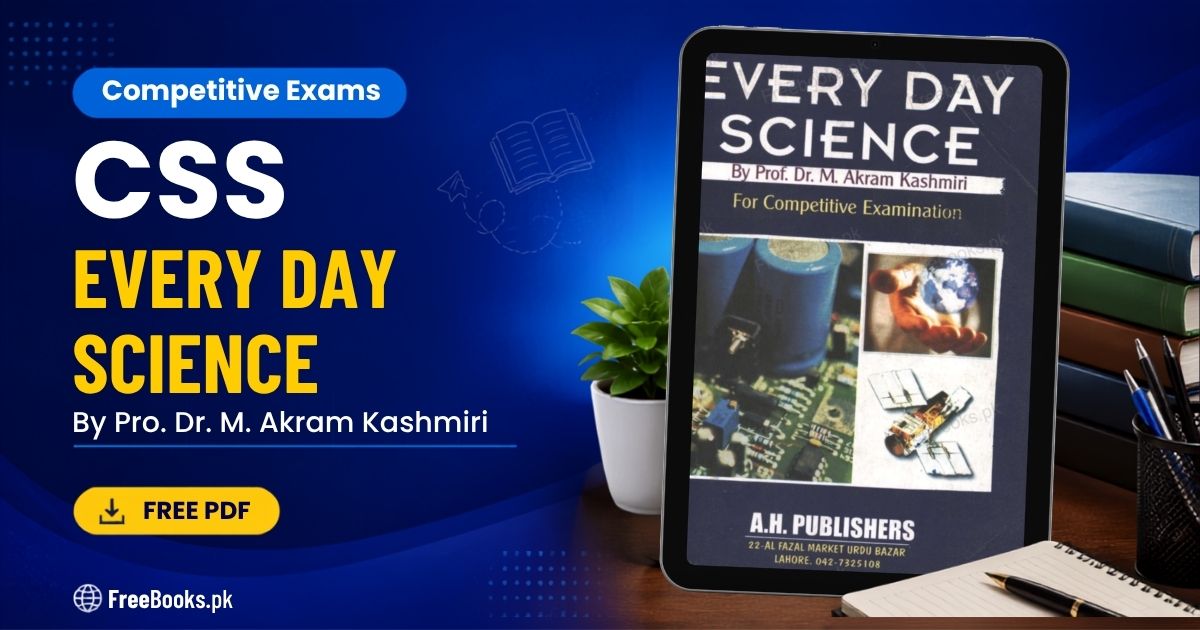
Every Day Science is a compulsory subject in the CSS (Central Superior Services) exam, carrying 100 marks. This book, written by Prof. Dr. M. Akram Kashmiri, Chairman of the Chemistry Department at Government College University Lahore, covers the full FPSC syllabus for Everyday Science in one place. It is published by A.H. Publishers, Lahore, in a revised and updated edition.
The book is aimed at CSS, PMS, and other competitive exam candidates. It explains science topics in simple language, without heavy technical jargon, so students from any background, arts or science, can understand and revise quickly before the paper. Chapter summaries and important questions on this page make revision faster, and the solved past papers inside the PDF add real exam practice.
Book Overview
| Subject | Everyday Science (Compulsory) |
| Category | CSS / Competitive Exams |
| Author | Prof. Dr. M. Akram Kashmiri |
| Publisher | A.H. Publishers, Lahore |
| Edition | Revised & Updated |
| Total Chapters | 6 (plus Objectives and Solved Question Papers) |
| Total Pages | 587 |
| Format | Printed book (available from the publisher) |
Chapter List
Chapter 1: Science
This chapter traces the history of science from the pre-science era, when fire and language were the first major discoveries, through the three broad stages of scientific development: imagination, creation, and application. It highlights the practical, experiment-based approach Muslim scientists brought to science during Europe’s Dark Ages, and their contributions to mathematics, chemistry, medicine, and astronomy.
Important Questions:
- Name some important discoveries of the Pre-Science era. Fire and language are considered the most important discoveries of the Pre-Science era.
- What is the main sequence for the development of science? Science develops through three stages: Imagination, Creation, and Application.
- What period is called the Dark Ages in Europe? The period from the second to the tenth century AD, when Europe made little scientific progress, is known as the Dark Ages.
- How did Muslim scientists’ approach to science differ from the Greeks? Muslim scientists based their work on observation and experiment rather than pure theory, which the Greeks relied on.
Chapter 2: The Universe
This chapter covers the Big Bang, galaxies, the solar system, and the Sun, Moon, and Earth, along with natural phenomena like eclipses, the blue colour of the sky, and rainbows. It also explains why the Moon always shows the same face to Earth and introduces the Oort Cloud as the source of comets at the edge of the solar system.
Important Questions:
- What is the Oort Cloud? A reservoir of comets located outside the solar system.
- What is the difference between a star and a planet? A star is a self-luminous body, while a planet is a rocky body that only reflects light.
- Why do we always see only one face of the Moon? Because the Moon’s rotation period equals its revolution period around the Earth, known as synchronous rotation.
- Why does the sky appear blue? Sunlight is scattered by dust particles in the atmosphere, and the blue part of the light scatters the most, an effect called the Tyndall Effect.
Chapter 3: Energy
This chapter defines the units used to measure energy and power, like the Newton, horsepower, and kilowatt-hour, and covers sources of energy from fossil fuels to hydroelectric and nuclear power. It explains isotopes, nuclear fission and fusion, and Pakistan’s own nuclear power projects, alongside everyday concepts like the electric fuse.
Important Questions:
- Define a Newton. A Newton is the force needed to move a one-kilogram mass one metre per second faster every second.
- What is a kilowatt-hour? It is the energy used by 1000 watts running for one hour, the unit an electric meter counts.
- What are isotopes? Atoms of the same element with the same number of protons but a different number of neutrons, such as Uranium-235 and Uranium-238.
- What does KANUPP stand for? Karachi Nuclear Power Plant, which produces about 0.2% of Pakistan’s total electricity.
Chapter 4: Products of Science
This chapter looks at how science shows up in everyday products: doped semiconductors in electronics, laser technology and holograms, and communication tools from radio waves to bar codes. It also covers ceramics, ores, and ordinary items like the abacus and pantograph that came before modern computing devices.
Important Questions:
- What is doping in semiconductors? The process of adding impurities to a semiconductor to boost its efficiency, creating n-type or p-type material.
- Who discovered the laser? Gordon Gould discovered the laser in 1957.
- What is a hologram? A special photograph made using laser light that appears as a three-dimensional picture.
- What is a bar code? A set of rectangular lines on a product’s packaging that a laser scanner reads to show the price on screen.
Chapter 5: Living Things
This chapter surveys the plant and animal kingdoms, cell structure, and how living things get energy through photosynthesis and respiration. It covers vitamins, hormones like insulin, essential amino acids the body cannot make on its own, and key processes like metabolism that keep the body running.
Important Questions:
- What is the difference between photosynthesis and respiration? Photosynthesis makes food using sunlight and releases oxygen, while respiration breaks down food to release energy and produces carbon dioxide.
- What are essential amino acids? Amino acids the body cannot make on its own and must get from food, eight in total: isoleucine, leucine, tryptophan, threonine, phenylalanine, valine, methionine, and lysine.
- What is insulin? A hormone secreted by the pancreas that regulates blood sugar level by helping glucose enter body tissues.
- What is haemoglobin? The iron-containing protein in red blood cells responsible for carrying oxygen around the body.
Chapter 6: Human Physiology
This chapter covers the human body’s major systems: blood composition and function, the normal heart rate and blood volume, and how the kidneys filter waste from the blood. It also introduces body muscles, sensory organs, and other systems that keep the body functioning day to day.
Important Questions:
- What is the composition of blood? Blood consists of a cellular fraction, containing red cells, white cells, and platelets, and a plasma fraction.
- What is the normal total blood volume in an adult? About 5.5 litres.
- What is the normal heart rate? About 72 beats per minute.
- What is the function of the kidneys? Kidneys control the amount of water in the body and filter waste from the blood, containing about 2.5 million tiny filtering units.
Objectives and Solved Question Papers
The book closes with a large bank of objective-type (MCQ) questions covering all six chapters for quick self-testing, followed by solved and unsolved CSS Everyday Science papers from 1993 to 2007 for practice under real exam conditions.
How to Get Every Day Science
Every Day Science is a copyrighted book by Dr. M. Akram Kashmiri. Freebooks.pk does not host or share copies of this book. You can buy the printed book from bookshops across Pakistan or from its publisher.
This page gives you a free overview of the book: what it covers, how its chapters are organised and how to use it for exam preparation. For free notes, past papers and other study material, see our CSS resources.
Who Should Read This
This book is meant for CSS aspirants preparing for the compulsory Everyday Science paper. It is also useful for PMS, PPSC, and other competitive exam candidates whose syllabus includes a general science section.
Applicable Exams
Written primarily for the CSS Everyday Science compulsory paper. It also works for PMS, PPSC, FPSC, and NTS exams that include a general science section, since the core topics overlap closely.
FAQs
Is this book for CSS only?
It is written mainly for CSS but also covers topics tested in PMS, PPSC, and other competitive exams with a general science paper.
Can other students use it?
Yes, students preparing for general knowledge or science-based competitive tests can use it for quick revision.
Is this the latest edition?
This is the revised and updated edition by A.H. Publishers.
Does it include solved exercises?
Yes, it includes solved and unsolved CSS Everyday Science papers from 1993 to 2007.
Who is the author of this book?
Prof. Dr. M. Akram Kashmiri, Chairman of the Chemistry Department at Government College University Lahore.
Does this page include chapter-wise important questions?
Yes, each chapter above includes a short summary and four important questions with answers, drawn from the book, for quick revision before exam day.
Related Books
- The Concepts of Information Technology Book PDF Download for CSS
- Competitive Journalism Book PDF Download for CSS (Abid Tehami)
- CSS Syllabus and Compulsory Papers Book PDF Download (Noor’s)
- Mass Communications Book PDF Download for CSS (Wilbur Schramm)
- Advanced Mass Communication Book PDF Download for CSS
- Muslim Struggle for Independence Book PDF Download for CSS
© Copyright Policy
Freebooks.pk is an educational resource for students in Pakistan. Textbooks and other books belong to their respective boards, authors and publishers, and all rights remain with them. If you are the copyright holder of any material on this page and want it changed or removed, please contact us or file a request under our DMCA policy. We review every request and remove reported content promptly.