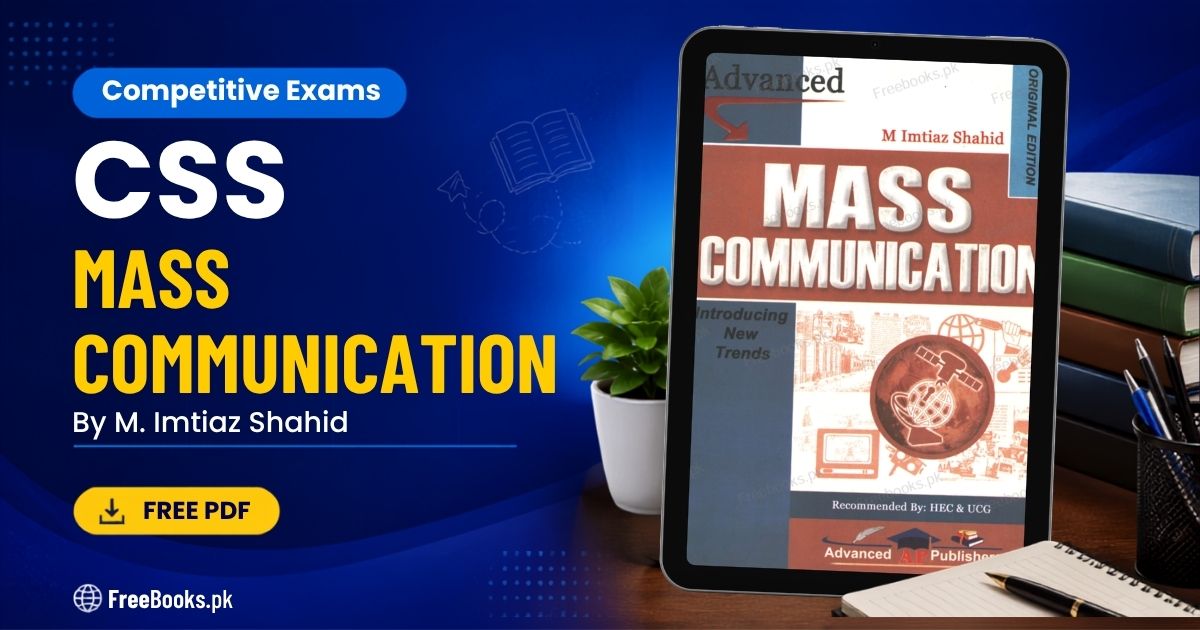
Advanced Mass Communication is a comprehensive reference book for Mass Communication and Journalism, written by M. Imtiaz Shahid and published by Advanced Publishers, Lahore. This revised, updated, and enlarged edition is recommended by the Higher Education Commission (HEC) and University Grants Commission (UGC), and is not tied to any specific school or college board — it is a standalone reference widely used for competitive exam preparation.
For CSS aspirants, Journalism and Mass Communication is a popular optional subject. This book covers the subject in full detail, from communication theory to Pakistan’s media landscape, and includes both subjective content and a large bank of MCQs, giving candidates one complete resource for both concept-building and practice.
Book Overview
- Category: CSS (Competitive Exams)
- Subject: Mass Communication / Journalism
- Author: M. Imtiaz Shahid
- Publisher: Advanced Publishers, Lahore
- Edition: Revised, Updated & Enlarged Edition, 2010
- ISBN: 978-969-9089-18-13
- Recommended By: HEC and UGC
- Total Chapters: 37, plus a Glossary and an MCQ bank
- Medium: English
- Format: PDF
Note: This book is not linked to any specific class or board. It is a general Mass Communication reference used mainly for competitive exam preparation.
Chapter List
Chapter 1 – Communication
Covers the process, definitions, and meanings of communication, including mass media, language, and animal and plant communication.
Chapter 2 – What is Mass Communication?
Traces the evolution of mass communication, interpersonal versus mass communication, the gatekeeper concept, and how mass communication is defined today.
Chapter 3 – The Nature of Channels
Compares media channels by space-time, participation, speed, and permanence, highlighting the unique strengths of print, radio, screen, and face-to-face communication.
Chapter 4 – Nature of Mass Communication
Covers newspapers, magazines, books, radio, television, and movies, along with the purposes, scope, and social responsibility of mass media.
Chapter 5 – Modifying Attitudes and Opinions
Explains how attitudes form and change, and how media influences decision-making, especially among young viewers.
Chapter 6 – Effects of Mass Communication
Covers major media effects theories including the Bullet Theory, Two-Step Flow, Uses and Gratification, Agenda-Setting, Spiral of Silence, and Cultivation Theory.
Chapter 7 – Information, Communication & Development
Covers the history and practice of development communication across regions, development journalism, and development support communication.
Chapter 8 – Propaganda and Psychological Warfare
Covers the etymology, types, and models of propaganda, with historical examples from the World Wars, Cold War, and recent conflicts.
Chapter 9 – Theories of the Press
Covers the Authoritarian, Libertarian, Social Responsibility, and Soviet-Communist theories of the press.
Chapter 10 – Mass Media: Past and Present
Covers the history of newspapers, pictorial and photo journalism, and the rise of radio and television (electronic) journalism.
Chapter 11 – Computer and Internet
Covers computers and communication, the internet’s social and political impact, and trends in online media and e-commerce.
Chapter 12 – Concentration of Media Ownership
Covers debates around media ownership concentration, citizen media, and how ownership affects media content.
Chapter 13 – Information and Globalization
Covers the digital divide, its global and geographical dimensions, and possible solutions including e-governance and e-democracy.
Chapter 14 – Journalism
Covers broadcast, documentary, and online journalism, variations like investigative and citizen journalism, and the professional and ethical standards of journalism.
Chapter 15 – Ethics in Journalism
Covers journalistic codes of ethics, the Journalists’ Creed, and core principles like accuracy, fairness, impartiality, and confidentiality of sources.
Chapter 16 – Freedom of the Press Today
Covers the role of the media consumer and reader interest in shaping a free press.
Chapter 17 – Special Language of Mass Communication
Covers perception, semantics, and how language, word choice, and readability affect mass communication.
Chapter 18 – News and News Writing
Covers hard and soft news, news values, the inverted pyramid structure, and writing for broadcast versus print.
Chapter 19 – Writing Style Difference in Newspaper, Radio & Television News
Compares writing style, structure, and word choice across newspaper, radio, and television news formats.
Chapter 20 – Editors and Editing
Covers the role of the news editor, copy editing, headline and caption writing, and changes in the editing profession.
Chapter 21 – Public Interest and News Values
Covers what makes news interesting to the public, audience motivations, and how editors balance competing public interests.
Chapter 22 – Editorial Page
Covers editorial writing, types of editorials, editorial policy, and editorial cartoons.
Chapter 23 – Feature and Column Writing
Covers news features, human-interest and biographical features, and the craft of column writing.
Chapter 24 – Interviewing and Reporting
Covers types of interviews, techniques for successful interviewing, and the role and responsibilities of a reporter.
Chapter 25 – Handout, Press Release, etc.
Covers how to write a press release, press conferences, and press communiqués.
Chapter 26 – Magazine Journalism
Covers magazine categories, modern magazine trends, and the shift toward online magazines.
Chapter 27 – Beginning of Press in the Subcontinent
Covers the characteristics of 18th-century journalism and the early growth of journalism in local languages, including Urdu journalism.
Chapter 28 – War of Independence and Journalism
Covers journalism’s role during the War of Independence of 1857.
Chapter 29 – Journalism After 1857
Covers the journalism of Sir Syed Ahmad Khan, Maulana Muhammad Ali Johar, Zafar Ali Khan, and the rise of Islamic and Urdu journalism through the early 20th century.
Chapter 30 – Mass Media in Pakistan
Covers press laws, censorship, PTV, PBC, and the structure and policy of electronic and Islamic media in Pakistan.
Chapter 31 – Internet in Pakistan
Covers broadband access, internet law, censorship, and the internet’s social impact in Pakistan.
Chapter 32 – Pakistan’s Media: Critical Issues
Covers citizen journalism, media and gender, and the ethical and policy challenges facing Pakistani media.
Chapter 33 – The Mediatization of Politics in Pakistan: A Structural Analysis
Covers the concept of mediatization and its structural impact on Pakistani politics.
Chapter 34 – Role of Media in National Development
Covers how public information and media contribute to national development.
Chapter 35 – Barriers to Journalism in Pakistan
Covers challenges like illiteracy, government attitudes, resource shortages, and pressure groups facing Pakistani journalism.
Chapter 36 – Advertising
Covers the history, purposes, classification, and ethics of advertising, along with advertising agencies and research.
Chapter 37 – Public Relations and Publicity
Covers the definitions, goals, tools, and ethics of public relations, along with key PR research models.
Plus: Glossary of Mass Communication Terms and an MCQ Bank
The book closes with a full glossary of mass communication terms and a large bank of multiple choice questions for self-testing and exam practice.
How to Get Advanced Mass Communication
Advanced Mass Communication is a copyrighted book by M. Imtiaz Shahid, published by Advanced Publishers, Lahore. Freebooks.pk does not host or share copies of this book. You can buy the printed book from bookshops across Pakistan or directly from Advanced Publishers, Lahore.
This page gives you a free overview of the book: what it covers, how its chapters are organised and how to use it for exam preparation. For free notes, past papers and other study material, see our CSS resources.
Who Should Read This
CSS aspirants who have chosen Journalism and Mass Communication as an optional subject need this book for complete coverage of theory, Pakistan’s media landscape, and practice MCQs. It also suits PMS candidates and students of Mass Communication at the university level.
Applicable Boards
This book is not tied to a specific school or college board. It works as a general Mass Communication and Journalism reference for CSS, PMS, and other competitive exams offering this subject.
FAQs
Is this book for CSS students?
Yes. This is a widely used reference for CSS candidates who choose Journalism and Mass Communication as an optional subject.
Is this book tied to a specific board or class?
No. This book is not linked to any school or college board — it is a standalone reference for competitive exam preparation, recommended by HEC and UGC.
Does it include MCQs for practice?
Yes. The book includes a large bank of multiple choice questions in addition to detailed subjective chapters.
Does it cover Pakistan’s media specifically?
Yes. Several chapters focus on the history and current issues of journalism and mass media in Pakistan, including press laws, censorship, and internet media.
Is this the same book previously listed on Freebooks.pk?
Yes, this is the same author’s book. This page replaces an older, thin listing with a complete chapter-by-chapter overview.
Related Books
- The Concepts of Information Technology Book PDF Download for CSS
- Competitive Journalism Book PDF Download for CSS (Abid Tehami)
- CSS Syllabus and Compulsory Papers Book PDF Download (Noor’s)
- Every Day Science Book PDF Download for CSS (Dr. M. Akram Kashmiri)
- Mass Communications Book PDF Download for CSS (Wilbur Schramm)
- Muslim Struggle for Independence Book PDF Download for CSS
© Copyright Policy
Freebooks.pk is an educational resource for students in Pakistan. Textbooks and other books belong to their respective boards, authors and publishers, and all rights remain with them. If you are the copyright holder of any material on this page and want it changed or removed, please contact us or file a request under our DMCA policy. We review every request and remove reported content promptly.