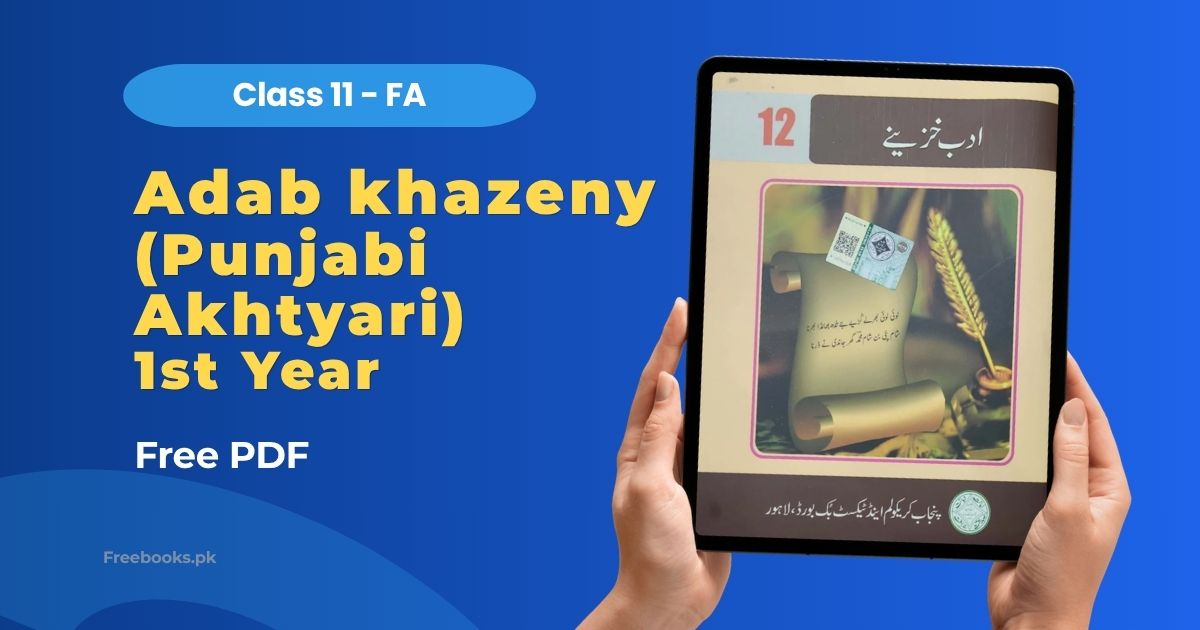
Punjabi Ikhtiari (Adab Khazeeny, Part 1) for 1st Year is the official Class 11 elective Punjabi textbook published by the Punjab Textbook Board (PTB), Lahore. It is written in Punjabi/Urdu script and follows the official Punjab Board syllabus.
For FA students, Punjabi Ikhtiari carries marks in the Intermediate Part 1 board exam. This book brings together prose and poetry from major Punjabi writers and poets, helping students revise the full syllabus and understand each piece before the final exam.
Note: This is Part 1 (Class 11) of the combined Adab Khazeeny series. For Part 2 (Class 12), see the Punjabi Ikhtiari Class 12 FA PDF page.
Book Overview
- Class: 11 (1st Year, Intermediate Part 1)
- Subject: Punjabi Ikhtiari (Adab Khazeeny, Part 1)
- Category: FA
- Board: Punjab Textbook Board (PTB, Lahore)
- Authors: Dr. Syed Akhtar Jaffery, Dr. Muhammad Aslam Rana (Late), Dr. Ismatullah Zahid
- Total Pieces: 12 prose + 24 poetry pieces, plus a glossary
- Medium: Punjabi / Urdu script
- Format: PDF
Chapter List
Prose Section (حصہ نثر)
1 – Meraj Sharif, by Moulvi Muhammad Saeed (معراج شریف)
A prose piece on the Holy Prophet’s (PBUH) journey of Meraj.
2 – Punjabi Zaban Di Kahani, by Muhammad Asif Khan (پنجابی زبان دی کہانی)
A prose piece on the history and story of the Punjabi language.
3 – Hazrat Baha-ud-Din Zakariya (R.A.) Multani, by Dr. Mehar Abdul Haq (حضرت بہاؤالدین زکریا رحمتہ اللہ علیہ ملتانی)
A prose piece on the life of the Sufi saint Baha-ud-Din Zakariya Multani.
4 – Pakistan Ban Gaya Ay, by Dr. Muhammad Baqar (پاکستان بن گیا اے)
A prose piece reflecting on the creation of Pakistan.
5 – Taahli Thalay, by Ishfaq Ahmed (ٹاہلی تھلے)
A prose piece by Ishfaq Ahmed.
6 – Shah Abdul Latif Bhattai (R.A.), by Bashir Hussain Nazim (شاہ عبداللطیف بھٹائی رحمتہ اللہ علیہ)
A prose piece on the life of the Sufi poet Shah Abdul Latif Bhattai.
7 – Khoparyaan te Aakhlay, by Mansha Yaad (کھوپڑیاں تے آکھلے)
A prose piece by Mansha Yaad.
8 – London De Tube Station, by Arshad Mir (لنڊن دے ٹیوب سٹیشن)
A travel-themed prose piece describing London’s tube stations.
9 – Rai Ahmed Khan Kharal Shaheed, by Prof. Muhammad Aslam (رائے احمد خاں کھرل شہید)
A prose piece on the life of freedom fighter Rai Ahmed Khan Kharal.
10 – Kapah Wich, by Abdul Majeed Salik (کپاہ وچ)
A prose piece by Abdul Majeed Salik.
11 – Lok Geet, by Dr. Syed Akhtar Jaffery (لوک گیت)
A prose piece introducing Punjabi folk songs.
12 – Un Duthay Rog, by Dr. Nasir Baloch (ان ڈٹھے روگ)
A prose piece by Dr. Nasir Baloch.
Poetry Section (حصہ نظم)
1 – Hamd, by Mian Muhammad Bakhsh (R.A.) (حمد)
A hamd (poem in praise of Allah).
2 – Naat, by Hafeez Taib (نعت)
A naat (poem in praise of the Holy Prophet PBUH).
3 – Shalok, by Hazrat Baba Fariduddin Masood Ganjshakar (R.A.) (شلوک)
Sufi verses attributed to Baba Farid.
4 – Kafiyan, by Shah Hussain (R.A.) (کافیاں)
Sufi kafis by Shah Hussain.
5 – Abyaat, by Sultan Bahu (R.A.) (ابیات)
Sufi verses (abyaat) by Sultan Bahu.
6 – Chaar Beetay Do Jharay, by Shah Murad (چار بیتے دو جھڑے)
A poem by Shah Murad.
7 – Abyaat-e-Harfi, by Ali Haider Multani (ابیات کی حرفی)
An alphabetical (harfi) verse form by Ali Haider Multani.
8 – Kafi, by Syed Bulleh Shah (R.A.) (کافی)
A Sufi kafi by Bulleh Shah.
9 – Minnat Wazari Kardon Bradaraan, by Syed Waris Shah (R.A.) (منت وزاری کردوں برادراں)
Verses by Waris Shah, renowned Punjabi poet.
10 – Dohray, by Hashim Shah (R.A.) (دوہڑے)
Punjabi dohray (couplets) by Hashim Shah.
11 – Kafi, by Khawaja Ghulam Farid (R.A.) (کافی)
A Sufi kafi by Khawaja Ghulam Farid.
12 – Hazrat Yousuf Apni Maan Di Qabr Tay, by Moulvi Ghulam Rasool Alampuri (R.A.) (حضرت یوسف اپنی ماں دی قبر تے)
A poem on the story of Prophet Yousuf visiting his mother’s grave.
13 – Kalam-e-Ishq Lahar, by Ustad Ishq Lahar (کلام عشق لہر)
Verses by the poet Ustad Ishq Lahar.
14 – Si Harfi Rabaiyat, by Ahmed Ali Sain (سی حرفی رباعیات)
An alphabetical (si-harfi) verse form by Ahmed Ali Sain.
15 – Ghazal, by Peer Fazl Gujrati (غزل)
A Punjabi ghazal.
16 – Ghazi te Shaheed, by Dr. Faqir Muhammad Faqir (غازی تے شہید)
A poem on the themes of the ghazi and the martyr.
17 – Apni Sohaan, by Hakeem Sher Muhammad Nasir (اپنی سوہاں)
A poem by Hakeem Sher Muhammad Nasir.
18 – Tofeeq Hussain, by Daim Iqbal Daim (توفیق حسین)
A poem by Daim Iqbal Daim.
19 – Odak Hondi Lo, by Sharif Kunjahi (اوڑک ہوندی لو)
A poem by Sharif Kunjahi.
20 – Ghazal, by Arif Abdul Mateen (غزل)
A Punjabi ghazal.
21 – Nawan Nawan Bor, by Ahmed Rahi (نواں نواں بور)
A poem by Ahmed Rahi.
22 – Bak Boota, by Baqi Siddiqui (بک بوٹا)
A poem by Baqi Siddiqui.
23 – Jhan Nazmaan, by Muneer Niazi (جھن نظماں)
A set of poems by Muneer Niazi.
24 – Jumma Bazaar, by Anwar Masood (جمعہ بازار)
A poem by Anwar Masood.
Farhang / Glossary (فرہنگ)
A glossary explaining difficult Punjabi words used across the prose and poetry sections.
Download Punjabi Ikhtiari Class 11 FA Book PDF (PTB)
Click the button below to download the complete Punjabi Ikhtiari (Adab Khazeeny, Part 1) Class 11 PDF for free. The file opens in a new tab and is ready to read or save on any device.
⬇ Download from PCTB (Official Copy)This file is hosted on the official Google Drive of the Punjab Curriculum & Textbook Board (PCTB). Freebooks.pk does not host this file.
Who Should Read This
FA students following the Punjab Textbook Board (PTB) syllabus in Class 11 / 1st Year who take Punjabi as an elective subject need this book. It also suits students preparing for the Intermediate Part 1 board exam who want to revise the full prose and poetry syllabus.
Applicable Boards
PTB (Punjab Textbook Board), Lahore, publishes this Punjabi Ikhtiari book mainly for Punjab Board FA students. Since the syllabus can vary by province, students from other boards should confirm their own curriculum before using this edition for exam preparation.
FAQs
Is this Punjabi Ikhtiari book for FA students?
Yes. This is Part 1 (Class 11 / 1st Year) of the official Punjabi Ikhtiari (Adab Khazeeny) book for FA students under the Punjab Textbook Board (PTB) syllabus.
Can other students use this book?
Yes, students from other boards studying a similar Punjabi elective syllabus can also use it, but they should confirm their own board’s curriculum first.
Is this the latest edition?
This PDF follows the official PTB Punjabi Ikhtiari Class 11 curriculum and content structure.
Does this book include both prose and poetry?
Yes, it includes 12 prose pieces and 24 poetry pieces, along with a glossary of difficult words.
Related Books
- Punjabi Ikhtiari 2nd Year FA Book
- Islamiat 1st Year FA Book
- English 1st Year FA Book
- English Grammar & Composition 1st Year FA Book
- Urdu 1st Year FA Book
- Akhlaqiat 1st Year FA Book
© Copyright Policy
Freebooks.pk is an educational resource for students in Pakistan. Textbooks and other books belong to their respective boards, authors and publishers, and all rights remain with them. If you are the copyright holder of any material on this page and want it changed or removed, please contact us or file a request under our DMCA policy. We review every request and remove reported content promptly.