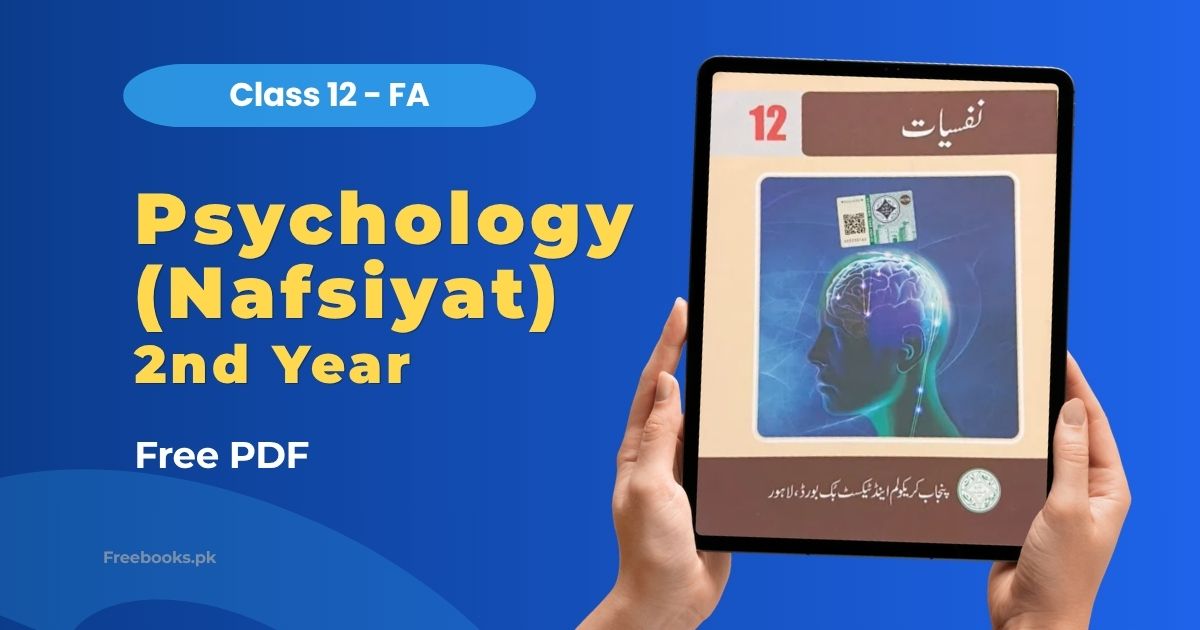
Psychology (Nafsiyat) for 2nd Year is the official Class 12 textbook of the Punjab Curriculum and Textbook Board, now part of PECTAA, for FA students. Written in Urdu medium, its four chapters cover human development, health and mental health, social psychology, and guidance and counseling.
This page is a chapter-by-chapter study guide in English. For each chapter you will find a summary, key points, a common mistake and two important questions with short answers. The Urdu chapter names are given so you can match them with your book.
For 1st Year, see the Psychology Class 11 book page.
Book Overview
- Class: 12 (2nd Year, Intermediate Part 2)
- Subject: Psychology (Nafsiyat)
- Category: FA
- Board: Punjab Board (PCTB, now PECTAA)
- Authors: Prof. Naqeeba-ud-Din Haider (Retired), Prof. Ismatullah Cheema, Prof. Tauqeer Tasleem Khan, Farida Sadiq
- Publisher: Shahzad Book Centre, Lahore
- Total Chapters: 4
- Exercises: Each chapter ends with a summary, objective and written questions, classroom activities and a reading list
- Medium: Urdu
Chapter List
Chapter 1: Developmental Psychology (نموئی نفسیات)
pp. 1–17 · Key topics: growth, development, maturation, stages of life, Piaget, Erikson, Kohlberg, senses of the newborn
The chapter studies the changes a person goes through from conception to death. It first separates three terms: growth, which is quantitative change in size; development, an orderly sequence of quantitative and qualitative change; and maturation, the unfolding of inherited abilities. Development is then studied in its cognitive, physical and social aspects, with human life divided into eight periods. Three major theories follow: Piaget on thinking, Erikson on psychosocial crises and Kohlberg on moral reasoning. The chapter ends with the senses of the newborn and verses and ahadith on human creation.
Key Points:
- Growth is quantitative; development is both quantitative and qualitative.
- Maturation can be phylogenetic, common to the species (such as crawling and walking), or ontogenetic, needing practice (such as swimming or cycling).
- The eight periods are prenatal, infancy, early childhood, late childhood, adolescence, early adulthood, late adulthood and old age.
- Piaget’s stages: sensori-motor (birth to 2), pre-operational (2 to 7), concrete operational (7 to 11), formal operational (from about 12).
- Conservation, the idea that quantity stays the same when shape changes, develops in the concrete operational stage.
- Erikson describes eight crises, from trust versus mistrust to ego integrity versus despair; identity versus role confusion belongs to adolescence.
- Kohlberg has three levels of moral reasoning with six stages.
Memory Tip: Tie each Erikson crisis to a life stage: a baby learns trust, a toddler autonomy, a teenager identity and an old person looks back with integrity or despair.
Common Mistake: Using growth and development as if they mean the same thing. Growth is only one part of development.
Important Questions:
- What is the difference between growth and maturation? Growth is an increase in size, height and weight. Maturation is the point at which inherited abilities become ready to perform a function, and it depends on the inner readiness of the body rather than on training alone.
- Compare the theories of Piaget and Erikson. Piaget explains how thinking develops through four stages from birth to about age 12. Erikson explains how personality develops through eight psychosocial crises across the whole life span.
Chapter 2: Psychology of Health (صحت کی نفسیات)
pp. 19–45 · Key topics: health, adjustment, views of mental health, normal and abnormal behaviour, stress, anxiety, eating disorders, exercise, schizophrenia
Starting from the WHO definition of health and the idea of adjustment, this long chapter explains why good health matters to a person and to society. It traces six historical views of mental health, then the views of Muslim thinkers, with Imam Ghazali and Maulana Ashraf Ali Thanvi discussed in detail. Four criteria separate normal from abnormal behaviour. The rest covers stress and its sources, anxiety disorders, eating disorders with advice on diet and exercise, schizoid personality disorder and schizophrenia with its types.
Key Points:
- WHO defines health as complete physical, mental and social well-being, not only the absence of disease.
- Six views of mental health: mythological, religious, medical, neural, social and psychological.
- Four criteria of abnormal behaviour: statistical, social, medical and psychological.
- On the Holmes and Rahe scale in the book, death of a spouse ranks highest (100), followed by divorce (73).
- Conflict has three types: approach-approach, approach-avoidance and avoidance-avoidance.
- Anxiety disorders covered include panic disorder, phobias, generalized anxiety and obsessive-compulsive disorder.
- Eating disorders covered are anorexia nervosa and bulimia nervosa, along with binge eating.
- Five types of schizophrenia are described: disorganized, catatonic, paranoid, undifferentiated and residual.
Common Mistake: Confusing schizophrenia with schizoid personality disorder. Schizoid personality is marked by social withdrawal and little emotion; schizophrenia involves severe disturbance such as hallucinations and delusions.
Important Questions:
- What does WHO mean by health? A state of complete physical, mental and social well-being, and not merely the absence of disease.
- What are the types of phobia given in the book? Specific phobia, a fear of particular things or situations; social phobia, a fear of being watched or judged by others; and agoraphobia, a fear of open or crowded places from which escape seems difficult.
Chapter 3: Social Psychology (سماجی نفسیات)
pp. 47–69 · Key topics: socialization, anti-social behaviour, prejudice, attitudes, attitude scales, public opinion, leadership
Social psychology studies how individuals and groups affect one another. After several definitions, the chapter explains socialization and the ten elements through which it happens, from the family to mass media. It then discusses anti-social behaviour, including smoking, drug addiction and violence, followed by prejudice and sexual harassment. Attitudes receive detailed treatment: how they form, how they change, and four scales for measuring them. The final parts cover public opinion, its formation, change, measurement and types, and a short section on leadership.
Key Points:
- The first books on social psychology came from William McDougall and E. A. Ross in 1908.
- The ten elements of socialization include family, peer group, relatives, educational, religious, political and legislative institutions, culture, mass media and leadership.
- Violence is divided into personal and instrumental.
- Prejudice has cognitive, emotional and behavioural levels.
- Attitude scales: Thurstone (11 points), Likert (5 points), Osgood (7 points between opposite adjectives) and Bogardus (social distance, 7 degrees).
- Kimball Young describes four stages in the formation of public opinion.
- Public opinion can be measured through voting, statistical methods, surveys, and rallies and processions.
Memory Tip: Remember scale sizes as T-11, L-5, O-7, B-7 for Thurstone, Likert, Osgood and Bogardus.
Common Mistake: Treating socialization as something that ends in childhood. The book says it continues from birth to death.
Important Questions:
- What is meant by socialization? The process through which a person learns the knowledge, values, language, skills and social norms of a society and adjusts to them. It continues throughout life.
- Name the scales used to measure attitudes. Thurstone’s scale, Likert’s scale, Osgood’s rating scale and Bogardus’s social distance scale.
Chapter 4: Guidance and Counseling (رہنمائی اور مشاورت)
pp. 70–93 · Key topics: guidance, counseling, principles, educational and vocational guidance, psychoanalysis, person-centred counseling, REBT
The chapter defines guidance as help that enables a person to make decisions and solve problems, and counseling as a closer process between counsellor and client. After comparing the two, it sets out six principles of guidance and shows why educational and vocational guidance are needed at secondary and higher secondary level. A section presents guidance in the light of the Quran and Sunnah. The last part explains three techniques of counseling: Freud’s classical psychoanalysis, Carl Rogers’s person-centred approach and Albert Ellis’s rational emotive behaviour therapy, along with its rational behaviour variant.
Key Points:
- Frank Parsons described guidance as vocational guidance.
- Principles include respect for every person, seeing each person as unique and whole, and the importance of past, present and future.
- Freud divides personality into id, ego and super ego; the id works on the pleasure principle and the ego on the reality principle.
- Psychoanalytic techniques are free association, dream analysis, transference, and analysis of resistance and interpretation.
- Dreams have manifest (visible) and latent (hidden) content.
- Carl Rogers stresses the client’s own growth and unconditional positive regard.
- Ellis’s ABC model: A is the activating event, B the belief system and C the emotional consequence.
Memory Tip: Match each therapist to one word: Freud with the past, Rogers with the client, Ellis with beliefs.
Common Mistake: Thinking that an event directly causes a feeling. In Ellis’s model the event leads to a feeling through the person’s belief about it.
Important Questions:
- Give two differences between guidance and counseling. Guidance mainly provides information, facts and principles, while counseling deals with feelings, needs and motivations. Guidance is more formal and informational; counseling is more private, personal and interpersonal.
- What is the role of the counsellor in person-centred counseling? The counsellor speaks little, avoids advice and does not decide for the client. The counsellor creates a warm, accepting atmosphere and reflects the client’s feelings so that the client can reach insight.
How to Study This Book
The book has only four chapters, but each one is long. Divide every chapter into its main headings and make a one-page sheet of definitions and names for each.
Chapters 1 and 4 are theory-heavy: for each theorist, learn the name, the main idea and the stages or techniques. Chapter 2 is best studied as a table with columns for disorder, main signs and treatment given in the book. Chapter 3 has many lists, such as the elements of socialization and factors in forming attitudes, so learn the headings first and then one line on each.
Each chapter ends with a short summary and exercises. Read the summary before the chapter to see its shape, and use the written questions to practise answers.
Keep in mind that the book describes disorders using DSM-IV, an older edition of the diagnostic manual. For your exam, follow the book. For anything about real health, a qualified doctor or psychologist is the right source: if you or someone you know is struggling, please talk to a trusted adult or a professional.
Who Should Read This
This guide is for FA students in Class 12 (2nd Year) following the Punjab Board syllabus who take Psychology. It suits students preparing for the Intermediate Part 2 exam who want a clear overview of each chapter before reading it in Urdu.
Applicable Boards
PCTB (now PECTAA), Lahore, publishes this Psychology book mainly for Punjab Board FA students. Since the syllabus can vary by province, students from other boards should confirm their own curriculum before using this edition for exam preparation.
Official Copy of Psychology Class 12
The button below opens the official PECTAA copy of this textbook.
→ Visit Official CopyThis file is hosted on the official Google Drive of PECTAA (formerly the Punjab Curriculum & Textbook Board, PCTB). Freebooks.pk does not host this file.
FAQs
How many chapters are in the Psychology Class 12 book?
Four: Developmental Psychology, Psychology of Health, Social Psychology, and Guidance and Counseling.
Is this Psychology book in Urdu?
Yes. The official Class 12 Psychology book is written in Urdu medium. This guide gives the chapter content in English and includes the Urdu chapter names.
Which theories of development does the book cover?
Piaget on cognitive development, Erikson on psychosocial development and Kohlberg on moral development.
Which counseling techniques are explained?
Classical psychoanalysis, person-centred counseling and rational emotive behaviour therapy.
What is the ABC model?
In Albert Ellis's model, A is the activating event, B is the belief system and C is the emotional consequence.
Related Books
- Psychology 1st Year FA Book
- Urdu 2nd Year FA Book
- Akhlaqiat 2nd Year FA Book
- Pak Studies 2nd Year FA Book
- Mutalla Pakistan 2nd Year FA Book
- Civics 2nd Year FA Book
Study Resources for Psychology 2nd Year
Free exam-preparation resources for Psychology 2nd Year from the Freebooks.pk Editorial Team — the latest paper pairing scheme. Study online or download.
© Copyright Policy
Freebooks.pk is an educational resource for students in Pakistan. Textbooks and other books belong to their respective boards, authors and publishers, and all rights remain with them. If you are the copyright holder of any material on this page and want it changed or removed, please contact us or file a request under our DMCA policy. We review every request and remove reported content promptly.