
Unit 11 compares shapes and moves them. Two figures are congruent when they have exactly the same shape and size, and similar when they have the same shape but possibly a different size. Simple conditions such as SSS, SAS, ASA and RHS tell us when two triangles are congruent.
The unit also covers geometric constructions with a ruler and compasses — triangles, quadrilaterals and the bisectors of lines and angles — and three transformations on the coordinate plane: translation, rotation and enlargement.
Learning Objectives
- Recognise congruent (≅) and similar (~) figures.
- Use the SSS, SAS, ASA and RHS conditions for congruent triangles.
- Use equal ratios of corresponding sides for similar figures.
- Construct triangles, quadrilaterals, perpendicular bisectors and angle bisectors.
- Translate and rotate shapes (90° and 180° about the origin) and find the centre of rotation.
- Enlarge shapes with a positive or negative scale factor and find the centre of enlargement.
Key Concepts
11.1 Congruent Figures
Congruent figures have the same shape and the same size; one fits exactly on the other. The symbol is ≅. Corresponding sides and corresponding angles are equal.
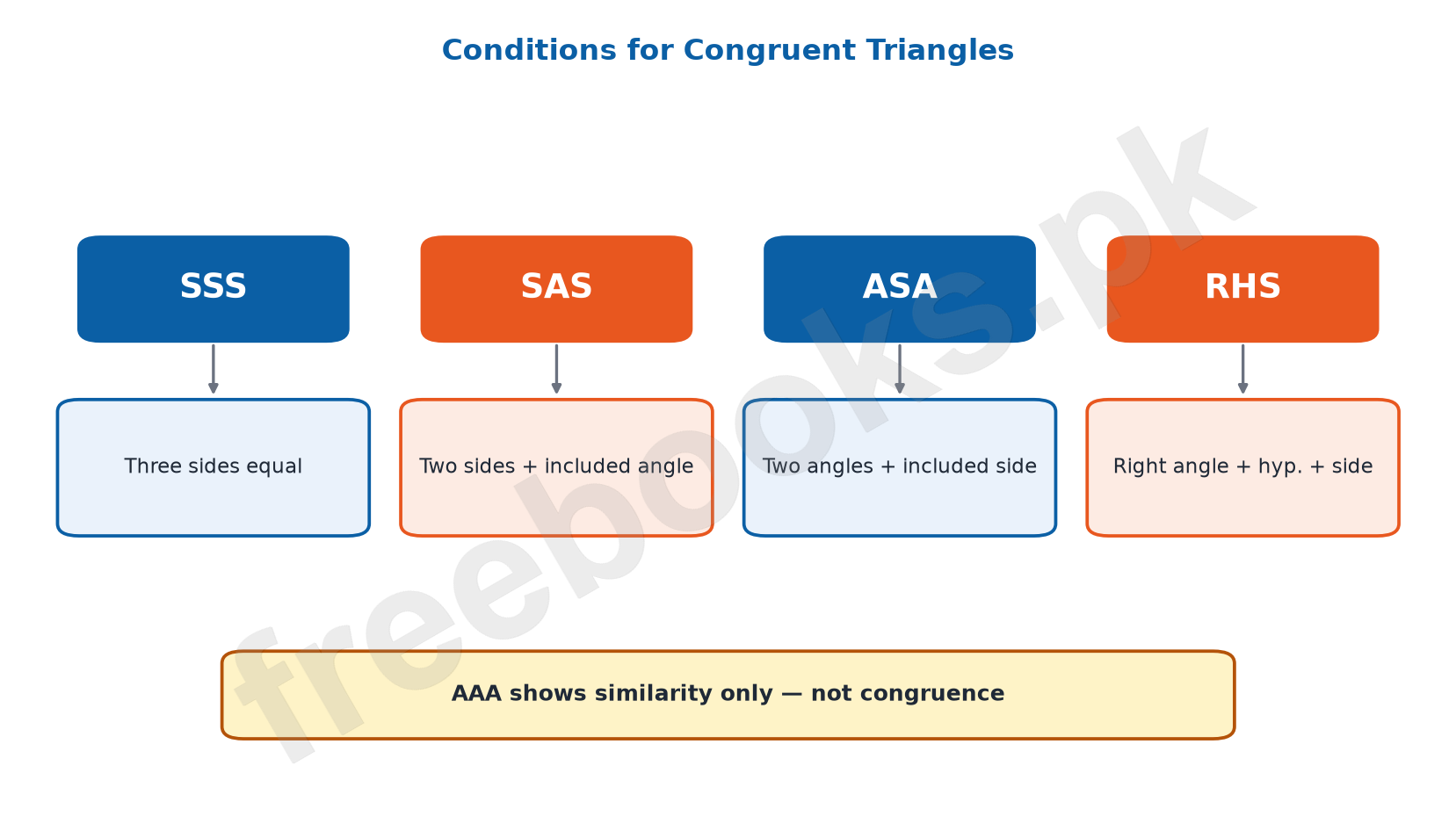
Two triangles are congruent if: SSS — all three sides are equal; SAS — two sides and the included angle are equal; ASA — two angles and the included side are equal; RHS — both are right-angled with equal hypotenuse and one other equal side.
Three equal angles (AAA) are not enough for congruence; they only show that the triangles are similar.
11.2 Similar Figures
Similar figures have the same shape but may differ in size. The symbol is ~. Corresponding angles are equal and corresponding sides are in the same ratio.
If △ABC ~ △PQR with AB = 4, PQ = 6, so the ratio is 2 : 3 and the scale factor is 1.5. If BC = 5, then QR = 7.5.
All congruent figures are similar (ratio 1 : 1), but similar figures are not always congruent.
11.3 Constructions
Triangle with three sides (SSS): draw one side as the base, draw arcs from its ends with radii equal to the other two sides, and join the base ends to the point where the arcs cross. This works only if any two sides together are longer than the third.
Perpendicular bisector of AB: with radius more than half of AB, draw arcs from A and B above and below the line; join the two crossing points. The line cuts AB at its midpoint at 90°.
Angle bisector: from the vertex draw an arc cutting both arms; from these two points draw equal arcs that cross; join the vertex to the crossing point. It divides the angle into two equal parts.
Quadrilaterals are constructed by splitting them into triangles, e.g., drawing a diagonal first and then constructing the two triangles on it.
11.4 Translation
A translation slides every point of a shape the same distance in the same direction. The image is congruent to the object and faces the same way.
A translation of a units right and b units up maps (x, y) to (x + a, y + b). For example, translating (2, 1) by 3 right and 4 down gives (5, −3).
11.5 Rotation
A rotation turns a shape about a fixed point (the centre of rotation) through an angle, clockwise or anticlockwise. The image is congruent to the object.
About the origin: 90° anticlockwise (x, y) → (−y, x); 90° clockwise (x, y) → (y, −x); 180° (x, y) → (−x, −y). So (3, 1) becomes (−1, 3), (1, −3) and (−3, −1).
To find the centre of rotation, join two pairs of corresponding points and draw the perpendicular bisector of each join; they meet at the centre.
11.6 Enlargement
An enlargement changes the size of a shape using a centre and a scale factor k. Each image point lies on the line from the centre through the object point, with image distance = k × object distance. About the origin, (x, y) → (kx, ky).
k > 1 makes the shape bigger; 0 < k < 1 makes it smaller; a negative k puts the image on the opposite side of the centre and turns it upside down. The image is similar to the object.
To find the centre of enlargement, draw lines through pairs of corresponding points; they meet at the centre.
Important Definitions
Congruent figures
Figures with the same shape and size (≅).
Similar figures
Figures with the same shape, equal angles and proportional sides (~).
Included angle
The angle between two given sides.
Scale factor
The ratio of a length in the image to the matching length in the object.
Perpendicular bisector
A line cutting a segment at its midpoint at right angles.
Angle bisector
A ray dividing an angle into two equal angles.
Transformation
A change in the position, orientation or size of a shape.
Translation
A slide of a shape without turning or resizing.
Rotation
A turn of a shape about a fixed centre through an angle.
Enlargement
A change in size about a centre by a scale factor.
Object and image
The shape before and after a transformation.
Key Facts at a Glance
| Rule | Result |
|---|---|
| Congruence conditions | SSS, SAS, ASA, RHS |
| AAA | Similar only, not congruent |
| Similar figures | Equal angles, sides in same ratio |
| Translation (a, b) | (x, y) → (x + a, y + b) |
| 90° anticlockwise | (x, y) → (−y, x) |
| 90° clockwise | (x, y) → (y, −x) |
| 180° rotation | (x, y) → (−x, −y) |
| Enlargement about O, k | (x, y) → (kx, ky) |
| k > 1 | Image larger |
| 0 < k < 1 | Image smaller |
| k < 0 | Image on opposite side, inverted |
| Translation / rotation image | Congruent to object |
Diagrams
Congruence conditions: Chart showing the SSS, SAS, ASA and RHS conditions for congruent triangles.
Rotation about the origin: A triangle rotated 90° anticlockwise and 180° about the origin on a grid.

Enlargement: A triangle enlarged by scale factor 2 and −1 about the origin.

Short Questions and Answers
What is the difference between congruent and similar figures?
Congruent: same shape and size; similar: same shape, size may differ.
Name the four conditions for congruent triangles.
SSS, SAS, ASA and RHS.
Why is AAA not a congruence condition?
Triangles with equal angles can have different sizes.
△ABC ~ △DEF, AB = 3, DE = 9, BC = 4. Find EF.
Ratio 1 : 3, so EF = 12.
Can a triangle have sides 3 cm, 4 cm and 8 cm?
No, because 3 + 4 < 8.
What does a perpendicular bisector do?
It cuts a segment into two equal parts at 90°.
Translate (−2, 5) by 4 right and 3 down.
(2, 2).
Rotate (4, 2) through 90° anticlockwise about O.
(−2, 4).
Rotate (4, 2) through 90° clockwise about O.
(2, −4).
Rotate (−3, 1) through 180° about O.
(3, −1).
Enlarge (2, −1) by scale factor 3 about O.
(6, −3).
Enlarge (4, 6) by scale factor ½ about O.
(2, 3).
Enlarge (1, 2) by scale factor −2 about O.
(−2, −4).
Is the image of a rotation congruent to the object?
Yes; only position and direction change.
How do you find a centre of enlargement?
Join corresponding points with lines; they meet at the centre.
Long Questions and Answers
Explain the conditions for congruent triangles.
SSS
If all three sides of one triangle equal the three sides of another, the triangles are congruent.
SAS
Two sides and the angle between them are equal in both triangles.
ASA
Two angles and the side between them are equal in both triangles.
RHS
Both triangles have a right angle, equal hypotenuses and one other pair of equal sides.
Explain similar figures with an example.
What makes figures similar?
Equal corresponding angles and corresponding sides in the same ratio.
How is scale factor found?
Divide a side of the image by the matching side of the object.
Two similar rectangles are 4 × 6 and 10 × x. Find x.
Scale factor 10/4 = 2.5, so x = 15.
How are congruence and similarity related?
Congruence is the special case of similarity with scale factor 1.
Describe how to construct a triangle and bisectors.
Construct △ABC with AB = 6 cm, BC = 5 cm, CA = 4 cm.
Draw AB = 6 cm; arc of 5 cm from B and 4 cm from A; join A and B to the crossing point C.
Bisect AB.
With equal radius more than 3 cm, draw arcs from A and B on both sides; join the crossing points.
Bisect angle A.
Arc from A cutting both arms; equal arcs from those two points; join A to their crossing point.
How do you check?
Measure: the two halves of AB and of angle A should be equal.
Explain translation and rotation.
Translation rule
Moving a right and b up maps (x, y) to (x + a, y + b).
Translate P(1, 1), Q(3, 1), R(1, 2) by 2 left and 3 up.
P′(−1, 4), Q′(1, 4), R′(−1, 5).
Rotate P, Q, R through 90° anticlockwise about O.
P′(−1, 1), Q′(−1, 3), R′(−2, 1).
Rotate P, Q, R through 180° about O.
P′(−1, −1), Q′(−3, −1), R′(−1, −2).
Explain enlargement with positive and negative scale factors.
What does an enlargement need?
A centre of enlargement and a scale factor.
Enlarge A(1, 1), B(2, 1), C(1, 3) by k = 2 about O.
A′(2, 2), B′(4, 2), C′(2, 6); sides are doubled.
Enlarge the same triangle by k = −1 about O.
A′(−1, −1), B′(−2, −1), C′(−1, −3); same size, opposite side, upside down.
Is the image congruent or similar?
Similar for any k; congruent only when k = 1 or −1.
How are centres of rotation and enlargement found?
Centre of rotation
Join two pairs of corresponding points and draw the perpendicular bisectors of these joins; they cross at the centre.
Centre of enlargement
Draw straight lines through each object point and its image; they all meet at the centre.
Find the scale factor after locating the centre.
Divide the distance from the centre to an image point by the distance to the matching object point.
When is the centre between object and image?
When the scale factor is negative.
Multiple Choice Questions (MCQs)
Symbol for congruent is: (A) ~ (B) ≅ (C) = (D) ≈
Correct answer: (B) ≅. ≅.
Symbol for similar is: (A) ~ (B) ≅ (C) ∥ (D) ⊥
Correct answer: (A) ~. ~.
Which is NOT a congruence condition? (A) SSS (B) SAS (C) AAA (D) RHS
Correct answer: (C) AAA. AAA gives similarity.
RHS applies to: (A) Any triangle (B) Right-angled triangles (C) Equilateral triangles (D) Quadrilaterals
Correct answer: (B) Right-angled triangles. Right angle needed.
Similar figures always have equal: (A) Sides (B) Areas (C) Angles (D) Perimeters
Correct answer: (C) Angles. Shape kept.
If the scale factor is 1, figures are: (A) Congruent (B) Not similar (C) Larger (D) Smaller
Correct answer: (A) Congruent. Same size.
A perpendicular bisector meets the segment at: (A) 45° (B) 60° (C) 90° (D) 180°
Correct answer: (C) 90°. Right angle.
(2, 3) translated 1 right, 2 up: (A) (3, 5) (B) (1, 1) (C) (4, 4) (D) (3, 1)
Correct answer: (A) (3, 5). Add.
(2, 3) rotated 180° about O: (A) (3, 2) (B) (−2, −3) (C) (−3, 2) (D) (2, −3)
Correct answer: (B) (−2, −3). Negate both.
(2, 3) rotated 90° anticlockwise about O: (A) (−3, 2) (B) (3, −2) (C) (−2, 3) (D) (3, 2)
Correct answer: (A) (−3, 2). (−y, x).
(2, 3) rotated 90° clockwise about O: (A) (−3, 2) (B) (3, −2) (C) (−2, −3) (D) (2, −3)
Correct answer: (B) (3, −2). (y, −x).
Enlargement by k = 3 about O maps (1, 2) to: (A) (3, 6) (B) (4, 5) (C) (1, 6) (D) (3, 2)
Correct answer: (A) (3, 6). Multiply.
A scale factor of ½ makes the image: (A) Larger (B) Smaller (C) Same size (D) Inverted
Correct answer: (B) Smaller. Half.
A negative scale factor places the image: (A) On the same side (B) On the opposite side of the centre (C) At the centre (D) Nowhere
Correct answer: (B) On the opposite side of the centre. Through the centre.
Translation changes a shape’s: (A) Size (B) Shape (C) Position only (D) Angles
Correct answer: (C) Position only. Slide.
Quick Revision Summary
- Congruent ≅: same shape and size; similar ~: same shape, proportional sides.
- Congruence tests: SSS, SAS, ASA, RHS (not AAA).
- Constructions: SSS triangle with arcs; perpendicular and angle bisectors.
- Translation (x + a, y + b).
- Rotation about O: 90° acw (−y, x); 90° cw (y, −x); 180° (−x, −y).
- Enlargement about O: (kx, ky); k < 0 → opposite side, inverted.
Exam Tips
- Write corresponding vertices in the same order: △ABC ≅ △PQR means A↔P, B↔Q, C↔R.
- Keep construction arcs visible; examiners look for them.
- Label image points with a dash: A → A′.
- Check rotations by turning the page with your hand.
- For enlargement, always measure distances from the centre, not from the shape.