Unit 9 is about straight lines and the equations that describe them. Every straight line (except a vertical one) can be written as y = mx + c, where m is the gradient (slope) and c is the y-intercept. Plotting such lines and finding where two of them meet leads to solving simultaneous linear equations.
These notes cover gradient, horizontal and vertical lines, the slope-intercept form and graphing, ordered pairs, changing the subject of a formula, constructing and solving simultaneous equations by substitution, elimination and graphs, word problems, and solving simple linear inequalities.
Learning Objectives
- Find and interpret the gradient and y-intercept of a straight line.
- Recognise horizontal (y = c) and vertical (x = a) lines.
- Plot graphs of y = mx and y = mx + c using a table of values.
- Change the subject of a formula and substitute values.
- Construct and solve simultaneous linear equations by substitution, elimination and graphs.
- Solve simple linear inequalities and show them on a number line.
Key Concepts
9.1 Gradient and Slope-Intercept Form
The gradient (slope) m of a line through (x₁, y₁) and (x₂, y₂) is m = (y₂ − y₁)/(x₂ − x₁) — the rise divided by the run. For (1, 2) and (3, 8), m = 6/2 = 3.
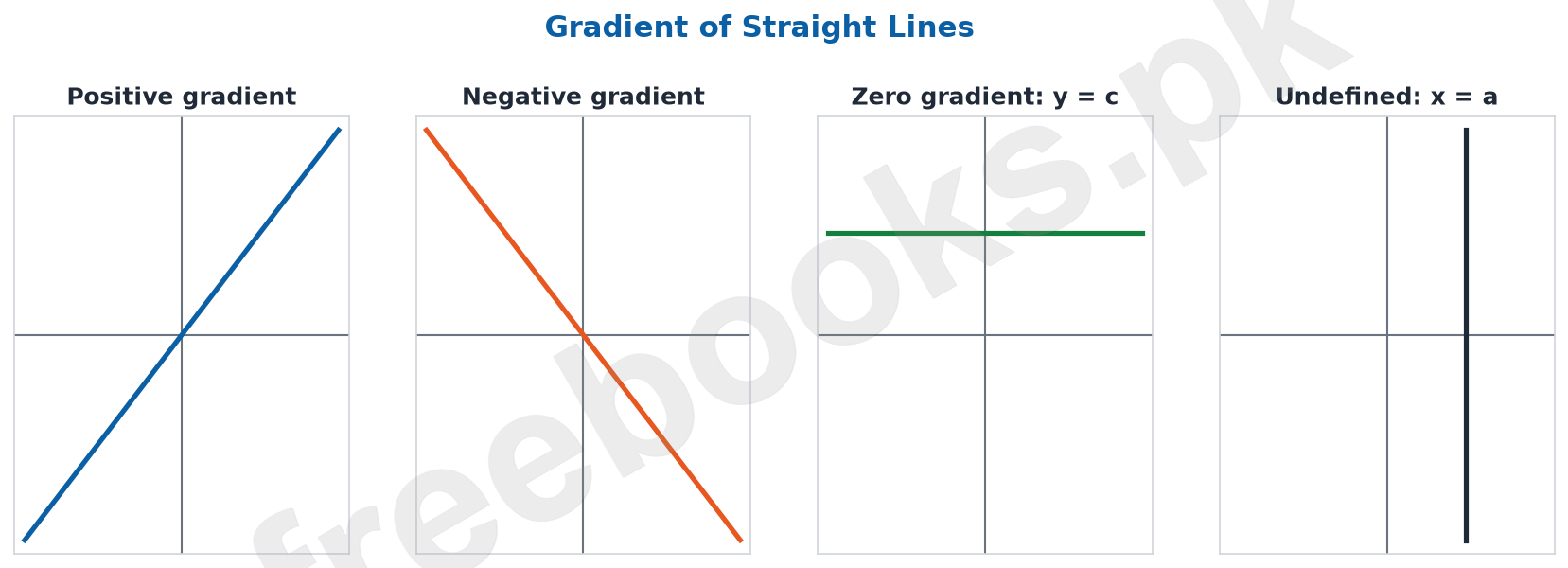
A positive gradient rises to the right, a negative gradient falls, a horizontal line (y = c) has gradient 0, and a vertical line (x = a) has an undefined gradient.
Slope-intercept form: y = mx + c, where c is the y-intercept (the point (0, c) where the line cuts the y-axis). y = 2x + 1 has gradient 2 and y-intercept 1. y = mx passes through the origin.
9.2 Ordered Pairs and Graphs
An ordered pair (x, y) gives the position of a point; order matters, so (2, 3) ≠ (3, 2).
To draw y = mx + c, choose some x-values, find y from the equation, plot the ordered pairs and join them with a straight line. Likewise, given y, solve the equation to find x.
9.3 Changing the Subject of a Formula
The subject is the variable on its own on one side. To change it, use inverse operations on both sides.
Examples: from v = u + at, t = (v − u)/a; from P = 2(l + w), w = P/2 − l; from A = πr², r = √(A/π). Then substitute known values to find the unknown.
9.4 Simultaneous Linear Equations
Two equations in the same two variables that are true at the same time form a pair of simultaneous equations. Their solution is the ordered pair that satisfies both.
Substitution: from x − y = 4 write x = y + 4 and substitute in x + y = 10 to get 2y + 4 = 10, so y = 3 and x = 7.
Elimination: add or subtract the equations to remove one variable. From 3x + 2y = 16 and x + 2y = 8, subtracting gives 2x = 8, so x = 4 and y = 2.
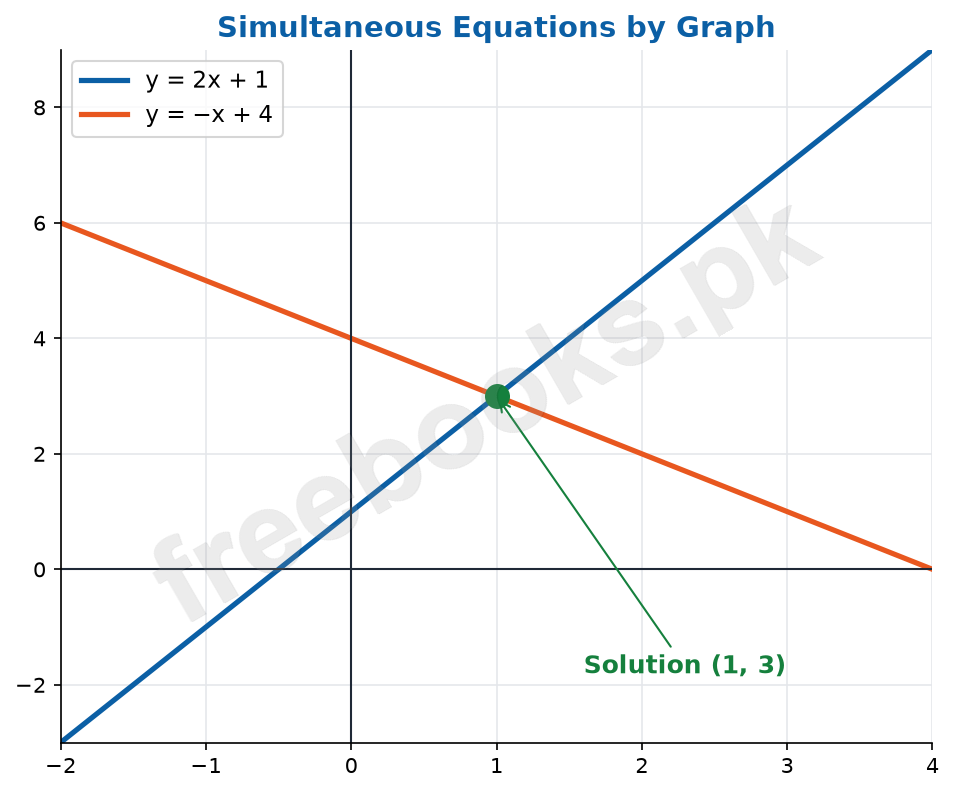
Graphical method: draw both lines; the point where they cross is the solution. y = 2x + 1 and y = −x + 4 meet at (1, 3).
9.5 Real-Life Problems
Choose letters for the unknowns, write two equations from the information and solve. Example: 3 pens and 2 books cost Rs. 340, and 1 pen and 2 books cost Rs. 260. Subtracting gives 2 pens = Rs. 80, so a pen costs Rs. 40 and a book Rs. 110.
9.6 Linear Inequalities
An inequality uses <, >, ≤ or ≥. It is solved like an equation, except that multiplying or dividing both sides by a negative number reverses the sign.
Examples: 2x + 3 < 11 gives x < 4; −3x ≥ 12 gives x ≤ −4; 5 − x > 2 gives x < 3.
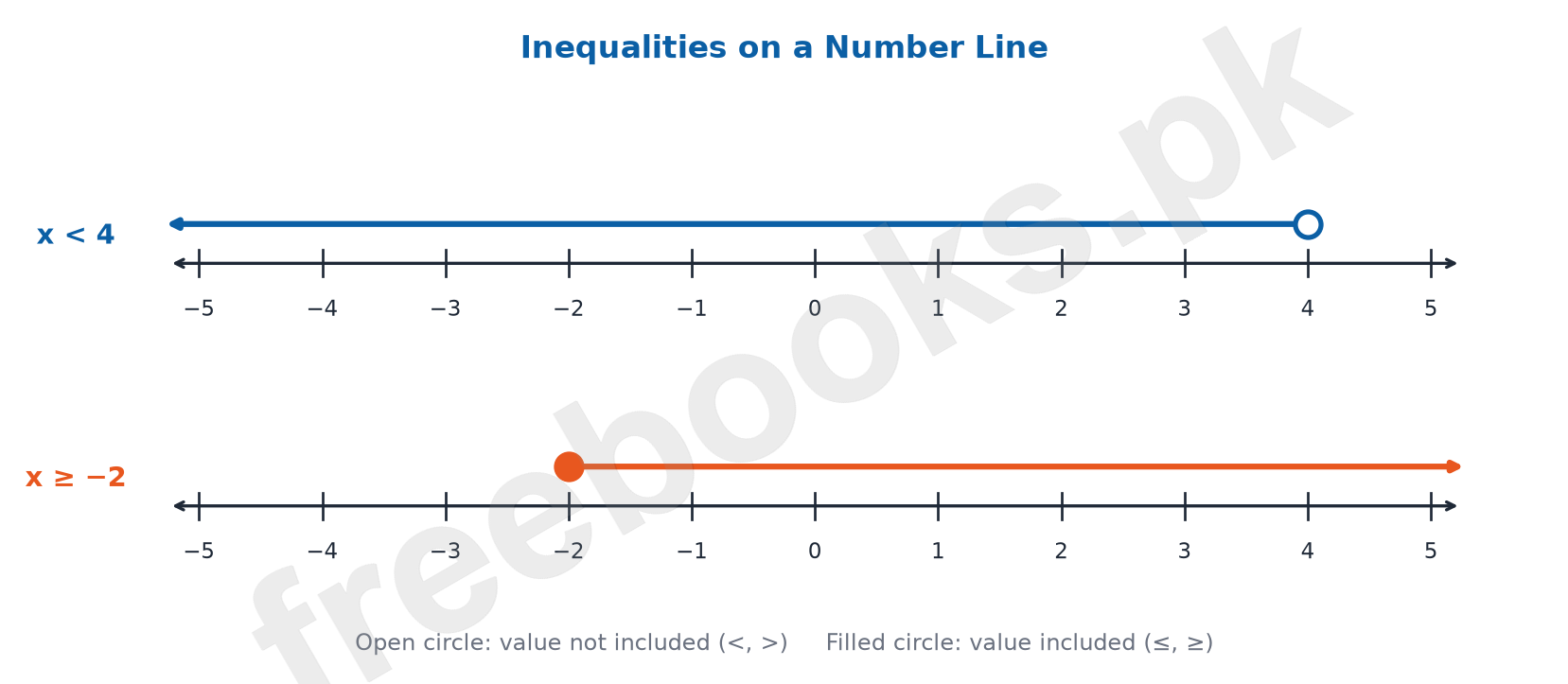
On a number line, an open circle shows that the end value is not included (<, >) and a filled circle shows that it is included (≤, ≥).
Important Definitions
Gradient (slope)
The steepness of a line: change in y ÷ change in x.
y-intercept
The point where a line crosses the y-axis, (0, c).
Slope-intercept form
The equation y = mx + c of a straight line.
Ordered pair
A pair (x, y) giving a point’s position, where order matters.
Subject of a formula
The variable expressed in terms of the others.
Simultaneous equations
Two equations whose common solution is required.
Substitution method
Solving by replacing one variable with an expression from the other equation.
Elimination method
Solving by adding or subtracting equations to remove a variable.
Linear inequality
A statement like 2x + 1 < 7 using <, >, ≤ or ≥.
Key Facts at a Glance
| Item | Rule / example |
|---|---|
| Gradient | m = (y₂ − y₁)/(x₂ − x₁) |
| Slope-intercept form | y = mx + c |
| Horizontal line | y = c, gradient 0 |
| Vertical line | x = a, gradient undefined |
| y = 2x + 1 | m = 2, c = 1 |
| v = u + at | t = (v − u)/a |
| x + y = 10, x − y = 4 | x = 7, y = 3 |
| 3x + 2y = 16, x + 2y = 8 | x = 4, y = 2 |
| y = 2x + 1 and y = −x + 4 | Meet at (1, 3) |
| 2x + 3 < 11 | x < 4 |
| −3x ≥ 12 | x ≤ −4 |
| Open / filled circle | Not included / included |
Diagrams
Solving simultaneous equations by graph: The lines y = 2x + 1 and y = −x + 4 crossing at the solution (1, 3).
Gradient of lines: Lines with positive, negative, zero and undefined gradients.
Inequalities on a number line: Number lines showing x < 4 and x ≥ −2 with open and filled circles.
Short Questions and Answers
Find the gradient of the line through (2, 1) and (6, 9).
(9 − 1)/(6 − 2) = 2.
Write the gradient and y-intercept of y = −3x + 5.
m = −3, c = 5.
What is the gradient of y = 7?
0, because it is a horizontal line.
Write the equation of the vertical line through (4, −1).
x = 4.
Find y when x = 3 in y = 4x − 2.
y = 10.
Find x when y = 11 in y = 2x + 5.
2x = 6, x = 3.
Make r the subject of C = 2πr.
r = C/(2π).
Make b the subject of A = ½bh.
b = 2A/h.
Solve x + y = 12 and x − y = 2.
x = 7, y = 5.
Solve 2x + y = 9 and x − y = 3.
Adding: 3x = 12, x = 4; y = 1.
What does the intersection of two lines represent?
The solution of the pair of simultaneous equations.
The sum of two numbers is 50 and their difference is 12. Find them.
31 and 19.
Solve 4x − 5 ≥ 7.
x ≥ 3.
Solve −2x < 8.
x > −4 (sign reverses).
How is x ≤ 1 shown on a number line?
A filled circle at 1 with an arrow to the left.
Long Questions and Answers
Explain gradient and the slope-intercept form of a line.
What is gradient?
The steepness of a line, found as rise ÷ run = (y₂ − y₁)/(x₂ − x₁).
What do the signs of gradient mean?
Positive rises to the right, negative falls, zero is horizontal and undefined is vertical.
What is y = mx + c?
The slope-intercept form, where m is the gradient and c is the y-intercept.
A line has gradient 3 and passes through (0, −2). Write its equation.
y = 3x − 2.
Draw the graph of y = 2x − 1.
Make a table of values.
x = −1, 0, 1, 2 give y = −3, −1, 1, 3.
Plot the points.
(−1, −3), (0, −1), (1, 1), (2, 3).
Join the points.
They lie on one straight line, which is extended in both directions.
Read the gradient and intercept.
The line rises 2 for every 1 across (m = 2) and cuts the y-axis at −1.
Solve simultaneous equations by substitution and elimination.
Solve 2x + 3y = 12 and x − y = 1 by substitution.
x = 1 + y; 2 + 2y + 3y = 12 → y = 2, x = 3.
Solve 5x + 2y = 19 and 3x − 2y = 5 by elimination.
Adding: 8x = 24 → x = 3; then 2y = 4 → y = 2.
How do you check the answer?
Substitute into both original equations; both must be true.
When is elimination easier?
When one variable has equal or opposite coefficients in both equations.
Solve simultaneous equations graphically.
Draw y = x + 2.
Points (0, 2), (1, 3), (2, 4).
Draw y = −2x + 5.
Points (0, 5), (1, 3), (2, 1).
Find the intersection.
The lines meet at (1, 3).
State the solution.
x = 1, y = 3.
Solve real-life problems using simultaneous equations.
A father is three times as old as his son; together they are 48. Find their ages.
f = 3s and f + s = 48 → 4s = 48, s = 12, f = 36.
2 kg apples and 3 kg bananas cost Rs. 1,100; 1 kg apples and 1 kg bananas cost Rs. 450. Find each price.
From the second, a = 450 − b; 900 − 2b + 3b = 1100 → b = Rs. 200 per kg, a = Rs. 250 per kg.
A rectangle’s perimeter is 34 cm and its length is 5 cm more than its width. Find its sides.
2(l + w) = 34, l = w + 5 → w = 6 cm, l = 11 cm.
A purse has Rs. 10 and Rs. 20 notes: 25 notes worth Rs. 350. How many of each?
x + y = 25, 10x + 20y = 350 → y = 10, x = 15.
Explain how to solve linear inequalities.
How is an inequality solved?
Like an equation, using the same operation on both sides.
What is the special rule?
Multiplying or dividing by a negative number reverses the inequality sign.
Solve 3x − 4 > 8 and 7 − 2x ≤ 1.
x > 4; −2x ≤ −6 → x ≥ 3.
How are solutions shown on a number line?
Open circle for < or >, filled circle for ≤ or ≥, with an arrow in the direction of the solutions.
Multiple Choice Questions (MCQs)
The gradient of y = 4x − 3 is: (A) −3 (B) 4 (C) 3 (D) −4
Correct answer: (B) 4. m = 4.
The y-intercept of y = 4x − 3 is: (A) 4 (B) 3 (C) −3 (D) 0
Correct answer: (C) −3. c = −3.
A horizontal line has gradient: (A) 1 (B) 0 (C) Undefined (D) −1
Correct answer: (B) 0. No rise.
x = 5 is a: (A) Horizontal line (B) Vertical line (C) Line through origin (D) Curve
Correct answer: (B) Vertical line. Vertical.
The line y = mx passes through: (A) (0, 1) (B) (1, 0) (C) (0, 0) (D) (m, 0)
Correct answer: (C) (0, 0). c = 0.
Gradient through (0, 0) and (2, 6) is: (A) 2 (B) 3 (C) 6 (D) 1/3
Correct answer: (B) 3. 6/2.
If y = 3x + 1 and x = 2, then y = (A) 5 (B) 6 (C) 7 (D) 8
Correct answer: (C) 7. 6 + 1.
Making h the subject of V = lbh gives: (A) h = V − lb (B) h = V/(lb) (C) h = lbV (D) h = lb/V
Correct answer: (B) h = V/(lb). Divide by lb.
Solution of x + y = 6, x − y = 2 is: (A) (4, 2) (B) (2, 4) (C) (3, 3) (D) (5, 1)
Correct answer: (A) (4, 2). x = 4, y = 2.
The graphical solution is the: (A) y-intercept (B) Intersection point (C) Gradient (D) Origin
Correct answer: (B) Intersection point. Common point.
Solving 2x + 1 = 7 gives x = (A) 2 (B) 3 (C) 4 (D) 6
Correct answer: (B) 3. 2x = 6.
2x < 10 gives: (A) x < 5 (B) x > 5 (C) x < 20 (D) x ≤ 5
Correct answer: (A) x < 5. Divide by 2.
−x > 3 gives: (A) x > 3 (B) x < −3 (C) x > −3 (D) x < 3
Correct answer: (B) x < −3. Sign reverses.
A filled circle on a number line means: (A) Not included (B) Included (C) Infinity (D) Zero
Correct answer: (B) Included. ≤ or ≥.
(3, 5) and (5, 3) are: (A) Equal (B) Different points (C) Both on y-axis (D) Both on x-axis
Correct answer: (B) Different points. Order matters.
Quick Revision Summary
- m = (y₂ − y₁)/(x₂ − x₁); y = mx + c (m gradient, c y-intercept).
- y = c horizontal (m = 0); x = a vertical (m undefined); y = mx through origin.
- Plot lines from a table of values; ordered pairs (x, y).
- Change subject with inverse operations; then substitute.
- Simultaneous equations: substitution, elimination, graph (intersection point).
- Inequalities: like equations, but × or ÷ by a negative reverses the sign.
Exam Tips
- Label equations (1) and (2) and show which operation you apply.
- Always check simultaneous solutions in both equations.
- Use at least three points when drawing a straight-line graph.
- Underline the sign flip when dividing an inequality by a negative.
- In word problems, state what each letter stands for.