Unit 7 opens the Algebra domain with number sequences and patterns. A sequence is a list of numbers that follows a rule, such as 3, 7, 11, 15, …. Spotting the rule lets us continue the list, find any term directly, and model real situations such as savings plans, seating rows and growth.
These notes cover number sequences, arithmetic sequences (constant difference), the term-to-term and position-to-term rules, the general (nth) term formula, geometric sequences (constant ratio) and real-life problems involving patterns.
Learning Objectives
- Recognise a number sequence and describe its rule.
- Distinguish arithmetic and geometric sequences.
- Use the term-to-term rule to continue a sequence.
- Use the position-to-term rule and the nth-term formula.
- Find terms of a geometric sequence using aₙ = a·rⁿ⁻¹.
- Solve real-life problems involving sequences and patterns.
Key Concepts
7.1 Number Sequences
A sequence is an ordered list of numbers called terms, written a₁, a₂, a₃, …. Each term has a position (1st, 2nd, 3rd, …).
Sequences can come from number patterns (2, 4, 6, 8, …), square numbers (1, 4, 9, 16, …) or shape patterns (matchstick or dot figures that grow by a fixed amount).
7.2 Arithmetic Sequences
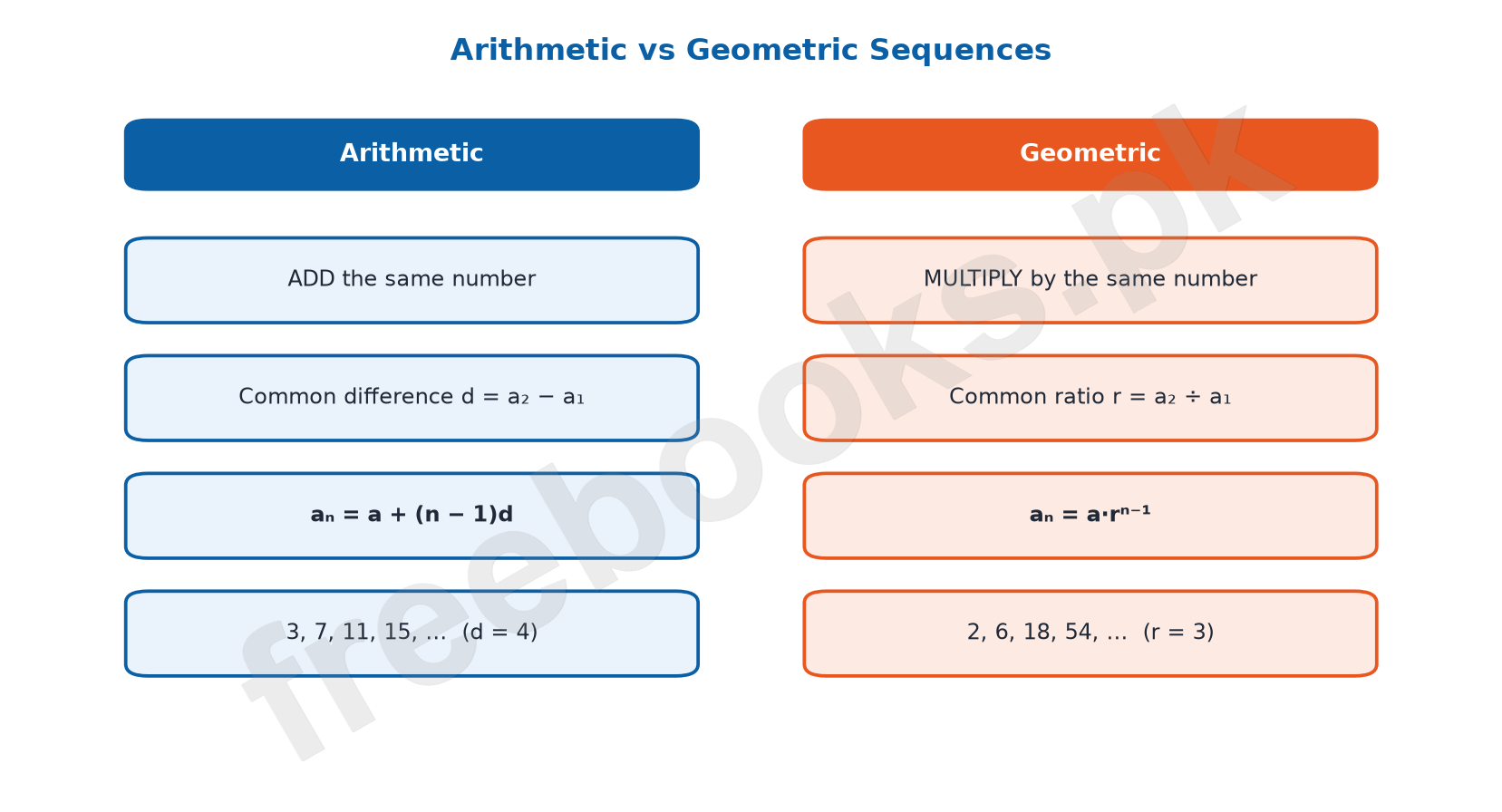
In an arithmetic sequence the difference between consecutive terms is constant. This common difference is d = a₂ − a₁. Example: 3, 7, 11, 15, … has d = 4; 20, 17, 14, … has d = −3.
Term-to-term rule: tells how to get the next term from the previous one, e.g., ‘start at 3 and add 4’.
Position-to-term rule: tells how to get a term directly from its position n. For 3, 7, 11, …, the nth term is aₙ = a + (n − 1)d = 3 + (n − 1)4 = 4n − 1. So the 10th term is 4 × 10 − 1 = 39.
Going backwards: if the nth term is 5n − 2, the sequence is 3, 8, 13, 18, … (put n = 1, 2, 3, …).
7.3 Geometric Sequences
In a geometric sequence each term is found by multiplying the previous term by a constant called the common ratio, r = a₂ ÷ a₁. Example: 2, 6, 18, 54, … has r = 3; 80, 40, 20, … has r = 1/2.
The nth term is aₙ = a·rⁿ⁻¹. For 2, 6, 18, …, a₆ = 2 × 3⁵ = 486.
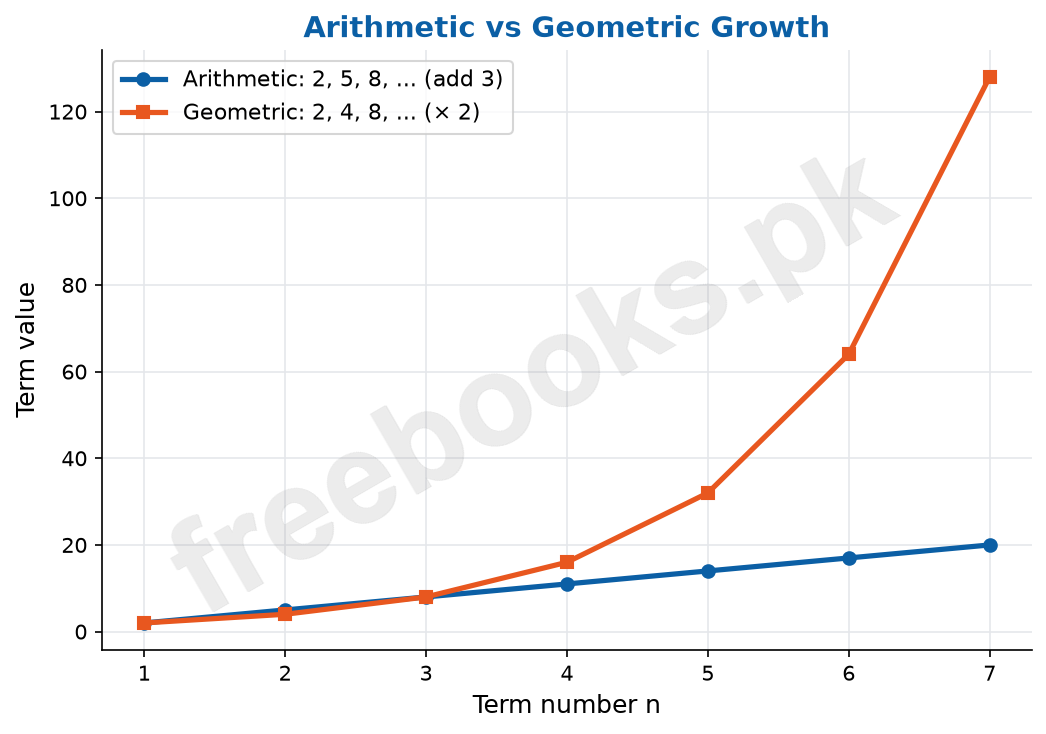
Arithmetic sequences grow by adding the same amount; geometric sequences grow by multiplying by the same amount, so they change much faster.
7.4 Real-Life Patterns
Seating: a hall has 20 seats in the first row and 2 more in each row. Row n has 20 + (n − 1)2 seats, so row 15 has 48 seats.
Savings: saving Rs. 500 in the first month and Rs. 100 more each month gives Rs. 1,600 in the 12th month.
Growth: bacteria that double every hour from 100 become 100 × 2⁵ = 3,200 after 5 hours — a geometric pattern.
Important Definitions
Sequence
An ordered list of numbers that follows a rule.
Term
Each number in a sequence.
Arithmetic sequence
A sequence with a constant difference between consecutive terms.
Common difference (d)
The fixed amount added to get each next term: d = a₂ − a₁.
Geometric sequence
A sequence in which each term is multiplied by a constant to get the next.
Common ratio (r)
The fixed multiplier in a geometric sequence: r = a₂ ÷ a₁.
Term-to-term rule
A rule that gives the next term from the previous term.
Position-to-term rule
A rule that gives a term directly from its position n.
General term (nth term)
A formula for any term, e.g., aₙ = a + (n − 1)d.
Key Facts at a Glance
| Item | Formula / example |
|---|---|
| Common difference | d = a₂ − a₁ |
| nth term (arithmetic) | aₙ = a + (n − 1)d |
| Common ratio | r = a₂ ÷ a₁ |
| nth term (geometric) | aₙ = a·rⁿ⁻¹ |
| 3, 7, 11, … | aₙ = 4n − 1; a₁₀ = 39 |
| 5n − 2 | 3, 8, 13, 18, … |
| 2, 6, 18, … | r = 3; a₆ = 486 |
| 80, 40, 20, … | r = 1/2 |
| Square numbers | 1, 4, 9, 16, 25, … |
| Odd numbers | aₙ = 2n − 1 |
| Even numbers | aₙ = 2n |
| Doubling from 100 (5 steps) | 3,200 |
Diagrams
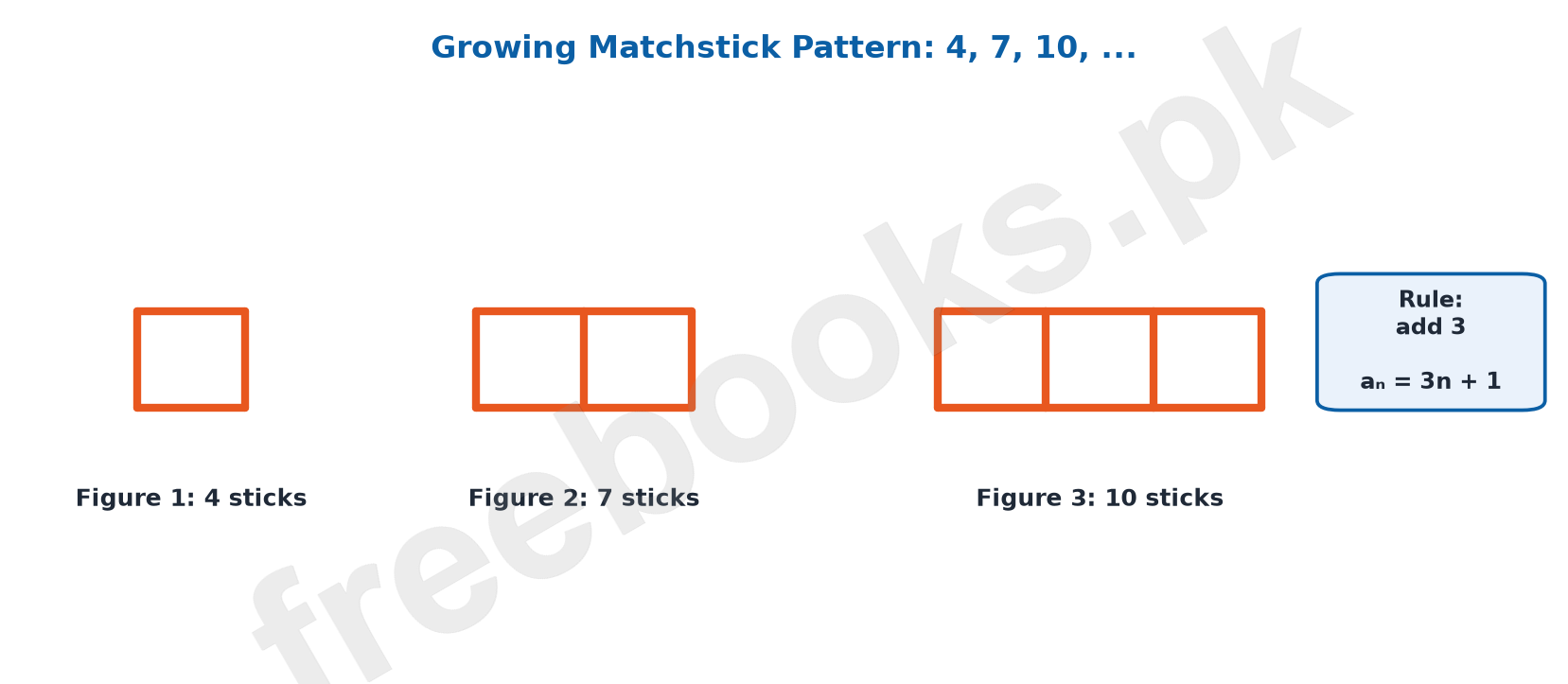
Growing matchstick pattern: A pattern of squares made of matchsticks that grows by 3 sticks each time (4, 7, 10, …).
Arithmetic vs geometric sequences: A comparison chart of arithmetic and geometric sequences with rules and examples.
Growth of sequences: A graph comparing the arithmetic sequence 2, 5, 8, … with the geometric sequence 2, 4, 8, ….
Short Questions and Answers
What is a sequence?
An ordered list of numbers that follows a rule.
Find the next two terms: 5, 11, 17, 23, …
29, 35 (add 6).
Is 2, 5, 9, 14, … arithmetic?
No; the differences 3, 4, 5 are not constant.
Find d for 40, 33, 26, …
d = 33 − 40 = −7.
Write the term-to-term rule for 1, 4, 7, 10, …
Start at 1 and add 3.
Find the nth term of 6, 10, 14, 18, …
aₙ = 6 + (n − 1)4 = 4n + 2.
Find the 20th term of 2, 9, 16, …
2 + 19 × 7 = 135.
Write the first four terms of aₙ = 3n + 5.
8, 11, 14, 17.
Which term of 4, 9, 14, … is 99?
4 + (n − 1)5 = 99, so n = 20.
Find r for 3, 12, 48, …
r = 12 ÷ 3 = 4.
Find the 5th term of 5, 10, 20, …
5 × 2⁴ = 80.
Find the next term of 243, 81, 27, …
9 (multiply by 1/3).
Distinguish arithmetic and geometric sequences.
Arithmetic adds a constant difference; geometric multiplies by a constant ratio.
A pattern uses 6, 11, 16, … tiles. How many in the 8th figure?
6 + 7 × 5 = 41 tiles.
A ball rises 64 cm then half as high each bounce. Height on the 4th bounce?
64, 32, 16, 8 → 8 cm.
Long Questions and Answers
Explain arithmetic sequences with the term-to-term and position-to-term rules.
What is an arithmetic sequence?
A sequence in which the same number (common difference d) is added each time, e.g., 7, 12, 17, 22, … with d = 5.
What is the term-to-term rule?
It gives the next term from the previous one: ‘start at 7 and add 5’.
What is the position-to-term rule?
It gives any term from its position: aₙ = 7 + (n − 1)5 = 5n + 2.
Use it to find the 30th term.
5 × 30 + 2 = 152.
Derive and use the general term of an arithmetic sequence.
How do the terms build up?
a₁ = a, a₂ = a + d, a₃ = a + 2d, a₄ = a + 3d; the number of d’s is one less than the position.
What is the general term?
aₙ = a + (n − 1)d.
Find the 15th term of 11, 8, 5, …
a = 11, d = −3: 11 + 14(−3) = −31.
Which term of 3, 10, 17, … is 199?
3 + (n − 1)7 = 199, so n − 1 = 28 and n = 29.
Explain geometric sequences with examples.
What is a geometric sequence?
A sequence where each term is the previous term multiplied by a constant ratio r.
How is r found?
Divide any term by the term before it: for 4, 12, 36, …, r = 3.
What is the nth term?
aₙ = a·rⁿ⁻¹.
Find the 6th term of 4, 12, 36, …
4 × 3⁵ = 972.
Solve real-life problems involving sequences.
A stadium has 30 seats in the first row and 4 more in each next row. How many seats in row 12?
30 + 11 × 4 = 74.
Ali saves Rs. 200 in week 1, increasing by Rs. 50 each week. Savings in week 10?
200 + 9 × 50 = Rs. 650.
A culture of 50 bacteria triples every hour. How many after 4 hours?
50 × 3⁴ = 4,050.
A taxi charges Rs. 150 for the first km and Rs. 40 for each extra km. Fare for 12 km?
150 + 11 × 40 = Rs. 590.
Explain shape patterns and how to find their rule.
What is a shape pattern?
A series of figures, such as squares of matchsticks, that grows in a regular way.
How is the rule found?
Count the objects in each figure, list the numbers and find the difference or ratio.
Squares in a row need 4, 7, 10, … matchsticks. Find the nth term.
d = 3, so aₙ = 4 + (n − 1)3 = 3n + 1.
How many matchsticks for 25 squares?
3 × 25 + 1 = 76.
Multiple Choice Questions (MCQs)
The common difference of 9, 13, 17, … is: (A) 3 (B) 4 (C) 9 (D) 13
Correct answer: (B) 4. 13 − 9.
The next term of 2, 6, 18, 54, … is: (A) 72 (B) 108 (C) 162 (D) 216
Correct answer: (C) 162. × 3.
The nth term of an arithmetic sequence is: (A) a + nd (B) a + (n − 1)d (C) a·rⁿ (D) a·rⁿ⁻¹
Correct answer: (B) a + (n − 1)d. Standard formula.
The nth term of a geometric sequence is: (A) a + (n − 1)d (B) a·rⁿ⁻¹ (C) a·nʳ (D) n·r
Correct answer: (B) a·rⁿ⁻¹. Standard formula.
Which sequence is arithmetic? (A) 1, 2, 4, 8 (B) 1, 4, 9, 16 (C) 5, 8, 11, 14 (D) 2, 6, 18, 54
Correct answer: (C) 5, 8, 11, 14. d = 3.
Which sequence is geometric? (A) 3, 6, 9, 12 (B) 3, 6, 12, 24 (C) 1, 3, 6, 10 (D) 2, 4, 7, 11
Correct answer: (B) 3, 6, 12, 24. r = 2.
The 10th term of 1, 4, 7, … is: (A) 25 (B) 28 (C) 31 (D) 30
Correct answer: (B) 28. 1 + 9 × 3.
If aₙ = 2n + 3, the 5th term is: (A) 10 (B) 13 (C) 15 (D) 8
Correct answer: (B) 13. 2 × 5 + 3.
r for 100, 50, 25, … is: (A) 2 (B) −50 (C) 1/2 (D) 25
Correct answer: (C) 1/2. 50 ÷ 100.
The term-to-term rule of 10, 7, 4, … is: (A) Add 3 (B) Subtract 3 (C) Multiply by 3 (D) Divide by 3
Correct answer: (B) Subtract 3. Subtract 3.
The nth term of the odd numbers is: (A) 2n (B) 2n − 1 (C) n + 1 (D) n²
Correct answer: (B) 2n − 1. 1, 3, 5, …
1, 4, 9, 16, … are: (A) Even numbers (B) Square numbers (C) Cube numbers (D) Prime numbers
Correct answer: (B) Square numbers. n².
4th term of 3, 6, 12, … is: (A) 18 (B) 24 (C) 36 (D) 48
Correct answer: (B) 24. 3 × 2³.
If d is negative, an arithmetic sequence is: (A) Increasing (B) Decreasing (C) Constant (D) Geometric
Correct answer: (B) Decreasing. Terms fall.
Doubling from 5 for 3 steps gives: (A) 15 (B) 30 (C) 40 (D) 20
Correct answer: (C) 40. 5 × 2³.
Quick Revision Summary
- Sequence: ordered list following a rule; terms a₁, a₂, a₃, ….
- Arithmetic: constant d; aₙ = a + (n − 1)d.
- Term-to-term: ‘start at a, add d’; position-to-term: formula in n.
- Geometric: constant r; aₙ = a·rⁿ⁻¹.
- Real life: seats, savings, fares (arithmetic); growth, halving (geometric).
Exam Tips
- Always check differences first; if they are not constant, try ratios.
- Write a, d (or r) and n before using a formula.
- To find which term equals a value, set aₙ equal to it and solve for n.
- Check your nth-term rule by substituting n = 1 and n = 2.
- In word problems, identify the first term and the fixed change carefully.