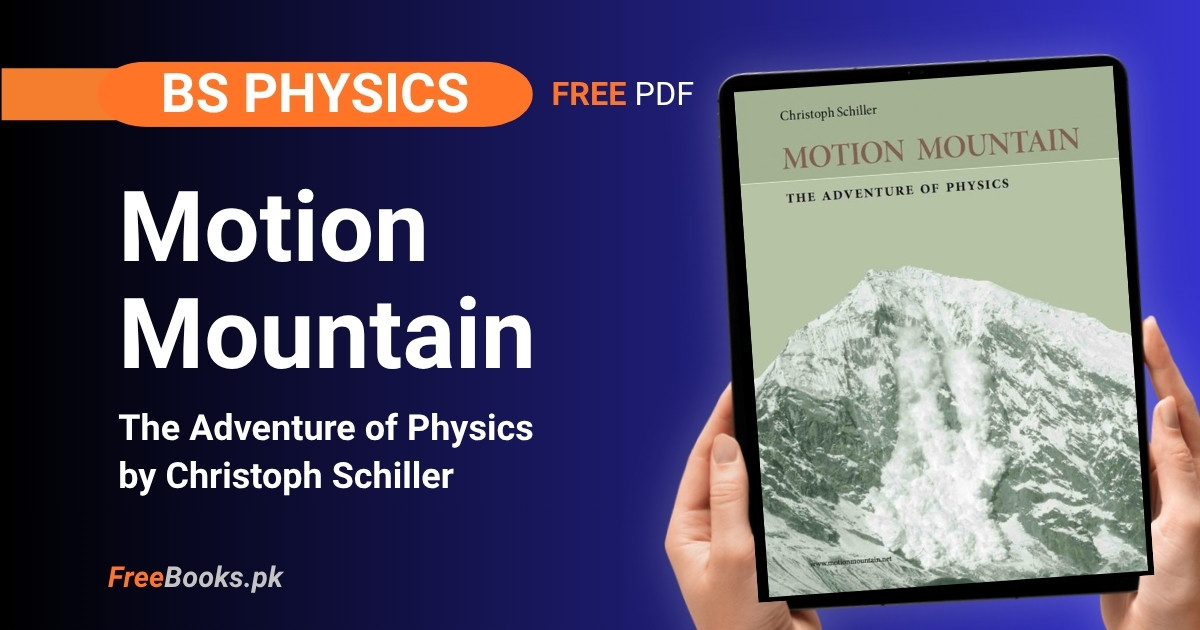
BS Physics students can download Motion Mountain: The Adventure of Physics by Christoph Schiller for free from the author’s own site. It is one continuous walk through physics in five volumes: everyday mechanics and heat, relativity and cosmology, electricity, light and the brain, quantum theory, and finally motion inside matter, from molecular motors to nuclei, quarks and the standard model. The PDFs run to more than 2,000 pages and carry embedded films.
The style differs from a standard course text. Formulas are kept few, every chapter starts from something we can observe, and the book holds about 1,900 numbered challenges, with hints and solutions at the back of each volume. For General Physics courses it works best beside your prescribed textbook: use it to see why the equations exist, to revise a topic from a second angle, or to read ahead into relativity and quantum physics. The author says plainly that it was not written with exams in mind.
Book Overview
| Course | General Physics – mechanics, heat, relativity, electromagnetism and optics, quantum physics, nuclei and particles |
| Degree Programs | BS Physics |
| Level | University – conceptual and readable; formulas are few and the mathematics grows from school level in Volume I to Hilbert spaces and Lie algebras in appendices of Volumes IV and V |
| Edition | Thirty-first edition (the official site calls it the 2021 edition); each PDF carries its own update date: Volume I March 2023, Volume II August 2023, Volumes III and IV September 2021, Volume V April 2025 |
| Author | Christoph Schiller (PhD, Université Libre de Bruxelles) |
| Publisher | Motion Mountain Research (Physikverein), a non-profit association that distributes the free textbook |
| Structure | 5 volumes with 57 chapters (15 + 11 + 10 + 9 + 12) plus appendices; a separate bonus volume on the author’s own unification research is not part of the five-volume textbook |
| Exercises | About 1,900 numbered challenges, graded easy, standard, difficult and research level, with hints and solutions at the back of each volume |
| Language | English (volunteer translations of parts exist in other languages) |
| License | CC BY-NC-ND 3.0 Germany, plus the author’s additional restriction on use in products and services — Model: Link-only |
| Format | Free PDF per volume, with embedded films; also one ZIP of all five volumes (about 520 MB); paper and Kindle editions are sold separately |
Chapter List
Volume I, Chapters 1–3: Describing Motion – Measurement, Space, Time and Kinematics
Volume I – Fall, Flow and Heat · Chapters 1–3 · Difficulty: Easy · Key topics: Galilean physics, clocks, time and space, length and area, paths, velocity, acceleration, vectors
Chapter 1 argues that everything that happens in nature is some type of motion, and that the usual definition (change of place with time) is correct but incomplete. Chapter 2 builds the Galilean description: time is deduced by comparing motions and read from clocks, space is built from distance relations measured with metre sticks, and both are modelled as continuous. It also shows why length and area exist as concepts while volume only exists approximately. Chapter 3 turns this into kinematics: a path written as x(t), y(t), z(t), with velocity and acceleration as vectors, and a warning that the method fails for the motion of images.
Key Points:
- Motion is the change of state of permanent objects; every type of change is due to the motion of particles
- Time is deduced by comparing motions, time is what we read from a clock, and time does not flow – only bodies flow
- Space is formed from the position and distance relations between objects; length and area are well defined for smooth shapes, volume only approximately
- g = 9.8 m/s2 is the same, within about one part in 300, for all falling bodies at all points on the Earth’s surface
- The Galilean model: velocity as a vector, space as a three-dimensional set of points, time as a one-dimensional line
- No experiment can check the continuum model for distances larger than 1025 m or smaller than 10−25 m
Memory Tip: Hold the three Galilean assumptions as matter, time, space: matter is impenetrable and moves, time is made of instants, space is made of points. If you can state each one without looking, you can also say where each one fails later in the series.
Common Mistake: Treating “motion is the change of position with time” as a full explanation. The book stresses it is only a description, because position and time are themselves deduced from motion.
Important Questions:
- Why does the book say that time does not flow? Time is deduced by comparing motions and is what we read from a clock; the book’s statement is that time does not flow, only bodies flow.
- Why does volume exist only as an approximation, while length and area exist? Length and area are well defined for nicely behaved lines and surfaces, but volume is well defined only for regions with smooth surfaces; if infinitely sharp cuts are allowed, volume is not defined in general.
Volume I, Chapters 4–6: Objects, Conservation, Relativity of Motion and Gravitation
Volume I – Fall, Flow and Heat · Chapters 4–6 · Difficulty: Medium · Key topics: objects and images, mass, momentum, energy, angular momentum, rotation of the Earth, Galilean relativity, universal gravitation, orbits, tides
Chapter 4 separates objects (things we can move with a collision) from images such as shadows, then defines mass through momentum conservation and introduces energy and angular momentum as conserved quantities, with a section on how we walk and run. Chapter 5 asks whether the Earth rotates, answers yes, and develops everyday relativity: undisturbed motion cannot be told from rest. Chapter 6 introduces universal gravitation, a = GM/r2, and applies it to falling bodies, the Moon, orbits as conic sections, tides, the shape of the Earth and the question of whether light can fall.
Key Points:
- Four conservation principles hold for closed systems in everyday life: linear momentum, angular momentum, energy and mass – none applies to images
- Momentum conservation defines mass: the mass ratio of two bodies is the negative inverse ratio of their accelerations
- Galileo’s principle of relativity: there is no difference between constant, undisturbed motion, however rapid, and rest
- Rotation is relative
- A spherical body of mass M produces the acceleration a = GM/r2 at distance r
- Gravitational mass and inertial mass are equal
Memory Tip: Use the push test to sort things: if you can move it with a collision it is an object, and the conservation laws apply; if you cannot (a shadow, a light spot) it is an image, and they do not.
Common Mistake: Saying heavier bodies fall faster because gravity pulls harder on them. Inertial and gravitational mass are equal, so a = GM/r2 depends on the attracting body’s mass, not on the falling body’s.
Important Questions:
- How do we tell an object from an image? If we can touch it, or more precisely move it with a collision, it is an object; otherwise it is an image. Conservation of momentum, angular momentum, energy and mass applies to objects but not to images.
- Why can we not feel the rotation of the Earth although its speed is large? Undisturbed (inertial) motion cannot be felt or measured, so the distinction between rest and motion depends on the observer, and the acceleration due to rotation is too small to feel.
Volume I, Chapters 7–9: Predictability, Action and Symmetry
Volume I – Fall, Flow and Heat · Chapters 7–9 · Difficulty: Medium · Key topics: force as momentum flow, friction, determinism, initial conditions, action, Lagrangian, groups, multiplets, Noether’s theorem
Chapter 7 treats mechanics as the athletic part of physics and recasts force as the flow of momentum through a surface, so a motor becomes a momentum pump. It then looks at friction, initial conditions and why all everyday motion is predictable, with a short section on free will. Chapter 8 introduces action, the time integral of kinetic minus potential energy, and the principle that nature minimizes it. Chapter 9 turns to symmetry: groups, multiplets and Noether’s theorem tie the conservation of energy and momenta to the sameness of nature under shifts in time and space and under rotations.
Key Points:
- Force is momentum flow, and a motor is a momentum pump; gravitation constantly pumps momentum into massive bodies
- The use of time implies determinism, and vice versa
- Action is the integral of the Lagrangian, measured in J·s; the actual trajectory between fixed end points satisfies δS = 0
- Systems move by minimizing change – equivalently, by maximizing the elapsed time between two situations
- Symmetry is invariance after change, and all symmetry transformations of a system form a mathematical group
- Noether’s theorem: nature’s symmetry under time and space translations and rotations gives conserved energy, linear momentum and angular momentum
Memory Tip: Action is the average of kinetic minus potential energy multiplied by the time. The book’s one-line summary is that nature is lazy: the real path is the one that minimizes total change.
Common Mistake: Thinking of force as something a body owns or stores. In this chapter force is the flow of momentum through a surface, which is why contact forces and friction are discussed at surfaces.
Important Questions:
- What does the book mean by saying a motor is a momentum pump? Force is momentum flow, so a motor is a device that pumps momentum from one body into another; gravitation in the same way constantly pumps momentum into massive bodies.
- How does the book state the principle of least action? The action is the time integral of the Lagrangian (kinetic minus potential energy); between fixed end points the actual trajectory is the one with δS = 0, so systems move by minimizing change.
Volume I, Chapters 10–12: Waves, the Atomic Structure of Matter and Fluids
Volume I – Fall, Flow and Heat · Chapters 10–12 · Difficulty: Medium · Key topics: oscillations, damping, resonance, waves, sound, solitons, atoms, shot noise, pressure, laminar and turbulent flow
Chapter 10 moves from single bodies to extended ones: harmonic oscillation with its amplitude, period and phase, damping and resonance, then water waves, sound, Huygens’ principle, wave equations, music, ultrasound, signals and solitons. Chapter 11 asks whether extended bodies really exist and answers with evidence that matter is neither continuous nor fractal, through examples that range from chocolate bars and animal jumps to felling trees and counting atoms. Chapter 12 describes flows of all kinds, pressure, laminar and turbulent motion, the atmosphere, and the physics of blood and breath.
Key Points:
- Every harmonic oscillation is described by three quantities: amplitude, period (the inverse of the frequency) and phase
- A simple pendulum keeps nearly constant frequency while its amplitude stays below about 20°, one reason pendulums were used in mechanical clocks
- Waves carry energy, momentum and angular momentum, and can interfere, diffract, refract, disperse, damp out and (if transverse) be polarized
- Matter is neither smooth nor fractal: it is made of countable atoms, and one mole holds about 6.0 × 10²³ particles
- Pressure is force per area, p = F/A – equivalently momentum change per area, or potential energy per volume
- Laminar flow without internal friction obeys Bernoulli’s equation (energy conservation); turbulent flow is not fully solved
Memory Tip: For any flow ask two questions: what flows (the extensive quantity) and what drives it (the intensive quantity). Their product is always the power of the flow.
Common Mistake: Treating oscillations and waves as separate topics. The chapter summary says oscillations are a special case of waves, usually standing waves in extended systems.
Important Questions:
- Why is matter not a continuum, according to Chapter 11? Matter breaks under finite loads and is neither scale-invariant, smooth nor fractal; it is made of countable components, atoms, whose size and arrangement produce the shape and extension of objects.
- How does the book separate laminar from turbulent flow? Laminar flow without internal friction is described by Bernoulli’s equation, i.e. energy conservation; turbulent flow is the most complicated problem of physics and is not yet fully solved, so the book only describes it.
Volume I, Chapters 13–15: Heat, Self-Organization and the Limits of Galilean Physics
Volume I – Fall, Flow and Heat · Chapters 13–15 · Difficulty: Medium · Key topics: temperature, entropy, thermodynamic principles, reversibility, Brownian motion, self-organization, chaos, limits of motion
Chapter 13 explains why everyday motion is irreversible although microscopic motion is reversible: temperature, thermal energy, Brownian motion, entropy as the logarithm of the number of microscopic states, the principles of thermodynamics and the question of why we cannot remember the future. Chapter 14 shows how order appears spontaneously, from patterns in sand to chaos and emergence, and why evolution does not contradict the second principle. Chapter 15 is short: it lists what Galilean physics cannot explain and concludes that precision needs the limits of motion, starting with the speed limit explored in Volume II.
Key Points:
- First principle: in a closed system the sum of mechanical and thermal energy is constant, so no perpetuum mobile of the first kind exists
- Entropy measures the logarithm of the number W of possible microscopic states; the characteristic entropy change for a single particle is about k
- Third principle: zero temperature is unattainable
- Microscopic motion is reversible; everyday irreversibility comes from the extremely low probability of motion reversal in many-particle systems
- Self-organizing systems are open and often far from equilibrium, so the second principle does not forbid them
- Physical chaos is irregular motion with a positive Lyapunov exponent in a strictly valid evolution
Memory Tip: Think of entropy as questions: it is the expected number of yes-or-no questions, multiplied by k ln 2, whose answers would tell you the microscopic state of the system.
Common Mistake: Claiming that evolution or self-organization breaks the second principle. The Earth is not a closed system in equilibrium, and the second principle applies to closed systems.
Important Questions:
- Why is everyday motion irreversible if microscopic motion is reversible? Because there are no completely closed systems in everyday life and because motion reversal in many-particle systems has an extremely low probability; macroscopic irreversibility does not contradict microscopic reversibility.
- Why does the book call Galilean physics inaccurate? It tacitly assumes an infinite universe and allows unlimited speeds, but infinite speeds would make time sequences and clocks impossible and an infinite universe would not have a dark night, so precision requires discovering the limits of motion.
Volume II, Chapters 1–3: Special Relativity – Maximum Speed and Relativistic Mechanics
Volume II – Relativity and Cosmology · Chapters 1–3 · Difficulty: Medium · Key topics: invariant speed of light, time differences, length contraction, Doppler effect, space-time, twin paradox, mass-energy equivalence, 4-vectors, horizons
Chapter 1 starts from the observation that light is the standard for undisturbed motion and that its speed in vacuum is finite, invariant and a limit. From that one fact it derives time differences between moving observers, length contraction, the Doppler effect, the composition of velocities, space-time and the twin paradox, along with puzzles such as the speed of a shadow. Chapter 2 rebuilds mechanics: mass and energy are equivalent, collisions are redone with 4-vectors and momenergy, and accelerating observers and event horizons appear. Chapter 3 compresses special relativity into four statements and asks where it breaks down.
Key Points:
- c = 299 792 458 m/s: light in vacuum has the same speed for all observers, and it is the limit speed for energy, forerunners and signals measured locally
- Time, age, distance, length, colour, angles and temperature depend on the observer; the speed of light in vacuum does not
- Mass and energy are equivalent: mass is concentrated energy
- Energy-momentum (momenergy) is the conserved 4-vector of mechanics
- A solid body of length l with proper acceleration a must obey la < c2, or its far end would exceed the speed of light
- Special relativity breaks down near the Planck limits; the highest energies observed are about a million times smaller
Memory Tip: Start every relativity problem from one sentence: there is a unique, maximal, invariant energy speed c. Time dilation, length contraction and the Doppler effect all follow from it.
Common Mistake: Saying nothing at all can ever go faster than light. The book’s limit applies to locally measured energy, forerunner and signal speeds; patterns such as a moving shadow can show larger apparent speeds without carrying energy.
Important Questions:
- What is special about the speed of light in this book? It equals 299 792 458 m/s, it is invariant (the same for all observers) and it is the limit speed for locally measured energy, forerunner and signal motion.
- Are mass and energy conserved separately in relativity? No. Only the energy-momentum 4-vector (momenergy) is conserved; mass and energy are equivalent, so mass is concentrated energy.
Volume II, Chapters 4–6: General Relativity – Maximum Force, Curved Space-Time and Weak Fields
Volume II – Relativity and Cosmology · Chapters 4–6 · Difficulty: Hard · Key topics: maximum force and power, horizons, free fall, gravitational red-shift, geodesics, light bending, time delay, orbits, gravitational waves
Chapter 4 presents general relativity through the author’s maximum-force principle: nature has a maximum force c4/4G and a maximum power c5/4G, realized on horizons, and the field equations follow from that limit. Chapter 5 returns to the speed limit and gravity: free fall as rest, clocks running at different rates at different heights, tides, curved space-time, geodesics and the question of what weight is. Chapter 6 tests the theory in weak fields: light bending twice the Newtonian value, time delay, orbits that do not close, the geodesic and Thirring effects, and gravitational waves.
Key Points:
- Maximum force F ≤ c4/4G = 3.0258(4) × 1043 N, and maximum power c5/4G; the surfaces that realize them are called horizons
- Rest is free fall, and in gravity time is height-dependent: the book’s wording is that gravity is the uneven running of clocks at different places
- The light deviation angle is α = 4GM/(c2b), twice the value from universal gravity; the predicted 1.75 arcseconds at the edge of the Sun was first confirmed in 1919
- Instead of closed ellipses, general relativity gives rosette-shaped orbits
- Passing masses delay electromagnetic waves, and empty vacuum can carry gravitational waves at the speed of light
- All experiments so far confirm the weak-field predictions and the force and power limits
Memory Tip: Remember “time depends on height”. Gravitational red-shift, tides and curved space-time all grow out of clocks ticking at different rates at different heights.
Common Mistake: Assuming every course starts general relativity from the maximum-force principle. The book presents it as its own formulation (also found independently by Gary Gibbons); your syllabus may begin with the equivalence principle and Einstein’s field equations, so match topics by name, not by order.
Important Questions:
- What is the maximum force in nature and where is it realized? F = c4/4G, about 3.0 × 1043 N, realized on event horizons; no force in any muscle, machine or system can exceed it.
- How does general relativity change the bending of light? The deviation angle is α = 4GM/(c2b), twice the universal-gravity value; the 1919 observation of starlight near the Sun matched it and ruled universal gravity out.
Volume II, Chapters 7–8: From Curvature to Motion, and the Night Sky
Volume II – Relativity and Cosmology · Chapters 7–8 · Difficulty: Hard · Key topics: curvature, Schwarzschild metric, Ricci tensor, Einstein tensor, field equations, dark night sky, big bang, inflation, expanding universe
Chapter 7 gives the machinery: curvature measured in two, three and four dimensions, the Schwarzschild metric, the Ricci tensor and scalar, the Einstein tensor and Einstein’s field equations, summarized as local curvature equal to local energy density divided by the maximum force. Chapter 8 asks what we actually see at night and builds cosmology from the answer: why the sky is dark, a short history of the universe, the big bang and its questions, inflation, the open, closed or marginal universe, and the evidence that the universe is spatially flat and expanding.
Key Points:
- The average curvature of a three-dimensional space is six times the excess radius of a small sphere divided by the cube of its radius
- In words, the field equations say: local curvature of space equals local energy density divided by the maximum force, and objects move along geodesics of that curvature
- General relativity plus the dark night sky imply that the universe is expanding and was once extremely small
- The book tabulates an age of 13.8(1) Ga and a Hubble constant of 71(4) km/s per Mpc
- The universe is spatially flat, its expansion is accelerating and there will be no big crunch
- The universe’s horizon distance, about 4 × 1026 m, obeys a relation similar to the black-hole radius 2Gm/c2
Common Mistake: Quoting the cosmological numbers in this chapter as final. They are values as of the volume’s update (August 2023), and the Hubble constant in particular is still debated, so check a current source before using a value in an exam answer.
Important Questions:
- Why is the night sky dark, and what does that tell us? The book argues that general relativity together with the black night sky implies a universe that is finite in size and age, is expanding, and was once extremely small.
- How does the book summarize Einstein’s field equations in words? Local curvature of space is given by the local energy density divided by the maximum force, and objects follow the geodesics defined by that curvature.
Volume II, Chapters 9–11: Black Holes, Space versus Time and General Relativity in a Nutshell
Volume II – Relativity and Cosmology · Chapters 9–11 · Difficulty: Medium · Key topics: horizons, orbits around black holes, singularities, space and time, closed time-like curves, hole argument, limits of general relativity
Chapter 9 treats black holes as matter in permanent free fall: horizons as limit surfaces, orbits around them, the no-hair property, black holes as energy sources, their formation and search, and singularities, ending with a quiz on whether the universe itself is a black hole. Chapter 10 asks whether space differs from time at all and finds that only matter and radiation allow the distinction. Chapter 11 summarizes general relativity for the layman, reviews its accuracy and research questions, and ends with its limits: it does not say what matter or light is.
Key Points:
- A black hole is matter in permanent free fall, or equivalently a strongly curved type of space, defined by its horizon
- For a given mass, black holes realize the maximum force, maximum density, maximum blackness and maximum entropy
- The black-hole radius is rS = 2Gm/c2
- General relativity has no fundamental distinction between space and time; only pragmatic ones using matter, radiation or space-time at infinity
- General relativity does not describe matter at all, and it leaves the nature of light and the vacuum unexplained
Memory Tip: Einstein’s image, quoted in the book: the left side of the field equations (curvature) is granite, the right side (matter) is sand. Granite is understood, sand is not.
Common Mistake: Treating general relativity as a complete theory. The closing section says it cannot explain what matter or light is, and hands those questions to the quantum volumes.
Important Questions:
- What is a black hole in the book’s definition? Matter in permanent free fall, or equivalently a strongly curved region of space defined by its horizon, which realizes the maximum force.
- Does general relativity separate space from time? Not fundamentally. Only pragmatic distinctions using matter, radiation or space-time at infinity are possible; matter is needed even to tell space from time.
Volume III, Chapters 1–2: Electricity, Magnetism and the Motion of Fields
Volume III – Light, Charges and Brains · Chapters 1–2 · Difficulty: Medium · Key topics: charge, electric field, magnets, motors, nerves, Maxwell’s equations, vector potential, Lagrangian of the field, contact
Chapter 1 starts with amber, lodestone and mobile phones and builds the basic picture of electricity: two signs of charge, charge conservation, field lines, pumping charge, magnets, motors, nerves and why motors prove relativity right. It ends by reducing classical electrodynamics to three basic facts about charges. Chapter 2 describes how electric and magnetic fields move: Maxwell’s two field equations, the vector potential, the Lagrangian and energy-momentum tensor of the field, parity and mirrors, and why everyday contact is really an exchange of electromagnetic fields.
Key Points:
- All everyday effects called mechanical are, without exception, of electrical origin
- Charge is conserved, flows and accumulates; like charges repel, unlike charges attract; the electric field E(x) is a vector field
- Three basic facts hold everything: charges exert forces on charges, charge is conserved, and charges move more slowly than light
- There are no magnetic charges (no magnetic monopoles), and changing magnetic fields produce electric fields
- The electromagnetic field itself carries energy, linear momentum and angular momentum
- In everyday contact nothing actually touches anything else; contact is the exchange of electromagnetic fields
Memory Tip: Remember the three basic facts as force, conservation, speed limit: charges push on charges, charge is conserved, and charges are slower than light.
Common Mistake: Believing two touching objects really touch. The chapter says everyday contact is the exchange of electromagnetic fields.
Important Questions:
- Which three facts about charges contain classical electrodynamics? Charges exert forces on other charges, electric charge is conserved, and charges move more slowly than light; Maxwell’s equations, the Lagrangian and the Lorentz force can be deduced from them.
- Do magnetic monopoles exist in classical electrodynamics? No. In nature there are no magnetic charges, and changes in magnetic fields produce electric fields.
Volume III, Chapters 3–4: Light and Applied Optics
Volume III – Light, Charges and Brains · Chapters 3–4 · Difficulty: Medium · Key topics: electromagnetic waves, polarization, colour, rainbows, signal speed, aether, black bodies, refraction, lenses, diffraction, holograms, the eye
Chapter 3 shows that light is an electromagnetic wave: Kirchhoff’s observation in 1848 that the measured speed of light matches 1/√(ε0μ0), experiments with waves, polarization, the electromagnetic spectrum, colour, rainbows, the difference between phase, group, forerunner and signal speed, and why the aether is indistinguishable from the vacuum. Chapter 4 covers applied optics: light sources and black bodies, mirrors, refraction and mirages, lenses and fibre optics, the diffraction limit, holograms and tomography, then the human eye and display technology.
Key Points:
- Light is an electromagnetic wave, and c = 1/√(ε0μ0) shows that c is invariant and the limit energy speed
- In vacuum ω = ck for all electromagnetic waves, and the phase, group and signal velocities all equal c
- A physical signal is the transport of information by the transport of energy; the forerunner velocity is the true signal velocity
- A black body absorbs all radiation falling on it, and the effective temperature of focused light cannot exceed that of its source
- Light always takes the path that requires the shortest travel time
- Generation and detection of light are always quantum effects; classical electrodynamics describes only its transport
Practice Tip: Hold polarizing sunglasses up to most LCD screens and rotate them. The picture dims at one angle, which shows polarization of light directly.
Common Mistake: Quoting the phase velocity as the speed of information. The chapter separates phase, group, forerunner and signal velocity; in vacuum they coincide at c, in materials they can differ.
Important Questions:
- How did physicists conclude that light is an electromagnetic wave? In 1848 Gustav Kirchhoff noted that the experimental value of the speed of light agreed with the combination 1/√(ε0μ0) measured in electromagnetic experiments, suggesting that light is an electromagnetic wave.
- What limits the temperature of light concentrated by a lens or mirror? The effective temperature of the light in a focus cannot exceed the temperature of the original light source.
Volume III, Chapters 5–6: Electromagnetic Effects and the Limits of Classical Electrodynamics
Volume III – Light, Charges and Brains · Chapters 5–6 · Difficulty: Medium · Key topics: lightning, ball lightning, planetary magnetic fields, levitation, Faraday cage, charge quantization, limits of Maxwell’s theory
Chapter 5 collects electromagnetic effects around us: lightning and atmospheric electricity, the question of ball lightning, planetary magnetic fields, levitation, and the radiation emitted by all bodies. A central result is that no static arrangement of electric fields can levitate a charged object, and no static arrangement of masses can levitate a massive object. Chapter 6 is short and summarizes classical electrodynamics in three principles (definition, charge conservation, invariance of c), then explains why it is wrong: charge values are discrete, space is curved, and Maxwell’s evolution equations are only approximate.
Key Points:
- No static arrangement of electric fields can levitate a charged object in free space or in air, and no static arrangement of masses can levitate a massive object
- The nature of all everyday material properties is electromagnetic
- The vertical electric field of the atmosphere is about 200 V/m
- A closed metal surface, or even a cage, shields a static field: a Faraday cage
- Three principles of classical electrodynamics: definition, charge conservation, invariance of c
- Electric charge values are quantized, so classical electrodynamics is only an approximation
Memory Tip: Hold the three principles as definition, conservation, speed limit: charges exert inverse-square forces, charge is conserved, and charges move more slowly than light.
Common Mistake: Repeating that the field inside a conductor is always zero. The book notes this is too simple: it holds for static fields and charges on the metal surface, while moving external fields or charges make the issue more complex.
Important Questions:
- Can a static electric field levitate a charged object? No. No static arrangement of electric fields can levitate a charged object in free space or in air, and the same holds for static arrangements of masses.
- Why does the book call classical electrodynamics wrong? Charge values are discrete rather than continuous and space is curved rather than flat, so Maxwell’s evolution equations are only approximate.
Volume III, Chapters 7–8: The Brain, Information, Language and Mathematics
Volume III – Light, Charges and Brains · Chapters 7–8 · Difficulty: Easy · Key topics: neurons, information, memory, language, concepts, sets, infinity, numbers
Chapter 7 steps back from physics to ask how the brain works, since the brain is the instrument that forms every physical concept. It covers evolution and children’s learning, neurons and networks, information as the result of classification, memory and the capacity of the brain. Chapter 8 asks what language is, how its components form a hierarchy, why mathematics is a language, and what concepts, sets, infinity, functions and numbers are, and closes with the goal of a description of nature that uses only one basic concept.
Key Points:
- Information is the result of classification, measured by counting the implied yes-or-no questions, the bits
- Interactions describe the difference between the whole and the sum of its parts
- A human language is a standard way of symbolic interaction; only systems that allow communication about what is not present, here or now qualify
- Statements describing observations must be translatable into all languages
- The semantic primitives of language include the basic elements of physics and of mathematics
- Physics aims at a description of nature that consists of only one basic concept
Memory Tip: Information is the number of yes-or-no questions needed to pin something down; one answer is one bit.
Common Mistake: Expecting examinable physics here. These chapters are the book’s own philosophy-of-physics thread; read them for the definitions of information, interaction and concept used later, not as syllabus revision.
Important Questions:
- How does the book define information? Information is the result of classification, and it is measured by counting the yes-or-no questions, the number of bits, that lead to it.
- What makes a sign system a language in the book’s sense? It must allow communication about what is not present, not here and not now, and it must express the complete spectrum of human messages.
Volume III, Chapters 9–10: Observations, Lies, Patterns and Classical Physics in a Nutshell
Volume III – Light, Charges and Brains · Chapters 9–10 · Difficulty: Easy · Key topics: truth, facts, lies, verification and falsification, observations, existence, explanation, classical physics summary, open questions
Chapter 9 asks how physics relates to truth: what a fact, a lie and a good lie are, what makes a statement nonsense, how observations are collected and whether instruments collect enough, whether induction is a problem, and what existence, void, infinity and creation mean for the universe. It ends with curiosity and courage as the traits an explorer needs. Chapter 10 closes classical physics: what can move, the properties of classical motion, the future of planet Earth, and the questions that remain at the top of the mountain: matter, colour and life.
Key Points:
- Truth is correspondence with facts; facts are observations shared with other people or machines; a lie is a statement in contrast with facts
- Specific statements cannot be falsified, only verified; universal statements cannot be verified, only falsified
- Self-reference is a form of nonsense
- A measurement is a comparison with a standard
- Classical physics describes motion with the concept of the infinitely small; motion is deterministic, predictable and limited
- After classical physics three things are still not understood: matter, colour and life
Memory Tip: Specific statements can be verified but never falsified; universal statements can be falsified but never verified.
Common Mistake: Trying to prove a universal law such as energy conservation by piling up confirming cases. The chapter says universal statements cannot be verified, only falsified, so one counter-example is what counts.
Important Questions:
- How does the chapter define truth and a lie? Truth is correspondence with facts, facts are observations shared with other people or machines, and a lie is a statement in contrast with facts.
- What does classical physics leave unexplained? The book says we do not understand matter, colour or life, which is why the series moves on to quantum physics.
Volume IV, Chapters 1–3: The Quantum of Action, Light and the Motion of Matter
Volume IV – The Quantum of Change · Chapters 1–3 · Difficulty: Medium · Key topics: smallest action, no rest, randomness, photons, single-photon interference, matter waves, quantons, Stern-Gerlach
Chapter 1 argues from the existence of a smallest action ħ: classical physics cannot explain any characteristic length or time scale, while a smallest change implies there is no rest, randomness, wave and particle behaviour and the transformation of matter. Chapter 2 applies this to light: faint lamps, photons as little arrows, interference of single photons, reflection and refraction from photon arrows, virtual photons and why photons are better called calculating devices. Chapter 3 applies it to matter: no infinite measurement precision, quantized conductivity, matter waves, rotating quantons, and the Stern-Gerlach experiment as digital beam splitting.
Key Points:
- Actions smaller than ħ = 1.06 × 10⁻³⁴ J·s are not observed in nature
- Classical constants (G, R, c, ε0, μ0) cannot be combined into a length or a time, so classical physics explains no scale
- In nature there is no rest, and there is motion inside matter
- Light is made of photons that behave like moving little arrows; each photon interferes only with itself
- Photons are bosons with no mass, no charge and no size, and they cannot be localized in light beams
- Atoms are spherical clouds, and the measured intrinsic angular momentum of bodies is always a multiple of ħ
Memory Tip: The book’s chain: a smallest action ħ means no rest, randomness, waves and particles together, and transformation of matter.
Common Mistake: Picturing photons as little stones. The book argues that the only classical particle-like aspects of photons are their quantized energy, momentum and spin.
Important Questions:
- What is the quantum of action and what does it imply? It is the smallest observable action, ħ = 1.06 × 10⁻³⁴ J·s; it implies there is no rest, motion exists inside matter, and observed changes smaller than ħ do not occur.
- Why can classical physics not explain any length scale? The classical constants G, R, c, ε0 and μ0 cannot be combined to yield a length or time value, so no size observed in nature can come from them.
Volume IV, Chapters 4–6: Wave Functions, Indistinguishability and Spin
Volume IV – The Quantum of Change · Chapters 4–6 · Difficulty: Hard · Key topics: wave function, Hilbert space, Schrödinger equation, Dirac equation, permutation symmetry, bosons, fermions, spin, Pauli principle
Chapter 4 introduces the quantum description of states as rotating arrows (complex vectors in Hilbert space), measurements as Hermitean operators, and the Schrödinger and Dirac equations, with sections on dispersion, tunnelling and the quantum phase. Chapter 5 shows that quantum particles are indistinguishable and countable and split into bosons and fermions through permutation symmetry, with the consequence that perfect clones do not exist. Chapter 6 links spin to rotation: the belt trick, the Pauli exclusion principle, the hardness of matter, and why the connection between spin and rotation requires antiparticles.
Key Points:
- States are rotating arrows (complex vectors in a Hilbert space); measurements are Hermitean operators; changes of viewpoint are unitary operators
- A full rotation of the arrow corresponds to ħ; a spinless non-relativistic particle follows the Schrödinger equation, a relativistic electron the Dirac equation
- Quantons are countable and perfectly indistinguishable: symmetric wave functions describe bosons, antisymmetric ones fermions
- The state of a physical system cannot be copied, so perfect clones do not exist
- Half-integer spin means fermions obeying Pauli’s exclusion principle; integer spin means bosons, whose sharing of states makes lasers possible
- Exclusion plus electrostatic repulsion explains the incompressibility of matter
Practice Tip: Try the belt trick from Chapter 6 with a real belt or strap: one full twist cannot be removed by moving the middle only, while two full twists can. That is the picture of spin 1/2.
Common Mistake: Calling quantum particles identical. The book warns that indistinguishable is the exact word, even though many physicists speak sloppily of identical particles.
Important Questions:
- What separates bosons from fermions? Particles with symmetric wave functions under exchange are bosons (integer spin, can share a state); those with antisymmetric wave functions are fermions (half-integer spin, obey the Pauli exclusion principle).
- Why are perfect clones impossible in nature? Even though quantum particles are indistinguishable, the state of a physical system cannot be copied to a second system with the same particle content, so perfect clones do not exist.
Volume IV, Chapters 7–9 and Appendix B: Superpositions, Probabilities, Colour and Quantum Physics in a Nutshell
Volume IV – The Quantum of Change · Chapters 7–9, Appendix B · Difficulty: Hard · Key topics: decoherence, entanglement, probabilities, colour of atoms, antimatter, virtual particles, fine-structure constant, numbers and Hilbert spaces
Chapter 7 asks why people are either dead or alive and answers with decoherence: baths in the environment destroy macroscopic superpositions. It covers entanglement, the Einstein-Podolsky-Rosen argument, why probabilities and wave function collapse appear in measurements, hidden variables, and the claim that probabilities come from baths. Chapter 8 explains colour, the size and shape of atoms, the Dirac equation, antimatter and virtual particles. Chapter 9 sums up quantum theory in one sentence about the smallest action. Appendix B covers numbers as mathematical structures, from complex numbers to quaternions, octonions and Hilbert spaces.
Key Points:
- Any environment is a bath; coherent superpositions of macroscopically distinct states never appear in everyday life because of rapid decoherence
- Probabilities appear whenever a process tries to distinguish situations that differ by about one quantum of action ħ
- Measuring an observable gives one of its eigenvalues an, with probability Pn = |φn†ψ|2
- The quantum of action fixes the size, shape, colour and material properties of all things around us
- The strength of electromagnetism is the fine-structure constant, α ≈ 1/137.036, whose value is still unexplained
- Quantum physics is the description of matter and radiation without the concept of the infinitely small
Memory Tip: Dead or alive: bath means decoherence, and decoherence means probabilities. Keep the three words linked.
Common Mistake: Treating the book’s interpretation as the only accepted one. The author notes that these conclusions agree with all experiments but are not yet shared by all physicists, so compare with your course text before writing an exam answer on measurement.
Important Questions:
- Why are people either dead or alive and never in a superposition? Coherent superpositions of macroscopically distinct states decay extremely fast because every environment acts as a bath, so such states never appear in everyday life.
- Where do quantum probabilities come from, in the book’s view? They appear when an experiment tries to distinguish situations differing by about ħ, and they arise from the unknown detailed state of an interacting bath combined with the quantum of action.
Volume V, Chapters 1–2: Biology, Pleasure, Materials and Quantum Technology
Volume V – Motion Inside Matter · Chapters 1–2 · Difficulty: Medium · Key topics: molecular motors, ATP synthase, pleasure, living clocks, chemistry, DNA, crystals, transistors, superconductivity, lasers
Chapter 1 applies the quantum of action to living things: self-reproducing machines, molecular motors such as ATP synthase, pleasure and the nerves, living clocks, decay and the golden rule, the quantum Zeno effect and consciousness. Chapter 2 is about materials and technology: chemistry from atomic bonds to DNA, crystals and why the floor does not fall, transistors, superconductivity and superfluidity, the fractional quantum Hall effect, matter at the lowest temperatures, and lamps and lasers, including the three lightbulb scams and applications of lasers.
Key Points:
- A living being is a collection of a huge number of specialized molecular machines that can self-reproduce
- Molecular motors work as quantum ratchets, and every human consists of trillions of machines
- Muscles work because molecules in them change shape when supplied with energy
- Atoms form bonds, so quantum effects produce molecules, gases, liquids, solids and all properties of materials
- Transistors, lasers, light detectors, superconducting magnets, magnetic resonance imaging and the internet are listed as results of applied quantum effects
- Pleasure controls human life, and every biological pleasure sensor rests on quantum motion
Common Mistake: Thinking quantum effects matter only at microscopic scales. The chapters show that muscles, nerves, materials and lasers, all everyday technology, rest on quantum motion.
Important Questions:
- What is a molecular motor? A shape-changing molecule that turns supplied energy into motion; muscles work because such molecules change shape, and linear motors and the rotating ATP synthase are examples.
- Which technologies does Chapter 2 trace back to quantum effects? Electronics and transistors, lasers, light detectors, data storage, superconducting magnets, magnetic resonance imaging, computers, telecommunication and the internet.
Volume V, Chapters 3–4: Quantum Electrodynamics and Quantum Theory with Gravitation
Volume V – Motion Inside Matter · Chapters 3–4 · Difficulty: Hard · Key topics: virtual particles, Casimir effect, Lamb shift, QED Lagrangian, renormalization, Unruh radiation, black hole evaporation, gravitons
Chapter 3 introduces virtual particles and quantum field theory through quantum electrodynamics: the Casimir effect, the Lamb shift, the QED Lagrangian, vacuum energy, photons hitting photons, and renormalization with the question of why an electron is so light. Chapter 4 mixes gravity with quantum theory: falling atoms, table tennis with neutrons, the gravitational Bohr atom, Fulling-Davies-Unruh radiation, evaporating black holes, the information paradox, gravitons and space-time foam, and the conclusion that quantum theory and general relativity conflict conceptually.
Key Points:
- Virtual particles owe their existence to the quantum of action and need not follow the energy-mass relation of special relativity
- Everyday matter is made of charged elementary particles that interact by photon exchange, and one Feynman diagram describes all electromagnetic processes
- The origin of the fine-structure constant is unknown, yet it fixes, for example, the refractive index of water and so the rainbow
- Black holes are not black: they radiate and evaporate
- Combining quantum theory with gravitation causes problems for both the particle concept and the space-time concept
- Quantum theory contradicts general relativity, not special relativity
Common Mistake: Assuming quantum theory and general relativity fit together because each works in its own domain. Chapter 4 ends by saying they contradict each other conceptually.
Important Questions:
- What is a virtual particle in the book? A short-lived particle that exists only because of the quantum of action; for that reason it does not have to follow the energy-mass relation of special relativity.
- What goes wrong when gravity is added to quantum theory? The combination puts into question both the particle concept and the space-time concept, because quantum theory and general relativity contradict each other conceptually.
Volume V, Chapters 5–7: Nuclei, the Sun and Stars, and the Strong Interaction
Volume V – Motion Inside Matter · Chapters 5–7 · Difficulty: Medium · Key topics: nuclear size, radioactivity, magnetic resonance imaging, reactions, fusion, nucleosynthesis, quark model, QCD, confinement
Chapter 5 starts with magnetic resonance imaging and moves through the size of nuclei, radioactivity, cosmic rays, radiometric dating, nuclear composites, nuclear reactions, bombs and reactors. Chapter 6 asks why stars shine, why fusion reactors are not yet common and where our atoms come from, with nucleosynthesis in the big bang, in stars and in neutron star mergers. Chapter 7 looks inside protons and neutrons: the particle zoo, the quark model, quantum chromodynamics, confinement and asymptotic freedom.
Key Points:
- Nuclei are composed of protons and neutrons, with diameters of one to a few femtometres
- A nucleus with angular momentum above zero allows magnetic resonance images to be made
- Stars and the Sun burn by nuclear fusion, and the energy released comes from the strong interaction between nucleons
- Big-bang nucleosynthesis made hydrogen and helium, stars made the light nuclei, and neutron star mergers and supernovae made the heavy nuclei
- QCD is a gauge theory with SU(3) symmetry whose Lagrangian is almost fixed by renormalizability, Lorentz invariance and gauge invariance
- QCD does not explain the number or masses of quarks, nor the absolute value of its coupling constant
Memory Tip: Where atoms come from: hydrogen and helium from the big bang, light nuclei from stars, heavy nuclei from mergers and supernovae.
Common Mistake: Treating nuclear physics as only bombs and reactors. The book uses it to explain the Sun, the stars, radiometric dating and medical imaging as well.
Important Questions:
- Where did the atoms in our bodies come from? Hydrogen and helium were formed in the big bang, light nuclei in stars, and heavy nuclei in neutron star mergers and supernova explosions; the dust later re-collected under gravity to form the Sun, the Earth and humans.
- Why do spinning nuclei matter in medicine? Nuclei with angular momentum larger than zero make magnetic resonance imaging possible.
Volume V, Chapters 8–10: The Weak Interaction, the Standard Model and Unification
Volume V – Motion Inside Matter · Chapters 8–10 · Difficulty: Hard · Key topics: W and Z bosons, parity violation, CP violation, electroweak mixing, Higgs boson, standard model, grand unification, supersymmetry
Chapter 8 covers the strangest of the interactions: particle transformation, W and Z bosons, maximal parity violation, CP violation, mixing and the electroweak Lagrangian. Chapter 9 presents the standard model in four tables, notes that no deviation from experiment has been found, and lists eight things still unknown, such as the origin of masses and of the three particle generations. Chapter 10 reviews dreams of unification: grand unification, supersymmetry and dualities, with the verdict that searches guided by mathematics and higher symmetry have so far failed.
Key Points:
- The weak interaction has a neutral Z boson of 91.2 GeV and charged W bosons of 80.4 GeV
- It couples only to left-handed particles and right-handed antiparticles; parity and charge conjugation are maximally violated, CP violation is tiny, and CPT is not violated
- It is a broken SU(2) gauge theory mixing with the unbroken U(1) of electrodynamics; the Higgs boson was found in 2012
- The electromagnetic and weak interactions are mixed but have not been unified
- No deviation between experiment and the standard model has been found, yet the origins of coupling constants, masses, mixing parameters, gauge groups and three generations remain unknown
- The book concludes that the search for a higher symmetry has failed and that unification needs an underlying physical principle
Memory Tip: The weak interaction is left-handed: all observed neutrinos are left-handed and all antineutrinos are right-handed.
Common Mistake: Saying the electroweak theory has unified electromagnetism and the weak force. The book says only their mixing has been elucidated.
Important Questions:
- What are the masses and roles of the W and Z bosons? The charged W boson (80.4 GeV) and the neutral Z boson (91.2 GeV) are the two kinds of weak radiation particles.
- What does the book say the standard model still cannot explain? The origin of the coupling constants, of the particle masses, of the mixing and CP violation parameters, of the gauge groups and of the three generations, and what happens in curved space-time.
Volume V, Chapters 11–12: Wobbly Objects and Quantum Physics in a Nutshell
Volume V – Motion Inside Matter · Chapters 11–12 · Difficulty: Medium · Key topics: flight and swimming, shape change, vortices, polymers, knots, quantum field theory summary, physics cube, open questions
Chapter 11 collects motion topics that textbooks neglect: bumblebees and miniature flight, swimming, falling cats and shape change, turning a sphere inside out, vortices, polymers, knots and links, and analogies between fluids, solids and space-time. Chapter 12 condenses quantum field theory and general relativity: achievements in precision, the physics cube, what is unexplained, and a closing look at what awaits, with five remaining questions that begin with what determines colours.
Key Points:
- A deformable body can change its own orientation in space without outside help, as a falling cat does
- Shape change is described by gauge theory, vortices follow the Schrödinger equation, and dislocations in solids behave relativistically
- Quantum physics in one sentence: actions smaller than ħ are not observed, and if something moves it is made of quantons
- Matter is made of fermions: six quarks and six leptons (three charged, three neutrinos), all with spin 1/2
- In flat space there are three interactions: electromagnetic, strong nuclear and weak nuclear
- Future experiments will not help unless they change the short list of unexplained aspects, so the rest of the quest is conceptual
Memory Tip: Hold the matter list as six plus six: six quarks that build nuclei and six leptons.
Common Mistake: Reading Chapter 11’s analogies as proof that space-time is a fluid or a solid. The book presents them as analogies and leaves open whether wobbly entities could reproduce all of modern physics, a question it takes to the bonus volume.
Important Questions:
- How can a falling cat turn over without outside help? A deformable body can change its own orientation by changing its shape, which the chapter describes as shape change governed by gauge theory.
- How does the book state quantum physics in one sentence? In nature, actions smaller than ħ = 1.054 571 800(13) × 10−34 J·s are not observed, and everything that moves is made of quantons.
Appendices of All Volumes: Notation, Units, Constants, Mathematics and Challenge Solutions
Appendices · Difficulty: Easy · Key topics: SI units, measurement, physical constants, natural units, complex numbers, Hilbert spaces, Lie algebras, challenge hints
Every volume ends with similar back matter. Volume I’s Appendix A lists notation and conventions: alphabets, number symbols, calendars and abbreviations. A units appendix appears in every volume: SI units, the meaning of measurement, precision and accuracy, limits to precision, a table of physical constants and useful numbers; Volumes IV and V add Planck’s natural units and other unit systems. Volume IV adds numbers as mathematical structures and Hilbert spaces; Volume V adds composite particle properties, algebras, Lie algebras, topology and Lie groups. Each volume then holds challenge hints and solutions, a bibliography, credits and indexes.
Key Points:
- Measurements are comparisons with standards, and the book uses SI units throughout
- Experimental results are cited with limited precision, usually two digits; high-precision values are in the constants tables
- Volume IV, Appendix B covers complex numbers, quaternions, octonions and the step from vector spaces to Hilbert spaces
- Volume V, Appendix C covers algebras, Lie algebras, topology, manifolds and Lie groups
- Challenges are graded e (easy), s (standard student level), d (difficult) and r (research level)
- Challenges marked ny have no solution in the book yet
Common Mistake: Skipping the hints and solutions at the back of each volume. They carry the worked reasoning, and an ny mark means the book has no answer yet, not that your answer is wrong.
Important Questions:
- How are the challenges graded? As e (easy), s (standard student level), d (difficult) or r (research level); challenges marked ny have no solution in the book yet.
- Where are the physical constants? In the units, measurements and constants appendix at the end of every volume, together with a list of useful numbers.
Download Motion Mountain PDF (Free)
This book is free from its official source. Click below to open the official Motion Mountain site, where each of the five volumes is a separate free PDF (Volume I is about 260 MB) and the whole set is available as one ZIP.
↓ Download PDFHow to Study This Book
Do not try to read all five volumes as one semester’s work: together they run to more than 2,000 PDF pages. Pick the volume that matches the course in front of you. For a first General Physics course, Volume I Chapters 1–9 cover kinematics, conservation laws, gravitation, force, action and symmetry, and Chapters 10–13 add waves, fluids and heat. For an electricity and optics course, Volume III Chapters 1–6 are the relevant part. For a modern physics course, read Volume II Chapters 1–3 for special relativity and Volume IV Chapters 1–6 for the quantum basics.
The author’s own order is Volume I to V, framed as a climb up one mountain, and the volumes point to each other by page number. Volume III builds on the speed-limit idea of Volume II Chapter 1, Volume IV Chapters 5–6 depend on the wave-function picture of Chapter 4, and Volume V assumes Volume IV. If you meet a reference such as “Vol. I, page 438”, the book is telling you where the concept was first defined.
Some chapters can be skipped without losing syllabus content. Volume III Chapters 7–9 (brain, language, truth and lies) are the author’s philosophy of physics, and Volume V Chapter 11 on wobbly objects is a collection of curiosities. The four nutshell chapters (Volume II Chapter 11, Volume III Chapter 10, Volume IV Chapter 9 and Volume V Chapter 12) are summaries, so they work best as revision once you have read the volume.
Know what the book does not do. A text search of all five PDFs finds no treatment of Hamilton’s equations, the Euler–Lagrange equations, Poisson brackets, partition functions, Fermi–Dirac statistics or spherical harmonics, and formulas are deliberately few. The quantum chapters do not solve the hydrogen atom the way a quantum mechanics course does. For problem-solving, derivations and exam practice, keep your prescribed course textbook beside it and use Motion Mountain for the concepts behind the equations.
Use the challenges. There are about 1,900 across the five volumes, graded easy, standard, difficult and research level, with hints and solutions at the back of each volume. Start with the easy and standard ones. The author’s own study advice is to summarize every section you read, aloud, in your own words, and to read from paper rather than a screen, so printing the chapter you are working on is in line with his method.
The files are large. Volume I is about 260 MB and Volume V about 85 MB, because the PDFs embed films and many images. Download over a good connection, and download only the volume you need first. The official site also offers all five volumes as a single ZIP of about 520 MB.
Used In These Programs
This book is used for the General Physics course in: BS Physics. Browse all General Physics books or all Physics books.
Who Should Read This
Motion Mountain suits BS Physics students in the first two years who want a readable second source beside their course textbook, students who plan to read ahead into relativity and quantum physics, and teachers looking for stories, puzzles and fresh explanations. It is a poor fit for exam drilling, because the author states that the book was not written with exams in mind, and for upper-year courses in general relativity, quantum mechanics or field theory it is an overview, not a derivation text. Be aware too that it takes some positions of its own, namely the maximum-force formulation of general relativity in Volume II and a decoherence-based view of quantum probabilities in Volume IV, so check your lecturer’s notation before copying a definition. Students whose school physics is rusty can revise from the Physics First Year (Class 11) FSc book first, and anyone who wants to follow the quantitative parts, such as the action integral in Volume I Chapter 8 or the curvature tools in Volume II Chapter 7, will want calculus alongside, for example Calculus Volume 1 by Strang & Herman (OpenStax).
Applicable Universities
This book is useful for students at Pakistani universities offering BS Physics programs including Punjab University, Quaid-i-Azam University, NUST, COMSATS, GC University Lahore, and other HEC-recognized institutions.
FAQs
Is Motion Mountain free?
Yes. Every volume’s copyright page states that the PDF is licensed under the Creative Commons Attribution-Noncommercial-No Derivative Works 3.0 Germany licence (CC BY-NC-ND 3.0 DE). The author adds a restriction: reproduction, distribution and use in whole or in part in any product or service, commercial or not, needs the copyright owner’s written consent. The PDFs are free to read, store and print for personal use and to distribute electronically, but only unmodified and at no charge.
Which edition is this, and is it current?
All five PDFs are the thirty-first edition, which the official site calls the 2021 edition. Each file shows its own update date in the footer: Volume I March 2023, Volume II August 2023, Volumes III and IV September 2021, Volume V April 2025. These were the files offered on the official site when we checked on 5 October 2026. Mechanics, relativity and quantum theory do not date quickly, but any value quoted as a recent measurement or open problem reflects the volume’s date, so check a current source before using it in an exam.
How many volumes, chapters and exercises does it have, and are there solutions?
There are five textbook volumes with 57 chapters in total (15, 11, 10, 9 and 12), plus a separate optional sixth volume on the author’s own research that is not part of the textbook. The volumes contain about 1,900 numbered challenges graded easy, standard, difficult and research level. Hints and solutions are given at the back of each volume, and challenges marked ny have no solution yet.
Is it good for complete beginners?
It is friendlier than most physics texts: Volume I explains everyday motion with clear language, few formulas and many stories, and it needs only school-level mathematics. The later volumes get harder, and the appendices of Volumes IV and V reach Hilbert spaces and Lie algebras. A beginner can start at Volume I Chapter 1 and read in order, but should not expect it to teach problem-solving technique.
Can it replace my course textbook?
No. The author states that the book was not written with exams in mind, and a text search of the PDFs finds no treatment of Hamilton’s equations, the Euler–Lagrange equations, partition functions or spherical harmonics. Use it as a conceptual companion beside the textbook your university prescribes.
Why does the book treat some topics differently from other textbooks?
The author builds general relativity on a maximum force of c4/4G (his own formulation, also found independently by Gary Gibbons), and Volume IV explains quantum probabilities through decoherence, a view the book says not all physicists share. Volume III also spends three chapters on the brain, language, truth and lies, which most syllabi do not include. Treat these as extra viewpoints and match definitions to your lecturer’s notes.
Related Books
- Physics First Year (Class 11) FSc Book – Punjab Board
- Physics 2nd Year FSC – Punjab Board
- Calculus Volume 1 – Strang & Herman (OpenStax)
- Calculus Volume 2 – Strang & Herman (OpenStax)
Motion Mountain is a free, five-volume tour from falling stones to quarks, best used beside your course textbook rather than instead of it. Browse more Physics books for the rest of your semester.
Motion Mountain – The Adventure of Physics, by Christoph Schiller (thirty-first edition). Free under the Creative Commons Attribution-Noncommercial-No Derivative Works 3.0 Germany licence, with the author’s additional restriction on use in products and services. Official source: https://www.motionmountain.net
© Copyright Policy
Freebooks.pk is an educational resource for students in Pakistan. Textbooks and other books belong to their respective boards, authors and publishers, and all rights remain with them. If you are the copyright holder of any material on this page and want it changed or removed, please contact us or file a request under our DMCA policy. We review every request and remove reported content promptly.