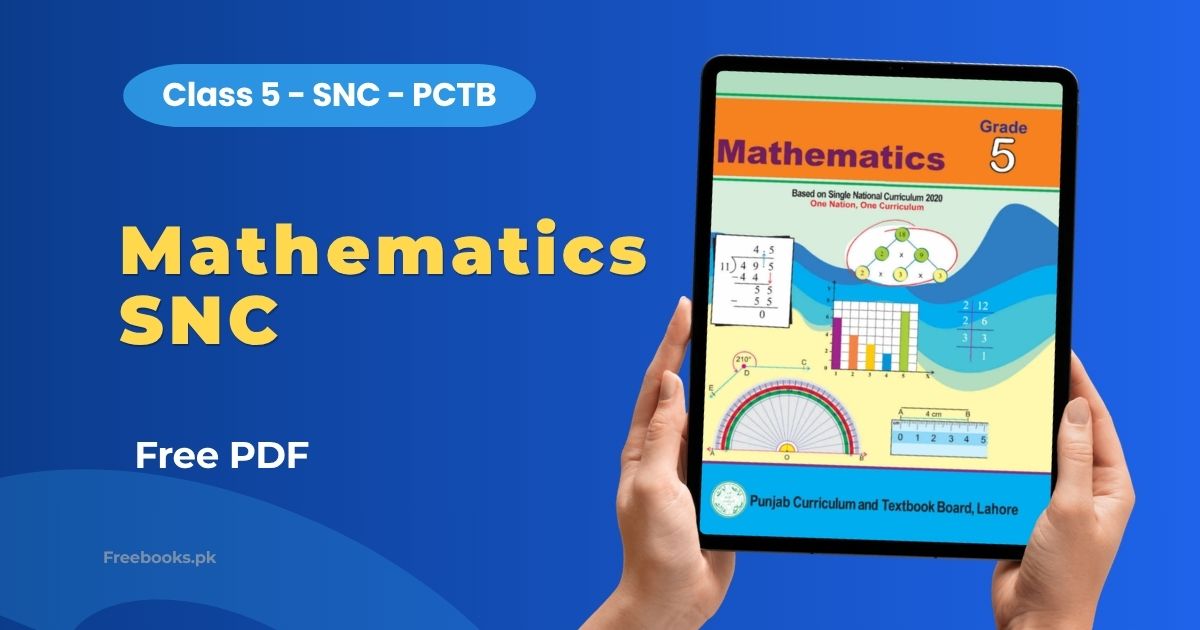
Mathematics for Class 5 is part of the official Punjab Curriculum and Textbook Board (PCTB) syllabus. This page has the current Single National Curriculum (SNC) 2020 book, plus the older PCTB edition in both English and Urdu Medium. The SNC book has 9 units, covering whole numbers, fractions, decimals, geometry, perimeter and area, and data handling.
For Class 5 students, this book builds core number sense and problem-solving skills needed for higher classes. Each unit here has a short summary and important questions with answers, so revision before tests and board exams is quicker, in whichever edition your school follows.
Book Overview
| Class | 5 |
| Subject | Mathematics |
| Board | Punjab Curriculum and Textbook Board (PCTB) |
| Editions Available | SNC 2020 (current) and PCTB old edition (English and Urdu Medium) |
| Total Units | 9 |
| Total Pages | 174 (SNC edition) |
| Format | PDF (Free Download) |
Chapter List
Unit 1: Whole Numbers and Operations
This unit teaches students to read, write, and understand numbers up to one million, using place value charts and expanded form for 6-digit numbers. It covers addition and subtraction of numbers up to 6 digits, and multiplication and division of numbers up to 5 digits by 2 and 3-digit numbers. The unit also introduces number patterns, showing how to find the rule of an increasing or decreasing pattern and extend it using addition, subtraction, multiplication, or division.
Important Questions:
- What is the place value of 5 in 456,907? Answer: 5 is at the ten thousands place, so its place value is 50,000.
- How do you write a number in expanded form? Answer: As the sum of the place values of each digit, e.g. 400,000 + 50,000 + 6,000 + 900 + 0 + 7.
- What is the rule of the pattern 5, 11, 17, 23? Answer: Each term increases by 6, so it is an addition pattern.
- How do you multiply a 5-digit number by a 3-digit number? Answer: Multiply by each digit of the multiplier separately, then add the partial products.
Unit 2: HCF and LCM
This unit explains how to find the Highest Common Factor (HCF) and Least Common Multiple (LCM) of two or three numbers up to 2 digits, using both prime factorization and division methods. It shows how HCF helps find the greatest quantity that divides given numbers exactly, useful for problems like cutting ropes into equal pieces. LCM helps find the smallest number divisible by given numbers, useful for problems about repeating events, like students visiting a lab together again.
Important Questions:
- What is HCF? Answer: The greatest number that divides two or more numbers completely.
- What is LCM? Answer: The smallest number that is completely divisible by two or more given numbers.
- Find the HCF of 36 and 54 using the division method. Answer: 18.
- Find the LCM of 8 and 12. Answer: 24.
Unit 3: Fractions
This unit covers addition and subtraction of fractions with different denominators, using the LCM to make denominators equal. It teaches multiplication of a fraction by a whole number and multiplication of two or three fractions, including proper, improper, and mixed numbers, with diagrams to show the process. It also explains division of fractions by converting mixed numbers into improper fractions and multiplying by the reciprocal.
Important Questions:
- How do you add fractions with different denominators? Answer: Find the LCM of the denominators, convert each fraction, then add the numerators.
- What is the product of 1/6 and 2/3? Answer: 1/9 in lowest form.
- How do you divide one fraction by another? Answer: Multiply the first fraction by the reciprocal of the second fraction.
- Subtract 3/4 from 2 and 2/3. Answer: 1 and 11/12.
Unit 4: Decimals and Percentage
This unit covers comparing and ordering decimals, addition and subtraction of decimals up to 3 decimal places, and multiplication and division of decimals by 10, 100, 1000, whole numbers, and other decimals. It teaches converting fractions into decimals through division, rounding off decimals to the nearest tenth or hundredth, and estimating sums and differences. The unit also introduces percentage as a special fraction with denominator 100, and shows conversions between fractions, decimals, and percentages.
Important Questions:
- Which is greater, 2.58 or 2.53? Answer: 2.58 is greater, since 8 is more than 3 at the hundredths place.
- How do you convert a percentage into a decimal? Answer: Divide the percentage by 100, e.g. 71% = 0.71.
- Round off 1.47 to the nearest tenth. Answer: 1.5.
- What is 30% of 20? Answer: 6.
Unit 5: Distance and Time
This unit teaches conversion of distance units, kilometres to metres, metres to centimetres, and centimetres to millimetres, and vice versa. It also covers conversion of time units, hours to minutes, minutes to seconds, and years to months, months to days, weeks to days, and vice versa. Students learn to add and subtract measures of distance and intervals of time, including carrying and borrowing, using real-life examples like travel distances and daily schedules.
Important Questions:
- How many metres are there in 56 km 450 m? Answer: 56,450 metres.
- Convert 480 minutes into hours. Answer: 8 hours.
- How many days are there in 6 weeks 3 days? Answer: 45 days.
- Add 2 km 670 m and 3 km 490 m. Answer: 6 km 160 m.
Unit 6: Unitary Method
This short unit teaches the unitary method, finding the value of one item first, then using it to find the value of many items, or the other way around. It covers three situations: finding the price of many objects when the price of one is known, finding the price of one object when the price of many is known, and finding a different quantity when the price of some units is known. Real-life examples include the cost of tubelights, notebooks, and buses.
Important Questions:
- What is the unitary method? Answer: Finding the value of one unit first and using it to find the value of multiple units.
- If 1 magnifying glass costs Rs 245, what do 8 cost? Answer: Rs 1,960.
- The cost of 20 chairs is Rs 7,240. What is the cost of 1 chair? Answer: Rs 362.
- 12 tubelights cost Rs 6,900. What is the cost of 7 tubelights? Answer: Rs 4,025.
Unit 7: Geometry
This large unit covers straight and reflex angles, measuring and constructing angles with a protractor, and classifying angles as acute, right, or obtuse. It explains adjacent, complementary, and supplementary angles, and describes triangles by their sides (equilateral, isosceles, scalene) and angles (acute, right, obtuse), including construction of triangles with given angles and sides. The unit also covers quadrilaterals such as square, rectangle, parallelogram, rhombus, trapezium and kite, reflective and rotational symmetry, and identifying cubes, cuboids, and pyramids from their nets.
Important Questions:
- What is a straight angle? Answer: An angle of 180 degrees.
- What are complementary angles? Answer: Two angles whose sum is 90 degrees.
- What is an isosceles triangle? Answer: A triangle with two equal sides.
- What is the net of a cube made of? Answer: 6 equal squares.
Unit 8: Perimeter and Area
This unit explains the difference between perimeter, the boundary length of a shape, and area, the space it covers, along with their units of measurement. It gives formulas for finding the perimeter and area of squares and rectangles, and applies them to real-life problems like fencing a field, tiling a floor, or finding the cost of a boundary wall. Students also practice finding a missing length or width when the perimeter or area is already known.
Important Questions:
- What is the formula for the perimeter of a square? Answer: 4 times the length of one side.
- What is the formula for the area of a rectangle? Answer: Length times width.
- Find the perimeter of a rectangle with length 26 cm and width 19.5 cm. Answer: 91 cm.
- A square room has a length of 11 m. What is its area? Answer: 121 square metres.
Unit 9: Data Handling
This unit teaches how to find the average of a set of quantities by dividing their sum by the number of quantities, and how to use averages to solve real-life problems, like exam marks or wages. It explains how to organize data using horizontal and vertical bar graphs, and how to read and interpret bar graphs to answer questions about totals, differences, and maximum or minimum values.
Important Questions:
- How do you find the average of a set of numbers? Answer: Divide the sum of the numbers by how many numbers there are.
- Find the average of 16, 12 and 11. Answer: 13.
- What does a bar graph show? Answer: It represents data visually using bars to compare values.
- If the sum of some quantities is 1,840 and their average is 115, how many quantities are there? Answer: 16.
Download Mathematics Class 5 PDF
Click the button below to download the Mathematics Class 5 PDF for free. Choose the edition that matches your school:
⬇ Download PDF (SNC English Medium)
⬇ Download PDF (PCTB Old, English Medium)
⬇ Download PDF (PCTB Old, Urdu Medium)
Who Should Read This
This book is meant for Class 5 students studying Mathematics under the Punjab Curriculum and Textbook Board, whether following the current SNC syllabus or the older PCTB edition in English or Urdu Medium. It also builds the number sense and problem-solving base useful for entry test Mathematics sections in later years.
Applicable Boards
This book is published by the Punjab Curriculum and Textbook Board (PCTB) and is the primary Mathematics textbook for Class 5 in Punjab. Since the current edition follows the Single National Curriculum (SNC), students in other provinces and boards using the same SNC syllabus can also refer to this book for their Class 5 Mathematics topics.
FAQs
Is this book for SNC or PCTB students?
Both editions are available on this page. Download the SNC 2020 edition if you follow the new curriculum, or the older PCTB edition in English or Urdu Medium if that is what your school uses.
Can other board students use this book?
Yes. Since the SNC edition is used across Pakistan, students from other boards following the Single National Curriculum can also use this book for Class 5 Mathematics.
Is this the latest edition?
The SNC 2020 book is the current edition used in Punjab schools. The PCTB edition is provided as an older alternative for schools still using it.
Does this book include exercises and questions?
Yes, each unit has exercises and a review exercise. This page also lists important questions with short answers for quick revision.
How many units are in this book?
The SNC edition has 9 units, covering whole numbers, HCF and LCM, fractions, decimals and percentage, distance and time, unitary method, geometry, perimeter and area, and data handling.
Is the PDF free to download?
Yes, all three editions on this page are completely free to download in PDF format.
Related Books
- English Class 5 SNC PDF Download – Punjab Board (PCTB)
- Urdu Class 5 SNC PDF Download – Punjab Board (PCTB)
- General Science Class 5 SNC PDF Download
- Islamiat Class 5 SNC PDF Download
- Social Studies Class 5 SNC PDF Download
Related Books
© Copyright Policy
Freebooks.pk is an educational resource for students in Pakistan. Textbooks and other books belong to their respective boards, authors and publishers, and all rights remain with them. If you are the copyright holder of any material on this page and want it changed or removed, please contact us or file a request under our DMCA policy. We review every request and remove reported content promptly.