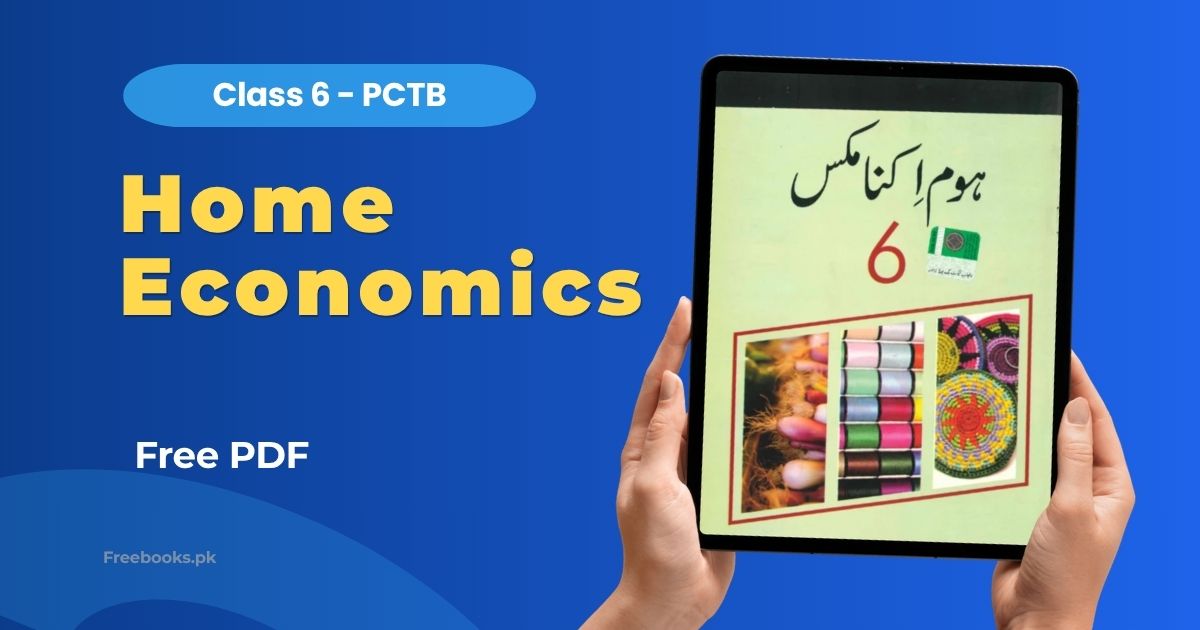
Home Economics for Class 6 is part of the official Punjab Curriculum and Textbook Board (PCTB) syllabus, in Urdu medium. It is part of the official Class 6 syllabus and covers 12 chapters across 85 pages, split into two sections: food and nutrition, and clothing with hand sewing.
For Class 6 students, this book builds everyday practical skills, cooking simple dishes, caring for clothes, and learning basic hand embroidery, alongside exam preparation. The chapter summaries and important questions on this page make revision quicker before class tests and the annual exam.
Book Overview
| Class | 6 |
| Subject | Home Economics |
| Medium | Urdu Medium |
| Board | Punjab Curriculum and Textbook Board (PCTB) |
| Author | Mrs. Anjum Nawaz |
| Publisher | Nadeem Law Book House, Lahore |
| Edition | 3rd Edition, April 2011 |
| Total Chapters | 12 |
| Total Pages | 85 |
| Format | PDF (Free Download) |
Chapter List
Chapter 1: Food and Nutrition (غذا اور غذائیت)
This chapter explains what food is and why the body needs it for survival, growth, and repair. It introduces the six essential nutrients, proteins, carbohydrates, fats, vitamins, minerals, and water, describing their sources and the role each plays in the body, from building tissue to providing energy and fighting disease. It closes by defining a proper and balanced diet as one that includes all six nutrients in the right amounts to keep the body healthy.
Important Questions:
- What are the three main functions food performs in the body? It supports growth, provides heat and energy, and repairs damaged tissue while building resistance to disease.
- What are the two main sources of protein? Animal sources such as meat, fish, eggs, and milk, and plant sources such as pulses, beans, and grains.
- What are the two types of vitamins based on solubility? Water-soluble vitamins like vitamin B-complex and C, and fat-soluble vitamins like vitamins A, D, E, and K.
- What is meant by a proper and balanced diet? A diet that includes protein, carbohydrates, fat, vitamins, minerals, and water in the right proportions for growth and health.
Chapter 2: Egg (انڈا)
This chapter explains the nutritional value of eggs, noting that the yolk is rich in fat, vitamin A, and minerals like phosphorus, calcium, and iron, while the egg white is almost pure protein. It covers how to tell a fresh egg from a spoiled one using tests like appearance, weight, and how it behaves in water, and explains two boiling methods, along with the steps for soft-boiled and hard-boiled eggs.
Important Questions:
- Which part of the egg contains more protein? The egg white, which is almost pure protein along with some water and minerals.
- How can you tell a fresh egg from a spoiled one in water? A fresh egg is heavy and sinks in water, while a spoiled egg is light and floats on the surface.
- How long should an egg be boiled for a soft-boiled result using the cold water method? Two to three minutes after the water starts boiling.
- Why should an egg be washed with cold water after boiling? It helps the shell come off easily and stops the egg from cooking further.
Chapter 3: Sago (ساگودانہ)
This chapter explains that sago is mainly a source of carbohydrates that gives the body heat and energy, along with a small amount of protein, and that its nutritional value increases when cooked with milk. It describes sago as light and easy to digest, making it suitable food for sick people and young children, and gives step by step instructions for cooking it with milk and sugar until the grains turn clear.
Important Questions:
- What is the main nutrient sago provides? Carbohydrates, which give the body heat and energy.
- Why is sago considered good for sick people and children? It is light, easy to digest, and helps restore strength and energy quickly.
- What sign shows that sago is fully cooked? The white grains turn clear and are no longer visible as solid white dots.
- Besides milk, in what else can sago be cooked? Sago can also be cooked in water when milk is not suitable or easily digested.
Chapter 4: Lemon Sikanjabeen (لیموں کی سکنجبین)
This chapter explains the nutritional importance of lemon and sugar, noting that lemon is rich in vitamin C and natural acidity, which strengthens immunity, protects against infection, and helps gums and teeth. It describes the two types of lemons available locally, one with more juice and one with less, and gives the recipe for sikanjabeen, a refreshing drink made from fresh lemon juice, sugar, salt, and water.
Important Questions:
- Which vitamin is lemon an important source of? Vitamin C, along with natural acidity and sourness.
- What are the two types of lemon mentioned in this chapter? One type with more juice, found mainly in December and January, and another with less juice, found mostly in spring and monsoon.
- What health benefits does lemon provide? It boosts immunity, protects against infections, strengthens gums and teeth, and helps stop bleeding and heal wounds.
- What ingredient in sikanjabeen provides carbohydrates? Sugar, which gives the body heat and energy and makes the drink sweet.
Chapter 5: Lassi and Raita (لسی اور رائتہ)
This chapter explains that milk is a complete food containing protein, carbohydrates, fat, vitamins, and minerals, and that yogurt made from milk carries nearly the same nutrients. It describes how yogurt can be eaten plain, made into raita with vegetables, or turned into dahi bhalay, and explains that raita becomes more nutritious with the addition of vegetables. It also gives instructions for making lassi and both boiled potato and boiled vegetable raita at home.
Important Questions:
- Why is milk considered a complete food? It contains adequate amounts of protein, carbohydrates, fat, vitamins, and minerals all together.
- How is yogurt traditionally made at home? By adding a small amount of starter yogurt to warm boiled milk and letting it set in a warm place.
- Why does adding vegetables to raita increase its nutritional value? Vegetables supply extra vitamins and minerals that support the body regular functions and health.
- Why is lassi especially popular in summer? Its cooling effect and salty, refreshing taste make it a favourite drink in hot weather.
Chapter 6: Sandwich (سینڈوچ)
This chapter explains that sandwiches are made by placing meat, egg, butter, cheese, or vegetables between slices of bread, and that their overall nutritional value depends on the fillings used, vegetables for vitamins and minerals, butter for fat, and egg, cheese, or meat for protein. It shows different ways to cut and present sandwiches, from tea-time slices to thicker meal sandwiches, and gives recipes for egg sandwiches and cucumber-tomato sandwiches.
Important Questions:
- What nutrient does the bread in a sandwich mainly provide? Carbohydrates.
- What determines the overall nutritional value of a sandwich? The nutritional value of the fillings placed inside it, such as vegetables, butter, egg, or meat.
- What ingredient provides protein in an egg sandwich? The mashed hard-boiled egg used as the filling.
- How should ready sandwiches be kept fresh until serving? Wrapped in a damp cloth or napkin so they stay soft.
Chapter 7: Salad (سلاد)
This chapter explains that salad can be made from raw or boiled vegetables as well as fruits, and that daily vegetable salad supplies the body with vitamins and minerals. It describes how to identify fresh produce by its shine, firmness, and lack of blemishes, and lists preparation tips such as washing vegetables thoroughly before use. It closes with recipes for a fresh vegetable salad, a boiled vegetable salad, and a fruit salad.
Important Questions:
- From what two sources can salad be prepared? From vegetables, both raw and boiled, and from fruits.
- What nutrients do leafy green vegetables and fruits mainly provide in a salad? Vitamins, calcium, and iron, along with carbohydrates from starchy vegetables and fruits.
- What is one sign of a fresh vegetable or fruit? It looks shiny and firm, with no dark spots or blemishes on the skin.
- What should always be done to vegetables before preparing a salad? They should be washed thoroughly with water first.
Chapter 8: Presenting Food on the Table (دسترخوان پر کھانا پیش کرنا)
This chapter explains that serving food is an art, and that even a simple meal looks appealing and increases appetite when presented neatly. It covers choosing a comfortable eating place, using clean and varied dishes, keeping the tablecloth simple with matching napkins, and setting the table so cutlery and glasses are placed correctly for each diner. It also lists table manners, such as washing hands before eating, waiting for elders to start, and reciting Bismillah before and Alhamdulillah after the meal.
Important Questions:
- Why does the chapter say serving food is an art? Because a neatly and attractively presented meal, even a simple one, increases appetite and enjoyment.
- What should be kept in mind when choosing dishes for serving food? Dishes do not need to be expensive, but their shapes and sizes should not all be identical.
- Where is the fork typically placed at a table setting? On the left side of the setting.
- What should a person say before starting and after finishing a meal? Bismillah before starting, and Alhamdulillah after finishing.
Chapter 9: Sewing Box (سلائی کا ڈبہ)
This chapter explains why keeping sewing items together in one place saves time and effort, and describes how to make a sewing box at home from an old shoebox covered with paper. It introduces the essential tools kept inside, scissors and shears, needles of different numbers, pins and pincushions, a thimble, sewing and embroidery threads, a measuring tape, a small ruler, an embroidery frame, tailor chalk, and a tracing wheel, explaining the purpose and care of each item.
Important Questions:
- What is the difference between shears and scissors? Shears are the larger scissors used for cutting cloth, while scissors are smaller and used for cutting thread and general trimming.
- Which needle number is the thickest? Number six, with needle numbers becoming finer as the number increases, up to the finest at number nine.
- What is a thimble used for? It is worn on the middle finger while sewing to protect it from being pricked by the needle.
- How should thread be tested for colourfastness before use? By rubbing a damp piece of the thread on white cloth to see if the colour comes off.
Chapter 10: Embroidery Stitches (کڑھائی کے ٹانکے)
This chapter teaches four basic embroidery stitches: stem stitch, used for making stems of flowers and leaves and for outlining shapes; chain stitch, used for stems and twigs and for the lazy daisy flower design; cross stitch, worked by counting the threads of the fabric to create patterns on materials like Aida cloth; and blanket stitch, used to finish and secure fabric edges so threads do not fray. Each stitch is explained with the materials needed and step by step instructions.
Important Questions:
- What is stem stitch mainly used for? Making the stems of flowers and leaves, and outlining the borders of shapes.
- What flower design is made using chain stitch? The lazy daisy stitch flower, usually made with six to eight petals.
- How is cross stitch worked? By counting the threads of the fabric rather than tracing a design, to keep the pattern even.
- What is the purpose of blanket stitch? To bind and finish fabric edges neatly so the threads do not come loose.
Chapter 11: Regional Stitches (علاقائی ٹانکے)
This chapter introduces embroidery stitches associated with specific regions of Pakistan: Sindhi stitch, worked in wave or straight line patterns for borders and fillings; Kashmiri stitch, using dark silk thread to fill flower and leaf outlines, popular on shawls and warm chadors; Balochi stitch, similar to Kashmiri work but used to fill triangular or square shapes, often on the necklines of shirts; and Swati stitch, worked from the back of the fabric using dark silk thread, common in Swat, Chitral, and Gilgit. It also introduces mirror work, popular in Sindh and Balochistan.
Important Questions:
- What are regional stitches formed from? A combination of different basic embroidery stitches associated with specific areas.
- What is Kashmiri stitch mainly used for? Filling in the outlines of flower and leaf designs, especially on shawls and warm chadors.
- Which regions is Swati stitch particularly associated with? Swat, Chitral, and Gilgit.
- Where is mirror work most commonly practiced? In Sindh and Balochistan, often combined with other embroidery stitches.
Chapter 12: Exhibition and Its Benefits (نمائش اور اس کی افادیت)
This chapter explains that holding an exhibition of items made in Home Economics class at the end of the year motivates students, builds their confidence, and lets them learn from seeing each other work. It gives guidance on choosing a suitable room with good lighting and enough wall space, arranging items class-wise with labels, and using classroom furniture to create display surfaces when a dedicated exhibition space is not available.
Important Questions:
- What benefit do students get from an end of year exhibition? It builds confidence and motivates them by letting them display their work and receive appreciation from others.
- What kind of room is suitable for holding an exhibition? A room with good lighting and at least two walls without windows or doors, for easy display.
- How should items in an exhibition be arranged? Class-wise, with proper labels, so each piece of work is presented clearly.
- Can items made by students be sold at the exhibition? Yes, items prepared by students, including group projects, can be displayed and offered for sale.
Download Home Economics Class 6 PDF
Click the button below to download the Home Economics Class 6 PDF for free:
Who Should Read This
This book is meant for Class 6 students studying Home Economics under the PCTB Urdu medium syllabus. It is also useful for anyone learning basic cooking, table setting, and hand embroidery skills at a beginner level.
Applicable Boards
This book is published by the Punjab Curriculum and Textbook Board (PCTB) and is taught in all Punjab Board affiliated schools. Students from other provincial boards studying a similar Home Economics syllabus may also find it useful.
FAQs
Is this Home Economics book for Class 6?
Yes, this is the official Punjab Curriculum and Textbook Board Home Economics textbook for Class 6, covering all 12 chapters of the syllabus.
Can other students use it?
Yes, students from other boards studying a similar Home Economics syllabus can also use this book for revision.
Is this the latest edition?
This PDF follows the third edition, printed in April 2011, the standard PCTB edition for Class 6.
Does it include practical activities?
Yes, each chapter includes recipes or step by step activities along with review questions for practice.
What topics does this book cover?
It covers food and nutrition topics like eggs, sago, lemon drink, lassi, sandwiches, and salad, plus clothing topics like the sewing box, embroidery stitches, regional stitches, and exhibitions.
How many pages does this book have?
The complete Home Economics Class 6 textbook has 85 pages across its 12 chapters.
Related Books
© Copyright Policy
Freebooks.pk is an educational resource for students in Pakistan. Textbooks and other books belong to their respective boards, authors and publishers, and all rights remain with them. If you are the copyright holder of any material on this page and want it changed or removed, please contact us or file a request under our DMCA policy. We review every request and remove reported content promptly.
Emicnomic ki book py full page Punjab board