Entrepreneurship is the process of designing, launching, and running a new business that offers a product, process, or service, and it involves the willingness to take risks and innovate in order to create value. This chapter explores what entrepreneurship means, the key characteristics that successful entrepreneurs share, and why entrepreneurship matters for economic growth and innovation, with examples ranging from global tech startups to local businesses and Pakistan's own thriving freelancing community.
The chapter then turns to the digital landscape, covering how digital technologies such as social media, mobile apps, cloud computing, and big data analytics are transforming the way businesses operate, along with digital marketing strategies, e-commerce platforms, and real Pakistani case studies like Daraz and Bykea. It also introduces practical digital tools for market research, online marketing, and e-commerce, before moving into business idea generation through problem identification and design thinking, developing comprehensive business plans, and finally ethical and sustainable entrepreneurship aligned with the UN Sustainable Development Goals (SDGs).
Learning Objectives
- Define entrepreneurship and explain its significance in the digital age
- Differentiate between types of entrepreneurship, such as startups, social enterprises, and local businesses
- Identify key characteristics of successful entrepreneurs, including innovation and risk-taking
- Analyze the impact of digital technologies on entrepreneurship, including digital marketing and e-commerce
- Identify digital tools and platforms used for market research, online marketing, and e-commerce operations
- Apply techniques for business idea generation, including problem identification and design thinking
- Describe the key components of a comprehensive business plan
- Explain the principles of ethical and sustainable entrepreneurship and their connection to the Sustainable Development Goals (SDGs)
Key Concepts
12.1 What Is Entrepreneurship?
Entrepreneurship is the process of starting a new business or organization. It involves identifying a need in the market, coming up with an idea to meet that need, and taking the risk to bring that idea to life. Entrepreneurs are the people who create and run these businesses — they are innovators, risk-takers, and problem-solvers. Examples range from tech startups like Facebook, Google, and Apple, which began as small companies founded by entrepreneurs with innovative ideas, to local businesses such as a neighborhood bakery or a small clothing boutique that serve their communities.
Pakistan is home to one of the largest freelancing communities in the world, ranking among the top countries for freelance growth, with entrepreneurs offering skills in software development, graphic design, and digital marketing. This entrepreneurial spirit helps drive economic growth and innovation across the country. The word 'entrepreneur' itself comes from a French word meaning 'to undertake' — entrepreneurs undertake the task of starting and running new businesses.
12.2 Key Characteristics and Importance of Entrepreneurship
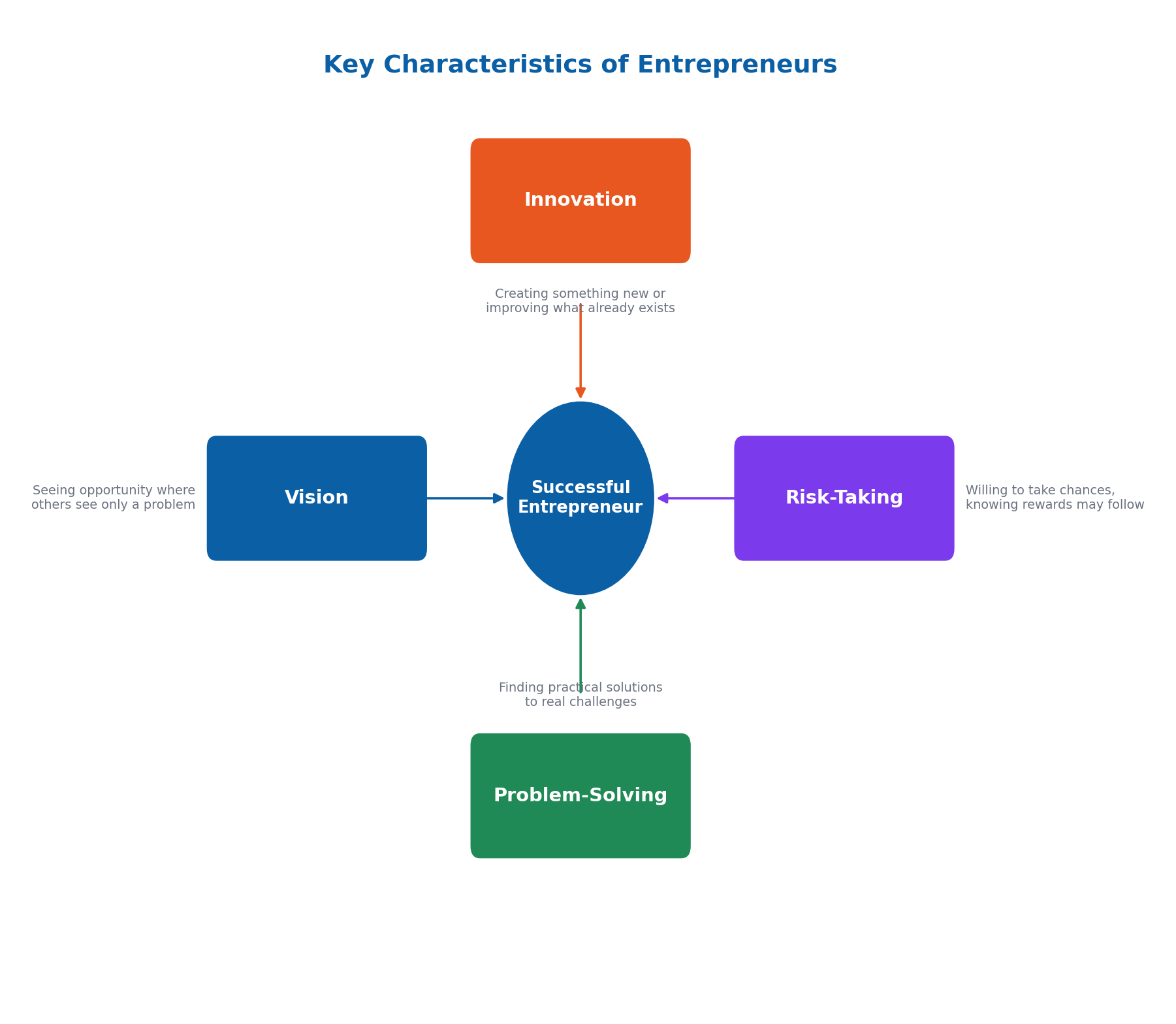
Successful entrepreneurs share several key characteristics. Innovation means creating something new or improving something that already exists — entrepreneurs are always looking for new ways to solve problems or make things better. Risk-taking is essential since starting a new business involves the possibility of failure, but entrepreneurs know that taking calculated risks can also lead to great rewards. Other important traits include problem-solving and vision — the ability to see an opportunity where others see only a problem.
Entrepreneurship is important because it drives economic growth, creates jobs, and fosters innovation. When entrepreneurs start new businesses, they contribute to the economy by creating jobs and providing new products and services, and new businesses bring fresh ideas and competition that lead to better products and services for everyone. Entrepreneurs also often come up with groundbreaking ideas that change how we live and work — the invention of the smartphone, for example, revolutionized communication and access to information.
12.3 Digital Transformation and Technologies
The digital landscape has revolutionized the way entrepreneurs start and grow their businesses. Digital entrepreneurship involves leveraging the power of the internet, digital platforms, and various technologies to create and run businesses. Digital technologies provide entrepreneurs with tools that can enhance business operations, reach a global audience, and improve efficiency, including social media (Facebook, Instagram, Twitter) for marketing and customer engagement, mobile apps that offer services directly to customers' smartphones, cloud computing that allows businesses to store data and run applications over the internet without heavy physical infrastructure, and big data analytics that helps businesses understand market trends and customer behavior.
While digital entrepreneurship offers opportunities such as access to a global market, cost-effective marketing, and enhanced customer engagement, it also comes with challenges such as cybersecurity threats, high competition, and the need for continuous innovation to keep up with technological advancements.
12.4 Digital Marketing and E-commerce
Digital marketing involves promoting products and services using digital channels, while e-commerce refers to buying and selling goods online. Key digital marketing strategies include Search Engine Optimization (SEO), which optimizes website content to rank higher in search results; Social Media Marketing, which uses social platforms to promote products and build brand awareness; Content Marketing, which creates valuable content like blogs and videos to attract customers; and Email Marketing, which sends targeted emails to promote products and build relationships. Digital marketing can reach a global audience at a fraction of the cost of traditional marketing, and its effectiveness can be measured precisely using analytics tools.
E-commerce platforms like Amazon, eBay, and Shopify let entrepreneurs set up online stores, manage inventory, process payments, and provide customer service to a global audience. In Pakistan, Daraz is a leading e-commerce platform that has transformed the shopping experience with a wide range of products, secure payment options, and efficient delivery, while Bykea is a Pakistani startup that uses mobile apps to provide on-demand transportation and delivery services — demonstrating the potential of digital entrepreneurship in emerging markets. According to the Pakistan Telecommunication Authority (PTA), Pakistan's e-commerce market was estimated at around $4 billion in 2021, with significant growth expected in the years since.
12.5 Digital Tools and Platforms
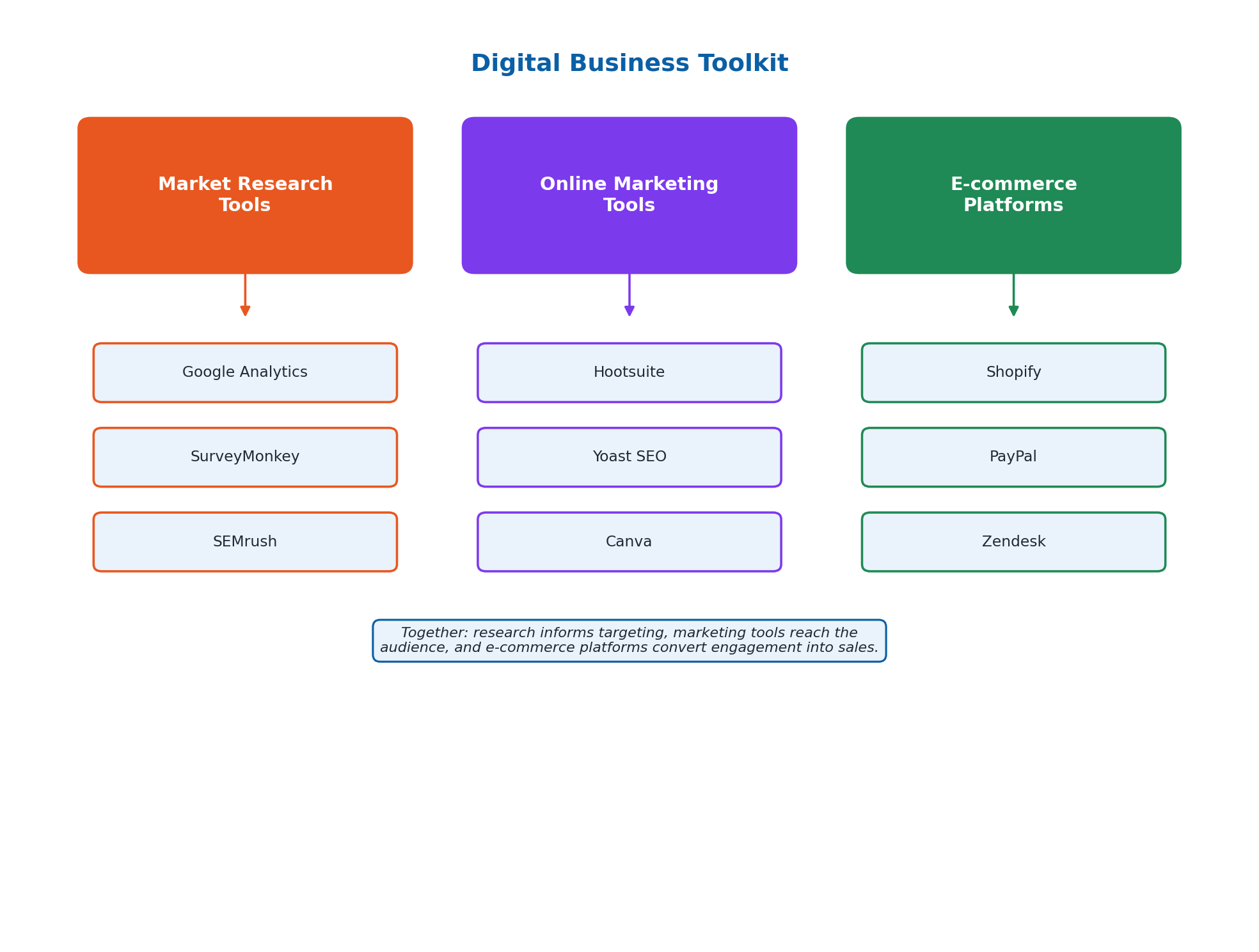
Digital tools are software and online services that help perform tasks efficiently, ranging from simple applications like Google Docs (which allows multiple users to collaborate on documents in real time) to complex Customer Relationship Management (CRM) systems. Market research tools help businesses understand their target audience, competitors, and market trends: Google Analytics tracks website traffic and user behavior, SurveyMonkey conducts online surveys to gather customer feedback, and SEMrush analyzes competitors' online presence and performance.
Online marketing tools assist businesses in promoting products through digital channels: Hootsuite manages social media accounts and schedules posts, Yoast SEO optimizes website content for search engines, and Canva creates visually appealing graphics and marketing materials. E-commerce platforms and tools enable businesses to sell online and manage operations: Shopify creates and manages online stores, PayPal integrates secure payment gateways, and Zendesk provides customer service solutions for handling inquiries and support.
12.6 Business Idea Generation
Generating business ideas is an important step in the entrepreneurial journey, combining ideation (the process of generating ideas) with problem-solving (finding effective solutions to challenges). Identifying market needs and opportunities is the first step toward a viable business idea, and this can be done through surveys and questionnaires that collect feedback directly from potential customers, market research that analyzes trends and consumer behavior, and observation of how people interact with existing products and services. In Pakistan, observing the popularity of online shopping has led entrepreneurs to build e-commerce platforms tailored to local preferences — the ride-hailing startup Careem, for example, began as a transportation service and expanded into delivery and payment solutions based directly on market needs.
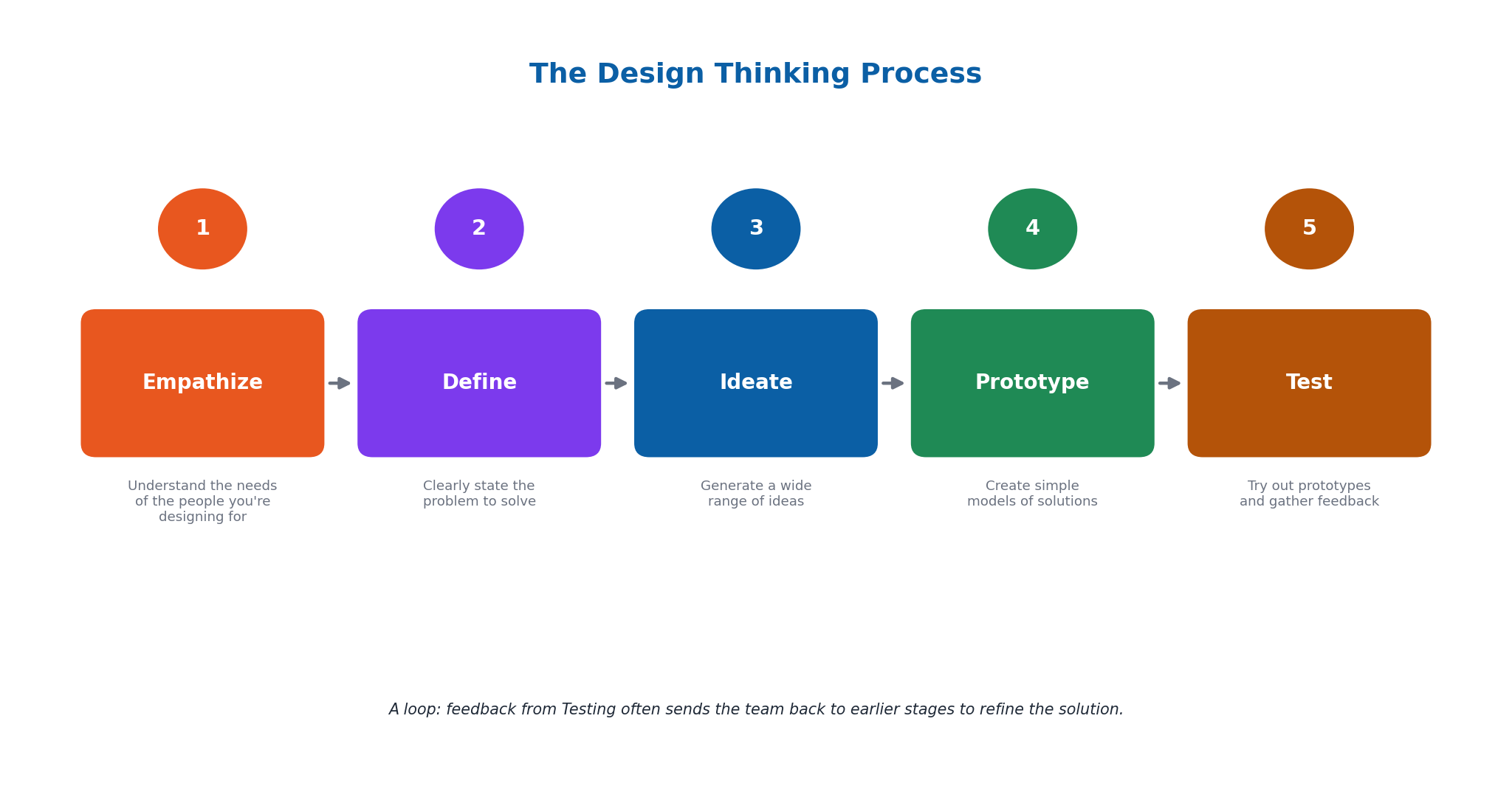
Creative problem-solving uses innovative thinking to develop solutions to identified problems, often through design thinking — a solution-focused approach with five stages: Empathizing (understanding the needs of the people you're designing for), Defining (clearly stating the problem to solve), Ideating (generating a range of ideas), Prototyping (creating simple models of solutions), and Testing (trying out prototypes and gathering feedback). Many successful companies, including Apple and Google, use design thinking to develop products that genuinely meet user needs — for example, students could use design thinking to develop an app that helps farmers in rural Pakistan access weather forecasts and market prices.
12.7 Developing Business Plans
A business plan is a detailed document that outlines a business's goals and the strategies used to achieve them, serving as a blueprint that helps entrepreneurs stay organized and focused. A comprehensive business plan typically includes three key components. Market Analysis involves researching the target market to understand customer needs and preferences, including studying market trends, analyzing competitors, and identifying the target audience. Revenue Models outline how a business will generate income, including pricing strategies, sales forecasts, and potential revenue streams. Digital Marketing Strategies describe how the business will be promoted online through channels such as social media, search engines, and email marketing.
Prototyping and iteration are also part of business planning: prototyping involves creating a preliminary model of a product or service — a sketch, digital model, or physical sample — to visualize and test ideas early, while iteration means making improvements based on feedback gathered from potential customers and stakeholders. Many successful companies, such as Facebook and Airbnb, started with simple prototypes and iterated based on user feedback to become the companies they are today.
12.8 Ethical and Sustainable Entrepreneurship
Entrepreneurship isn't only about making profits — it is also about conducting business in a way that is ethical and sustainable. Ethical entrepreneurship involves incorporating principles of ethics into all aspects of business operations and decision-making, including honesty (being truthful in all business dealings), integrity (acting consistently with moral values), fairness (ensuring equal opportunities and fair treatment), and respect (valuing the rights and dignity of all individuals). Sustainable growth focuses on developing a business that meets present needs without compromising the ability of future generations to meet their own needs.
The Sustainable Development Goals (SDGs) are a set of 17 global goals established by the United Nations to address social, economic, and environmental challenges, and businesses can play a crucial role in achieving them. Businesses can contribute to Social Sustainability by ensuring fair labor practices and supporting community development, Environmental Sustainability by reducing carbon footprints and minimizing waste, and Economic Sustainability by creating jobs and fostering innovation. A Pakistani startup focusing on solar energy solutions, for example, contributes to SDG 7 (Affordable and Clean Energy) by providing sustainable energy to communities with limited access to electricity, while Pakistan's first certified green building, the WWF-Pakistan Head Office in Lahore, showcases sustainable architecture contributing to multiple SDGs.
Important Definitions
What is entrepreneurship?
The process of designing, launching, and running a new business, often initially a small business, offering a product, process, or service for sale or hire, involving the willingness to take risks and innovate to create value.
What is digital entrepreneurship?
The practice of leveraging the internet, digital platforms, and various digital technologies to create and run businesses, including digital marketing and e-commerce.
What is e-commerce?
The buying and selling of goods and services online, often through platforms like Amazon, Daraz, or Shopify that let businesses set up stores, manage inventory, and process payments.
What is digital marketing?
The practice of promoting products and services using digital channels such as search engines, social media, content, and email, rather than traditional advertising methods.
What is design thinking?
A solution-focused approach to creative problem-solving involving five stages: Empathizing, Defining, Ideating, Prototyping, and Testing.
What is a business plan?
A detailed document that outlines a business's goals and the strategies it will use to achieve them, typically including a market analysis, a revenue model, and a digital marketing strategy.
What is a revenue model?
A plan outlining how a business will generate income, including its pricing strategies, sales forecasts, and potential revenue streams.
What are the Sustainable Development Goals (SDGs)?
A set of 17 global goals established by the United Nations to address social, economic, and environmental challenges, which businesses can support through ethical and sustainable practices.
Key Facts and Relations
| Topic | Key Fact / Relation |
|---|---|
| Meaning of the word 'entrepreneur' | From a French word meaning 'to undertake' |
| 2 key characteristics of entrepreneurs | Innovation and Risk-Taking (also Problem-Solving) |
| 3 example market research tools | Google Analytics, SurveyMonkey, SEMrush |
| 3 example online marketing tools | Hootsuite, Yoast SEO, Canva |
| 5 steps of design thinking | Empathize, Define, Ideate, Prototype, Test |
| 3 core components of a business plan | Market Analysis, Revenue Model, Digital Marketing Strategy |
| Pakistan's e-commerce market size (2021, PTA estimate) | Around $4 billion |
| Number of UN Sustainable Development Goals | 17 global goals |
Diagrams
Key Characteristics of Entrepreneurs: A diagram showing the core traits of successful entrepreneurs: Innovation, Risk-Taking, Problem-Solving, and Vision
Digital Business Toolkit: A diagram comparing Market Research Tools, Online Marketing Tools, and E-commerce Platforms with real examples of each
The Design Thinking Process: A flow diagram of the five-stage design thinking process: Empathize, Define, Ideate, Prototype, and Test
Short Questions & Answers
What is entrepreneurship?
Entrepreneurship is the process of starting and running a new business or organization, involving identifying a market need, developing an idea to meet it, and taking the risk to bring that idea to life.
What does the word 'entrepreneur' mean and where does it come from?
The word 'entrepreneur' comes from a French word meaning 'to undertake' — entrepreneurs undertake the task of starting and running new businesses.
Name two key characteristics of successful entrepreneurs.
Innovation, which means creating something new or improving on what exists, and risk-taking, which means being willing to take chances despite the possibility of failure.
What is digital entrepreneurship?
Digital entrepreneurship is the practice of leveraging the internet, digital platforms, and technologies such as social media, mobile apps, and cloud computing to create and grow a business.
What is the difference between digital marketing and e-commerce?
Digital marketing involves promoting products and services using digital channels like SEO, social media, and email, while e-commerce refers to the actual buying and selling of goods and services online.
What is design thinking, and what is its first step?
Design thinking is a solution-focused approach to creative problem-solving; its first step is Empathizing, which means understanding the needs of the people you are designing for.
What are the three main components of a business plan mentioned in the chapter?
Market Analysis, which researches the target market and competitors; a Revenue Model, which outlines how the business will generate income; and Digital Marketing Strategies, which describe how the business will be promoted online.
How can a business contribute to environmental sustainability?
A business can contribute to environmental sustainability by reducing its carbon footprint, using renewable resources, and minimizing waste, in line with the UN Sustainable Development Goals.
Long Questions & Answers
Explain why entrepreneurship is important for economic growth and innovation, using examples from the chapter.
How does entrepreneurship contribute to economic growth and competition?
Entrepreneurship plays a central role in driving economic growth, creating jobs, and fostering innovation in any economy. When entrepreneurs identify a need in the market and start new businesses to meet it, they directly contribute to the economy by creating employment opportunities and offering new products and services that were not previously available. This process also introduces fresh ideas and healthy competition into a market, and that competition tends to push existing companies to improve their own offerings, ultimately resulting in better products, better services, and often lower prices for everyone.
How is entrepreneurship linked to innovation?
Entrepreneurship is closely tied to innovation and long-term progress, since entrepreneurs are frequently the people who come up with the groundbreaking ideas that change how people live and work. The invention of the smartphone is a clear example of this kind of entrepreneurial innovation — a single new product category that went on to revolutionize communication and access to information worldwide.
How does Pakistan's freelancing community illustrate these principles?
Pakistan is home to one of the largest freelancing communities in the world and ranks among the top countries for freelance growth, with entrepreneurs offering skills in software development, graphic design, and digital marketing to clients across the globe. This entrepreneurial activity brings foreign income into the country, builds valuable digital skills among young people, and helps drive broader economic growth and innovation.
How do Daraz and Bykea illustrate entrepreneurship solving real problems?
Local case studies such as Daraz, which transformed online shopping in Pakistan through secure payments and efficient delivery, and Bykea, which used mobile technology to solve real transportation and delivery challenges in Pakistani cities, demonstrate how entrepreneurship converts everyday problems into successful, job-creating businesses. Together, these examples show that entrepreneurship is not simply about individual business owners seeking profit — it is a broader economic engine that creates jobs, sparks innovation, and improves the range and quality of products and services available to society as a whole.
Explain how market research tools, online marketing tools, and e-commerce platforms can work together to help a business succeed in the digital world.
What are market research tools, and what examples exist?
Market research tools help a business understand its target audience, competitors, and broader market trends before it invests heavily in a product or campaign. Google Analytics tracks website traffic and user behavior, revealing which pages visitors spend time on and where they drop off; SurveyMonkey allows a business to run online surveys that gather direct feedback from potential or existing customers; and SEMrush analyzes competitors' online presence, helping a business understand what rivals are doing well and where gaps in the market might exist.
What are online marketing tools, and what examples exist?
Once a business has a clear picture of customer needs, online marketing tools become essential for actually reaching and engaging that target audience. Hootsuite lets a business manage multiple social media accounts and schedule posts from a single dashboard, ensuring a consistent online presence without constant manual effort; Yoast SEO helps optimize website content so it ranks higher in search engine results and reaches customers actively searching for related products; and Canva makes it easy to design visually appealing graphics and marketing materials without needing professional design skills.
What are e-commerce platforms, and what examples exist?
E-commerce platforms convert audience attention into actual sales and ongoing customer relationships. Shopify allows a business to create and manage a fully functional online store; PayPal integrates secure payment gateways so customers can complete purchases with confidence; and Zendesk provides customer service tools to handle inquiries and support after the sale. Together, these tools handle the final stage of the customer journey, from browsing to a completed, well-supported purchase.
How do market research, marketing, and e-commerce tools work together for business success?
When these three categories work together in sequence — research informing who to target and what they want, marketing tools reaching and engaging that audience, and e-commerce platforms converting that engagement into secure, well-supported sales — a business is far better positioned to succeed in the competitive digital marketplace than if it relied on guesswork or used these tools in isolation.
Explain the design thinking process and how it can be applied to create a new product or service, using an example relevant to farmers in rural Pakistan.
What happens in the Empathizing and Defining stages of design thinking?
Design thinking is a solution-focused, human-centered approach to creative problem-solving that moves through five connected stages. In Empathizing, the goal is to genuinely understand the needs, challenges, and daily experiences of the people the product or service is being designed for, often through direct conversations, observation, or research rather than assumptions. In Defining, the team takes everything learned during empathizing and distills it into a clear, specific statement of the actual problem that needs to be solved, since a vague or overly broad problem statement makes it difficult to design a focused solution.
What happens in the Ideating and Prototyping stages of design thinking?
In Ideating, the team generates as wide a range of possible ideas and solutions as possible, deliberately avoiding early judgment so that creative or unconventional ideas have room to surface. In Prototyping, the most promising ideas are turned into simple, low-cost models — a sketch, a basic digital mockup, or a rough physical sample — that make the idea tangible enough to react to.
What happens in the Testing stage, and why might it loop back?
In Testing, prototypes are put in front of real users to gather feedback, and that feedback is then used to refine the idea, often looping back to earlier stages if needed. This looping is what makes design thinking iterative rather than strictly linear — if testing reveals that the core problem was misunderstood or a solution missed the mark, the team can return to empathizing, defining, or ideating rather than pushing ahead with something that does not actually work for real users.
How are the Empathizing and Defining stages applied to the rural Pakistan farmer example?
A team of students might begin by empathizing with farmers directly, visiting a village or speaking with farming families to understand the specific difficulties they face in planning their planting and harvesting around unpredictable weather and in getting fair prices for their crops. Based on those conversations, the team would define the core problem clearly, for example: 'Farmers in this region lack easy, reliable access to accurate weather forecasts and current market prices for their crops.'
How are the Ideating, Prototyping, and Testing stages applied to the rural Pakistan farmer example?
In the ideating stage, the team might brainstorm many possible solutions, from a simple SMS alert service to a full smartphone app, before narrowing in on the most promising concept given the farmers' access to basic mobile phones. They would then build a prototype, perhaps a simple mockup of an SMS-based system or a basic app screen showing today's weather and nearby market prices, and test it with a small group of farmers to see whether the information is genuinely useful, easy to understand, and delivered in a way farmers can act on.
Multiple Choice Questions (MCQs)
What is entrepreneurship? (A) The process of starting a new business or organization (B) The process of buying and selling stocks (C) The process of working for a large company (D) The process of creating a marketing campaign
Correct answer: (A) The process of starting a new business or organization. Entrepreneurship is the process of designing, launching, and running a new business or organization, offering a product, process, or service.
What is a key characteristic of entrepreneurs? (A) Avoiding risks (B) Seeking job security (C) Innovation (D) Following established methods
Correct answer: (C) Innovation. Innovation is a key characteristic of entrepreneurs, who are always looking for new ways to solve problems or improve on what already exists.
What is an example of a digital technology used by modern entrepreneurs? (A) Newspaper advertisements (B) Television commercials (C) Mobile apps (D) Door-to-door sales
Correct answer: (C) Mobile apps. Mobile apps are a digital technology that lets modern entrepreneurs offer services directly to customers' smartphones.
Which of the following is an example of a digital tool for creating and editing documents online? (A) SurveyMonkey (B) Google Docs (C) SEMrush (D) Zendesk
Correct answer: (B) Google Docs. Google Docs is a digital tool for creating and editing documents online, allowing multiple users to collaborate in real time.
Which tool is commonly used for optimizing website content for search engines? (A) Hootsuite (B) Yoast SEO (C) Shopify (D) PayPal
Correct answer: (B) Yoast SEO. Yoast SEO is used to optimize website content so it ranks higher in search engine results.
Which of the following is NOT a technique for identifying market needs? (A) Surveys and Questionnaires (B) Market Research (C) Observation (D) Brainstorming
Correct answer: (D) Brainstorming. Surveys and Questionnaires, Market Research, and Observation are techniques for identifying market needs; Brainstorming is instead used during creative problem-solving to generate ideas.
What is the first step in the design thinking process? (A) Prototyping (B) Testing (C) Empathizing (D) Defining
Correct answer: (C) Empathizing. Empathizing, which means understanding the needs of the people being designed for, is the first step in the design thinking process.
What is the primary purpose of creating a business plan? (A) To attract investors (B) To outline strategies for growth (C) To study market trends (D) To implement digital marketing strategies
Correct answer: (B) To outline strategies for growth. A business plan primarily serves as a blueprint that outlines the strategies a business will use to achieve its goals and grow.
What does market analysis involve? (A) Calculating revenue forecasts (B) Researching competitors and understanding customer needs (C) Developing pricing strategies (D) Implementing digital marketing campaigns
Correct answer: (B) Researching competitors and understanding customer needs. Market analysis involves researching the target market, including studying trends, analyzing competitors, and understanding customer needs and preferences.
Which Sustainable Development Goal (SDG) focuses on affordable and clean energy? (A) SDG 5 (B) SDG 7 (C) SDG 12 (D) SDG 17
Correct answer: (B) SDG 7. SDG 7, Affordable and Clean Energy, focuses on ensuring access to affordable, reliable, sustainable, and modern energy for all.
Quick Revision Summary
- Entrepreneurship = starting and running a new business; word comes from French for 'to undertake'
- Key entrepreneur traits: Innovation, Risk-Taking, Problem-Solving, Vision
- Digital technologies for business: social media, mobile apps, cloud computing, big data analytics
- 4 digital marketing strategies: SEO, Social Media Marketing, Content Marketing, Email Marketing
- Market research tools: Google Analytics, SurveyMonkey, SEMrush
- Online marketing tools: Hootsuite, Yoast SEO, Canva | E-commerce tools: Shopify, PayPal, Zendesk
- Design thinking (5 steps): Empathize, Define, Ideate, Prototype, Test
- Business plan components: Market Analysis, Revenue Model, Digital Marketing Strategy
Exam Tips
- Remember design thinking with the acronym EDIPT: Empathize, Define, Ideate, Prototype, Test
- Copyright/trademark/patent belong to Chapter 11 — don't confuse them with Chapter 12's business plan components
- 3 components of a business plan: Market Analysis, Revenue Model, Digital Marketing Strategy — a common short-answer question
- Pakistani case studies to remember: Daraz (e-commerce), Bykea (ride-hailing/delivery), Careem (transport → delivery/payments)
- SDGs = 17 UN goals; know SDG 7 (Affordable and Clean Energy) as it appears directly in past exam questions
- Ethical entrepreneurship principles: Honesty, Integrity, Fairness, Respect — remember as 'HIFR'