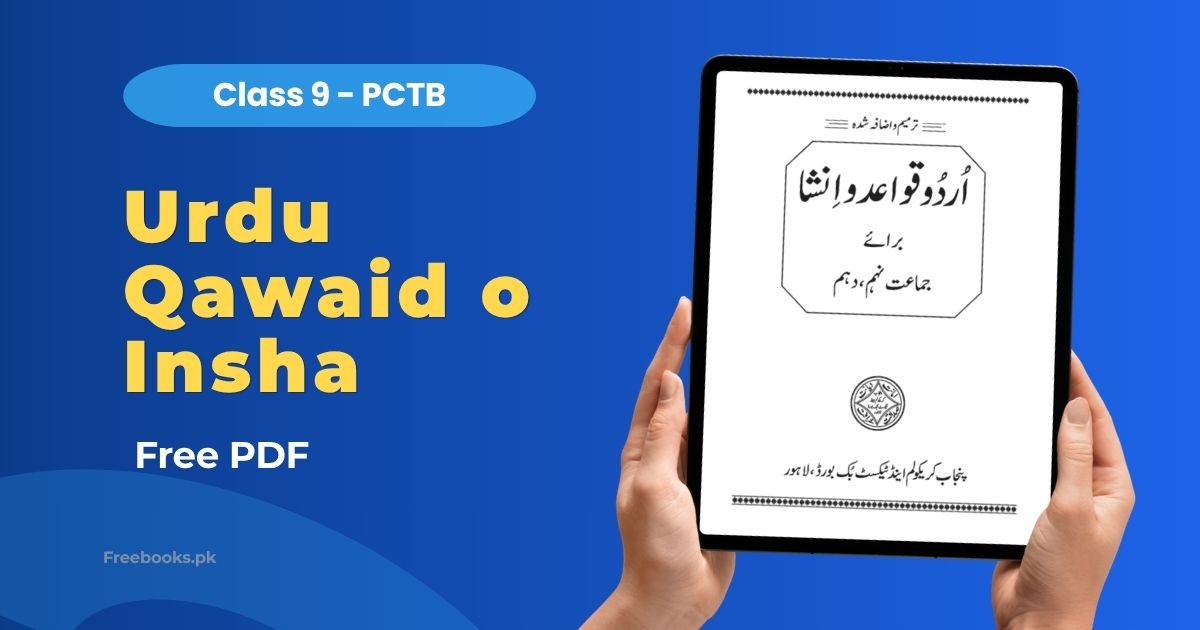
Urdu Qawaid o Insha (Urdu Grammar and Composition) is the official textbook published by the Punjab Curriculum and Textbook Board (PCTB), Lahore, for Class 9. This is a revised and expanded edition covering both language grammar and composition writing, and follows the official Punjab Board syllabus.
For Class 9 students, this book lays the groundwork in Urdu grammar rules and writing formats — letters, applications, receipts, dialogues, stories, and essays. Explanations are simple and example-driven, helping students build the basics before moving into the more exam-focused practice they’ll need in Class 10.
Book Overview
- Class: 9
- Subject: Urdu Qawaid o Insha (Grammar and Composition)
- Board: Punjab Board (PCTB, Lahore)
- Authors: Dr. Arifa Syeda Zahra, Prof. Syed Waqar Azeem, Dr. Suhail Bukhari, Mirza Hadi Ali Baig, Molana Mustafa Hussain Fazil
- Supervisor: Dr. Ali Muhammad Khan (Professor of Urdu, PCTB Consultant)
- Publisher: Punjab Curriculum and Textbook Board, Lahore
- Edition: Revised and Expanded (Experimental Edition)
- Medium: Urdu
- Format: PDF
Note: This Urdu Qawaid o Insha book is published as one combined syllabus for Class 9 and Class 10 — the same grammar and composition topics apply across both years, taught with increasing depth. For the Class 10 page, see Urdu Qawaid o Insha Class 10.
Chapter List
Part 1: Qawaid-e-Zaban (Language Grammar)
1 – Words, Sentences and Kalima Types (لفظ، جملہ اور کلمے کی قسمیں)
Starts with the basics: what a word and a sentence are, how compound and coordinate sentences are formed, and the different types of Kalima (parts of speech) in Urdu.
2 – Urdu Script and Letters (رسم الخط اور حروف)
Introduces dotted, undotted, and heavy letters, along with the distinction between Shamsi and Qamari letters in Urdu script.
3 – Noun and Its Types (اسم اور اس کی اقسام)
Covers noun classification by meaning, the difference between definite (Marfa) and indefinite (Nakra) nouns, noun types by structure, and gender and number.
4 – Verb and Auxiliary Verbs (فعل اور افعال معاون)
Explains the types of verbs and how auxiliary (helping) verbs work in Urdu sentences.
5 – Particles and Vocabulary (حروف، مترادف و متضاد الفاظ)
Covers particles (Huroof) and their types, along with synonyms, antonyms, and words that sound alike but carry different meanings.
6 – Punctuation, Prefixes/Suffixes and Compounds (رموز اوقاف، سابقے لاحقے، مرکبات)
Introduces punctuation marks, common prefixes and suffixes, and how compound words are formed and classified.
7 – Usage Rules and Pronunciation (استعمال کی قواعد اور تلفظ)
Covers the correct use of “ne” and “ko” in sentences, along with pronunciation basics for commonly confused words.
8 – Idioms, Proverbs and Rhetoric (محاورے، ضرب الامثال، علم بیان)
Introduces everyday idioms and proverbs, plus a first look at Urdu rhetoric (Ilm-e-Bayan) and literary devices.
Part 2: Insha Pardazi (Composition Writing)
9 – Letter Writing (خطوط نویسی)
Teaches the parts of a letter, proper titles and etiquette, and walks through sample letters step by step.
10 – Application Writing (عرائض نویسی)
Covers the basic format for writing an application, with guidelines and beginner-friendly sample applications.
11 – Receipt Writing (رسید نویسی)
Explains what a receipt needs to include and shows sample receipts for common situations.
12 – Dialogue Writing (مکالمہ نگاری)
Introduces how to structure a written dialogue between two or more people, with sample conversations.
13 – Story Writing (کہانی نویسی)
Covers the essentials of writing a short story, including sample stories and practice building a story from a given outline.
14 – Essay Writing (مضمون نگاری)
Introduces the types of essays and works through sample essays to build confidence with structure and flow.
15 – Reading Comprehension and Practice (تفہیم عبارت اور مشق)
Explains how to approach a comprehension passage, with sample passages, questions and answers, plus extra passages for practice.
Download Urdu Qawaid o Insha Class 9 Book PDF (PCTB)
Click the button below to download the complete Urdu Qawaid o Insha PDF for free. This combined Class 9-10 book covers the full grammar and composition syllabus — the file opens in a new tab and is ready to read or save on any device.
⬇ Download PDFWho Should Read This
Class 9 students following the Punjab Board (PCTB) syllabus need this book to build a solid foundation in Urdu grammar and composition before their Matric exams. It’s also useful for anyone who wants a clear, example-led introduction to Urdu writing formats.
Applicable Boards
PCTB (Punjab Curriculum and Textbook Board), Lahore, publishes this Urdu Qawaid o Insha book for Punjab Board Class 9 students. Since the grammar and composition syllabus can vary slightly by province, students from other boards should confirm their own curriculum before using this edition for exam preparation.
FAQs
Is this Urdu Qawaid o Insha book for Class 9?
Yes. This is the official Class 9 page for the PCTB Urdu Qawaid o Insha textbook, which is published as one combined book for Class 9 and Class 10.
Is this different from the Class 10 version?
The underlying book and topics are the same for both classes, since PCTB publishes Urdu Qawaid o Insha as a single Class 9-10 syllabus. Our Class 9 and Class 10 pages cover the same chapter list with class-appropriate context — see the separate Class 10 page for that framing.
Is this the latest edition?
Yes. This is the revised and expanded (experimental) edition published by PCTB.
Does this book cover both grammar and composition?
Yes. It has two parts: Qawaid-e-Zaban (language grammar) and Insha Pardazi (composition writing, including letters, applications, stories, and essays).
Related Books
- Urdu Class 10
- Urdu Class 8
- Urdu Class 9
- Urdu Class 9 (Urdu Medium)
- English Grammar & Composition Class 9
- Mathematics Class 9 (English Medium)
Study Resources for Urdu Class 9
Free exam-preparation resources for Urdu Class 9 from the Freebooks.pk Editorial Team — the free PDF textbook, chapter-wise notes (definitions, short & long questions and MCQs), the latest paper pairing scheme. Study online or download.