
Electrochemistry is the branch of chemistry dealing with the relationship between electricity and chemical reactions, centered on oxidation-reduction (redox) reactions. Redox reactions either occur spontaneously and produce electricity (as in galvanic cells) or are driven by electricity to force a non-spontaneous reaction to occur (as in electrolytic cells).
This unit covers the three complementary definitions of oxidation and reduction; oxidation states and the rules for assigning them; oxidizing and reducing agents; redox reactions with oxidation-number tracking; the construction and working of electrolytic cells and galvanic (Daniel) cells; industrial electrochemical processes including the Downs cell (sodium metal) and Nelson's cell (NaOH); and corrosion, rusting, and its prevention through methods including galvanizing, tin coating, and electroplating.
Learning Objectives
- Define oxidation and reduction in terms of gain/loss of oxygen, hydrogen, and electrons
- Identify oxidizing and reducing agents in a redox reaction
- Define oxidation state and apply the rules for assigning oxidation numbers
- Determine the oxidation number of an atom of any element in a compound or ion
- Sketch and label an electrolytic cell, identifying the cathode, anode, and ion movement
- Sketch and label a Daniel (galvanic) cell, showing electron flow and half-cell reactions
- Distinguish between electrolytic and galvanic (voltaic) cells
- Describe the industrial manufacture of sodium metal (Downs cell) and sodium hydroxide (Nelson's cell)
- Explain electrolytic refining of copper
- Define corrosion and describe the electrochemical mechanism of rusting
- Summarize methods used to prevent corrosion, including electroplating
Key Concepts
7.1 Oxidation and Reduction Reactions
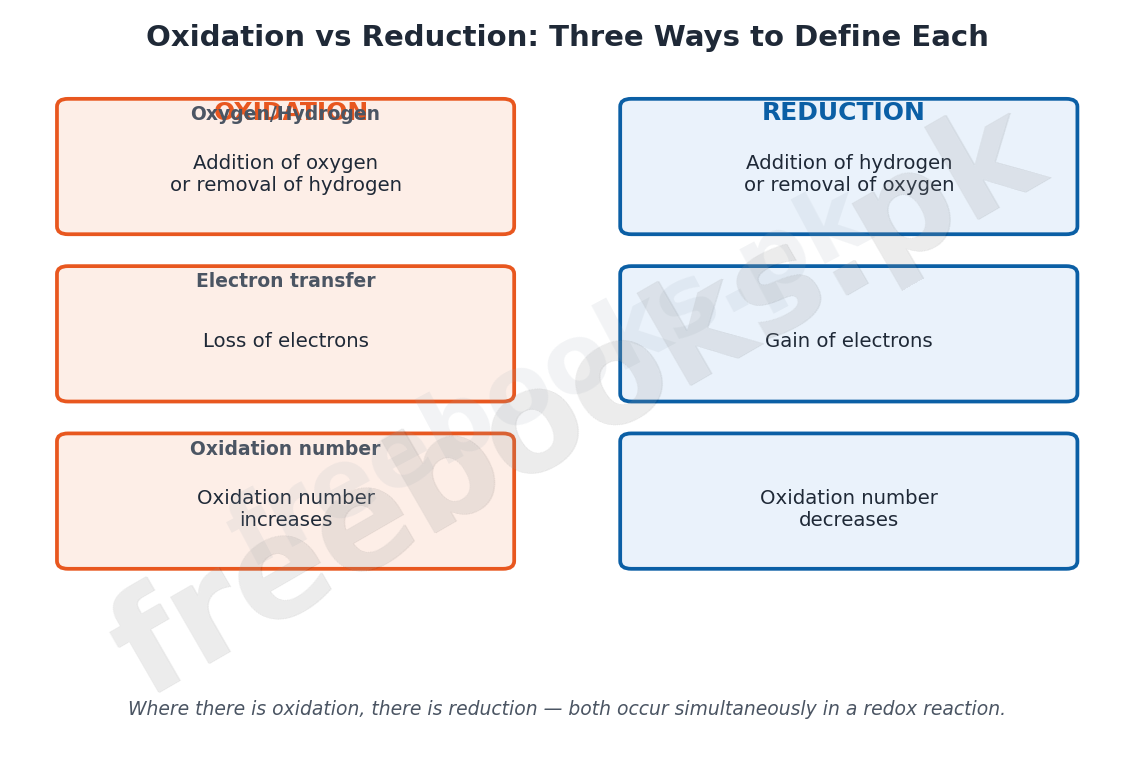
Oxidation and reduction can first be understood in terms of oxygen/hydrogen transfer: oxidation is the addition of oxygen or removal of hydrogen, while reduction is the addition of hydrogen or removal of oxygen. Both processes occur simultaneously in a reaction — where there is oxidation, there is reduction. For example, in the reaction between zinc oxide and carbon, oxygen is removed from zinc oxide (reduction) and added to carbon (oxidation); in the reaction between hydrogen sulphide and chlorine, hydrogen is removed from H2S (oxidation) and added to chlorine (reduction).
Many redox reactions do not involve oxygen or hydrogen at all, so a more general definition uses electron transfer: oxidation is the loss of electrons by an atom or ion (e.g. Zn(s) → Zn2+(aq) + 2e−), while reduction is the gain of electrons (e.g. Cl2(g) + 2e− → 2Cl−(aq)). A reaction between sodium and chlorine illustrates this: sodium loses an electron (oxidation) to become Na+, while chlorine simultaneously gains that electron (reduction) to become Cl−, and the two ions then combine to form NaCl.
7.2 Oxidation State and Rules for Assigning Oxidation Numbers
Oxidation state (or oxidation number, O.N.) is the apparent charge assigned to an atom of an element in a molecule or ion — for example, in HCl, H has O.N. +1 and Cl has O.N. -1. The key rules are: the O.N. of any element in its free (uncombined) state is zero; the O.N. of a monoatomic ion equals its charge; Group 1 elements are always +1, Group 2 always +2, and Group 13 always +3; hydrogen is +1 in most compounds but -1 in metal hydrides; oxygen is -2 in most compounds, -1 in peroxides, and +2 in OF2; the more electronegative atom in a substance takes the negative oxidation number; in neutral molecules the sum of all oxidation numbers is zero; and in ions, the sum of oxidation numbers equals the ion's overall charge.
When assigning oxidation numbers, the sign is written before the number (e.g. +2), whereas valency (the apparent charge on an atom/ion) is written with the number first and the sign after (e.g. 2+). For example, in HNO3, using H = +1 and O = -2: [+1] + [O.N. of N] + 3[-2] = 0, giving O.N. of N = +5. Similarly, in H2SO4, the oxidation number of sulphur works out to +6, and in KClO3, the oxidation number of chlorine works out to +5.
7.3 Oxidizing and Reducing Agents
An oxidizing agent is a species that oxidizes another substance by taking electrons from it — in doing so, the oxidizing agent itself is reduced (gains electrons). Non-metals, being more electronegative, tend to act as oxidizing agents. A reducing agent is a species that reduces another substance by donating electrons to it — the reducing agent itself is oxidized (loses electrons) in the process. Almost all metals are good reducing agents because they readily lose electrons.
7.4 Oxidation-Reduction Reactions
A redox reaction is one in which the oxidation state of one or more substances changes. Tracking oxidation numbers through a reaction reveals which species are oxidized and which are reduced. For example, in Zn(s) + 2HCl(aq) → ZnCl2(aq) + H2(g), zinc's oxidation number rises from 0 to +2 (oxidized) while hydrogen's falls from +1 to 0 (reduced). Similarly, in 2H2(g) + O2(g) → 2H2O(l), hydrogen is oxidized from 0 to +1 while oxygen is reduced from 0 to -2.
7.5 Electrochemical Cells
An electrochemical cell contains two electrodes dipped in an electrolyte solution, either driving a non-spontaneous reaction with electric current (electrolytic cell) or generating electric current from a spontaneous reaction (galvanic/voltaic cell). Electrolytes are substances that conduct electricity in aqueous solution or molten state. Strong electrolytes (e.g. NaCl, NaOH, H2SO4) ionize almost completely; weak electrolytes (e.g. CH3COOH, Ca(OH)2) ionize only slightly and conduct poorly; non-electrolytes (e.g. sugar solution, benzene) do not ionize at all and do not conduct.
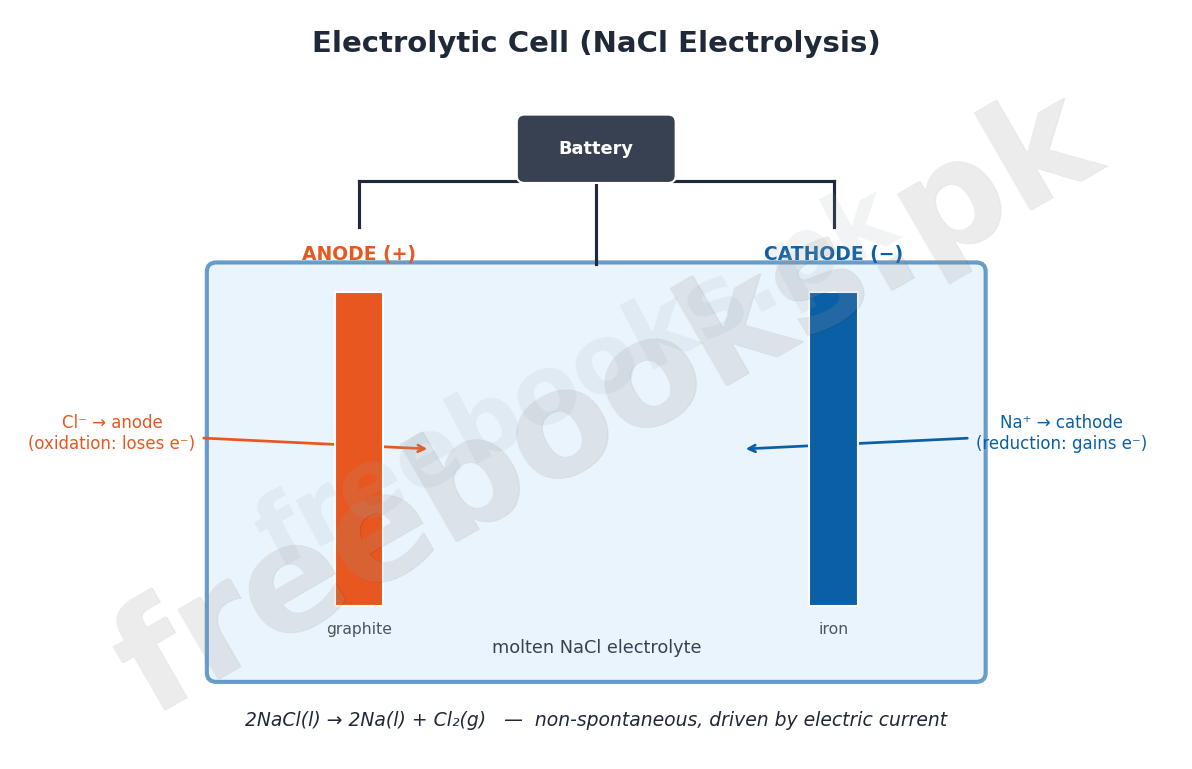
An electrolytic cell uses electric current to drive a non-spontaneous reaction (electrolysis) — the anode carries a positive charge and the cathode a negative charge. Anions migrate to the anode and are oxidized there (lose electrons); cations migrate to the cathode and are reduced there (gain electrons). For fused NaCl electrolysis: anode (oxidation): 2Cl−(l) → Cl2(g) + 2e−; cathode (reduction): 2Na+(l) + 2e− → 2Na(l). Pure water is a very weak electrolyte; adding a little acid improves conductivity, and electrolysis of acidified water produces O2 at the anode and H2 at the cathode.
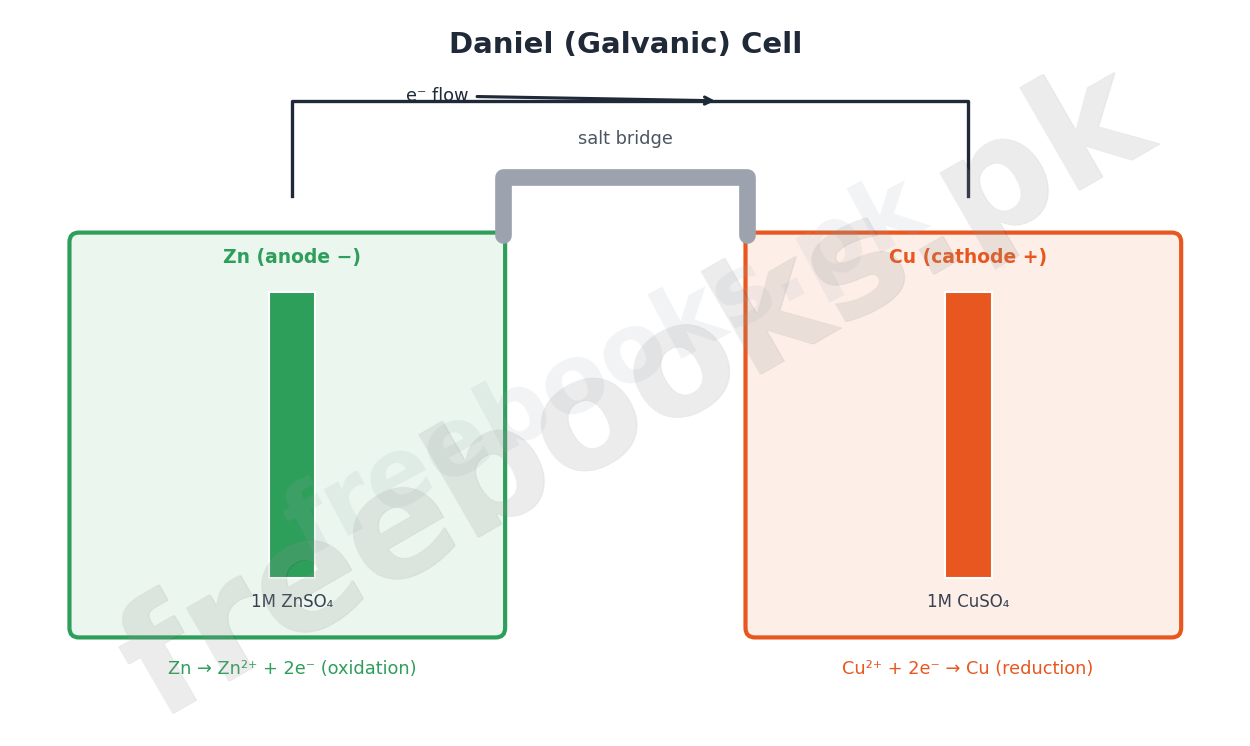
A galvanic (voltaic) cell, such as the Daniel cell, uses a spontaneous redox reaction to generate electric current — here the anode is negative and the cathode is positive (the reverse of an electrolytic cell). A Daniel cell has two half-cells joined by a salt bridge: a zinc electrode in ZnSO4 solution and a copper electrode in CuSO4 solution. Zinc loses electrons more readily than copper, so oxidation (Zn → Zn2+ + 2e−) occurs at the zinc electrode, electrons flow through the external wire to the copper electrode, and reduction (Cu2+ + 2e− → Cu) occurs there. The overall reaction Zn(s) + Cu2+(aq) → Zn2+(aq) + Cu(s) produces electric current, the same principle used in everyday batteries.
7.6 Electrochemical Industries
Sodium metal is manufactured industrially by electrolysis of fused NaCl in the Downs cell, a circular furnace with a central graphite anode and a surrounding iron cathode, separated by steel gauze to prevent product mixing. Cl− ions are oxidized to Cl2 gas at the anode; Na+ ions are reduced to molten sodium at the cathode, which floats on the denser molten salt and is collected separately. Overall: 2NaCl(fused) → Cl2(g) + 2Na(l).
Sodium hydroxide (caustic soda) is manufactured industrially by electrolysis of brine (aqueous NaCl) in Nelson's cell, which has a graphite anode suspended inside a U-shaped perforated iron cathode lined with an asbestos diaphragm. Cl− ions are discharged at the anode producing Cl2 gas; H+ ions are discharged at the cathode producing H2 gas, while NaOH solution percolates out and collects in a catch basin. Overall: 2NaCl(aq) + 2H2O(l) → H2(g) + Cl2(g) + 2NaOH(aq).
Impure copper is purified by electrolytic refining: impure copper serves as the anode and a pure copper plate as the cathode, in a copper sulphate electrolyte. At the anode, copper atoms dissolve as Cu2+ ions (oxidation); at the cathode, Cu2+ ions gain electrons and deposit as pure copper (reduction), leaving impurities behind.
7.7 Corrosion and Its Prevention
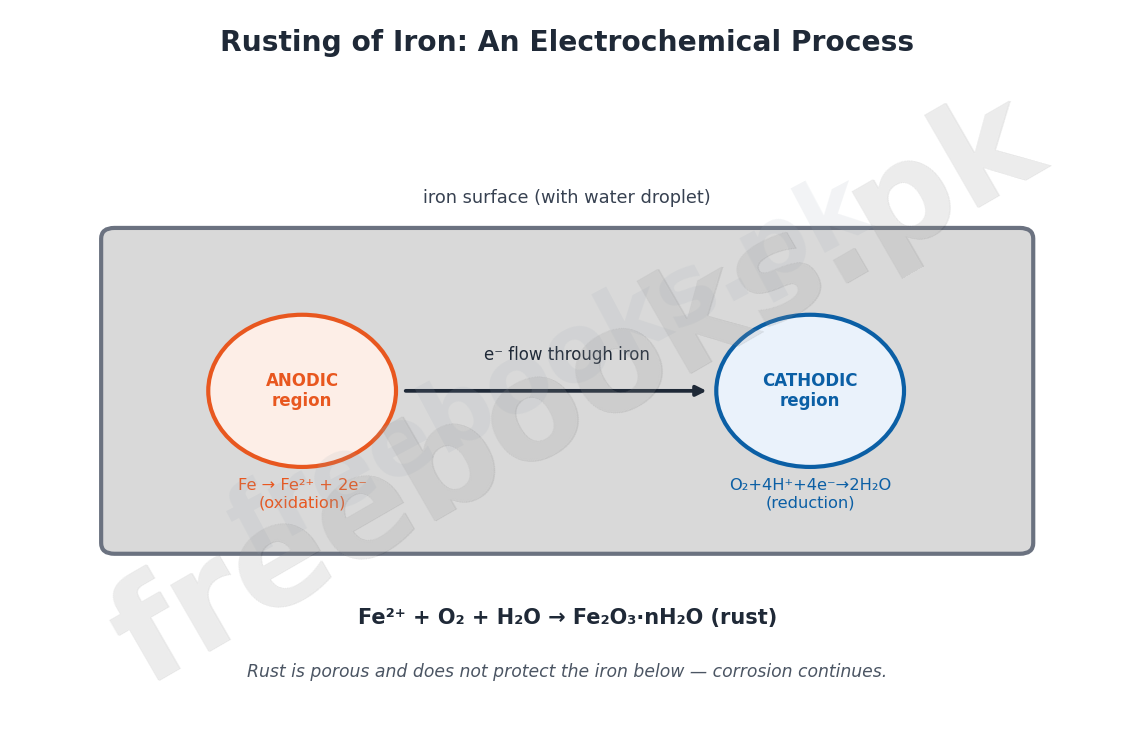
Corrosion is the slow, continuous eating away of a metal by its surrounding medium through a redox reaction; the corrosion of iron specifically is called rusting, which requires moist air (both water vapour and oxygen must be present). At the anodic region (stains/dents on the iron surface), Fe is oxidized: 2Fe(s) → 2Fe2+(aq) + 4e−. Electrons flow through the iron to a cathodic region of high O2 concentration, where oxygen is reduced in the presence of H+ ions (supplied by carbonic acid from dissolved CO2): O2(g) + 4H+(aq) + 4e− → 2H2O(l). The Fe2+ formed later reacts with more oxygen and water to form rust, Fe2O3·nH2O, which is porous and does not protect the metal beneath, so rusting continues until the iron is consumed.
Corrosion prevention methods include: removing surface stains (which act as corrosion sites); applying paints or grease as protective, weatherproof barriers; alloying, such as combining iron with chromium and nickel to form stainless steel; and metallic coating, where corrosion-resistant metals like zinc, tin, or chromium are applied over iron. Galvanizing (zinc coating) protects iron even after the coating is broken, because zinc corrodes preferentially; tin coating protects only while the tin layer stays intact, since once broken, a galvanic cell forms and the exposed iron rusts rapidly.
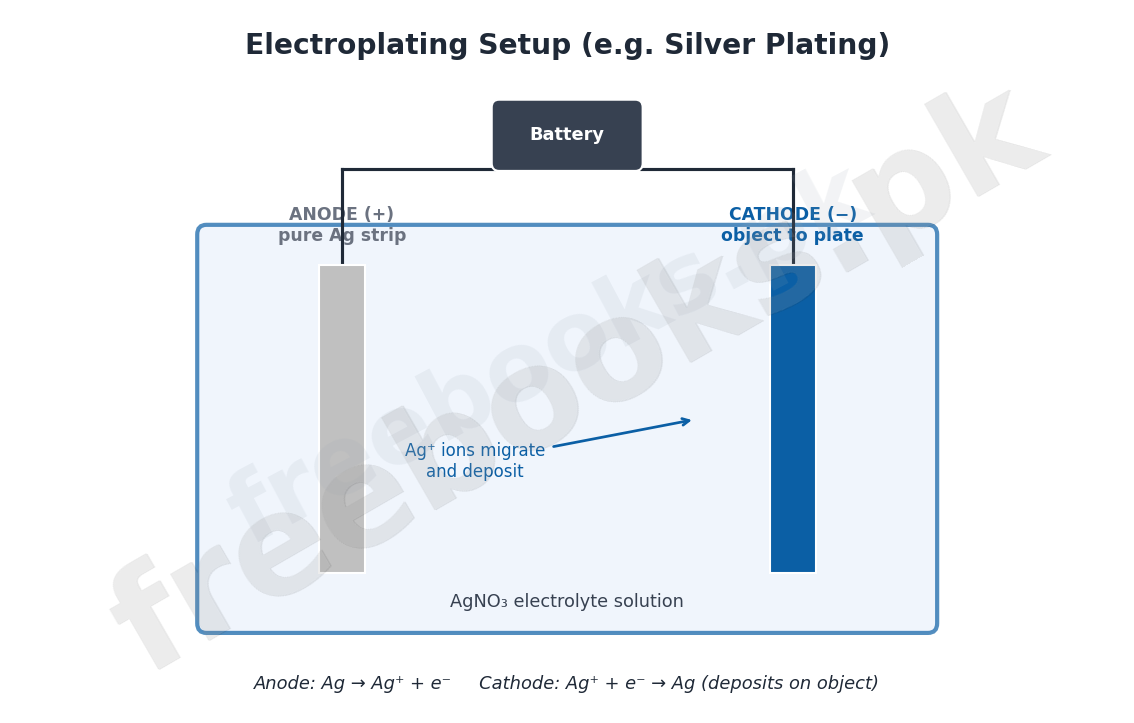
Electroplating deposits one metal over another using electrolysis: the anode is made of the metal to be deposited, the cathode is the object to be plated, and the electrolyte is a salt solution of the depositing metal. In silver plating, a silver strip anode dissolves (Ag → Ag+ + e−) and Ag+ ions migrate to and deposit on the cathode object (Ag+ + e− → Ag). Chromium plating uses an antimonial lead anode with Cr2(SO4)3 electrolyte, and steel is usually first plated with nickel or copper (for better adhesion) before the final chromium layer, which resists corrosion and gives a bright, silvery finish.
Important Definitions
Define oxidation (electron concept).
The loss of electrons by an atom or ion during a chemical reaction.
Define reduction (electron concept).
The gain of electrons by an atom or ion during a chemical reaction.
Define oxidation state (oxidation number).
The apparent charge assigned to an atom of an element in a molecule or ion.
Define oxidizing agent.
A species that oxidizes another substance by removing electrons from it, and is itself reduced in the process.
Define reducing agent.
A species that reduces another substance by donating electrons to it, and is itself oxidized in the process.
Define redox reaction.
A chemical reaction in which the oxidation states of one or more substances change, involving simultaneous oxidation and reduction.
Define electrolyte.
A substance that can conduct electricity in its aqueous solution or molten state.
Define electrolytic cell.
An electrochemical cell in which a non-spontaneous chemical reaction is driven by passing electric current through an electrolyte.
Define galvanic (voltaic) cell.
An electrochemical cell in which a spontaneous chemical reaction takes place and generates electric current.
Define electrolysis.
The chemical decomposition of a compound into its components by passing an electric current through its solution or molten state.
Define corrosion.
The slow and continuous eating away of a metal by the action of its surrounding medium, occurring through a redox reaction.
Define rusting.
The specific term for the corrosion of iron, forming hydrated iron(III) oxide (Fe2O3·nH2O) in the presence of moist air.
Define electroplating.
The process of depositing one metal over another by means of electrolysis, to protect against corrosion or improve appearance.
Define galvanizing.
The process of coating a thin protective layer of zinc onto iron or steel to prevent corrosion.
Define salt bridge.
A U-shaped tube containing a saturated electrolyte solution that connects the two half-cells of a galvanic cell, keeping both solutions electrically neutral by allowing ion migration.
Key Formulas
| Topic | Formula |
|---|---|
| Sum of O.N. in a neutral molecule | Σ(oxidation numbers) = 0 |
| Sum of O.N. in an ion | Σ(oxidation numbers) = charge on the ion |
| Oxidation (electron loss) | M(s) → M^n+(aq) + n e⁻ |
| Reduction (electron gain) | X + n e⁻ → X^n− |
| Downs cell overall reaction | 2NaCl(fused) → Cl₂(g) + 2Na(l) |
| Nelson's cell overall reaction | 2NaCl(aq) + 2H₂O(l) → H₂(g) + Cl₂(g) + 2NaOH(aq) |
| Overall rusting reaction | 2Fe(s) + O₂(g) + 4H⁺(aq) → 2Fe²⁺(aq) + 2H₂O(l); → Fe₂O₃·nH₂O (rust) |
Diagrams
Oxidation vs Reduction: Three Ways to Define Each: Side-by-side summary of the oxygen/hydrogen, electron-transfer, and oxidation-number definitions of oxidation and reduction.
Electrolytic Cell (NaCl Electrolysis): Labelled diagram of an electrolytic cell showing the battery, anode, cathode, and ion migration during electrolysis of molten NaCl.
Daniel (Galvanic) Cell: Labelled diagram of a Daniel cell showing the zinc and copper half-cells, salt bridge, external wire, and direction of electron flow.
Rusting of Iron: An Electrochemical Process: Diagram showing the anodic (oxidation) and cathodic (reduction) regions on an iron surface that together produce rust.
Electroplating Setup: Diagram of an electroplating cell (e.g. silver plating) showing the anode, cathode (object), electrolyte, and ion deposition.
Short Questions & Answers
Why is the reaction between magnesium and oxygen (2Mg + O2 → 2MgO) considered a redox reaction even though it only shows addition of oxygen?
Because while oxygen is being added to magnesium (oxidation), magnesium is simultaneously being reduced in the sense that it loses electrons to oxygen, and oxygen itself is reduced by gaining those electrons — so both oxidation and reduction occur together, satisfying the definition of a redox reaction.
Why must the sign precede the number when writing an oxidation state, but follow the number for valency?
This is simply the established chemical convention: oxidation numbers are written as +2 or -2, while valency (the apparent ionic charge) is written as 2+ or 2-, allowing the two related but distinct concepts to be distinguished at a glance.
Why are non-metals generally good oxidizing agents?
Because non-metals are highly electronegative and have a strong tendency to attract and gain electrons, which means they readily take electrons from other substances (oxidizing them) while being reduced themselves.
Why does the anode carry a positive charge in an electrolytic cell but a negative charge in a galvanic cell?
In an electrolytic cell, the anode is connected to the positive terminal of an external battery, giving it a positive charge. In a galvanic cell, the anode is the electrode where oxidation spontaneously occurs and electrons are released, making it electron-rich and therefore negatively charged relative to the cathode.
Why is a salt bridge necessary in a Daniel cell?
Because as the reaction proceeds, positive ions build up in the anode half-cell and negative ions build up in the cathode half-cell; the salt bridge allows ions to migrate between the two half-cells to keep both solutions electrically neutral, allowing the reaction to continue.
Why does rusting require both moisture and oxygen to occur?
Because rusting is an electrochemical redox process: oxygen is needed at the cathodic region to be reduced (gaining the electrons released at the anode), while water provides the medium through which ions can migrate between the anodic and cathodic regions — without both, the redox circuit cannot be completed.
Why does acidic water accelerate the rusting of iron?
Because the reduction half-reaction at the cathodic region requires H+ ions to reduce oxygen to water, and an acidic medium supplies these H+ ions in greater abundance, speeding up the overall rusting process.
Why does galvanizing protect iron even after the zinc coating is scratched or broken?
Because zinc is more reactive than iron and corrodes preferentially, acting as a sacrificial anode — as long as some zinc remains in contact with the iron, it will continue to be oxidized instead of the iron, even where the coating is damaged.
Why does tin-plated iron rust rapidly once the tin layer is broken?
Because tin is less reactive than iron, so once the protective tin layer is broken and iron is exposed, a galvanic cell forms in which the iron (more reactive) becomes the anode and corrodes rapidly, actually accelerating rusting at the exposed point.
Why is nickel or copper often plated onto steel before the final chromium layer in electroplating?
Because chromium does not adhere well directly to steel and would allow moisture to seep through and strip the metal off; a nickel or copper underlayer provides good adhesion, allowing the chromium plated over it to last much longer.
Long Questions & Answers
Explain the concept of oxidation and reduction using the three complementary definitions, with suitable examples.
How are oxidation and reduction defined in terms of oxygen and hydrogen?
Oxidation is the addition of oxygen or the removal of hydrogen from a substance during a reaction, while reduction is the addition of hydrogen or the removal of oxygen. For example, in the reaction between zinc oxide and carbon, oxygen is removed from zinc oxide (reduction) while it is added to carbon (oxidation).
How are oxidation and reduction defined in terms of electron transfer?
Oxidation is the loss of electrons by an atom or ion, such as Zn(s) → Zn2+(aq) + 2e−, while reduction is the gain of electrons, such as Cl2(g) + 2e− → 2Cl−(aq). This definition is more general because it covers redox reactions that do not involve oxygen or hydrogen at all.
How are oxidation and reduction defined in terms of oxidation number?
Oxidation corresponds to an increase in the oxidation number of an element, while reduction corresponds to a decrease. For example, when Zn(0) becomes Zn2+, its oxidation number rises from 0 to +2, confirming oxidation; when Cl2(0) becomes Cl−, chlorine's oxidation number falls from 0 to -1, confirming reduction.
Why must oxidation and reduction always occur together?
Because electrons that are lost by one species during oxidation must be gained by another species, which undergoes reduction — the two processes are two halves of the same electron-transfer event, so a redox reaction always contains both simultaneously, even if only one type of change (like oxygen addition) is immediately visible.
Describe the construction and working of a Daniel cell, and explain how it differs from an electrolytic cell.
How is a Daniel cell constructed?
A Daniel cell consists of two half-cells connected by a salt bridge: the left half-cell has a zinc electrode dipped in 1M zinc sulphate solution, and the right half-cell has a copper electrode dipped in 1M copper sulphate solution. Each electrode is connected through a wire to an external circuit.
How does the Daniel cell generate electric current?
Zinc has a greater tendency to lose electrons than copper, so oxidation occurs at the zinc electrode (Zn → Zn2+ + 2e−), releasing electrons that flow through the external wire to the copper electrode. At the copper electrode, these electrons are gained by copper ions in solution, which are reduced and deposit as copper metal (Cu2+ + 2e− → Cu), and this flow of electrons through the wire constitutes the electric current.
What is the role of the salt bridge?
The salt bridge is a U-shaped tube containing a saturated electrolyte in a jelly-like support, sealed at both ends with porous material. It allows ions to migrate between the two half-cells, keeping both solutions electrically neutral as the reaction proceeds, which allows the redox reaction to continue producing current.
How does a Daniel cell (galvanic cell) fundamentally differ from an electrolytic cell?
A galvanic cell like the Daniel cell uses a spontaneous redox reaction to generate electric current, converting chemical energy into electrical energy, with the anode being negative and the cathode positive. An electrolytic cell does the opposite: it uses an external electric current to force a non-spontaneous reaction to occur, converting electrical energy into chemical energy, with the anode being positive and the cathode negative.
Multiple Choice Questions (MCQs)
Spontaneous chemical reactions take place in: (A) electrolytic cell (B) galvanic cell (C) Nelson's cell (D) Downs cell
Correct answer: (B) galvanic cell. A galvanic (voltaic) cell is defined as one in which a spontaneous redox reaction occurs and generates electric current, unlike electrolytic cells which require an external current to drive a non-spontaneous reaction.
Formation of water from hydrogen and oxygen (2H2 + O2 → 2H2O) is a: (A) redox reaction (B) acid-base reaction (C) neutralization reaction (D) decomposition reaction
Correct answer: (A) redox reaction. Hydrogen is oxidized (0 to +1) and oxygen is reduced (0 to -2) in this reaction, making it a classic redox reaction.
Which one of the following is NOT an electrolytic cell? (A) Downs cell (B) galvanic cell (C) Nelson's cell (D) both galvanic cell and Nelson's cell
Correct answer: (B) galvanic cell. A galvanic cell is fundamentally different from an electrolytic cell — it generates current from a spontaneous reaction rather than using current to force a non-spontaneous one, so it is not an electrolytic cell (unlike Downs and Nelson's cells, which are both electrolytic).
The oxidation number of chromium in K2Cr2O7 is: (A) +2 (B) +6 (C) +7 (D) +14
Correct answer: (B) +6. Using O.N. of K = +1 and O = -2: 2(+1) + 2(O.N. Cr) + 7(-2) = 0, giving 2 + 2(O.N. Cr) – 14 = 0, so O.N. of Cr = +6.
Which one of the following is NOT an electrolyte? (A) sugar solution (B) sulphuric acid solution (C) lime solution (D) sodium chloride solution
Correct answer: (A) sugar solution. Sugar solution is a non-electrolyte because sugar molecules do not ionize in water and therefore cannot conduct electricity.
The most common example of corrosion is: (A) chemical decay (B) rusting of iron (C) rusting of aluminium (D) rusting of tin
Correct answer: (B) rusting of iron. Rusting of iron is explicitly identified as the most common and well-known example of the general phenomenon of corrosion.
In Nelson's cell, which gas is produced at the cathode? (A) Cl2 (B) H2 (C) O3 (D) O2
Correct answer: (B) H2. At the cathode of Nelson's cell, H+ ions are discharged and reduced, producing hydrogen gas (H2), while chlorine gas forms at the anode.
During the formation of water from hydrogen and oxygen, which of the following does NOT occur? (A) hydrogen is oxidized (B) oxygen is reduced (C) oxygen gains electrons (D) hydrogen behaves as an oxidizing agent
Correct answer: (D) hydrogen behaves as an oxidizing agent. Hydrogen is oxidized (loses control of electrons) in this reaction and therefore acts as a reducing agent, not an oxidizing agent — oxygen is the oxidizing agent here since it gains electrons and is reduced.
The chemical formula of rust is: (A) Fe2O3·nH2O (B) Fe2O3 (C) Fe(OH)3·nH2O (D) Fe(OH)3
Correct answer: (A) Fe2O3·nH2O. Rust is hydrated iron(III) oxide, correctly written as Fe2O3·nH2O, reflecting its variable water content.
In the redox reaction between Zn and HCl, the oxidizing agent is: (A) Zn (B) H+ (C) Cl− (D) H2
Correct answer: (B) H+. H+ ions gain electrons and are reduced to H2 gas in this reaction, making H+ the species that gets reduced — and the species that is reduced is, by definition, the oxidizing agent.
Quick Revision Summary
- Oxidation = add O / remove H / lose e⁻ / O.N. increases; Reduction = add H / remove O / gain e⁻ / O.N. decreases
- Oxidizing agent = itself reduced (gains e⁻), usually a non-metal; reducing agent = itself oxidized (loses e⁻), usually a metal
- O.N. rules: free element = 0; monoatomic ion = its charge; Group1=+1, Group2=+2, Group13=+3; H=+1 (except hydrides -1); O=-2 (except peroxides -1, OF2 +2)
- Electrolytic cell: non-spontaneous, uses current, anode(+)/cathode(−), electrical→chemical energy
- Galvanic/voltaic cell: spontaneous, produces current, anode(−)/cathode(+), chemical→electrical energy
- Anode = oxidation (in both cell types); Cathode = reduction (in both cell types)
- Downs cell → Na metal from fused NaCl; Nelson's cell → NaOH from brine
- Rusting: Fe oxidized at anodic region, O2 reduced at cathodic region (needs H+), rust = Fe2O3·nH2O
- Corrosion prevention: remove stains, paint/grease, alloying (stainless steel), metallic coating (galvanizing, tin, electroplating)
- Galvanizing protects even when scratched (Zn sacrificial); tin coating fails once broken (Fe becomes anode, rusts faster)
Exam Tips
- Master the O.N. assignment rules cold — this unit's numericals depend entirely on applying them correctly and quickly
- Always double-check which half-reaction is oxidation (electron loss, O.N. increases) vs reduction before labeling anode/cathode
- Memorize the anode/cathode charge reversal between electrolytic cells (anode +) and galvanic cells (anode −) — a very common exam trap
- Draw and label the Daniel cell and Downs/Nelson's cells from memory — diagram-based questions are common in this unit
- Learn the exact half-cell reactions for Downs cell, Nelson's cell, rusting, and at least one electroplating example (silver or chromium)
- Understand WHY galvanizing outperforms tin coating — this reasoning-based question appears frequently
- Practice identifying oxidizing vs reducing agents by determining which species is reduced (oxidizing agent) and which is oxidized (reducing agent) in a given equation