Chemistry is the branch of science that deals with the composition, structure, properties and reactions of matter. This unit introduces the eight major branches of chemistry, then builds the basic vocabulary used throughout the subject: matter, substance, mixture, element, compound, atomic number, mass number, relative atomic mass, chemical formulae, ions, and molecules.
The second half of the unit introduces the mole concept — the link between the mass of a substance and the number of particles (atoms, molecules or formula units) it contains — along with Avogadro's Number, and the chemical calculations used to convert between mass, moles, and number of particles.
Learning Objectives
- Identify and differentiate among the eight branches of chemistry
- Distinguish between matter, substance and mixture, and between physical and chemical properties
- Differentiate among elements, compounds and mixtures, and between homogeneous and heterogeneous mixtures
- Define atomic number, mass number, atomic mass unit and relative atomic mass based on the C-12 scale
- Differentiate between empirical formula and molecular formula, and between formula unit and molecular formula
- Define ions, cations, anions, molecular ions, formula units and free radicals, and distinguish among them
- Relate gram atomic mass, gram molecular mass and gram formula mass to the mole
- Describe how Avogadro's Number is related to a mole of any substance, and use it in chemical calculations
Key Concepts
1.1 Branches of Chemistry
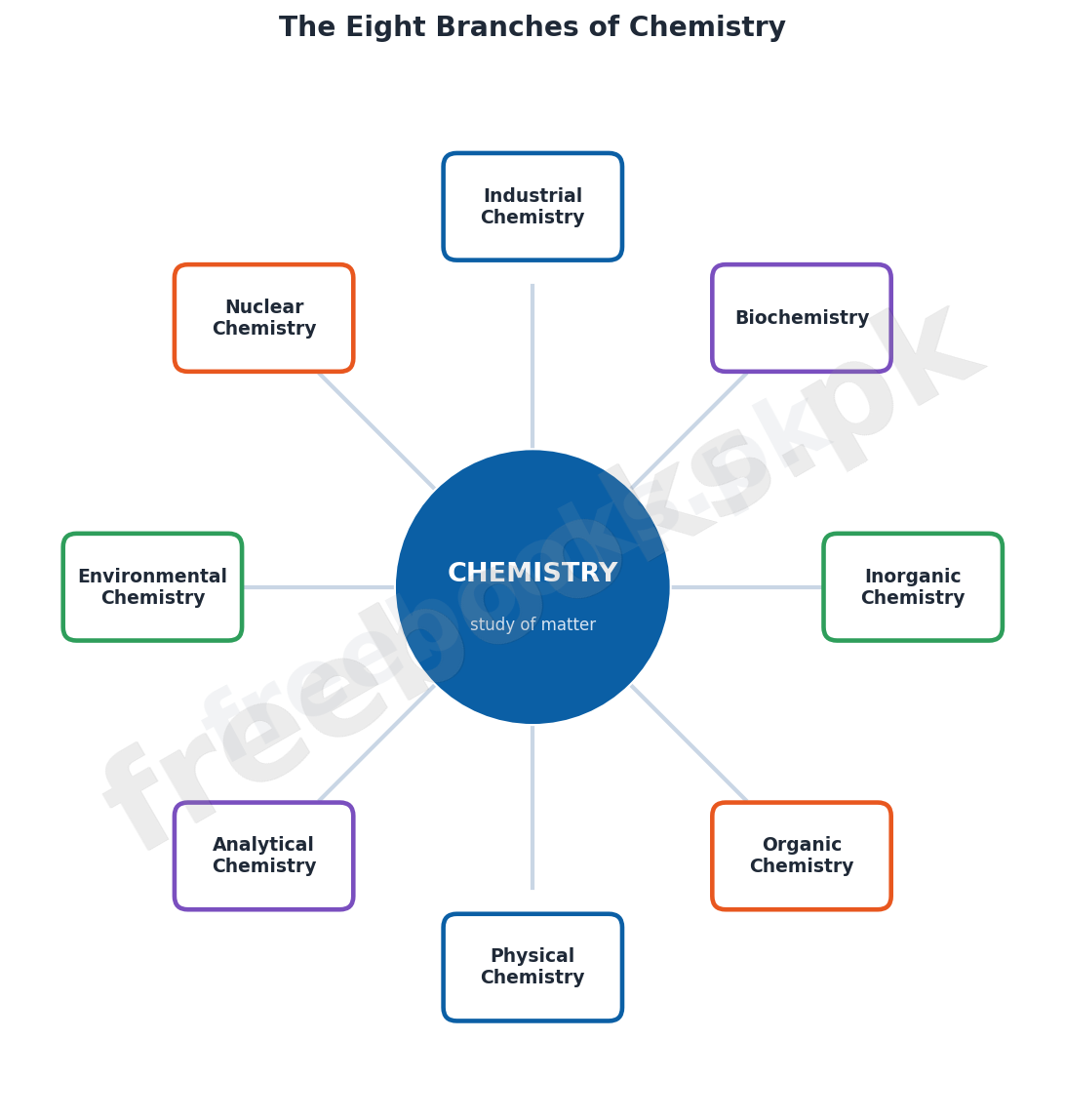
Chemistry is divided into eight main branches. Physical Chemistry deals with the relationship between the composition and physical properties of matter, such as the structure of atoms, the behaviour of gases, liquids and solids, and the effect of temperature or radiation on matter. Organic Chemistry studies covalent compounds of carbon and hydrogen (hydrocarbons) and their derivatives, covering petroleum, petrochemicals and pharmaceutical industries. Inorganic Chemistry studies all elements and their compounds except hydrocarbons and their derivatives, with applications in glass, cement, ceramics and metallurgy.
Biochemistry studies the structure, composition and chemical reactions of substances found in living organisms, including the synthesis and metabolism of carbohydrates, proteins and fats. Industrial Chemistry deals with manufacturing chemical compounds on a commercial scale, such as oxygen, chlorine, ammonia, caustic soda, nitric acid and sulphuric acid. Nuclear Chemistry deals with radioactivity, nuclear processes and atomic energy, with applications in radiotherapy, food preservation and nuclear power generation. Environmental Chemistry studies the components of the environment and the effects of human activity on it. Analytical Chemistry deals with the separation and analysis of a sample to identify its components — qualitative analysis identifies what is present, while quantitative analysis determines how much of each component is present.
1.2 Basic Definitions: Matter, Substance and Mixture
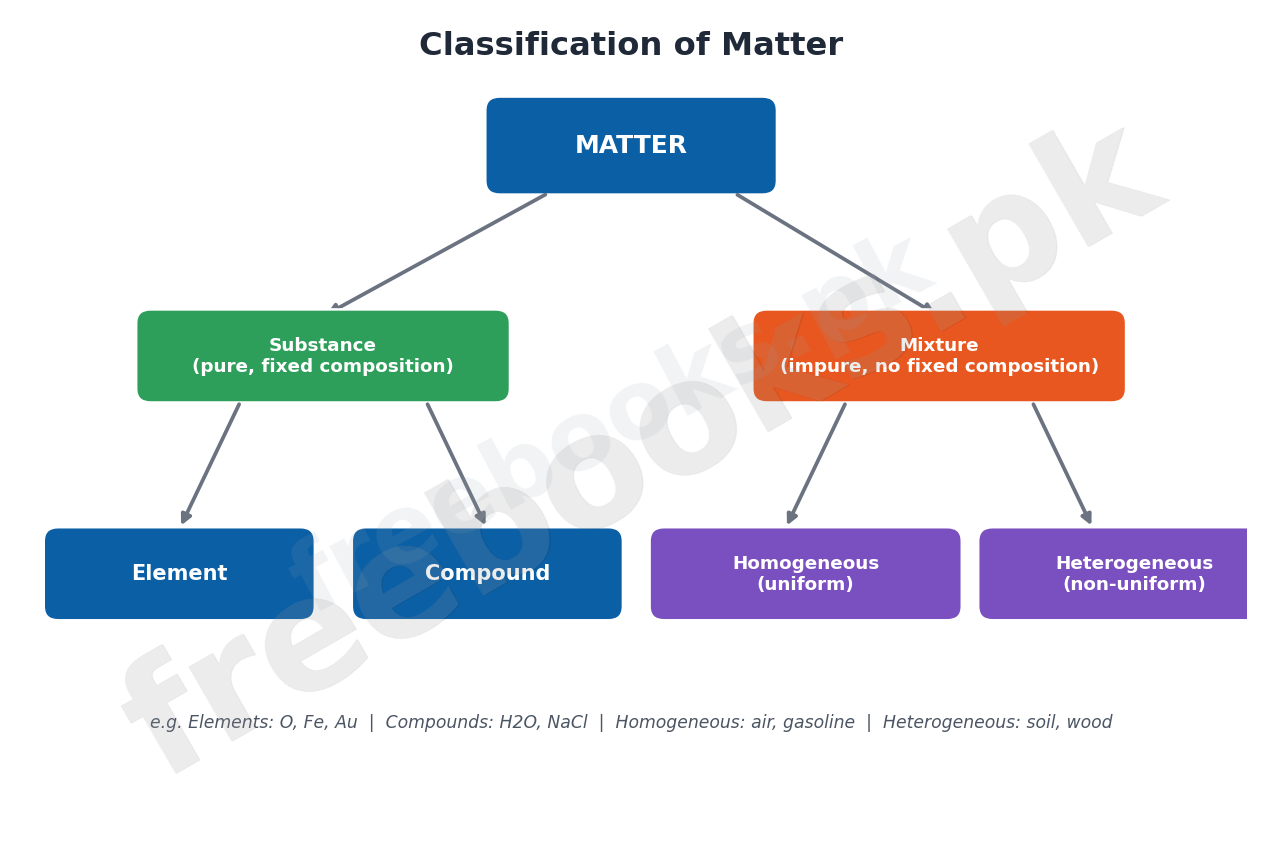
Matter is anything that has mass and occupies space, and can exist in one of three physical states: solid, liquid or gas. A pure piece of matter with a fixed composition is called a substance, while impure matter with no fixed composition is called a mixture (homogeneous or heterogeneous).
Physical properties are associated with the physical state of a substance — colour, smell, taste, hardness, solubility, melting point and boiling point — and do not change its chemical composition (e.g. ice melting to water). Chemical properties depend on the composition of the substance; when a substance undergoes a chemical change, its composition changes and new substances form (e.g. water decomposing into hydrogen and oxygen gas).
1.2.1 Elements, Compounds and Mixtures
An element is a substance made up of the same type of atoms, having the same atomic number, and cannot be decomposed into simpler substances by ordinary chemical means. 118 elements are currently known, of which 92 occur naturally; about 80 percent of all elements are metals. Elements are represented by symbols — a single capital letter (H, N, C) or a capital plus lowercase letter (Ca, Na, Cl) — taken from the element's English, Latin, Greek or German name.
Valency is the combining capacity of an element, based on the number of electrons in its outermost shell. Elements with fewer than four valence electrons (like Na, Mg, Al) lose electrons to complete their octet, showing valencies of 1, 2 and 3 respectively; elements with five or more valence electrons (like N, O, Cl) gain electrons instead, showing valencies of 3, 2 and 1 respectively. Some elements, such as iron, show variable valency (Fe2+ in ferrous compounds, Fe3+ in ferric compounds).
A compound is a substance made of two or more elements chemically combined in a fixed ratio by mass; the elements lose their individual properties and the compound has entirely new properties (e.g. water forms from hydrogen and oxygen combining in a fixed 1:8 mass ratio). Ionic compounds form a three-dimensional crystal lattice and are represented by formula units (e.g. NaCl); covalent compounds mostly exist as molecules and are represented by molecular formulae (e.g. H2O).
A mixture forms when two or more elements or compounds mix physically without any fixed ratio, and each component keeps its own chemical identity; mixtures can be separated by physical methods such as distillation, filtration, evaporation, crystallisation or magnetisation. A homogeneous mixture has uniform composition throughout (e.g. air, gasoline), while a heterogeneous mixture does not (e.g. soil, wood).
1.2.2 Atomic Number and Mass Number
The atomic number (Z) of an element equals the number of protons in the nucleus of its atoms; every atom of a given element has the same atomic number, which acts as its identification number (e.g. all hydrogen atoms have Z = 1, all carbon atoms have Z = 6). The mass number (A) is the sum of the number of protons and neutrons in the nucleus of an atom, calculated as A = Z + n, where n is the number of neutrons.
1.2.3 Relative Atomic Mass and the Atomic Mass Unit
Since the actual mass of an atom is too small to measure directly, atomic masses are compared against 1/12th the mass of a carbon-12 atom. This ratio is the relative atomic mass of an element, expressed in atomic mass units (amu), where 1 amu = 1.66 x 10^-24 g. On this scale, a proton has a mass of about 1.0073 amu, a neutron about 1.0087 amu, and an electron about 5.486 x 10^-4 amu.
1.2.4 Writing Chemical Formulae, Empirical and Molecular Formulae
A chemical formula is written by placing the positive ion first and the negative ion second, marking the valency of each ion at its top-right corner, then cross-exchanging those valencies to the lower-right corner of the other ion (e.g. Na+Cl- becomes NaCl; Ca2+Cl- becomes CaCl2). If the valencies are equal they are dropped from the formula; if a radical is involved (like SO4 2-), its net charge is used the same way, with the radical written inside parentheses when more than one is needed (e.g. Al2(SO4)3).
The empirical formula is the simplest whole-number ratio of atoms (or ions, for an ionic compound) present in a compound — for example, glucose has empirical formula CH2O. The molecular formula shows the actual number of atoms of each element present in one molecule, and is related to the empirical formula by Molecular formula = (Empirical formula)n, where n is a whole number — for example, benzene's molecular formula C6H6 comes from empirical formula CH with n = 6. Ionic compounds exist only as empirical formulae, called formula units (e.g. NaCl, KBr).
1.2.5 Molecular Mass and Formula Mass
Molecular mass is the sum of the atomic masses of all atoms in one molecule of a molecular substance (e.g. water, H2O, has molecular mass 18 amu). Formula mass is used instead for ionic compounds, and is the sum of atomic masses of all atoms in one formula unit (e.g. sodium chloride has formula mass 58.5 amu, and CaCO3 has formula mass 100 amu).
1.3.1 Ions, Molecular Ions and Free Radicals
An ion is an atom or group of atoms carrying a charge. A cation carries a positive charge, formed when an atom loses electrons from its outermost shell (e.g. Na+, K+); an anion carries a negative charge, formed when an atom gains electrons (e.g. Cl-, O2-). A molecular ion (or radical) forms when a molecule loses or gains an electron, giving it a net positive or negative charge (e.g. CH4+, He+); cationic molecular ions are more common than anionic ones.
A free radical is an atom or group of atoms with an odd (unpaired) number of electrons, shown with a dot over the symbol (e.g. Cl(dot), H3C(dot)); free radicals form by homolytic (equal) bond breakage when heat or light energy is absorbed, and are extremely reactive because they seek to complete their octet.
Molecules are classified by the number and type of atoms they contain: monoatomic (one atom, e.g. He, Ne, Ar), diatomic (two atoms, e.g. H2, O2, HCl), triatomic (three atoms, e.g. H2O, CO2), and polyatomic (many atoms, e.g. CH4, H2SO4). A molecule made of the same type of atom is homoatomic (e.g. O3, S8); one made of different atoms is heteroatomic (e.g. CO2, NH3).
1.4 & 1.5 Avogadro's Number and the Mole
Avogadro's Number is a fixed collection of 6.02 x 10^23 particles, represented by the symbol N_A — named after the Italian scholar Amedeo Avogadro (1776-1856). 6.02 x 10^23 atoms of an element, 6.02 x 10^23 molecules of a molecular substance, or 6.02 x 10^23 formula units of an ionic compound are all equivalent to one mole of that substance, just as twelve eggs make one dozen.
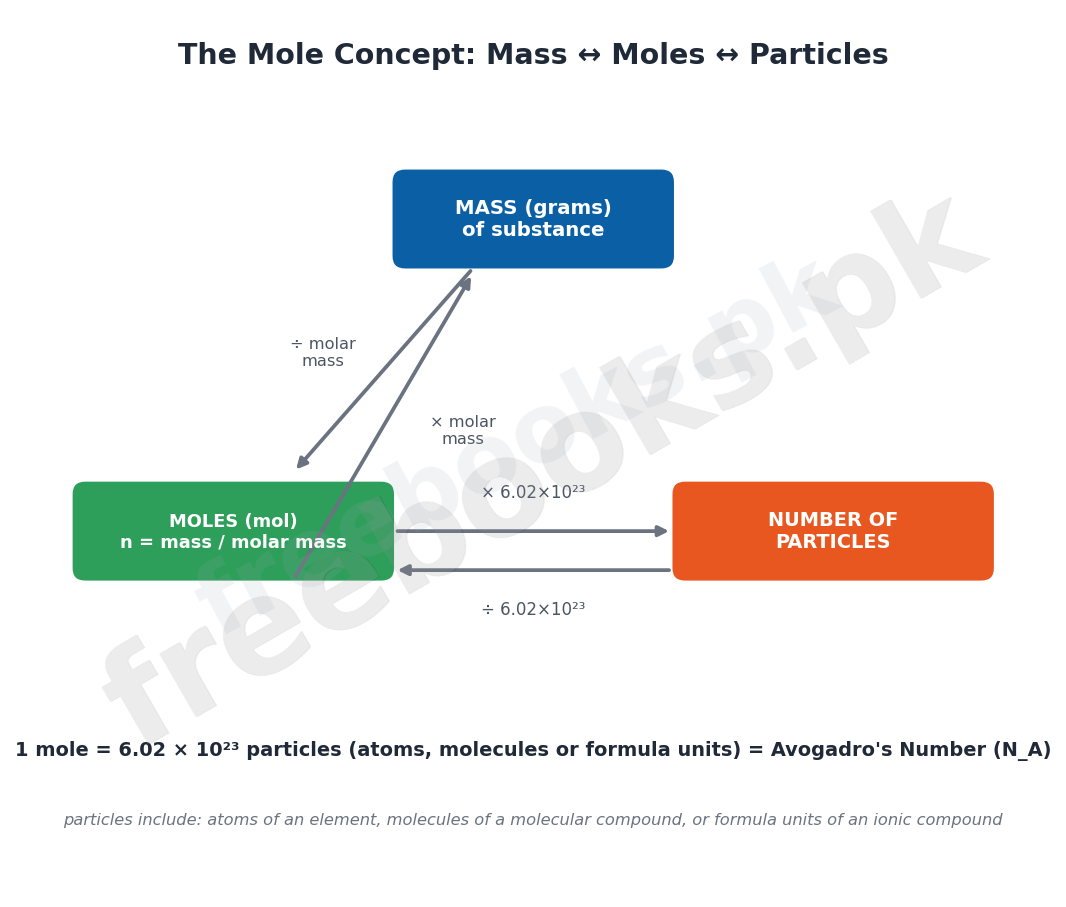
A mole is defined as the amount of a substance that contains 6.02 x 10^23 particles, abbreviated 'mol'. When the atomic mass, molecular mass or formula mass of a substance is expressed in grams, that quantity is called its molar mass and equals one mole of the substance (e.g. 12 g of carbon = 1 mole of carbon; 18 g of H2O = 1 mole of water). The relationship between mass and moles is: Number of moles = known mass of substance / molar mass of substance.
1.6 Chemical Calculations
Two linked calculations recur throughout chemistry: mole-mass calculations (Number of moles = known mass / molar mass, and its rearrangement Mass = number of moles x molar mass) and mole-particle calculations (Number of moles = number of particles / 6.02×10^23, and its rearrangement Number of particles = number of moles x 6.02×10^23). To find the number of atoms in a molecular compound or the number of ions in an ionic compound, always calculate the number of moles first, then the number of molecules or formula units, and only then the number of atoms or ions — never jump straight from mass to number of particles.
Important Definitions
What is chemistry?
The branch of science that deals with the composition, structure, properties and reactions of matter.
Define matter.
Anything that has mass and occupies space; it can exist as a solid, liquid or gas.
What is a substance?
A piece of matter in pure form, having a fixed composition and specific properties.
What is a mixture?
Impure matter formed by combining two or more substances without a fixed ratio; it may be homogeneous or heterogeneous.
Define an element.
A substance made up of the same type of atoms, having the same atomic number, that cannot be broken down into simpler substances by ordinary chemical means.
Define a compound.
A substance made of two or more elements chemically combined together in a fixed ratio by mass, with properties entirely different from its constituent elements.
What is valency?
The combining capacity of an element with other elements, depending on the number of electrons in its outermost (valence) shell.
Define atomic number (Z).
The number of protons present in the nucleus of an atom of an element; it is the same for every atom of that element.
Define mass number (A).
The sum of the number of protons and neutrons present in the nucleus of an atom, calculated as A = Z + n.
What is relative atomic mass?
The average mass of the atoms of an element compared to 1/12th the mass of an atom of carbon-12.
Define atomic mass unit (amu).
The unit for relative atomic mass, equal to 1/12th the mass of one atom of carbon-12; 1 amu = 1.66 x 10^-24 g.
What is an empirical formula?
The simplest whole-number ratio of atoms (or ions) present in a compound.
What is a molecular formula?
A formula that shows the actual number of atoms of each element present in one molecule of a compound.
Define a formula unit.
The simplest whole-number ratio of ions present in an ionic compound, used to represent it since ionic compounds do not exist as independent molecules.
Define a mole.
The amount of a substance that contains 6.02 x 10^23 particles (atoms, molecules or formula units); abbreviated 'mol'.
What is Avogadro's Number?
A fixed collection of 6.02 x 10^23 particles, represented by the symbol N_A, equivalent to one mole of any substance.
Define a cation and an anion.
A cation is an atom or group of atoms with a positive charge, formed by losing electrons. An anion is an atom or group of atoms with a negative charge, formed by gaining electrons.
What is a free radical?
An atom or group of atoms possessing an odd (unpaired) number of electrons, represented by a dot over the element's symbol, and formed by homolytic bond breakage.
Key Formulas
| Topic | Formula |
|---|---|
| Mass number | A = Z + n (n = number of neutrons) |
| Atomic mass unit | 1 amu = 1.66 x 10^-24 g |
| Molecular formula from empirical formula | Molecular formula = (Empirical formula)n |
| Number of moles from mass | Number of moles = known mass of substance / molar mass of substance |
| Mass from number of moles | Mass of substance (g) = number of moles x molar mass (g) |
| Number of moles from number of particles | Number of moles = given number of particles / 6.02 x 10^23 |
| Number of particles from number of moles | Number of particles = number of moles x 6.02 x 10^23 |
| Avogadro's Number | N_A = 6.02 x 10^23 particles = 1 mole of any substance |
Diagrams
Classification of Matter: Flowchart showing how matter divides into substances (elements and compounds) and mixtures (homogeneous and heterogeneous), with real-life examples of each.
The Eight Branches of Chemistry: A radial diagram showing chemistry's eight main branches — physical, organic, inorganic, biochemistry, industrial, nuclear, environmental and analytical chemistry — around the central subject.
The Mole Concept: Mass, Moles and Particles: A triangle diagram showing how to convert between mass (grams), number of moles, and number of particles using molar mass and Avogadro's Number (6.02 x 10^23).
Short Questions & Answers
Which branch of chemistry studies the behaviour of gases, liquids and solids?
Physical chemistry studies the behaviour of gases, liquids and solids, along with the effect of temperature or radiation on matter.
How does a compound differ from a mixture in terms of composition?
A compound has a fixed composition by mass and is represented by a chemical formula, while a mixture has no fixed composition and its components can be separated by simple physical methods.
What is the difference between a homogeneous and a heterogeneous mixture?
A homogeneous mixture has uniform composition throughout, such as air or gasoline, while a heterogeneous mixture does not have uniform composition, such as soil or wood.
Why is the atomic mass of an atom called its relative atomic mass?
Because the actual mass of an atom is too small to measure directly, so it is instead expressed relative to 1/12th the mass of a carbon-12 atom.
Differentiate between an empirical formula and a molecular formula with one example.
An empirical formula gives the simplest whole-number ratio of atoms (e.g. CH2O for glucose), while a molecular formula gives the actual number of atoms in one molecule (e.g. C6H6O6 for glucose).
What is the difference between a cation and an anion?
A cation is a positively charged ion formed by losing electrons (e.g. Na+), while an anion is a negatively charged ion formed by gaining electrons (e.g. Cl-).
How many particles are present in one mole of any substance?
One mole of any substance contains 6.02 x 10^23 particles (atoms, molecules or formula units), known as Avogadro's Number.
Why can ionic compounds not be represented by a molecular formula?
Because ionic compounds do not exist as independent molecules; they form a three-dimensional crystal lattice and are represented instead by their simplest ratio, the formula unit.
What is a free radical, and how is it represented?
A free radical is an atom or group of atoms with an odd (unpaired) number of electrons, represented by placing a dot over the element's symbol, e.g. Cl-dot.
Distinguish between a molecule and a molecular ion.
A molecule is always neutral and is a stable unit formed by the combination of atoms, while a molecular ion carries a positive or negative charge and forms when a molecule loses or gains an electron, making it a reactive species.
Long Questions & Answers
Define element, compound and mixture, and explain how they are classified and distinguished from one another.
What is an element and how is it represented?
An element is a substance made up of the same type of atoms, having the same atomic number, that cannot be broken down into simpler substances by ordinary chemical means. Elements are represented by symbols derived from their English, Latin, Greek or German names — a single capital letter (H, N, C) or a capital plus lowercase letter (Ca, Na, Cl). 118 elements are known today, of which 92 occur naturally, and about 80 percent are metals.
What is a compound and how does it form?
A compound is a substance formed when two or more elements chemically combine in a fixed ratio by mass. During this combination the elements lose their own individual properties and produce an entirely new substance — for example, hydrogen and oxygen combine in a fixed 1:8 mass ratio to form water, which behaves nothing like either gas alone.
How is a mixture different from an element or compound?
A mixture forms when two or more elements or compounds are combined physically, without any fixed ratio, and each component retains its own chemical identity and properties. Unlike compounds, mixtures can be separated back into their original components using simple physical methods such as filtration, distillation, evaporation or crystallisation.
How are mixtures further classified?
Mixtures are classified as homogeneous, where the composition is uniform throughout (such as air, gasoline or ice cream), or heterogeneous, where the composition is not uniform throughout (such as soil, rock or wood).
Explain the mole concept and describe how mass, number of moles, and number of particles of a substance are related.
What is a mole?
A mole is the amount of a substance that contains 6.02 x 10^23 particles — atoms, molecules, or formula units, depending on whether the substance is an element, a molecular compound, or an ionic compound. It is abbreviated 'mol' and provides a bridge between the microscopic world of particles and the macroscopic world of measurable mass.
What is Avogadro's Number and why is it important?
Avogadro's Number, 6.02 x 10^23, represented by N_A, is the fixed number of particles present in exactly one mole of any substance. It plays the same role for chemists that 'a dozen' plays for counting eggs — it allows an enormously large, fixed count of particles to be handled as a single convenient unit, the mole.
How is the mass of a substance related to the number of moles?
The number of moles of a substance equals its known mass divided by its molar mass: Number of moles = known mass / molar mass. Rearranging this equation gives Mass of substance (g) = number of moles x molar mass (g), allowing conversion in either direction between a measured mass and a mole quantity.
How is the number of moles related to the number of particles?
The number of moles of a substance equals the given number of particles divided by Avogadro's Number: Number of moles = number of particles / 6.02×10^23. Rearranging gives Number of particles = number of moles x 6.02×10^23. To find the number of atoms in a molecule or ions in a formula unit, the number of moles and then the number of molecules/formula units must be found first — never jump directly from mass to number of particles.
Multiple Choice Questions (MCQs)
Industrial chemistry deals with the manufacturing of compounds: (A) in the laboratory (B) on a micro scale (C) on a commercial scale (D) on an economic scale
Correct answer: (C) on a commercial scale. Industrial chemistry is defined as the branch that deals with the manufacturing of chemical compounds on a commercial scale.
Which one of the following can be separated by physical means into its components? (A) a compound (B) an element (C) a mixture (D) a radical
Correct answer: (C) a mixture. A mixture, unlike a compound or element, can be separated into its components by simple physical methods such as filtration or distillation.
The most abundant element occurring in the oceans (by weight) is: (A) oxygen (B) hydrogen (C) nitrogen (D) silicon
Correct answer: (A) oxygen. Oxygen makes up about 86% of the oceans by weight, as hydrogen and oxygen combine to form water.
Which one of the following elements is found in greatest abundance in the Earth's crust? (A) oxygen (B) aluminium (C) silicon (D) iron
Correct answer: (A) oxygen. Oxygen constitutes about 47% of the Earth's crust by weight, the highest of any single element.
One atomic mass unit (amu) is equivalent to: (A) 1.66 x 10^-24 mg (B) 1.66 x 10^-24 g (C) 1.66 x 10^-24 kg (D) 1.66 x 10^-23 g
Correct answer: (B) 1.66 x 10^-24 g. By definition, 1 amu = 1.66 x 10^-24 grams.
Which one of the following molecules is not tri-atomic? (A) H2 (B) O3 (C) H2O (D) CO2
Correct answer: (A) H2. H2 is a diatomic molecule (two atoms), while O3, H2O and CO2 each contain three atoms.
The molar mass of H2SO4 is: (A) 98 g (B) 98 amu (C) 9.8 g (D) 9.8 amu
Correct answer: (A) 98 g. The molecular mass of H2SO4 is 98 amu, and when expressed in grams it becomes the molar mass, 98 g.
An atom or group of atoms carrying a positive charge is called a/an: (A) anion (B) cation (C) free radical (D) isotope
Correct answer: (B) cation. A cation is an atom or group of atoms carrying a positive charge, formed when electrons are lost from the outermost shell.
The simplest whole-number ratio of atoms present in a compound is called its: (A) molecular formula (B) empirical formula (C) structural formula (D) formula unit only
Correct answer: (B) empirical formula. The empirical formula gives the simplest whole-number ratio of atoms present in a compound.
How many particles are contained in exactly one mole of a substance? (A) 6.02 x 10^22 (B) 6.02 x 10^23 (C) 1.66 x 10^-24 (D) 3.01 x 10^23
Correct answer: (B) 6.02 x 10^23. One mole of any substance contains 6.02 x 10^23 particles, known as Avogadro's Number.
Quick Revision Summary
- Chemistry has 8 branches: physical, organic, inorganic, biochemistry, industrial, nuclear, environmental, analytical
- Matter = substance (element or compound) OR mixture (homogeneous or heterogeneous)
- Atomic number (Z) = number of protons; Mass number (A) = protons + neutrons = Z + n
- 1 amu = 1.66 x 10^-24 g, based on 1/12th the mass of a carbon-12 atom
- Empirical formula = simplest whole-number ratio; Molecular formula = (Empirical formula)n
- Cation = positive ion (loses electrons); Anion = negative ion (gains electrons); Free radical = odd/unpaired electrons
- 1 mole = 6.02 x 10^23 particles (Avogadro's Number, N_A) = molar mass in grams
- Number of moles = mass / molar mass; Number of particles = moles x 6.02 x 10^23
Exam Tips
- Memorise the eight branches of chemistry with one defining feature of each — a common short-question topic
- Practice writing chemical formulae using the cross-exchange valency method until it becomes automatic
- Always calculate through moles first — never jump directly from mass to number of particles or vice versa
- Be ready to classify given substances (element, compound or mixture; homogeneous or heterogeneous) — a frequent exam question type
- Learn the standard values by heart: 1 amu = 1.66 x 10^-24 g and Avogadro's Number = 6.02 x 10^23
- Practice numericals on mole-mass and mole-particle calculations, since these carry heavy weightage in numerical questions