Chapter 9 explains how a plant keeps itself alive without moving: how it obtains mineral nutrients, how its roots take in water and salts, how water is lost and pulled up the stem, how food is moved from leaves to the rest of the plant, and how it exchanges gases, gets rid of wastes and copes with too much or too little water.
The notes cover macronutrients and micronutrients with the special roles of nitrogen and magnesium, the internal structure of the root, transpiration and the opening and closing of stomata, the transpiration pull, the pressure flow mechanism, gaseous exchange through stomata and lenticels, plant excretion, and the adaptations of mesophytes, hydrophytes, xerophytes and halophytes.
Learning Objectives
- Classify mineral nutrients into macronutrients and micronutrients and state the roles of nitrogen and magnesium.
- Describe the structure of the root and how water and salts are absorbed.
- Describe transpiration, the opening and closing of stomata and the factors affecting transpiration.
- Explain the transport of water by transpiration pull and of food by the pressure flow mechanism.
- Describe gaseous exchange and excretion in plants.
- Explain the osmotic adjustments of mesophytes, hydrophytes, xerophytes and halophytes.
Key Concepts
9.1 Nutrition and Mineral Nutrients
Autotrophs such as plants, algae and some bacteria make their own food; heterotrophs such as animals, fungi and most bacteria obtain food from other organisms. Nutrition is the set of processes by which food is obtained or made and used for energy and growth.
Photosynthesis gives plants sugar, but to build proteins, nucleic acids and chlorophyll they also need mineral elements absorbed from the soil. Elements needed in large amounts are macronutrients; those needed in small amounts are micronutrients. The textbook lists C, H, O, N, P, K, S, Ca and Mg as macronutrients and Fe, Mo, B, Cu, Mn, Zn, Cl and Ni as micronutrients.
Some key roles: phosphorus is part of ATP and nucleic acids; potassium controls the opening and closing of stomata; calcium strengthens cell walls; sulphur is part of some proteins and vitamins; iron is needed for photosynthesis and many enzymes; molybdenum is part of the enzyme that converts nitrate.
Nitrogen is part of all proteins, enzymes, nucleic acids and chlorophyll. Roots absorb it mainly as nitrate. Lack of nitrogen slows growth and causes chlorosis, the yellowing of leaves. Carnivorous plants obtain extra nitrogen from the insects they trap.
Magnesium is at the centre of the chlorophyll molecule and activates many enzymes. It is absorbed as Mg2+ ions. Deficiency also causes chlorosis and may lead to leaf fall. Because plants move nitrogen and magnesium from old leaves to young ones when they are scarce, yellowing appears first in the older leaves.
9.2 Transport, Root Structure and Uptake
Transport is the movement of water, minerals, food, hormones and wastes inside the body. In all land plants except mosses and liverworts, xylem carries water and salts upward and phloem carries food.
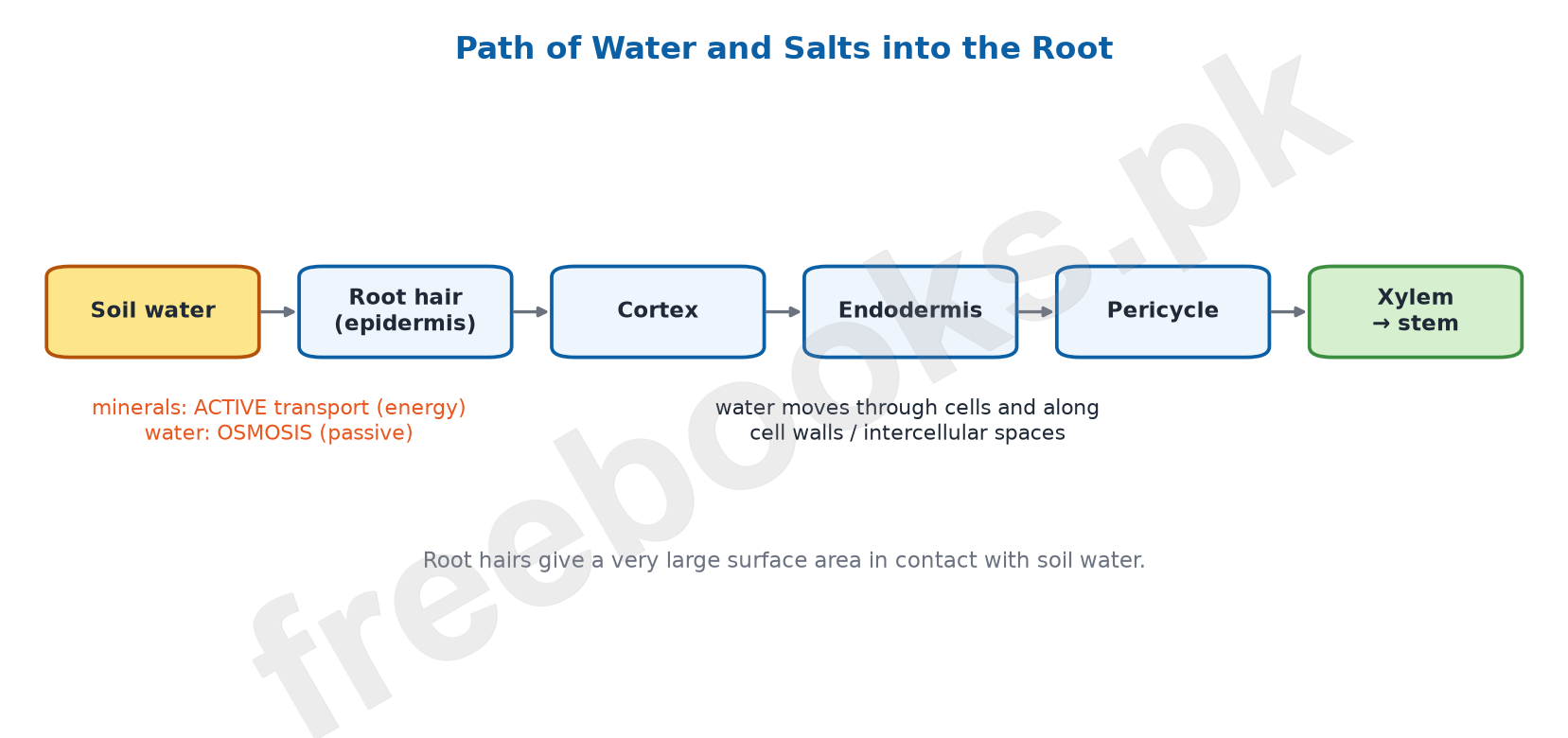
Root hairs are tiny extensions of epidermal cells that push between soil particles and give a huge surface for absorption. Root hairs take in mineral ions by active transport, using energy, because the ions are more concentrated inside than in the soil. This makes the cell sap more concentrated than soil water, so water enters by osmosis (passive transport).
From the epidermis, water passes through the cortex (a broad zone of cells), the endodermis (the innermost layer of the cortex) and the pericycle into the xylem at the centre of the root. It travels both through the cells and along cell walls and intercellular spaces. The root xylem is continuous with the xylem of the stem.
9.3 Transpiration and Stomata
Transpiration is the loss of water vapour from the aerial parts of a plant. Most occurs through stomata (stomatal transpiration); some occurs through the cuticle and through lenticels in the bark. Inside the leaf, water moves from xylem into the walls of mesophyll cells, evaporates into the air spaces and diffuses out through the stomata.
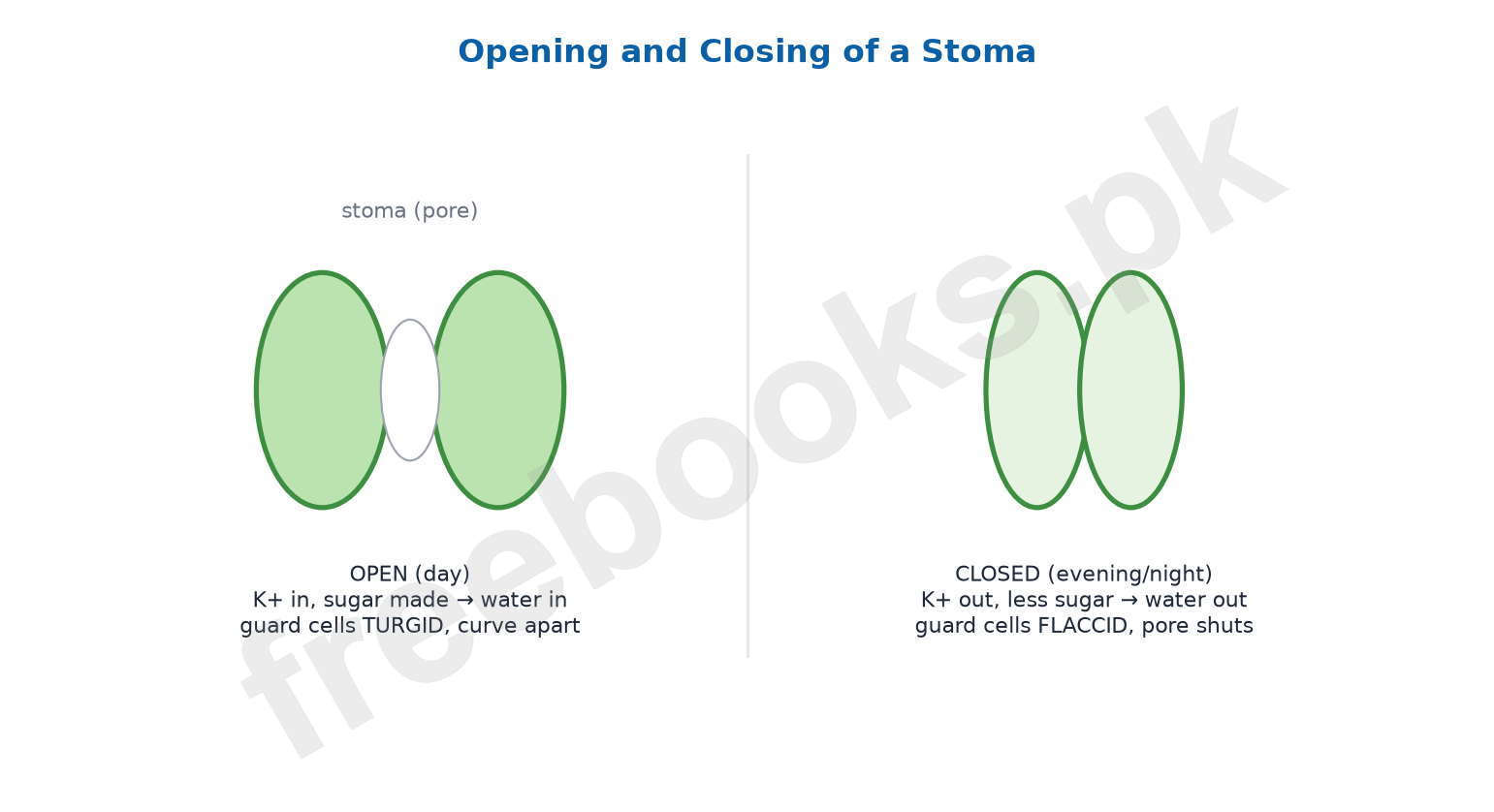
Each stoma lies between two guard cells, which are the only epidermal cells with chloroplasts. Their inner walls are thicker than the outer walls. During the day guard cells take in potassium ions by active transport and make sugar by photosynthesis; their solute concentration rises, water enters by osmosis and they become turgid. Because the thin outer walls stretch more, the cells bend apart and the stoma opens.
In the evening potassium ions leave and sugar falls, water moves out, the guard cells become flaccid and the stoma closes.
Transpiration is called a ‘necessary evil’: the plant loses water, but the evaporation creates the pull that lifts water and minerals up the plant and also cools the leaves. Its rate increases with higher temperature, stronger wind and larger leaf area, and decreases with higher humidity. Most stomata are on the lower leaf surface, so more water is lost from there.
9.4 Transport of Water: Transpiration Pull
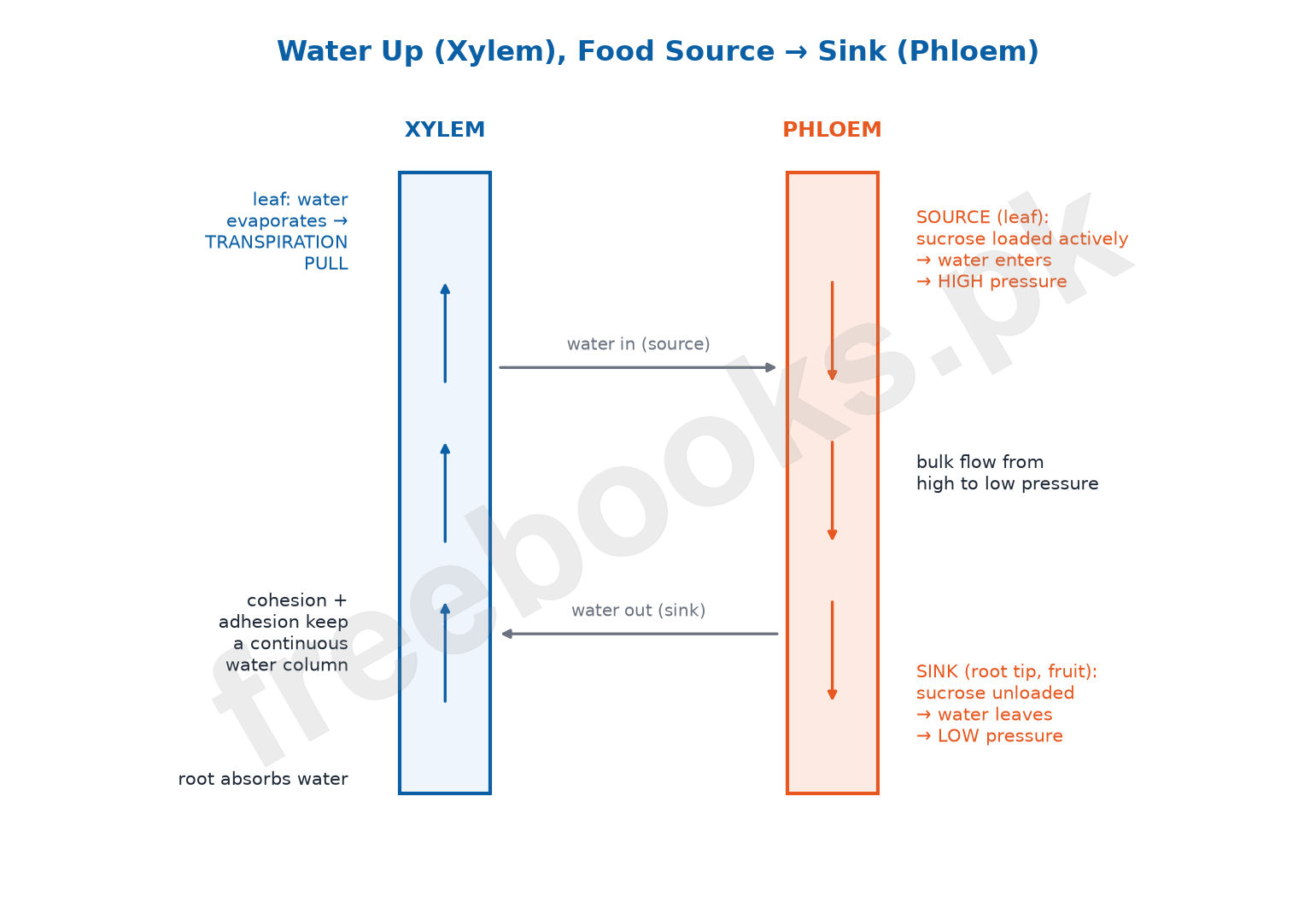
Roots do not push water all the way up a tall plant. Instead, water lost from leaves by transpiration is replaced from the xylem, and this creates a pulling force, the transpiration pull, on the water in the xylem.
Water in the xylem forms a continuous column from root to leaf because water molecules attract each other (cohesion), they stick to the xylem walls (adhesion), and the xylem vessels are very narrow. When molecules leave at the top, the tension is passed down the whole column and the column moves upward.
9.5 Translocation of Food: Pressure Flow
Food is moved in the phloem, mostly as sucrose, from sources to sinks. Sources are places that supply sugar, such as photosynthesising leaves or storage organs releasing food. Sinks are places that use or store sugar, such as growing tips, developing fruits and storage roots. Unlike xylem, phloem can carry food in either direction.
At the source, sucrose is actively loaded into the sieve tubes, with energy supplied by companion cells. The high sugar concentration draws water in from the nearby xylem by osmosis, building up pressure. At the sink, sucrose is actively unloaded and water leaves the sieve tubes, lowering the pressure. The difference in pressure pushes the sugar solution in bulk from source to sink.
9.6 Gaseous Exchange
All living plant cells respire all the time, while green cells also photosynthesise in light. During the day photosynthesis is faster than respiration, so leaves take in CO2 and give out O2 overall. At night only respiration occurs, so plants take in O2 and give out CO2.
Gases diffuse through the epidermis of young roots, stems and leaves, and especially through stomata in leaves and young stems. Woody stems are covered by bark, through which gases cannot pass, so exchange takes place through small pores in the bark called lenticels.
9.7 Excretion in Plants
Excess CO2 at night and excess O2 in the day are released through stomata and general surfaces. Extra water is removed mainly by transpiration (stomatal, cuticular and lenticular).
In guttation, water droplets ooze from special pores (hydathodes) at the tips or edges of leaves, usually at night or early morning when transpiration is low and water pressure in the xylem is high, as in grasses. Guttation is different from dew, which forms when water vapour in the air condenses on leaves.
Other wastes are stored as harmless crystals, kept in leaves that later fall, or released as latex (rubber plant), gums (kikar/Acacia), resins (conifers) and mucilage (lady finger).
9.8 Osmotic Adjustments
Mesophytes grow where water is moderate, such as maize, rose and tomato. They have well-developed roots, a cuticle, and close their stomata in hot dry periods.
Hydrophytes, such as water lily, grow in or near fresh water. They absorb water over their whole surface and have broad floating leaves with many stomata on the upper surface to lose excess water.
Xerophytes, such as cacti, live in deserts. They have deep roots, few stomata, a thick waxy cuticle, and some store water in succulent stems or roots.
Halophytes, such as many sea grasses and salt-marsh plants, live in salty water. They absorb salts to make their cells more concentrated than the surroundings, so they do not lose water, and they store extra salt or excrete it through salt glands.
Important Definitions
Nutrients
Substances an organism needs for energy, growth, repair and maintenance.
Macronutrients
Mineral elements needed by plants in large amounts, such as N, P, K, Ca and Mg.
Micronutrients
Mineral elements needed in small amounts, such as Fe, Zn, Cu and B.
Chlorosis
Yellowing of leaves due to lack of chlorophyll, often from N or Mg deficiency.
Root hairs
Fine extensions of root epidermal cells that absorb water and minerals.
Endodermis
The innermost layer of the root cortex.
Pericycle
A narrow layer of cells just inside the endodermis.
Transpiration
Loss of water vapour from the aerial parts of a plant.
Guard cells
Paired epidermal cells that open and close a stoma by changing turgor.
Lenticels
Small pores in bark through which gases are exchanged.
Transpiration pull
The upward pulling force on xylem water created by transpiration.
Translocation
Transport of food in the phloem.
Source
A part of the plant that supplies sugar to the phloem.
Sink
A part of the plant that uses or stores sugar.
Guttation
Loss of liquid water droplets from pores at leaf tips or margins.
Mesophyte
A plant adapted to moderate water supply.
Hydrophyte
A plant living in or near fresh water.
Xerophyte
A plant adapted to very dry conditions.
Halophyte
A plant adapted to salty habitats.
Key Facts at a Glance
| Topic | Key point |
|---|---|
| Nitrogen absorbed as | Nitrate |
| Magnesium absorbed as | Mg2+ ions |
| Element at centre of chlorophyll | Magnesium |
| Element controlling stomata | Potassium |
| Deficiency symptom of N and Mg | Chlorosis, first in older leaves |
| Water entry into root hair | Osmosis (passive) |
| Mineral entry into root hair | Active transport |
| Path of water in root | Root hair → cortex → endodermis → pericycle → xylem |
| Main site of transpiration | Stomata, mostly on lower leaf surface |
| Water rise in xylem | Transpiration pull + cohesion + adhesion |
| Food transported as | Sucrose, by pressure flow, source → sink |
| Gas exchange in woody stems | Lenticels |
| Excretory products | Latex, gums, resins, mucilage, crystals |
Diagrams
Water and salt uptake by the root: The path of water and minerals from soil through the root hair, cortex, endodermis and pericycle into the xylem.
Opening and closing of a stoma: Turgid guard cells bending apart to open the stoma by day and flaccid guard cells closing it at night.
Water up, food both ways: Transpiration pull lifting water in the xylem and the pressure flow of sugar in the phloem from source to sink.
Short Questions and Answers
Why do plants need minerals if they can make food by photosynthesis?
Photosynthesis makes only sugar; to make proteins, nucleic acids, chlorophyll and enzymes plants also need elements such as N, P, S and Mg from the soil.
Why does magnesium deficiency make leaves yellow?
Magnesium is part of chlorophyll; without it chlorophyll cannot be made and existing chlorophyll is broken down, so leaves turn yellow (chlorosis).
Why do older leaves turn yellow first when nitrogen is short?
The plant moves nitrogen from older leaves to the young growing leaves, so the old leaves lose chlorophyll first.
How do root hairs help in absorption?
They greatly increase the surface area in contact with soil water and absorb minerals actively, which then draws in water by osmosis.
Why do minerals enter root hairs by active transport?
The mineral concentration is often higher inside the root hair than in soil water, so ions must be moved against the gradient using energy.
Why is transpiration called a necessary evil?
It wastes water, but it also creates the pull that lifts water and minerals to the leaves and helps cool the plant.
How does wind increase transpiration?
It removes the humid air around the leaf, keeping the outside air drier so water vapour diffuses out faster.
Why do guard cells contain chloroplasts?
They make sugar by photosynthesis, which helps keep their solute concentration high so they stay turgid and the stoma stays open in daylight.
What makes the water column in xylem continuous?
Water molecules attract one another, stick to the xylem walls and fill very narrow tubes, so the column does not break.
Why can phloem transport food in both directions?
Food always flows from a source to a sink, and sources and sinks can be above or below one another, such as a storage root acting as a source in spring.
Why do plants give out CO2 at night?
At night there is no photosynthesis, but respiration continues, so the CO2 it produces is released.
How is guttation different from dew?
Guttation droplets come out of the plant through pores at the leaf margins; dew forms from water vapour in the air condensing on the leaf surface.
How do halophytes avoid losing water to salty surroundings?
They absorb salts to make their cells more concentrated than the surrounding water, and store or excrete extra salt through salt glands.
Long Questions and Answers
Describe mineral nutrition in plants with the roles of nitrogen and magnesium.
What are mineral nutrients?
Chemical elements absorbed from soil that plants need to make biomolecules other than sugar. They are grouped as macronutrients (needed in large amounts) and micronutrients (small amounts).
What are the roles of nitrogen?
Nitrogen is part of proteins, enzymes, nucleic acids and chlorophyll. It is absorbed as nitrate and promotes rapid growth and good seed and fruit production.
What are the roles of magnesium?
Magnesium is the central atom of chlorophyll and activates many enzymes; it helps fruit formation and seed germination. It is absorbed as Mg2+.
What happens when these elements are lacking?
Growth slows and leaves become yellow (chlorosis), starting with the older leaves; prolonged magnesium deficiency can make leaves fall.
Explain how roots absorb water and salts and pass them to the xylem.
What is the role of root hairs?
They provide a huge absorbing surface in direct contact with soil water.
How are salts and water absorbed?
Root hairs take in mineral ions by active transport using energy; the more concentrated cell sap then draws in water from the soil by osmosis.
Which tissues does water pass through?
From the epidermis water moves through the cortex, the endodermis and the pericycle to reach the xylem at the centre of the root.
What two routes does water use inside the root?
It moves through the living cells and also along the cell walls and intercellular spaces; the root xylem then carries it into the stem xylem.
Describe transpiration and the mechanism of opening and closing of stomata.
What is transpiration and where does it occur?
Loss of water vapour from aerial parts, mainly through stomata, and also through the cuticle and lenticels. Water evaporates from mesophyll cell walls into air spaces and diffuses out.
How does a stoma open?
In daylight guard cells take in K+ ions actively and make sugar; water enters by osmosis, the guard cells become turgid and, because their inner walls are thicker, they curve apart and the pore opens.
How does a stoma close?
In the evening K+ ions leave and sugar falls, water leaves the guard cells, they become flaccid and the inner walls come together, closing the pore.
Which factors affect transpiration?
Higher temperature, stronger wind and larger leaf area increase it; high humidity decreases it. More stomata on the lower surface mean more water is lost from there.
Explain the transport of water and food in plants.
What is transpiration pull?
Evaporation from leaves draws water out of the xylem, creating tension that pulls the whole water column upwards.
Why does the water column not break?
Cohesion between water molecules, adhesion to xylem walls and the narrowness of xylem vessels keep it continuous from root to leaf.
What happens at the source in pressure flow?
Sucrose is actively loaded into sieve tubes using energy from companion cells; water follows from the xylem by osmosis, raising pressure.
What happens at the sink?
Sucrose is actively unloaded and water leaves the sieve tubes, lowering pressure, so the sugar solution flows in bulk from source to sink.
Describe gaseous exchange, excretion and osmotic adjustment in plants.
How do plants exchange gases?
Through stomata in leaves and young stems, through the epidermis of young parts, and through lenticels in woody stems; by day CO2 is taken in and O2 given out, at night the reverse.
How do plants remove extra water?
Mainly by transpiration through stomata, cuticle and lenticels, and in some plants by guttation from pores at the leaf margins.
How are other wastes removed?
They are stored as crystals, kept in leaves that fall, or released as latex, gums, resins and mucilage.
How do different plants adjust to water conditions?
Mesophytes close stomata in dry spells; hydrophytes lose water through many upper stomata; xerophytes have deep roots, thick cuticle, few stomata and succulent organs; halophytes accumulate salts and excrete extra salt.
Multiple Choice Questions (MCQs)
Which element is the central atom of chlorophyll? (A) Iron (B) Magnesium (C) Nitrogen (D) Potassium
Correct answer: (B) Magnesium. Mg is at the centre of chlorophyll.
Which nutrient controls stomatal opening? (A) Calcium (B) Potassium (C) Zinc (D) Boron
Correct answer: (B) Potassium. K+ ions change guard cell turgor.
Which of these is a micronutrient? (A) Nitrogen (B) Phosphorus (C) Zinc (D) Calcium
Correct answer: (C) Zinc. Zinc is needed in small amounts.
Yellowing of leaves due to lack of chlorophyll is called: (A) Guttation (B) Chlorosis (C) Plasmolysis (D) Transpiration
Correct answer: (B) Chlorosis. Chlorosis.
Water enters root hairs by: (A) Active transport (B) Osmosis (C) Guttation (D) Translocation
Correct answer: (B) Osmosis. Water follows the solute gradient passively.
The innermost layer of the root cortex is the: (A) Pericycle (B) Endodermis (C) Epidermis (D) Xylem
Correct answer: (B) Endodermis. Endodermis.
Most transpiration occurs through: (A) Lenticels (B) Cuticle (C) Stomata (D) Root hairs
Correct answer: (C) Stomata. Stomatal transpiration is the main type.
Transpiration is slowest when the air is: (A) Hot and dry (B) Windy (C) Humid and still (D) Dry and windy
Correct answer: (C) Humid and still. High humidity reduces evaporation.
A stoma opens when its guard cells are: (A) Flaccid (B) Turgid (C) Dead (D) Plasmolysed
Correct answer: (B) Turgid. Turgid guard cells bend apart.
Food is translocated in the phloem mainly as: (A) Glucose (B) Starch (C) Sucrose (D) Cellulose
Correct answer: (C) Sucrose. Sucrose is the transport sugar.
Which is a sink? (A) Mature leaf in sunlight (B) Growing root tip (C) Storage root in spring (D) Photosynthesising mesophyll
Correct answer: (B) Growing root tip. Growing tips use sugar.
Gas exchange in woody stems occurs through: (A) Stomata (B) Lenticels (C) Root hairs (D) Hydathodes
Correct answer: (B) Lenticels. Bark has lenticels.
Acacia (kikar) trees excrete: (A) Latex (B) Gums (C) Resins (D) Mucilage
Correct answer: (B) Gums. Kikar produces gum.
A cactus is an example of a: (A) Hydrophyte (B) Xerophyte (C) Halophyte (D) Mesophyte
Correct answer: (B) Xerophyte. Desert plant with succulent stem.
Water lily leaves have most stomata on the: (A) Lower surface (B) Upper surface (C) Petiole (D) Roots
Correct answer: (B) Upper surface. The lower surface touches water.
Quick Revision Summary
- Macronutrients (large amounts) vs micronutrients (small amounts). N: proteins, nucleic acids, chlorophyll (as nitrate). Mg: centre of chlorophyll (as Mg2+). Deficiency → chlorosis, older leaves first.
- Root hairs: minerals by active transport, water by osmosis → cortex → endodermis → pericycle → xylem.
- Transpiration: mainly via stomata; increased by heat, wind, leaf area; decreased by humidity.
- Stoma opens: K+ in + sugar → water in → turgid guard cells curve apart. Closes: K+ out → flaccid.
- Water rises by transpiration pull + cohesion + adhesion in narrow xylem.
- Pressure flow: sucrose loaded at source (active) → water in → high pressure → bulk flow → unloaded at sink.
- Gas exchange: stomata, epidermis, lenticels. Excretion: transpiration, guttation, latex, gums, resins, mucilage.
- Mesophytes, hydrophytes, xerophytes, halophytes: each has adaptations to its water conditions.
Exam Tips
- Learn the path of water in the root as a chain; it is often asked as a short question or flow diagram.
- In stomata answers, mention K+ ions, osmosis, turgor and the uneven thickness of guard cell walls.
- For transport, keep it clear: xylem = water and salts, one way up; phloem = food, both ways, source to sink.
- Give one example plant for each osmotic group: maize (mesophyte), water lily (hydrophyte), cactus (xerophyte), sea grass (halophyte).
- Draw a labelled diagram of an open and closed stoma; it earns easy marks.
Note on Facts
The textbook lists carbon, hydrogen and oxygen among mineral nutrients absorbed from soil. They are essential macronutrients, but plants obtain them from carbon dioxide (air) and water, not as minerals from the soil.
The textbook’s description of guttation is a little unclear. Guttation happens mainly at night or early morning, when stomata are closed and root pressure pushes water out through pores (hydathodes) at the leaf tips and edges.
The textbook’s figure caption reads ‘Closed stomach in the leaf of tomato’; it should read ‘closed stomata’.