Reproduction is how organisms produce new individuals of their own kind. In asexual reproduction there is no fusion of gametes, and the offspring are genetically identical to the parent. In sexual reproduction male and female gametes fuse, and the offspring show variation.
Chapter 10 first describes the main kinds of asexual reproduction (binary fission, budding, spore formation and vegetative propagation), then artificial propagation by cuttings and grafting, and finally sexual reproduction in flowering plants: alternation of generations, the parts of a flower, formation of the embryo sac and pollen grain, pollination, double fertilisation, and seed and fruit formation.
Learning Objectives
- Describe binary fission, budding, spore formation and vegetative propagation.
- Explain natural vegetative propagation by stems, suckers and leaves.
- Distinguish natural vegetative propagation from artificial propagation; describe cuttings and grafting.
- State the advantages and disadvantages of vegetative propagation.
- Explain alternation of generations and the parts of a flower.
- Describe the life cycle of a flowering plant including double fertilisation.
Key Concepts
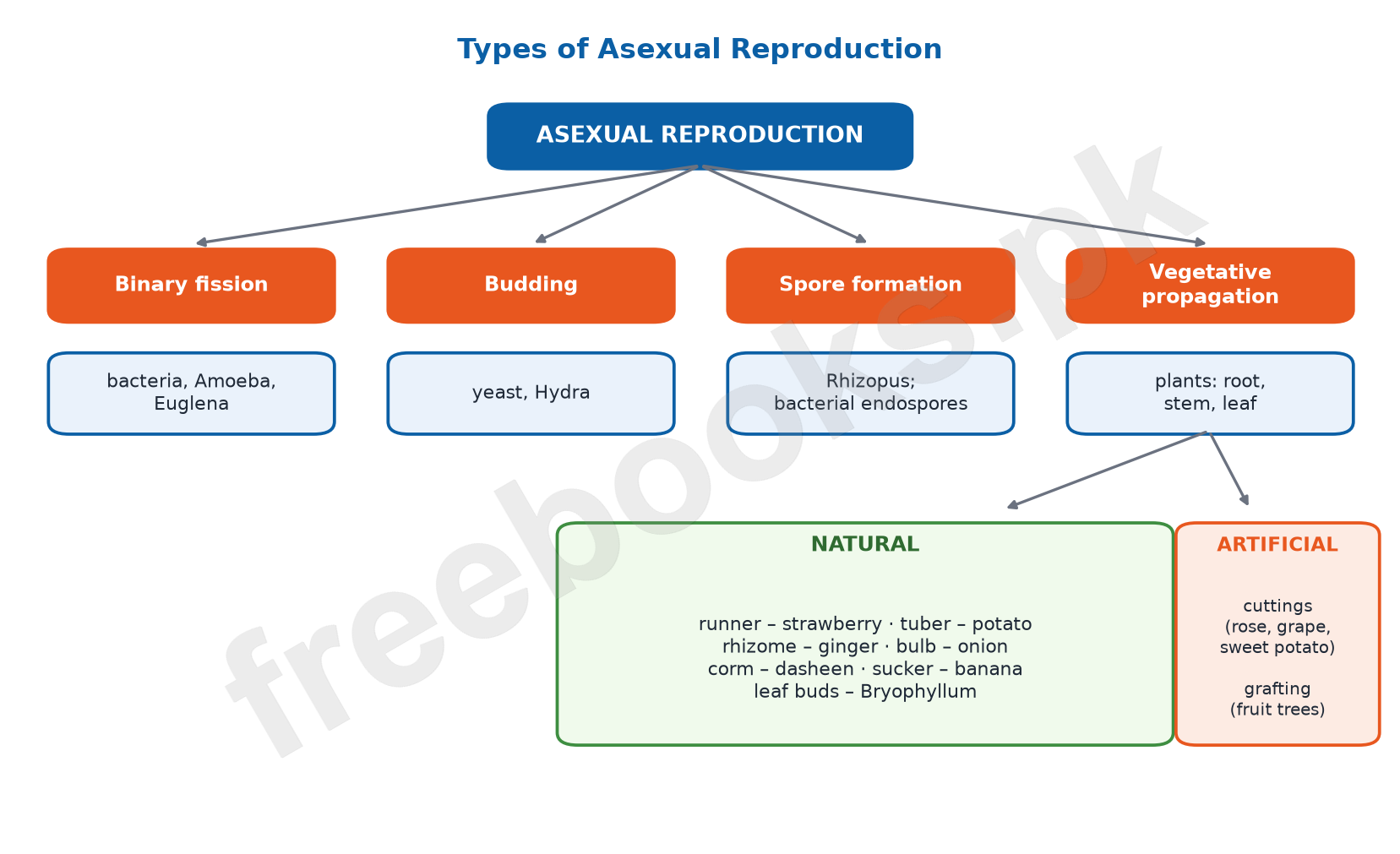
10.1 Types of Asexual Reproduction
Binary fission: the parent cell divides into two equal daughter cells. In bacteria the DNA is copied, the copies move apart, the membrane pinches in and a new wall forms. Protists such as Amoeba and Euglena divide their nucleus and then their cytoplasm. Some flatworms such as planarians can also split into two.
Budding: a small outgrowth (bud) forms on the parent, grows and either separates or stays attached. It is common in yeast and also occurs in Hydra.
Spore formation: spores are tough, thick-walled asexual cells. Fungi such as Rhizopus (bread mould) form them in sac-like sporangia, which burst to release them. Spores survive harsh conditions and germinate when conditions improve. Some bacteria form endospores inside the cell, which can survive even if the cell dies; this is why poorly sterilised canned food can be dangerous.
Vegetative propagation: a new plant grows from a vegetative part (root, stem or leaf) of the parent. It is quicker than sexual reproduction and produces plants identical to the parent. It may be natural or artificial.
10.1 Natural Vegetative Propagation
Stolons (runners) are horizontal stems above the ground; new plants form at their nodes, as in strawberry. Tubers are swollen underground stems with buds called ‘eyes’, as in potato. Rhizomes are horizontal underground stems with nodes, as in ginger and ferns.
Bulbs are very short underground stems with fleshy food-storing leaves and a bud, as in onion, tulip and lily. Corms look like bulbs but are mostly solid stem with a few thin papery leaves outside, as in dasheen (taro, arvi).
Suckers are shoots that arise from the base of the stem or from roots and later become independent, as in banana. Some leaves, as in Bryophyllum, have buds along their margins that grow into new plants when the leaf touches the soil.
10.2 Artificial Propagation
Artificial propagation means people deliberately use vegetative parts to grow new plants, for example by cuttings, grafting, layering or tissue culture. It is used to multiply plants with useful characteristics.
Cutting: a piece of stem or root is cut and planted so that it grows roots and shoots. Roses and grapevines are grown from stem cuttings and sweet potato from root cuttings.
Grafting: a bud or shoot (the scion) from one plant is joined to the rooted stem (the stock) of another plant of a related kind so that they grow as one. It combines good qualities of both, and is used for most commercial fruit trees such as plum, almond and cherry.
Advantages: many identical plants are produced quickly, and desirable qualities such as good fruit are kept. Disadvantage: all the plants are genetically the same, so a single disease or change in environment can damage all of them.
10.3 Alternation of Generations
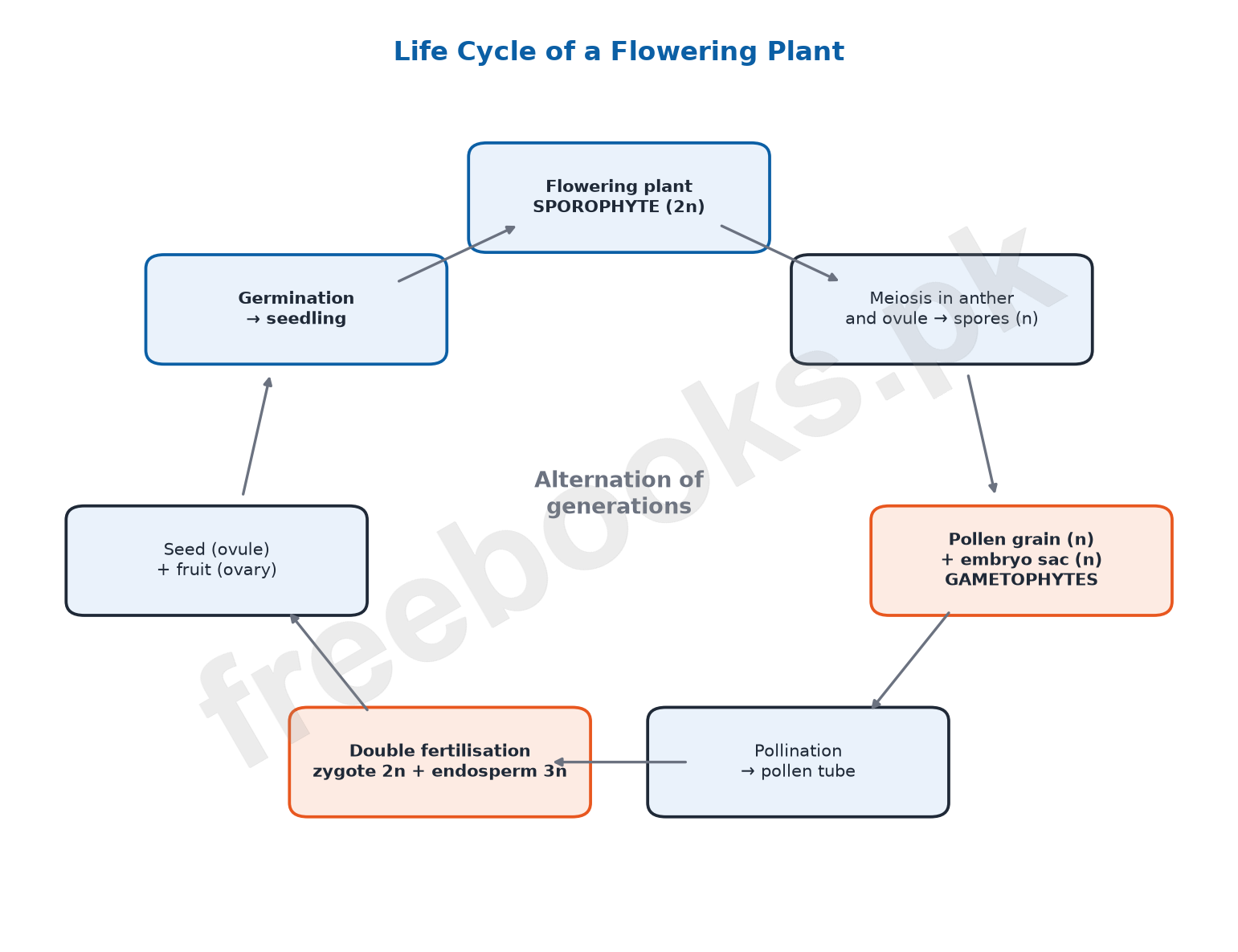
Plants alternate between two generations. The diploid sporophyte produces haploid spores by meiosis. A spore grows into a haploid gametophyte, which produces gametes by mitosis. Gametes fuse to form a diploid zygote, which grows into the next sporophyte.
In a flowering plant the plant we see is the sporophyte; the gametophytes are tiny and live inside the flower: the pollen grain (male) and the embryo sac (female).
10.3 Parts of a Flower
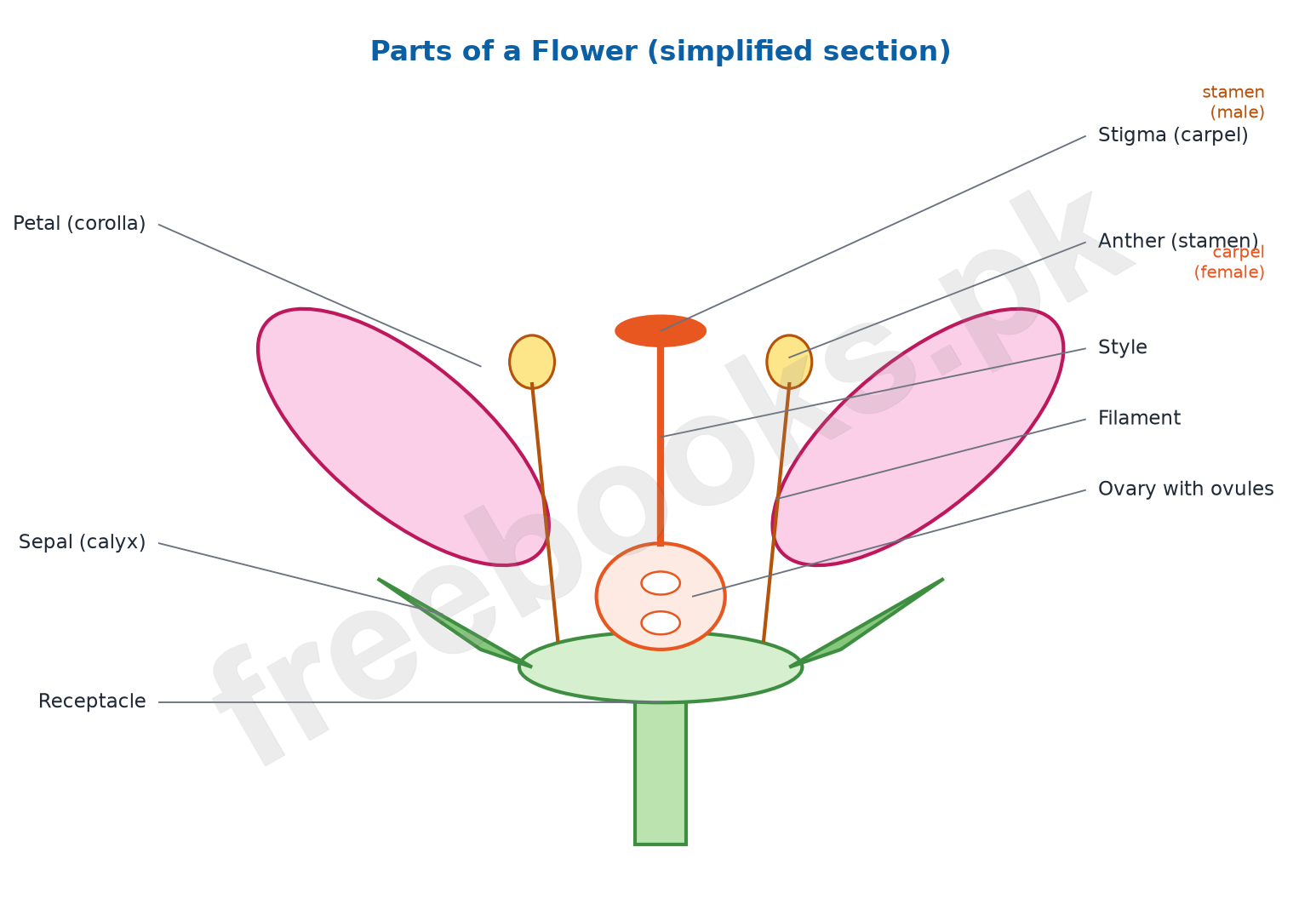
The flower sits on the receptacle, the swollen end of the flower stalk. Its parts are in four whorls. The calyx (sepals) is the outermost whorl and protects the bud. The corolla (petals), often brightly coloured, attracts pollinators.
The androecium is the male whorl of stamens; each stamen has an anther, containing pollen sacs, on a stalk called the filament. The gynoecium is the female whorl of carpels; each carpel has an ovary containing ovules, a stalk called the style, and a stigma at the tip that receives pollen. One or more fused carpels form a pistil.
10.3 Life Cycle of a Flowering Plant
Female gametophyte: in the ovule, a diploid megaspore mother cell undergoes meiosis to give four haploid megaspores, of which only one survives. Its nucleus divides by mitosis to give eight nuclei. Two of these (polar nuclei) fuse to form the fusion nucleus, and one becomes the egg. The resulting seven-celled structure is the embryo sac.
Male gametophyte: in the anther, each microspore mother cell undergoes meiosis to form four haploid microspores. Each microspore divides by mitosis into a two-celled pollen grain with a tube cell and a generative cell; the generative cell later forms two sperms.
Pollination is the transfer of pollen from an anther to a stigma. In self-pollination pollen reaches the stigma of the same flower or another flower on the same plant; in cross-pollination it reaches a flower on a different plant of the same species.
Double fertilisation: on the stigma, the tube cell grows a pollen tube down the style to the ovule, entering through the micropyle. One sperm fuses with the egg to form a diploid zygote (which becomes the embryo); the other fuses with the fusion nucleus to form a triploid nucleus (which becomes the endosperm, the food store). This double fusion is unique to flowering plants.
After fertilisation the ovule becomes the seed and the ovary becomes the fruit. Seeds are dispersed and, in suitable conditions, the embryo grows into a new sporophyte. In parthenocarpy the ovary forms a fruit without fertilisation, giving seedless fruits such as banana and seedless grapes.
Important Definitions
Asexual reproduction
Reproduction without fusion of gametes, giving offspring identical to the parent.
Sexual reproduction
Reproduction involving fusion of male and female gametes.
Binary fission
Division of a parent cell into two equal daughter cells.
Budding
Formation of a new individual from an outgrowth of the parent.
Spore
A thick-walled asexual reproductive cell that can survive harsh conditions.
Endospore
A resistant spore formed inside a bacterial cell.
Vegetative propagation
Production of a new plant from a root, stem or leaf of the parent.
Stolon (runner)
A horizontal stem growing above ground that forms new plants at its nodes.
Tuber
A swollen underground stem with buds (eyes), as in potato.
Rhizome
A horizontal underground stem with nodes, as in ginger.
Bulb
A short underground stem with fleshy leaves, as in onion.
Corm
A short, solid underground stem with a few papery leaves, as in dasheen.
Grafting
Joining a part of one plant onto another so they grow as one plant.
Alternation of generations
Alternation of a diploid sporophyte and a haploid gametophyte in a plant’s life cycle.
Pollination
Transfer of pollen from an anther to a stigma.
Double fertilisation
Fusion of one sperm with the egg and the other with the fusion nucleus in flowering plants.
Endosperm
Triploid food-storing tissue of the seed.
Parthenocarpy
Development of fruit without fertilisation, giving seedless fruit.
Key Facts at a Glance
| Method / structure | Example |
|---|---|
| Binary fission | Bacteria, Amoeba, Euglena |
| Budding | Yeast, Hydra |
| Spores in sporangia | Rhizopus (bread mould) |
| Stolon / runner | Strawberry |
| Tuber | Potato |
| Rhizome | Ginger, ferns |
| Bulb | Onion, tulip, lily |
| Corm | Dasheen (arvi) |
| Sucker | Banana |
| Leaf buds | Bryophyllum |
| Stem cutting / root cutting | Rose, grapevine / sweet potato |
| Grafting | Plum, almond, cherry |
| Parthenocarpy | Banana, seedless grapes |
| Ploidy after double fertilisation | Zygote 2n · Endosperm 3n |
Diagrams
Types of asexual reproduction: A chart of binary fission, budding, spore formation and vegetative propagation with examples of natural and artificial methods.
Parts of a flower: A simplified section of a flower labelling sepal, petal, stamen (anther, filament) and carpel (stigma, style, ovary, ovule).
Life cycle of a flowering plant: The cycle from sporophyte to spores, pollen grain and embryo sac, pollination, double fertilisation, seed and new plant.
Short Questions and Answers
Why are offspring of asexual reproduction identical to their parent?
Only one parent is involved and new cells are formed by mitosis, so the genetic material is copied exactly.
How does binary fission in bacteria differ from that in Amoeba?
Bacteria have no nucleus, so the DNA is copied and the cell pinches in and builds a new wall; Amoeba first divides its nucleus and then its cytoplasm.
Why can spores survive harsh conditions?
They have thick, tough walls that protect them from drying and heat until conditions become favourable.
Why are improperly canned foods risky?
Bacterial endospores can survive poor sterilisation, germinate inside the can and produce toxins.
How is a potato tuber recognised as a stem and not a root?
It has nodes with buds (‘eyes’) that grow into shoots, which is a feature of stems.
Distinguish a bulb from a corm.
A bulb is a short stem surrounded by fleshy food-storing leaves (onion); a corm is mostly solid stem with only a few thin, dry leaves (dasheen).
How does Bryophyllum reproduce vegetatively?
Buds along its leaf margins grow into small plants when the leaf falls on moist soil.
Why do farmers graft fruit trees?
To combine a good-quality fruiting variety with a strong, disease-resistant root system and to get identical high-quality trees quickly.
Give one disadvantage of vegetative propagation.
All the offspring are genetically identical, so a disease or environmental change that harms one plant can harm all of them.
What are the two gametophytes of a flowering plant?
The male gametophyte is the pollen grain and the female gametophyte is the embryo sac inside the ovule.
Name the parts of a carpel and the job of each.
The stigma receives pollen, the style connects the stigma to the ovary, and the ovary contains ovules.
Why is fertilisation in flowering plants called double?
Two fusions occur: one sperm with the egg to form the zygote and the other with the fusion nucleus to form the endosperm nucleus.
What do the ovule and ovary become after fertilisation?
The ovule becomes the seed and the ovary becomes the fruit.
Long Questions and Answers
Describe the main types of asexual reproduction.
What is binary fission?
The division of one cell into two equal daughter cells. Bacteria copy their DNA, pinch in and form a new wall; protists such as Amoeba divide their nucleus and then their cytoplasm.
What is budding?
A small outgrowth develops on the parent, grows and may separate to live independently, as in yeast and Hydra.
What is spore formation?
Fungi such as Rhizopus produce thick-walled spores inside sporangia; the spores are released, survive bad conditions and germinate later. Some bacteria form endospores.
What is vegetative propagation?
New plants grow from roots, stems or leaves of the parent, either naturally or with human help; the offspring are identical to the parent.
Explain natural vegetative propagation with examples.
How do above-ground stems help?
Stolons (runners) grow along the soil surface and new plants form at their nodes, as in strawberry.
How do underground stems help?
Tubers (potato) have buds called eyes; rhizomes (ginger) have nodes along a horizontal stem; bulbs (onion) and corms (dasheen) store food and produce new shoots.
What are suckers?
Shoots from the base of the stem or roots that grow roots of their own and become new plants, as in banana.
How can leaves produce new plants?
In Bryophyllum, buds on the leaf margins grow into new plantlets when the leaf touches moist soil.
Describe artificial propagation and its advantages and disadvantages.
What is artificial propagation?
The deliberate use of vegetative parts by people to raise new plants, using methods such as cuttings, grafting, layering and tissue culture.
How are cuttings used?
A piece of stem or root is planted and develops roots and shoots: roses and grapevines from stem cuttings, sweet potato from root cuttings.
What is grafting?
A bud or shoot of one plant is joined onto the rooted stem of a related plant so they grow as one, combining useful qualities; used for plum, almond and cherry trees.
What are the advantages and disadvantages?
Many plants with the same good qualities are produced quickly, but their genetic sameness means they are all equally sensitive to a disease or environmental change.
Describe the life cycle of a flowering plant.
How is the female gametophyte formed?
A megaspore mother cell in the ovule undergoes meiosis; one of the four megaspores survives and its nucleus divides by mitosis into eight. Two fuse as the fusion nucleus and one forms the egg, giving the embryo sac.
How is the male gametophyte formed?
Microspore mother cells in the anther undergo meiosis to form microspores; each divides by mitosis into a pollen grain with a tube cell and a generative cell, which forms two sperms.
How do pollination and fertilisation take place?
Pollen is transferred to the stigma by self- or cross-pollination. A pollen tube grows to the ovule; one sperm fuses with the egg (zygote, 2n) and the other with the fusion nucleus (endosperm nucleus, 3n): double fertilisation.
What happens after fertilisation?
The zygote becomes the embryo, the triploid nucleus becomes endosperm, the ovule becomes the seed and the ovary becomes the fruit; seeds germinate into new sporophytes.
Multiple Choice Questions (MCQs)
The usual method of reproduction in bacteria is: (A) Budding (B) Binary fission (C) Spore formation only (D) Grafting
Correct answer: (B) Binary fission. Bacteria divide into two.
Yeast commonly reproduces by: (A) Binary fission (B) Budding (C) Rhizome (D) Grafting
Correct answer: (B) Budding. A bud grows out of the parent cell.
Rhizopus produces spores in: (A) Anthers (B) Sporangia (C) Ovaries (D) Tubers
Correct answer: (B) Sporangia. Spores form in sporangia.
Strawberry spreads naturally by: (A) Tubers (B) Bulbs (C) Runners (stolons) (D) Suckers
Correct answer: (C) Runners (stolons). Runners form new plants at nodes.
The ‘eyes’ of a potato are: (A) Roots (B) Buds (C) Seeds (D) Spores
Correct answer: (B) Buds. They are buds on the stem tuber.
Onion is an example of a: (A) Corm (B) Bulb (C) Rhizome (D) Runner
Correct answer: (B) Bulb. Fleshy leaves around a short stem.
Banana plants commonly produce new plants by: (A) Suckers (B) Runners (C) Spores (D) Leaf buds
Correct answer: (A) Suckers. Suckers arise from the base.
Bryophyllum reproduces vegetatively by: (A) Root cuttings (B) Buds on leaf margins (C) Bulbs (D) Grafting
Correct answer: (B) Buds on leaf margins. Leaf-margin buds.
Sweet potato is propagated by: (A) Stem cuttings (B) Root cuttings (C) Grafting (D) Seeds only
Correct answer: (B) Root cuttings. Its swollen roots sprout.
In flowering plants the sporophyte is: (A) The pollen grain (B) The embryo sac (C) The main plant (D) The spore
Correct answer: (C) The main plant. The visible plant is the sporophyte.
Pollen is produced in the: (A) Ovary (B) Stigma (C) Anther (D) Sepal
Correct answer: (C) Anther. Anthers contain pollen sacs.
The part of a carpel that receives pollen is the: (A) Style (B) Stigma (C) Ovary (D) Filament
Correct answer: (B) Stigma. Stigma.
Endosperm nucleus is: (A) Haploid (B) Diploid (C) Triploid (D) Tetraploid
Correct answer: (C) Triploid. Sperm (n) + fusion nucleus (2n) = 3n.
After fertilisation the ovary becomes the: (A) Seed (B) Fruit (C) Embryo (D) Endosperm
Correct answer: (B) Fruit. Ovary → fruit.
Seedless grapes are produced by: (A) Double fertilisation (B) Parthenocarpy (C) Budding (D) Binary fission
Correct answer: (B) Parthenocarpy. Fruit forms without fertilisation.
Quick Revision Summary
- Asexual: no gametes, identical offspring. Sexual: gametes fuse, variation.
- Binary fission (bacteria, Amoeba), budding (yeast, Hydra), spores (Rhizopus; bacterial endospores), vegetative propagation.
- Natural vegetative: runner (strawberry), tuber (potato), rhizome (ginger), bulb (onion), corm (dasheen), sucker (banana), leaf buds (Bryophyllum).
- Artificial: cuttings (rose, grape; sweet potato root), grafting (fruit trees). + quick, identical; − no variation.
- Alternation of generations: sporophyte (2n) → spores (n, meiosis) → gametophyte (n) → gametes (mitosis) → zygote (2n).
- Flower: calyx, corolla, androecium (anther + filament), gynoecium (stigma + style + ovary).
- Double fertilisation: sperm + egg → zygote (2n); sperm + fusion nucleus → endosperm (3n). Ovule → seed, ovary → fruit.
Exam Tips
- Learn one example for each asexual method; most MCQs test examples.
- Remember which structures are stems: runner, tuber, rhizome, bulb and corm are all stems, even if underground.
- Draw and label a flower; examiners often ask for the four whorls and the parts of stamen and carpel.
- In double fertilisation questions, always state the ploidy: zygote 2n, endosperm 3n.
- Keep the order: pollination → pollen tube → fertilisation → seed and fruit.
Note on Facts
The textbook gives garlic as an example of a corm. A garlic head is actually a compound bulb made of cloves. Well-known corms are dasheen (taro/arvi), crocus and gladiolus.
The textbook describes the embryo sac as seven cells: one egg, one fusion nucleus and five non-functional cells. In standard terms these are the egg cell, two synergids, three antipodal cells and a large central cell containing the two polar nuclei (which fuse to form the fusion nucleus).
The textbook’s chapter pages carry the running header ‘Plant Physiology’ in places; the chapter is Reproduction in Plants.