
Chapter 8 built the general tools for describing any probability distribution — the PMF, PDF, expectation, and variance. This chapter applies those tools to two of the most important and widely used discrete probability distributions in statistics: the binomial distribution, which models the number of successes in a fixed number of independent trials (like counting heads in repeated coin tosses, or defective items when sampling with replacement), and the hypergeometric distribution, which models the same kind of counting problem but when sampling is done without replacement from a finite population, making successive trials dependent rather than independent.
Both distributions answer the same basic question — 'how many successes out of n trials?' — but they apply to different real-world sampling situations, and recognizing which one fits a given problem (replacement vs. no replacement, fixed vs. changing probability of success) is one of the most practical skills this chapter builds.
Learning Objectives
- Define a Bernoulli trial and list the four properties of a binomial experiment
- Apply the binomial probability formula P(X=x) = C(n,x) p^x q^(n-x) to compute exact, cumulative, and range probabilities
- Identify whether a binomial distribution is symmetric, positively skewed, or negatively skewed based on p
- Calculate expected (binomial) frequencies for a fixed number of repeated experiments
- Derive and apply the mean (np) and variance (npq) of the binomial distribution
- Define a hypergeometric experiment and list its four defining properties
- Apply the hypergeometric probability formula and calculate its mean and variance
- Distinguish when to use the binomial distribution versus the hypergeometric distribution for a given sampling problem
Key Concepts
9.1 Introduction: Bernoulli Trials and the Binomial Experiment
In experiments like tossing a coin or repeatedly drawing a card, each individual repetition is called a trial, and the result of each trial is classified as either a success or a failure. The probability of success is denoted p and the probability of failure is denoted q, where q = 1-p (so p+q=1). If an experiment is repeated n times, the number of successes is denoted x and the number of failures is n-x.
A trial with exactly two possible outcomes — success or failure — is called a Bernoulli trial; for each Bernoulli trial the probability of success stays the same, and successive trials are independent. An experiment made up of repeated Bernoulli trials, where the probability of success stays constant from trial to trial, is called a binomial experiment. A binomial experiment has four defining properties: (i) each trial results in an outcome classified as success or failure; (ii) the probability of success remains constant from one trial to the next; (iii) the repeated trials are independent of each other; (iv) the experiment is repeated a fixed number of times.
9.2 Binomial Probability Distribution
For n independent trials, each with probability of success p and probability of failure q (q+p=1), the probability of exactly x successes is P(X=x) = C(n,x).p^x.q^(n-x), for x=0,1,2,…,n. The random variable X is called the binomial variable, its distribution is the binomial distribution, and n and p are the two parameters of the distribution, often written b(x,n,p). These probabilities are exactly the individual terms produced by expanding the binomial expression (q+p)^n — which is why the distribution is named 'binomial' and why the coefficients C(n,x) are called binomial coefficients.
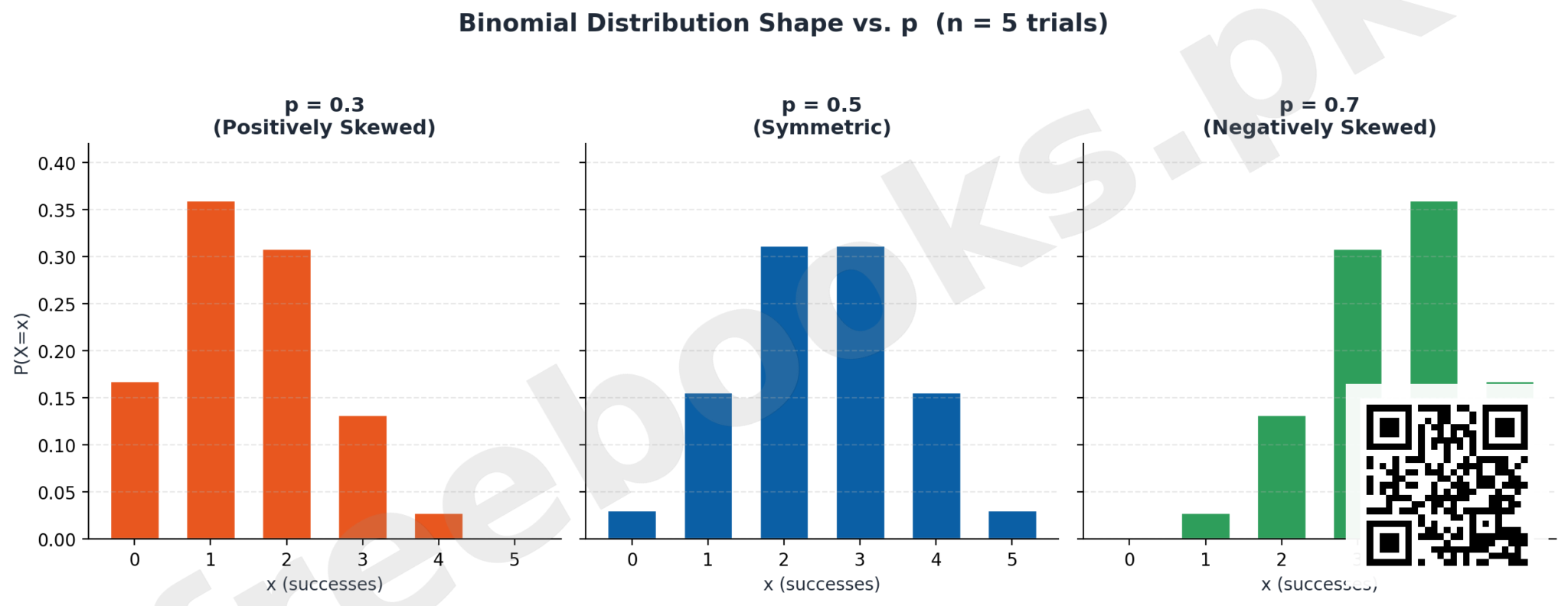
The shape of the binomial distribution depends entirely on p: if p=q=1/2, the distribution is perfectly symmetrical. If p is not equal to q, the distribution is skewed — specifically, if p is greater than 1/2 the distribution is negatively skewed (tail toward lower values), and if p is less than 1/2 the distribution is positively skewed (tail toward higher values).
9.2.1 Binomial Frequency Distribution
When a binomial probability distribution is multiplied by the number of experiments N (repetitions of the whole n-trial experiment), the result is called the binomial frequency distribution. The expected frequency of exactly x successes across N experiments is f(X=x) = N.P(X=x) = N.C(n,x).q^(n-x).p^x — this is simply the theoretical probability scaled up to a real count, useful for predicting how many out of N groups (families, batches, samples) will show a particular number of successes.
9.2.2 Mean and Variance of the Binomial Distribution
Through algebraic derivation starting from E(X) = sum of x.P(x) and expanding using the binomial theorem, the mean of the binomial distribution simplifies elegantly to E(X) = np — the number of trials multiplied by the probability of success on each trial, which matches the intuitive idea that if you flip a coin n times with probability p of heads, you'd 'expect' about np heads on average.
Following the same style of derivation for E(X^2), and using the computing formula Var(X) = E(X^2) – [E(X)]^2, the variance of the binomial distribution simplifies to Var(X) = npq, and consequently the standard deviation is sigma = square-root(npq). These two compact formulas, mean = np and variance = npq, are among the most frequently used results in this chapter and let you find the mean and spread of a binomial distribution instantly, without building a full probability table.
9.3 Hypergeometric Distribution
When successive trials are conducted without replacement, they are no longer independent — the probability of success changes from one trial to the next depending on what was already drawn. An experiment where a random sample is chosen without replacement from a finite population is called a hypergeometric experiment. It has four defining properties: (i) the experiment is repeated a fixed number of times; (ii) the successive trials are dependent; (iii) the probability of success varies from trial to trial (it is not fixed); (iv) each outcome is still classified as success or failure. The random variable representing the number of successes is called the hypergeometric variable, and its distribution is the hypergeometric distribution.
Suppose there are N total items, of which k are classified as successes and (N-k) as failures, and n items are selected at random without replacement (n <= N). The probability of getting exactly x successes (and n-x failures) is P(X=x) = [C(k,x).C(N-k,n-x)] / C(N,n), for x=0,1,2,…,n. The hypergeometric distribution has three parameters: n, k, and N. Its mean is nk/N, and its variance is (nk/N).(1 – k/N).((N-n)/(N-1)) — notice the extra factor (N-n)/(N-1), called the finite population correction factor, which distinguishes it from the simpler binomial variance and accounts for the fact that sampling is without replacement from a limited population.
Important Definitions
What is a Bernoulli trial?
A trial with exactly two possible outcomes — success and failure — where the probability of success stays constant and successive trials are independent.
What is a binomial experiment?
An experiment made up of a fixed number of independent Bernoulli trials, each with the same probability of success p.
What is the binomial probability formula?
P(X=x) = C(n,x).p^x.q^(n-x), giving the probability of exactly x successes in n independent trials.
What are the two parameters of the binomial distribution?
n (the number of trials) and p (the probability of success on each trial).
What is the mean and variance of the binomial distribution?
Mean = np; Variance = npq (where q = 1-p); Standard deviation = square-root(npq).
What is a hypergeometric experiment?
An experiment in which a random sample is drawn without replacement from a finite population, making successive trials dependent and the probability of success variable.
What is the hypergeometric probability formula?
P(X=x) = [C(k,x).C(N-k,n-x)] / C(N,n), where N is the population size, k is the number of successes in the population, and n is the sample size.
What is the finite population correction factor?
The term (N-n)/(N-1) appearing in the hypergeometric variance formula, which adjusts for sampling without replacement from a finite population of size N.
How do you decide whether to use the binomial or hypergeometric distribution?
Use the binomial distribution when sampling is with replacement (or from an effectively infinite population) so trials are independent and p is constant; use the hypergeometric distribution when sampling is without replacement from a small, finite population so trials are dependent and the probability of success changes.
Key Facts and Relations
| Topic | Key Fact / Relation |
|---|---|
| Binomial probability | P(X=x) = C(n,x) p^x q^(n-x), x = 0,1,…,n |
| Binomial frequency distribution | f(X=x) = N.P(X=x) = N.C(n,x) q^(n-x) p^x |
| Binomial mean | E(X) = np |
| Binomial variance | Var(X) = npq |
| Binomial standard deviation | sigma = sqrt(npq) |
| Binomial distribution shape | p=q=0.5: symmetric | p>0.5: negatively skewed | p<0.5: positively skewed |
| Hypergeometric probability | P(X=x) = [C(k,x).C(N-k,n-x)] / C(N,n) |
| Hypergeometric mean | Mean = nk/N |
| Hypergeometric variance | Var(X) = (nk/N)(1 – k/N)((N-n)/(N-1)) |
Diagrams
Binomial Distribution Shape vs. p (n=5): Three side-by-side binomial probability bar charts for n=5 with p=0.3, p=0.5, and p=0.7, illustrating positively skewed, symmetric, and negatively skewed binomial distributions respectively
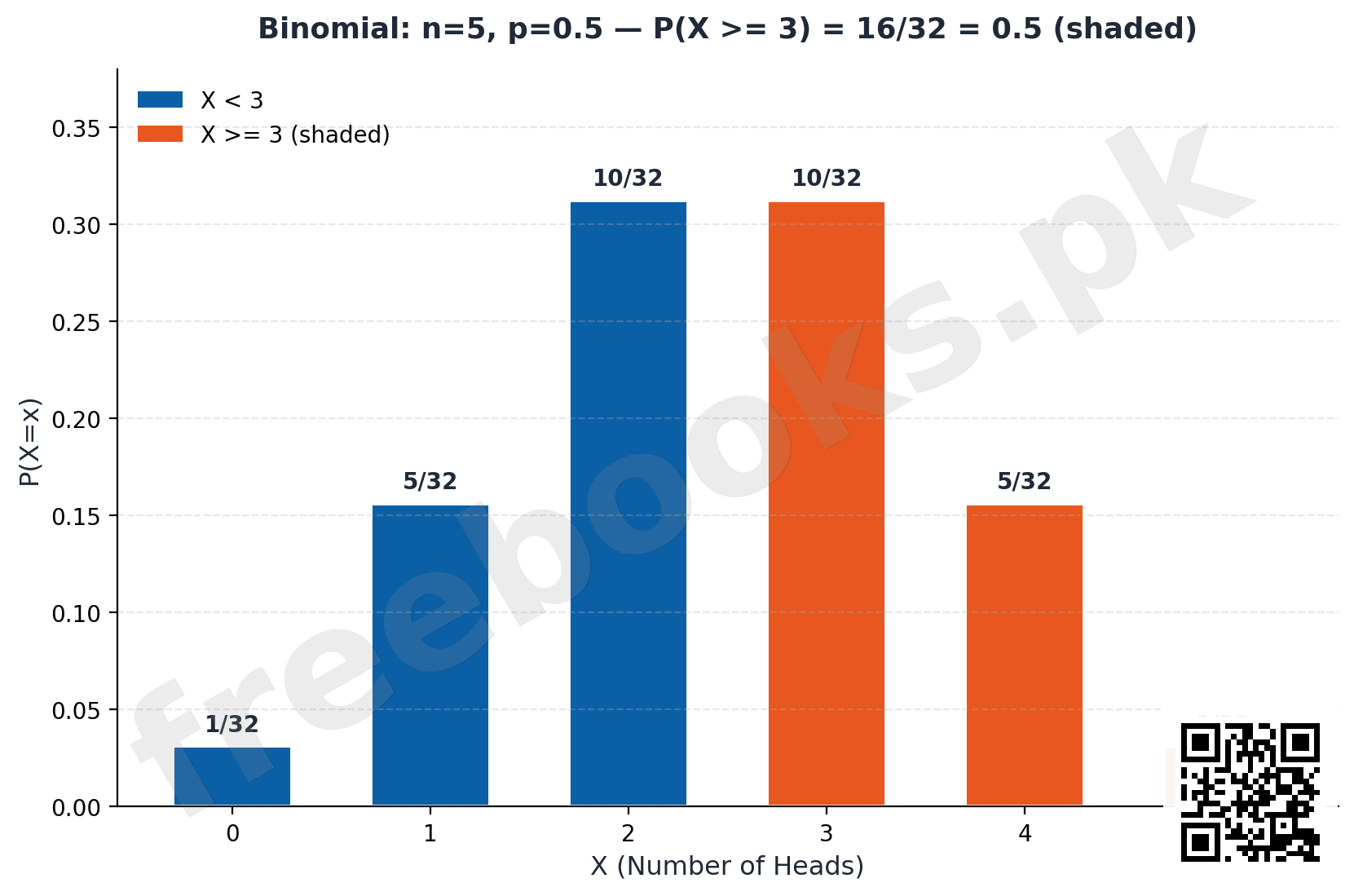
Binomial Probability: At Least 3 Heads in 5 Coin Tosses: A binomial bar chart for n=5, p=0.5 (5 fair coin tosses) with the bars for X=3, X=4, X=5 shaded to show P(X>=3) = 16/32 = 0.5, matching Example 9.2 from the textbook
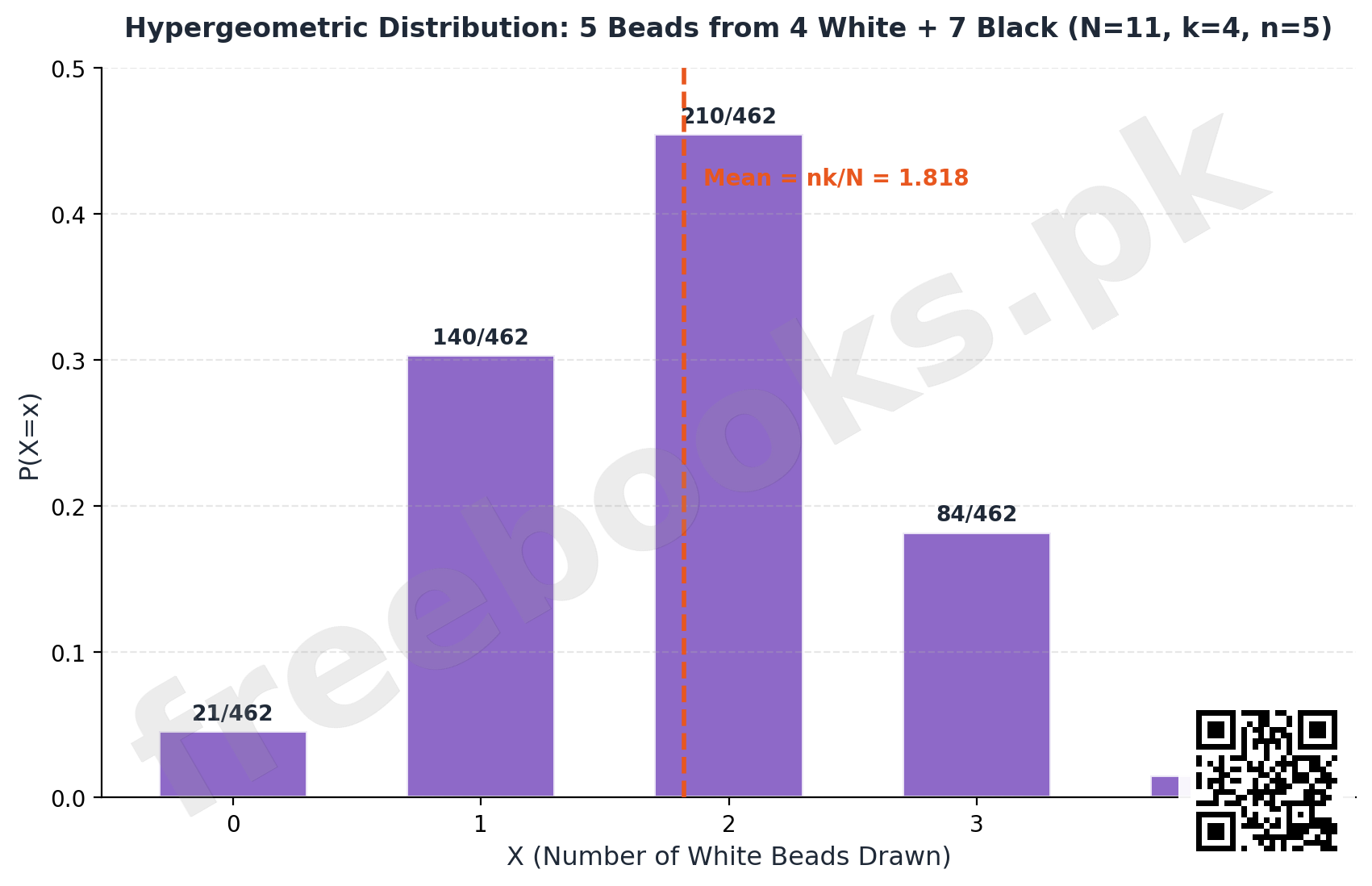
Hypergeometric Probability Distribution: White Beads Example: A probability bar chart for the hypergeometric distribution of white beads drawn (5 beads from a bowl of 4 white and 7 black, N=11, k=4, n=5), with the mean (1.818) marked, matching Example 9.9 from the textbook
Short Questions & Answers
List the four properties of a binomial experiment.
Each trial results in success or failure; the probability of success stays constant across trials; the trials are independent; the experiment is repeated a fixed number of times.
Why is the binomial distribution symmetric when p = 0.5?
Because when p equals q (both 0.5), the probability of getting x successes equals the probability of getting (n-x) successes, making the distribution perfectly mirror-symmetric around its center.
State the mean and variance of a binomial distribution with n=20 trials and p=0.4.
Mean = np = 20(0.4) = 8; Variance = npq = 20(0.4)(0.6) = 4.8.
Why are successive trials dependent in a hypergeometric experiment but independent in a binomial experiment?
Because a hypergeometric experiment samples without replacement, so removing an item changes the composition of what remains and shifts the probability of success on the next draw; a binomial experiment samples with replacement (or from an effectively infinite population), so the probability of success never changes.
What does the finite population correction factor (N-n)/(N-1) account for in the hypergeometric variance?
It adjusts the variance downward to reflect that sampling without replacement from a finite population produces less variability than sampling with replacement would.
How many parameters does the binomial distribution have, and what are they? How about the hypergeometric?
Binomial: two parameters, n and p. Hypergeometric: three parameters, n, k, and N.
Long Questions & Answers
Explain the binomial probability distribution: define a binomial experiment, state its formula, and explain how its mean and variance are used, including how the shape of the distribution depends on p.
What is a Bernoulli trial, and what four conditions define a binomial experiment?
A Bernoulli trial is any single trial with exactly two possible outcomes, success and failure, where the probability of success, p, stays fixed and each trial has no influence on any other. A binomial experiment is a fixed number, n, of identical, independent Bernoulli trials. Four conditions must hold: every trial produces a success or failure; the probability of success p stays exactly the same across all trials; every trial is completely independent of every other; and the total number of trials n is fixed and known in advance rather than allowed to vary.
What is the binomial probability formula, and why does it include the term C(n,x)?
The probability of observing exactly x successes across n trials is P(X=x) = C(n,x) times p raised to x, times q raised to (n-x), where q is the probability of failure, 1 minus p. The combinatorial term C(n,x) exists because it counts the number of distinct ways exactly x successes could be arranged among the n trials — a run of x successes could occur in many different orders across the sequence, and every one of those equally likely orderings needs to be included in the total probability.
Where does the name 'binomial distribution' come from, and how are 'at least' or 'at most' probabilities calculated?
The binomial formula, and the name 'binomial' distribution itself, trace back to the algebraic expansion of (q+p) raised to power n, since expanding this expression produces exactly the same terms, C(n,x).q^(n-x).p^x, as its individual components — which is also why C(n,x) is called a binomial coefficient. Beyond calculating one exact number of successes, the formula also enables answering 'at least,' 'at most,' or 'between' style questions, simply by calculating individual probabilities for every relevant value of x and adding them together, since these events are mutually exclusive.
What are the mean and variance of a binomial distribution?
Once a binomial distribution is defined by its two parameters, n and p, its mean simplifies to the simple result E(X) = n times p — matching intuition, since flipping a fair coin with a 50% chance of heads 10 times, we would expect around 10 times 0.5, or 5 heads, on average. Following a similar derivation and substituting into the standard computing formula, the variance reduces to the compact result Var(X) = n.p.q, with the standard deviation following as the square root of n.p.q.
How does the shape of the binomial distribution depend on p?
The parameter p governs the overall visual shape of the distribution when plotted as a bar chart. Whenever p equals q, meaning both equal exactly 0.5, the distribution comes out perfectly symmetrical, since the probability of x successes always exactly equals the probability of (n minus x) successes. When p and q are not equal, the distribution becomes skewed: whenever p is greater than 0.5, the distribution becomes negatively skewed, with its longer tail toward lower values of x; whenever p is less than 0.5, the distribution becomes positively skewed, with its longer tail toward higher values of x.
Explain the hypergeometric distribution, including how it differs from the binomial distribution, state its probability formula and its mean and variance, and explain when each distribution should be used.
Why does sampling without replacement break the binomial model, and what defines a hypergeometric experiment?
Many real sampling situations draw items one after another from a fixed, limited collection without replacing each drawn item — picking cards from a deck, selecting committee members, or testing components from a finite batch. This breaks the binomial requirement that the probability of success stay constant across trials, because removing an item permanently changes the remaining population's composition. A hypergeometric experiment is built around drawing a random sample without replacement from a finite population. It is characterized by four properties: a fixed number of trials n; trials that are dependent rather than independent; a probability of success that varies from trial to trial; and each outcome still classifiable as success or failure.
What is the hypergeometric probability formula, and why is it built the way it is?
The hypergeometric distribution is specified using three quantities: N, the total population size; k, how many of those N items qualify as successes; and n, the sample size drawn without replacement. The probability of exactly x successes in the sample is P(X=x) = [C(k,x) times C(N-k, n-x)] divided by C(N,n). C(k,x) counts the ways of choosing x successes from the k available; C(N-k, n-x) counts the ways of choosing the remaining n-x failures from the N-k available; and C(N,n), the denominator, counts the total ways any sample of size n could be selected from the population, normalizing the probability.
What are the mean and variance of the hypergeometric distribution?
The mean of the hypergeometric distribution is n.k divided by N, closely resembling the binomial mean n.p, since the ratio k/N plays the same conceptual role as p, representing the overall proportion of successes in the population. The variance is given by the more elaborate expression (n.k/N) times (1 minus k/N), further multiplied by the correction term (N-n) divided by (N-1). This extra term makes the hypergeometric variance formula more complex than the binomial's, reflecting the effect of sampling without replacement from a finite population.
What is the finite population correction factor, and why does it appear in the hypergeometric variance?
The term (N-n) divided by (N-1), appearing as an extra multiplier in the hypergeometric variance formula, is called the finite population correction factor. It exists because sampling without replacement from a strictly finite, limited population mechanically produces systematically less overall variability than comparable independent sampling with replacement would produce. This correction factor mathematically adjusts the variance downward to properly account for that underlying structural difference, ensuring the hypergeometric variance correctly reflects the reduced randomness that results from a shrinking, non-replenished population as sampling proceeds.
When should the binomial distribution be used instead of the hypergeometric distribution, and vice versa?
Deciding which distribution applies comes down to one diagnostic question: is the sampling conducted with replacement, or effectively from a sufficiently large, practically unlimited population where removing items makes no meaningful difference to the probabilities — in which case the binomial distribution remains appropriate? Or is the sampling conducted explicitly without replacement from a comparatively small, genuinely finite population, where each item removed measurably shifts the probabilities governing subsequent draws — in which case the hypergeometric distribution must be used to arrive at correct probability calculations.
Multiple Choice Questions (MCQs)
A trial with exactly two possible outcomes, success and failure, is called a: (A) Binomial experiment (B) Bernoulli trial (C) Hypergeometric trial (D) Random trial
Correct answer: (B) Bernoulli trial. A Bernoulli trial has exactly two outcomes with constant success probability and independence between trials.
Which of these is NOT a property of a binomial experiment? (A) Fixed number of trials (B) Constant probability of success (C) Independent trials (D) Probability of success changes each trial
Correct answer: (D) Probability of success changes each trial. A changing probability of success is a property of the hypergeometric experiment, not the binomial experiment.
The binomial probability formula is: (A) P(X=x) = np (B) P(X=x) = C(n,x) p^x q^(n-x) (C) P(X=x) = npq (D) P(X=x) = p/q
Correct answer: (B) P(X=x) = C(n,x) p^x q^(n-x). P(X=x) = C(n,x) p^x q^(n-x) gives the probability of exactly x successes in n independent trials.
A binomial distribution is symmetric when: (A) p = 0 (B) p = 1 (C) p = q = 0.5 (D) n = 1
Correct answer: (C) p = q = 0.5. When p equals q (both 0.5), the binomial distribution is perfectly symmetric.
If p > 0.5 in a binomial distribution, the distribution is: (A) Symmetric (B) Positively skewed (C) Negatively skewed (D) Uniform
Correct answer: (C) Negatively skewed. When p exceeds 0.5, success is more likely, and the distribution becomes negatively skewed.
The mean of a binomial distribution is given by: (A) npq (B) np (C) sqrt(npq) (D) n/p
Correct answer: (B) np. The mean of the binomial distribution is E(X) = np.
The variance of a binomial distribution is given by: (A) np (B) npq (C) nq (D) sqrt(np)
Correct answer: (B) npq. The variance of the binomial distribution is Var(X) = npq.
A hypergeometric experiment involves sampling: (A) With replacement from an infinite population (B) Without replacement from a finite population (C) With replacement from a finite population (D) Without any population
Correct answer: (B) Without replacement from a finite population. The hypergeometric distribution specifically applies to sampling without replacement from a finite population.
The hypergeometric probability formula is: (A) P(X=x) = C(n,x)p^x q^(n-x) (B) P(X=x) = [C(k,x).C(N-k,n-x)] / C(N,n) (C) P(X=x) = nk/N (D) P(X=x) = np
Correct answer: (B) P(X=x) = [C(k,x).C(N-k,n-x)] / C(N,n). The hypergeometric formula divides the product of two combinations by C(N,n).
The finite population correction factor in the hypergeometric variance formula is: (A) np (B) npq (C) (N-n)/(N-1) (D) k/N
Correct answer: (C) (N-n)/(N-1). The factor (N-n)/(N-1) adjusts the variance to account for sampling without replacement from a finite population.
Quick Revision Summary
- Binomial experiment: fixed n trials, constant p, independent trials, success/failure outcomes
- Binomial formula: P(X=x) = C(n,x) p^x q^(n-x)
- Binomial shape: p=0.5 symmetric | p>0.5 negatively skewed | p<0.5 positively skewed
- Binomial mean = np; Binomial variance = npq; SD = sqrt(npq)
- Binomial frequency distribution: f(X=x) = N.P(X=x) for N repetitions of the experiment
- Hypergeometric experiment: fixed n, dependent trials, changing probability of success, finite population
- Hypergeometric formula: P(X=x) = [C(k,x).C(N-k,n-x)] / C(N,n)
- Hypergeometric mean = nk/N; variance = (nk/N)(1-k/N)((N-n)/(N-1)) — includes finite population correction
- Use binomial when sampling WITH replacement (or huge population); use hypergeometric WITHOUT replacement from a small finite population
Exam Tips
- Always check the four binomial conditions before applying the binomial formula — 'with replacement' or 'independent' are the key trigger words
- 'Without replacement' from a small finite population is the trigger phrase for hypergeometric — don't default to binomial
- For 'at least' or 'at most' binomial problems, list out and sum the individual P(X=x) terms rather than trying to shortcut it
- Memorize mean=np and variance=npq for binomial — they save enormous time versus building a full probability table
- In hypergeometric problems, carefully identify N (population), k (successes in population), and n (sample size) before plugging into the formula