If you bought 7 tickets out of 700 sold for a raffle, you'd say you have 1 chance in 100 of winning — probability is exactly this: a measure of the likelihood that something will happen. It cannot predict whether a specific event will actually occur, only how likely it is, yet most decisions in daily life are based on likelihood rather than absolute certainty.
This chapter builds the mathematical toolkit needed to work with chance events: essential set theory and Venn diagrams, counting techniques (factorials, permutations, and combinations), the formal definitions of random experiments, sample spaces, and events, the classical and axiomatic definitions of probability, and the two central theorems of the subject — the addition theorem (for finding the probability that at least one of two events occurs) and the multiplication theorem (for finding the probability that two events occur together), including conditional probability.
Learning Objectives
- Use basic set notation and operations: union, intersection, difference, and complement
- Calculate factorials, permutations, and combinations for counting problems
- Define random experiment, sample space, sample point, and event, and classify events as simple or compound
- Distinguish mutually exclusive, independent, dependent, equally likely, and exhaustive events
- State the classical, relative frequency, and axiomatic (mathematical) definitions of probability
- Apply the addition theorem for mutually exclusive and not mutually exclusive events
- Calculate conditional probability and apply the multiplication theorem for independent and dependent events
- Solve applied probability problems involving cards, dice, and drawing balls from a bag
Key Concepts
6.1 Sets and Venn Diagrams
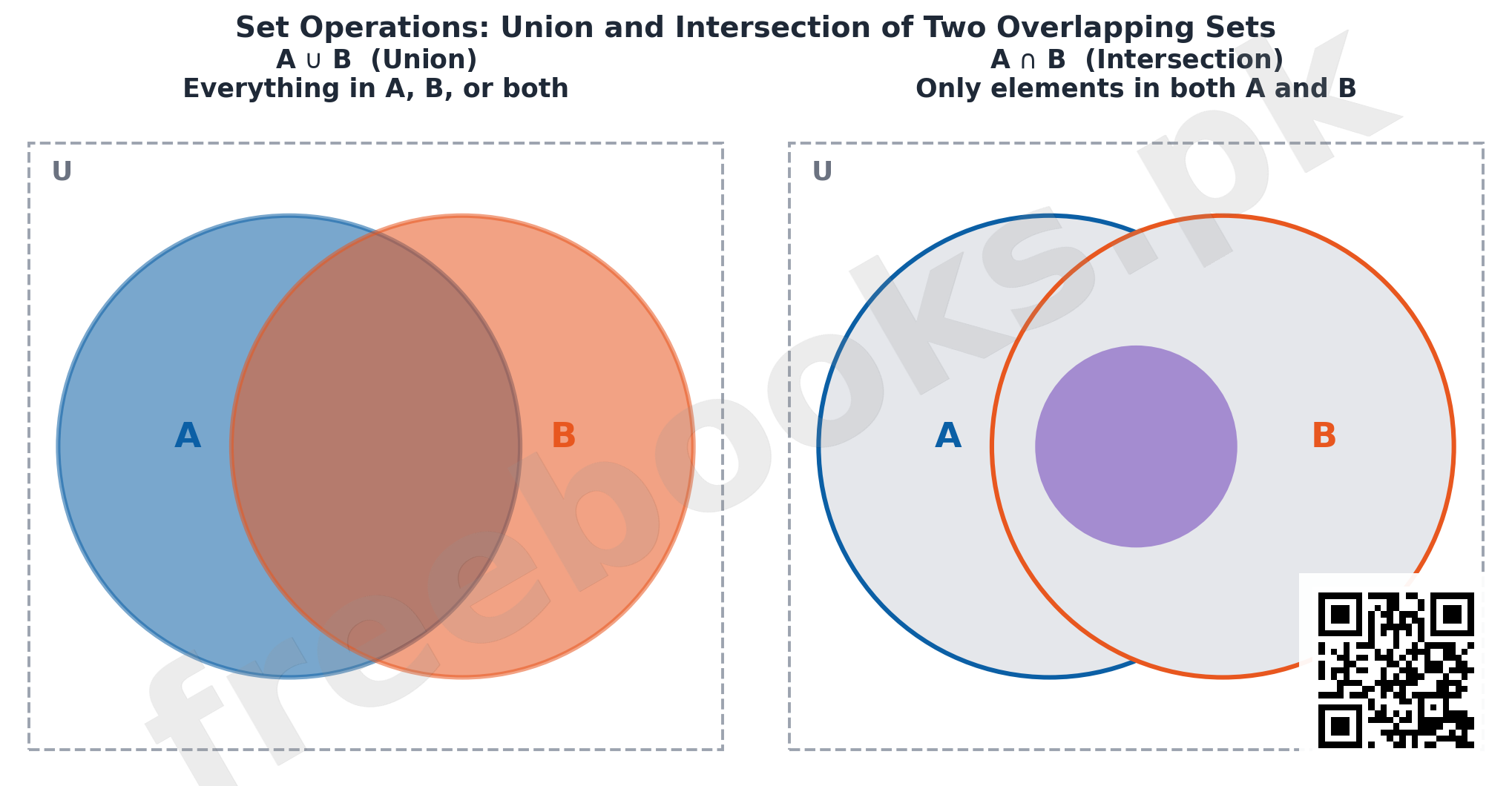
A set is a well-defined collection of distinct objects, called its elements; sets are denoted by capital letters (A, B, C) and elements by small letters. A null (empty) set contains no elements. Set A is a subset of B if every element of A is also in B; it is a proper subset if B also contains at least one element not in A. A universal set U contains all elements under consideration. Two sets are disjoint if they share no elements (A intersect B = empty set); they are overlapping if they share at least one element but neither is a subset of the other.
A Venn diagram represents the universal set U as a rectangle and its subsets as circles, visually showing relationships between sets. The union of A and B (A union B) contains every element belonging to A, to B, or to both. The intersection of A and B (A intersect B) contains only elements belonging to both A and B. The difference A minus B contains elements of A that are not in B. The complement of A (written A-bar or A with a superscript c) is U minus A — everything in the universal set that is not in A.
6.1.1 Factorial, Permutations and Combinations
For a positive integer n, the factorial n! is the product of the first n positive integers: n! = n(n-1)(n-2)…3.2.1, which can also be written recursively as n! = n(n-1)!. A permutation is an arrangement of a finite number of objects in a definite order; the number of ways of arranging n objects taken r at a time is nPr = n!/(n-r)!. When n objects include repeated items (n1 alike of one kind, n2 alike of another, and so on), the number of distinct permutations is n!/(n1! n2! … nk!).
A combination is a selection of objects made without regard to order; the number of combinations of n things taken r at a time is nCr = n!/(r!(n-r)!). The key distinction: permutations count arrangements (order matters), while combinations count selections (order doesn't matter), so nCr is always smaller than or equal to nPr for the same n and r.
6.1.2 Random Experiments, Sample Space and Events
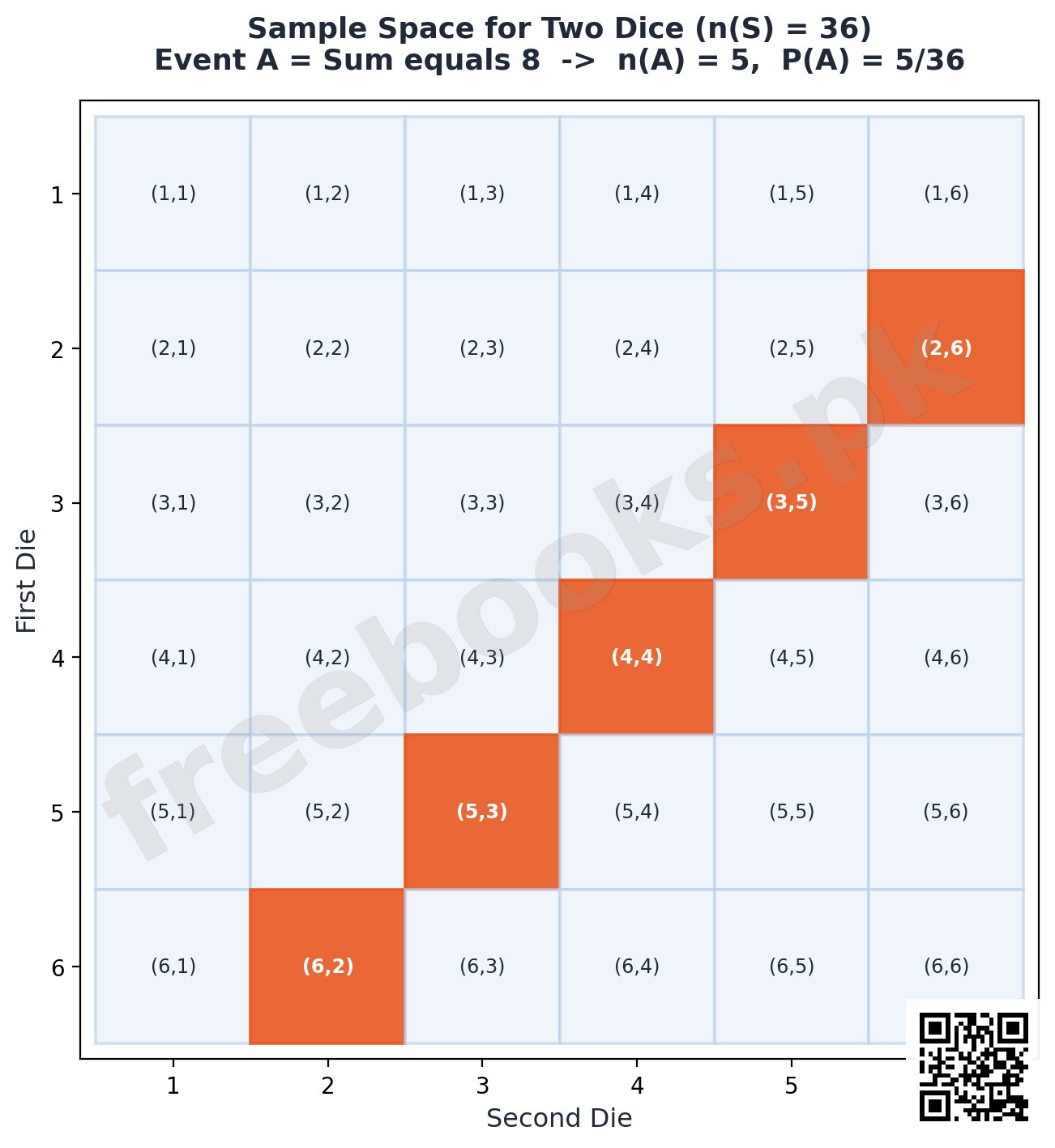
A random experiment produces different outcomes even when repeated many times under similar conditions, and can be repeated any number of times with at least two possible outcomes each trial. The sample space S is the set of all possible outcomes of a random experiment, and each individual outcome is a sample point — for a single coin toss, S = {H, T}; for two coin tosses, S = {HH, HT, TH, TT}; for a single die, S = {1,2,3,4,5,6}; and for two dice, S contains all 36 ordered pairs (i,j) with i,j from 1 to 6.
An event is any subset of the sample space. A simple event consists of exactly one sample point; a compound event consists of more than one. Two events are independent if the occurrence of one does not affect the occurrence of the other, and dependent if it does. Two events are mutually exclusive if they cannot occur together (their intersection is empty). Two events are equally likely if they have the same chance of occurring. When a sample space is partitioned into mutually exclusive events whose union is the entire sample space, those events are called exhaustive.
6.2 Definitions of Probability
The classical (a priori) definition: if there are n equally likely, mutually exclusive, and exhaustive outcomes, and m of them are favourable to event A, then P(A) = m/n (favourable outcomes divided by possible outcomes). The relative frequency (a posteriori) definition: if a random experiment is repeated n times under uniform conditions and event A occurs m times, then P(A) is the limiting value of m/n as n grows very large. The mathematical (axiomatic) definition expresses probability using sample points: P(A) = n(A)/n(S), the number of sample points in A divided by the total number of sample points in S.
Every valid probability must satisfy these axioms: P(A) is never negative; P(A) always lies between 0 and 1 inclusive; the probability of the entire sample space is P(S) = 1; and for two mutually exclusive events, P(A union B) = P(A) + P(B).
6.3 Addition Theorem of Probability
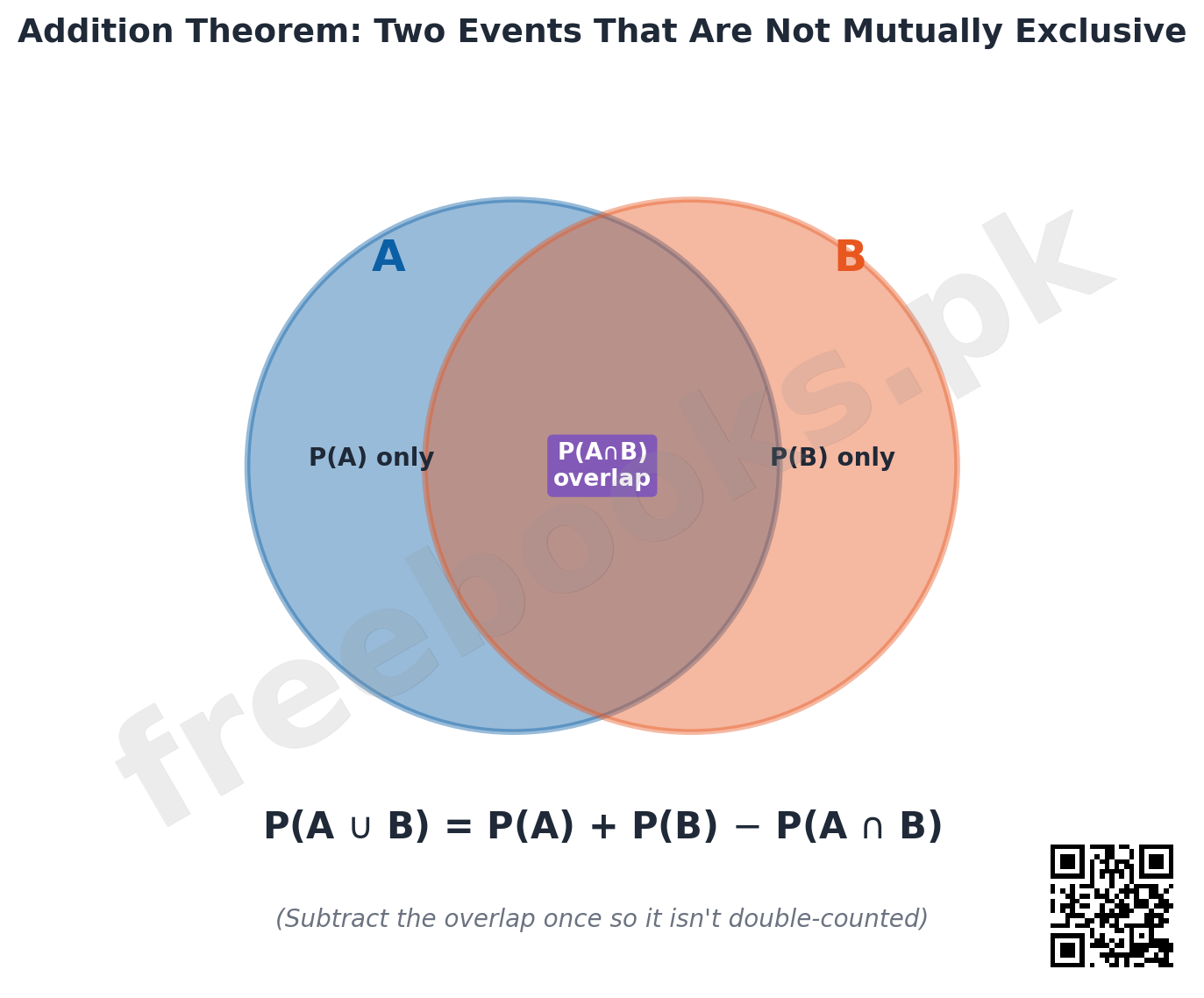
For two events that are not mutually exclusive, the probability that at least one of them occurs is P(A union B) = P(A) + P(B) – P(A intersect B) — the subtraction corrects for double-counting the outcomes that belong to both events. For two mutually exclusive events (where A intersect B is empty, so P(A intersect B) = 0), this simplifies to the special case P(A union B) = P(A) + P(B).
6.4 Conditional Probability and the Multiplication Theorem
The conditional probability of event A given that event B has already occurred, written P(A/B), is defined as P(A intersect B) / P(B), provided P(B) is greater than zero; if P(B) = 0, the conditional probability is undefined. This lets us update the probability of one event based on knowing another event has happened.
For two independent events, the multiplication theorem states that the probability both occur is simply the product of their individual probabilities: P(A intersect B) = P(A) x P(B). For events that are not independent (dependent events), the joint probability instead uses conditional probability: P(A intersect B) = P(A) x P(B/A), or equivalently P(A intersect B) = P(B) x P(A/B) — the probability of the first event happening, multiplied by the conditional probability of the second given that the first has already occurred.
Important Definitions
What is a sample space?
The set of all possible outcomes of a random experiment, usually denoted S; each individual outcome within it is called a sample point.
What is an event?
Any subset of the sample space; a simple event contains exactly one sample point, while a compound event contains more than one.
What are mutually exclusive events?
Two events that cannot occur together, meaning their intersection is the empty set (A intersect B = empty set).
What are independent events?
Two events where the occurrence of one does not affect the probability of the other occurring.
What is the classical definition of probability?
P(A) = (number of favourable outcomes) / (number of equally likely, mutually exclusive, exhaustive possible outcomes), i.e., m/n.
What is conditional probability?
The probability that event A occurs given that event B has already occurred, calculated as P(A/B) = P(A intersect B) / P(B), for P(B) greater than 0.
What is the addition theorem for events that are not mutually exclusive?
P(A union B) = P(A) + P(B) – P(A intersect B), subtracting the overlap so it isn't counted twice.
What is the multiplication theorem for independent events?
P(A intersect B) = P(A) x P(B), the probability that both independent events occur equals the product of their individual probabilities.
What is the difference between a permutation and a combination?
A permutation counts arrangements where order matters; a combination counts selections where order does not matter.
Key Facts and Relations
| Topic | Key Fact / Relation |
|---|---|
| Factorial | n! = n(n-1)(n-2)…3.2.1 |
| Permutations | nPr = n! / (n-r)! |
| Permutations with repeated items | n! / (n1! n2! … nk!) |
| Combinations | nCr = n! / (r!(n-r)!) |
| Classical probability | P(A) = m / n = favourable outcomes / possible outcomes |
| Mathematical (axiomatic) probability | P(A) = n(A) / n(S) |
| Complement rule | P(A-bar) = 1 – P(A) |
| Addition theorem (general) | P(A union B) = P(A) + P(B) – P(A intersect B) |
| Addition theorem (mutually exclusive) | P(A union B) = P(A) + P(B) |
| Conditional probability | P(A/B) = P(A intersect B) / P(B), for P(B) > 0 |
| Multiplication theorem (independent events) | P(A intersect B) = P(A) x P(B) |
| Multiplication theorem (dependent events) | P(A intersect B) = P(A) x P(B/A) = P(B) x P(A/B) |
Diagrams
Union and Intersection of Two Overlapping Sets: A Venn diagram of two overlapping sets A and B inside universal set S, with the union (A or B) and intersection (A and B) regions shaded and labelled, matching the set operations introduced in this chapter
Sample Space for Two Dice: Sum Equals 8: The full 6×6 grid of 36 equally likely outcomes for rolling two dice, with the 5 outcomes summing to 8 highlighted, illustrating the classical definition of probability P(A) = n(A)/n(S)
Addition Theorem: P(A union B) = P(A) + P(B) – P(A intersect B): A Venn diagram showing two overlapping events A and B with their individual probabilities and overlap labelled, illustrating why the intersection must be subtracted once to avoid double-counting
Short Questions & Answers
What is the difference between a random experiment and a deterministic one?
A random experiment produces different outcomes even under identical repeated conditions, while a deterministic process always produces the same outcome given the same conditions.
Why must probability always lie between 0 and 1?
Because probability is defined as a ratio of favourable outcomes to total possible outcomes, and the number of favourable outcomes can never be negative or exceed the total number of possible outcomes.
Give an example of mutually exclusive events.
In a single coin toss, getting heads and getting tails are mutually exclusive, since both cannot happen on the same toss.
Why is nPr always greater than or equal to nCr for the same n and r?
Because nPr counts every distinct ordering of a selection separately, while nCr counts each unique selection only once regardless of order, so nPr = nCr multiplied by r! (the number of orderings).
Why is conditional probability undefined when P(B) = 0?
Because the conditional probability formula P(A intersect B)/P(B) requires dividing by P(B), and division by zero is undefined.
How does the addition theorem simplify for mutually exclusive events?
Since mutually exclusive events cannot overlap, P(A intersect B) = 0, so the general formula P(A union B) = P(A) + P(B) – P(A intersect B) simplifies to just P(A union B) = P(A) + P(B).
What does it mean for two events to be exhaustive?
That together, their union covers the entire sample space, with no possible outcome left out.
Long Questions & Answers
Explain the classical, relative frequency, and axiomatic (mathematical) definitions of probability, and describe how they relate to each other.
What is the classical (a priori) definition of probability, and what is its limitation?
The classical definition applies when an experiment has a fixed number of possible outcomes that are all equally likely, mutually exclusive, and collectively exhaustive. If there are n total outcomes and m are favourable to event A, the classical definition sets P(A) equal to m over n. It works from logical symmetry and doesn't require actually running the experiment. Its limitation is that it only applies cleanly when the outcomes really are equally likely, which isn't always true, such as with a biased coin or a horse race where competitors don't have identical chances.
What is the relative frequency (a posteriori) definition of probability, and what is its limitation?
The relative frequency definition relies on repeated observation rather than logical symmetry. An experiment is carried out a large number of times, n, under uniform conditions, and the number of times event A occurs, m, is recorded. Probability is defined as the value the ratio m/n approaches as n grows larger, technically the limit of m/n as n approaches infinity. This is more flexible than the classical definition since it needs no equal-likelihood assumption, but it requires large amounts of real data, since with few trials the observed ratio can fluctuate before settling toward its true value.
What is the axiomatic (mathematical) definition of probability?
The axiomatic, or mathematical, definition unifies the classical and relative frequency ideas into a single, more rigorous framework built on the sample space concept. Probability is defined as the ratio of the number of sample points in event A to the total number of sample points in the entire sample space S, written n(A) divided by n(S). This framework is considered mathematical because it doesn't just offer a calculation method — it also lays out a small set of axioms that any valid assignment of probabilities must satisfy, regardless of how those probabilities were originally derived.
What axioms must a valid probability assignment satisfy, and how does the axiomatic definition relate to the other two?
Any valid assignment of probabilities must satisfy four axioms: probability can never be negative, every probability must fall between 0 and 1 inclusive, the probability of the entire sample space must equal exactly 1, and for any two mutually exclusive events, the probability that either occurs equals the sum of their individual probabilities. Both the classical and relative frequency definitions can be shown to satisfy these axioms under the right conditions, which is exactly what makes the axiomatic definition the more general, foundational description of probability underlying both practical approaches.
Explain the addition theorem and the multiplication theorem of probability, including the role conditional probability plays in the multiplication theorem for dependent events.
What is the addition theorem, and why does its formula subtract the intersection term?
The addition theorem states that for any two events A and B, the probability that at least one occurs is P(A union B) = P(A) + P(B) – P(A intersect B). The subtraction corrects for double-counting: if some sample points belong to both A and B, simply adding the two probabilities would count those overlapping points twice, once in each event's total. Subtracting the probability of the intersection ensures every sample point belonging to the combined event is counted exactly once, no matter how many of the original events it belonged to.
What happens to the addition theorem when two events are mutually exclusive?
When two events are mutually exclusive, meaning they cannot possibly occur together and share no sample points, the correction term in the addition theorem disappears entirely, since P(A intersect B) is simply zero. This leaves the simpler special-case formula P(A union B) = P(A) + P(B) directly, without needing to subtract anything. This special case is a direct consequence of the general addition theorem rather than a separate rule, applying whenever the two events genuinely cannot happen at the same time.
What is the multiplication theorem for independent events?
The multiplication theorem addresses whether both of two events happen together, rather than whether at least one happens. When events A and B are independent — meaning knowing whether A occurred tells us nothing about B — the probability both happen simultaneously is simply the product of their individual probabilities, P(A intersect B) = P(A) times P(B). This falls out of counting the combined experiment's outcomes: A's n outcomes can each combine freely with B's N outcomes, giving mM favourable combinations out of nN total, which reduces to (m/n) times (M/N).
What is conditional probability, and how does the multiplication theorem work for dependent events?
When two events are not independent, simple multiplication no longer holds, and conditional probability becomes essential. Conditional probability, P(A given B), captures how the probability of A changes once B is already known to have occurred, and is defined as P(A intersect B) divided by P(B). Rearranging produces the multiplication theorem for dependent events: P(A intersect B) = P(A) times P(B given A), or equivalently P(B) times P(A given B). Both versions express the same logic: the probability of both events occurring is the probability of the 'first' event, multiplied by the updated, conditional probability of the second, given the first has already happened.
Multiple Choice Questions (MCQs)
The number of ways of arranging n objects taken r at a time (order matters) is given by: (A) nCr (B) nPr (C) n! (D) n/r
Correct answer: (B) nPr. nPr = n!/(n-r)! counts ordered arrangements (permutations), where order matters.
A combination differs from a permutation in that a combination: (A) Considers order important (B) Does not consider order (C) Only applies to two objects (D) Is always larger than the permutation
Correct answer: (B) Does not consider order. A combination is a selection made without regard to order, unlike a permutation.
Two events that cannot occur together are called: (A) Independent events (B) Exhaustive events (C) Mutually exclusive events (D) Equally likely events
Correct answer: (C) Mutually exclusive events. Mutually exclusive events have an empty intersection — they cannot both occur on the same trial.
The classical definition of probability requires outcomes to be: (A) Random and unpredictable only (B) Equally likely, mutually exclusive, and exhaustive (C) Based on repeated trials only (D) Independent of the sample space
Correct answer: (B) Equally likely, mutually exclusive, and exhaustive. The classical (a priori) definition specifically requires equally likely, mutually exclusive, exhaustive outcomes.
For any event A, which of the following is always true? (A) P(A) can be negative (B) 0 <= P(A) <= 1 (C) P(A) > 1 (D) P(A) = n(S)
Correct answer: (B) 0 <= P(A) <= 1. One of the basic axioms of probability is that P(A) always lies between 0 and 1 inclusive.
If A and B are mutually exclusive, P(A union B) equals: (A) P(A) x P(B) (B) P(A) – P(B) (C) P(A) + P(B) (D) P(A) / P(B)
Correct answer: (C) P(A) + P(B). For mutually exclusive events, P(A intersect B) = 0, so the addition theorem simplifies to P(A union B) = P(A) + P(B).
Conditional probability P(A/B) is defined as: (A) P(A) x P(B) (B) P(A intersect B) / P(B) (C) P(A) + P(B) (D) P(B) / P(A)
Correct answer: (B) P(A intersect B) / P(B). P(A/B) = P(A intersect B) / P(B), provided P(B) > 0.
If A and B are independent events, P(A intersect B) equals: (A) P(A) + P(B) (B) P(A) – P(B) (C) P(A) x P(B) (D) P(A/B)
Correct answer: (C) P(A) x P(B). For independent events, the multiplication theorem gives P(A intersect B) = P(A) x P(B).
The general addition theorem for two events not mutually exclusive is: (A) P(A) + P(B) (B) P(A) + P(B) – P(A intersect B) (C) P(A) x P(B) (D) P(A) – P(B)
Correct answer: (B) P(A) + P(B) – P(A intersect B). The general form subtracts the overlap: P(A union B) = P(A) + P(B) – P(A intersect B).
A sample space is best described as: (A) Any subset of possible outcomes (B) The set of all possible outcomes of a random experiment (C) A single favourable outcome (D) The complement of an event
Correct answer: (B) The set of all possible outcomes of a random experiment. The sample space S is the complete set of all possible outcomes of a random experiment.
Quick Revision Summary
- Set operations: Union (A or B), Intersection (A and B), Difference (A minus B), Complement (U minus A)
- Permutation nPr = n!/(n-r)! (order matters); Combination nCr = n!/(r!(n-r)!) (order doesn't matter)
- Sample space S = all possible outcomes; Event = any subset of S; Simple event = 1 point, Compound = more than 1
- Mutually exclusive: A intersect B = empty set. Independent: occurrence of one doesn't affect the other
- Classical probability: P(A) = m/n (favourable/possible, when outcomes equally likely)
- Axiomatic: 0 <= P(A) <= 1; P(S) = 1; P(A union B) = P(A)+P(B) for mutually exclusive events
- Addition theorem (general): P(A union B) = P(A) + P(B) – P(A intersect B)
- Conditional probability: P(A/B) = P(A intersect B) / P(B), for P(B) > 0
- Multiplication (independent): P(A intersect B) = P(A) x P(B)
- Multiplication (dependent): P(A intersect B) = P(A) x P(B/A) = P(B) x P(A/B)
Exam Tips
- Always double-check whether a word problem needs a permutation (order matters, e.g. 'arrange', 'rank') or a combination (order doesn't matter, e.g. 'select', 'choose')
- Before applying the addition theorem, check if events are mutually exclusive — if yes, skip the subtraction term entirely
- For 'and' probability questions, check independence first: independent events just multiply; dependent events need conditional probability
- Remember P(A/B) is NOT the same as P(B/A) in general — always double-check which event is 'given'
- Complement trick: P(at least one) is often easier via 1 – P(none), especially for 'at least' word problems
- When drawing balls/cards without replacement, events become dependent — use conditional probability, not simple multiplication