The buying power of a rupee changes over time — something that cost 10 rupees in 1960 could easily cost 60 rupees decades later. To make meaningful comparisons of prices, wages, quantities, or the general cost of living across different time periods, statisticians use index numbers: ratios or averages of ratios, usually expressed as percentages, that measure the relative change in a variable over time.
This chapter covers how to construct simple and composite (aggregate) index numbers, the difference between unweighted and weighted index numbers, the major named index formulas (Laspeyre's, Paasche's, and Fisher's), and how real-world price indices like the Consumer Price Index (CPI) and Wholesale Price Index (WPI) are built and interpreted, including how they're used to measure inflation and the purchasing power of money.
Learning Objectives
- Define an index number and calculate a simple index number for a single variable
- Distinguish simple index numbers from composite (aggregate) index numbers
- Calculate unweighted index numbers: simple aggregate index and average relative index
- Explain link relatives and calculate chain indices
- Calculate weighted index numbers: Laspeyre's, Paasche's, and Fisher's ideal index
- Explain how the Consumer Price Index (CPI) and Wholesale Price Index (WPI) are constructed and used
- Calculate the rate of inflation from CPI values across years
- State the main limitations and uses of index numbers
Key Concepts
5.1 Introduction
An index number measures the relative change in a variable over time, usually expressed as a percentage. To construct one, two or more time periods are considered, with one period chosen as the base. The index number for the current year n is calculated as In = (price in current year / price in base year) x 100. By convention, the index number for the base year itself is always 100. This chapter uses standard notation: p0i and q0i for the price and quantity of the ith commodity in the base year, and pni and qni for the current year.
5.1.1 Types of Index Numbers
A simple index number measures the relative change in a single variable with respect to a base year — for example, an index of wheat prices alone or wages alone, calculated as Pon = (price in year n / price in base year) x 100. A composite (aggregate) index number measures the relative change in two or more variables together, such as a whole basket of commodity prices, and can be calculated as either unweighted or weighted index numbers, each of which may in turn be a price index, quantity index, or value index. The value index number is Von = (sum of pn*qn) / (sum of p0*q0) x 100.
5.1.2 and 5.1.3 Limitations and Uses of Index Numbers
Index numbers have real limitations: it is not possible to account for every change in a product, no single index suits every purpose, the choice of base period can introduce error, they are only rough indications of relative change, and different construction methods can give different results for the same data. Despite this, index numbers are widely used: price indices measure average price change and the buying power of money over time; the CPI helps cancel out the effect of inflation or deflation; the WPI helps adjust contract prices and payments for industrial organizations; quantity indices track changes in production, consumption, and trade; and import/export price indices measure a country's terms of trade.
5.2 Construction of Price Index Numbers
Building a price index involves several deliberate steps. First, the purpose and scope must be clearly defined — why, where, and what changes are being measured. Second, the components (commodities and their prices) must be selected carefully, with at least twenty items recommended for practical purposes, precisely defined and consistently available over time. Third, the base year must be chosen with care: it should reflect normal prices and not be too far removed from the current year, and may even be an average of several years rather than a single year. Fourth, weights must be chosen to reflect the relative importance of each commodity — for example, wheat should carry more weight than tea — commonly formulated as Woi = Voi / (sum of Voi), where Voi = poi x qoi is the value of the commodity in the base year. Fifth, an averaging method must be chosen; arithmetic mean is used in practice for convenience, even though geometric mean is theoretically more appropriate for averaging ratios.
5.3 Unweighted Index Numbers
Unweighted index numbers give equal importance to every item. The simple aggregate index is the ratio of the sum of current-year prices to the sum of base-year prices, expressed as a percentage: Pon = (sum of Pn) / (sum of P0) x 100. Its main drawback is that it is sensitive to the measuring units used and does not reflect that commodities differ in importance. The average relative index instead averages the individual price relatives (Pni/P0i) for each commodity: Pon = (1/k) x sum of (Pni/P0i). This avoids the units problem but still fails to weight commodities by their real-world importance.
When the relative importance of commodities shifts over time, a link relative can be calculated instead, using the previous year (rather than a single fixed base year) as the comparison point: Link relative = (price in current year / price in previous year) x 100. Because link relatives have no fixed base, they are converted into chain indices for comparability — the chain index for the first year is set to 100, and each subsequent year's chain index is obtained by multiplying its link relative by the previous year's chain index and dividing by 100. Chain indices computed this way turn out to be mathematically identical to price relatives computed from the first year as a fixed base. The chain base method is rarely used in practice for this reason, but has some advantages: it makes year-to-year comparisons easy, allows substituting new items for obsolete ones, allows the weighting system to be updated over time, and can accommodate changes in geographic coverage.
5.4 Weighted Index Numbers
Weighted index numbers assign each commodity a weight proportional to its real importance, most commonly using its quantity as the weight. The weighted aggregate price index is Pon = (sum of poi*qoi in current year) / (sum of poi*qoi in base year) x 100. Three major named formulas differ in which year's quantities they use as weights. Laspeyre's index uses base year quantities as weights: Pon = (sum of pni*q0i) / (sum of p0i*q0i) x 100 — convenient since base year quantities don't need to be re-collected, though this tends to overweight commodities whose prices have risen. Paasche's index instead uses current year quantities as weights: Pon = (sum of pni*qni) / (sum of p0i*qni) x 100 — this gives comparatively less weight to commodities whose prices have increased. Fisher's ideal index is the geometric mean of the Laspeyre and Paasche indices, splitting the difference between the two: Pon = square root(Laspeyre x Paasche) x 100.
5.5 Consumer Price Index (CPI) and Wholesale Price Index (WPI)
The Consumer Price Index (CPI), also called the cost of living index, measures the aggregate change in the cost of a fixed basket of goods and services purchased at current prices compared with a base period (always set to 100). It is calculated separately for different income and occupational groups across many cities, covering hundreds of consumption items reflecting local tastes and habits. Constructing the CPI involves five main steps: deciding the category of people it represents, conducting a family budget inquiry (via random sampling) to learn what is consumed and at what prices, selecting the items to include, collecting retail price quotations, and choosing weights — most commonly via the Aggregative Expenditure Method (Laspeyre's formula using base year quantities) or the Family Budget Method, which computes Pon = (sum of I*W) / (sum of W) x 100, where I is the price relative and W = p0*q0 is the base year value weight for each item.
The CPI is the standard way of measuring inflation: the rate of inflation for a given year is calculated as [(current year CPI – previous year CPI) / previous year CPI] x 100, and an average annual inflation rate over several years is simply the average of the individual yearly rates. Because the CPI's base is set to 100 (and currency subdivides into 100 smaller units), the purchasing power of money can be measured as its inverse: (100 / CPI) x 100. The Sensitive Price Indicator (SPI) is calculated identically to the CPI but covers only a small set of essential commodities rather than the full consumption basket. The Wholesale Price Index (WPI), despite its name, actually measures changes in producers' selling prices (not wholesale prices), using weights derived from the value of marketable surplus, and is computed using the same formulas as the CPI.
Important Definitions
What is an index number?
A ratio or average of ratios, usually expressed as a percentage, that measures the relative change in a variable (such as price, wages, or quantity) over time, relative to a base period.
What is a simple index number?
An index number that measures the relative change in a single variable with respect to a base year, such as an index of wheat prices alone.
What is a composite (aggregate) index number?
An index number that measures the relative change in two or more variables together with respect to a base year, such as a basket of many commodity prices.
What is a link relative?
The price of an item in the current year expressed as a percentage of its price in the immediately preceding year, rather than a fixed base year.
What is a chain index?
An index built from link relatives by setting the first year to 100 and multiplying each subsequent year's chain index by that year's link relative, divided by 100.
What is Laspeyre's index?
A weighted price index that uses base year quantities as weights for both the base and current year prices.
What is Paasche's index?
A weighted price index that uses current year quantities as weights for both the base and current year prices.
What is Fisher's ideal index?
The geometric mean of Laspeyre's and Paasche's indices, used because it balances the tendency of each to over- or under-weight commodities with rising prices.
What is the Consumer Price Index (CPI)?
An index measuring the aggregate change in the cost of a fixed basket of consumer goods and services at current prices compared to a base period, also called the cost of living index.
Key Facts and Relations
| Topic | Key Fact / Relation |
|---|---|
| Simple index number | In = (price in current year / price in base year) x 100 |
| Simple aggregate index | Pon = (sum of Pn) / (sum of P0) x 100 |
| Average relative index | Pon = (1/k) x sum of (Pni / P0i) |
| Link relative | Link relative = (Pn / Pn-1) x 100 |
| Chain index | Chain index(year n) = link relative(n) x chain index(n-1) / 100 |
| Laspeyre's price index | Pon = (sum of pni*q0i) / (sum of p0i*q0i) x 100 |
| Paasche's price index | Pon = (sum of pni*qni) / (sum of p0i*qni) x 100 |
| Fisher's ideal index | Pon = sqrt(Laspeyre x Paasche) x 100 |
| Family Budget Method (CPI) | Pon = (sum of I*W) / (sum of W) x 100, where I = (Pn/P0)x100, W = p0*q0 |
| Rate of inflation | Rate = [(current CPI – previous CPI) / previous CPI] x 100 |
| Purchasing power of money | Purchasing power = (100 / CPI) x 100 |
Diagrams
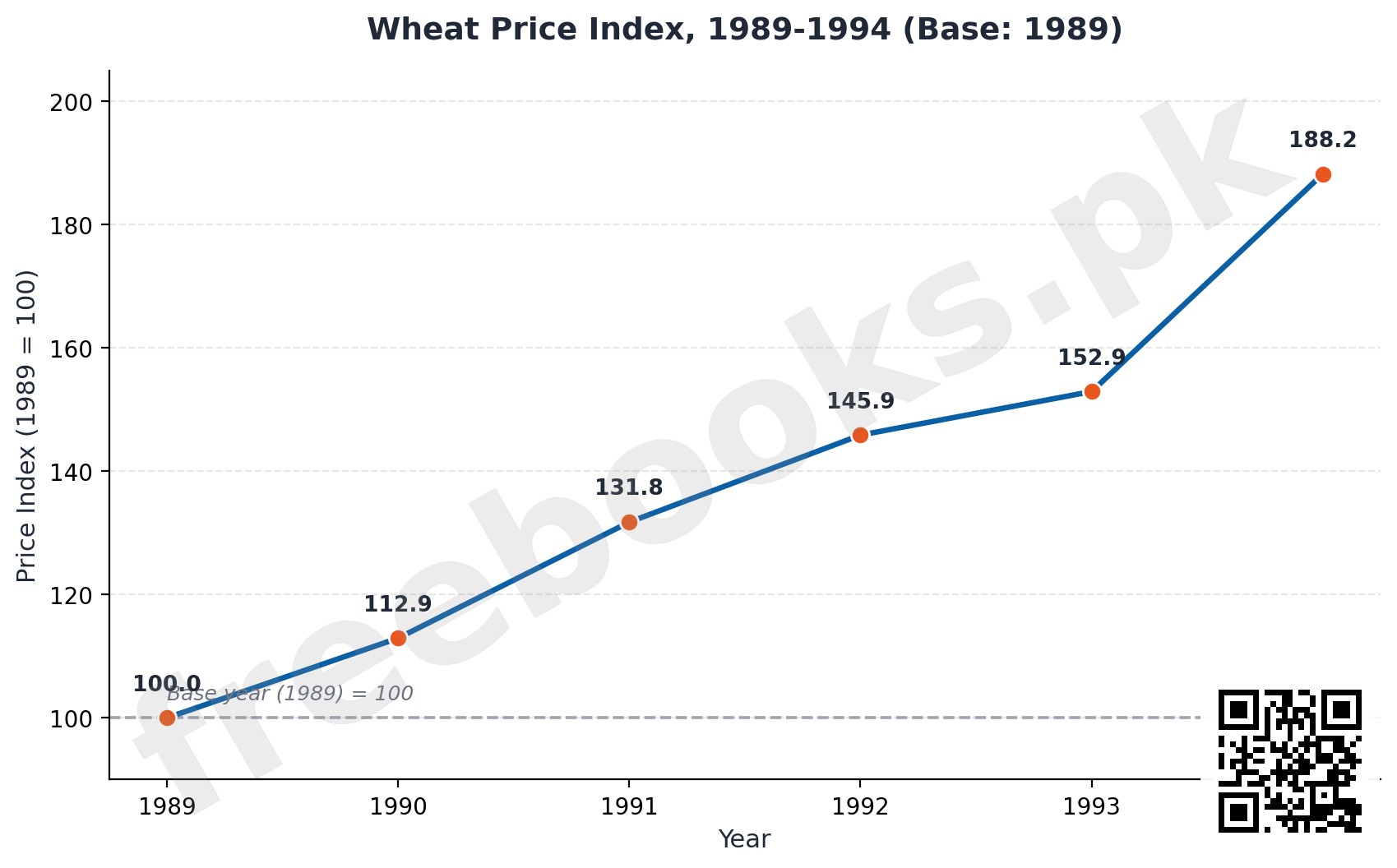
Wheat Price Index, 1989-1994 (Base: 1989): A line chart of the simple price index for wheat from 1989 to 1994, using 1989 as the base year (index = 100), showing the rising trend calculated in the chapter's opening worked example
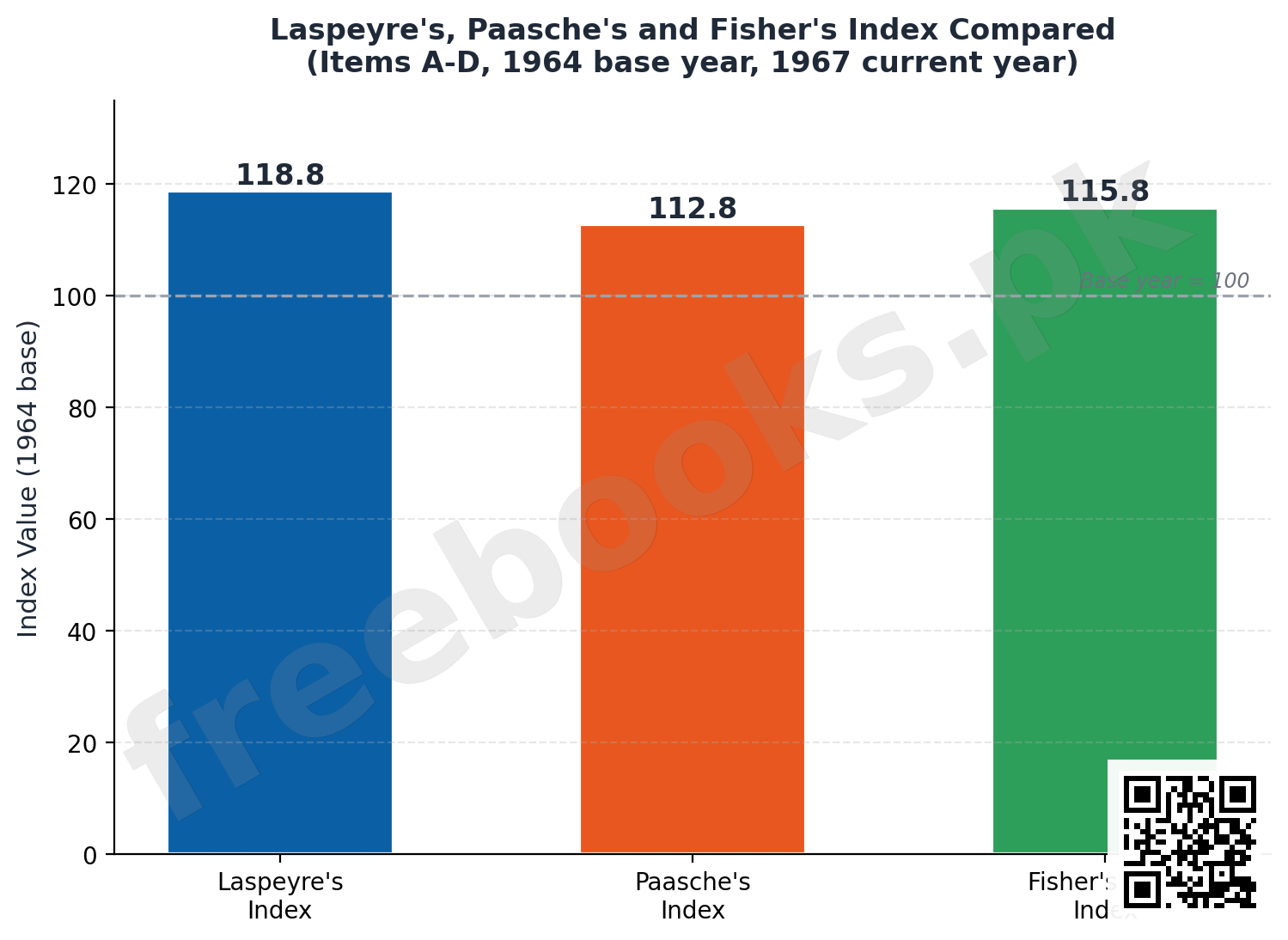
Laspeyre's, Paasche's and Fisher's Index Compared: A bar chart comparing the three weighted index numbers calculated from the same worked example data (items A-D, 1964 base year, 1967 current year): Laspeyre's 118.8, Paasche's 112.8, and Fisher's ideal index 115.8
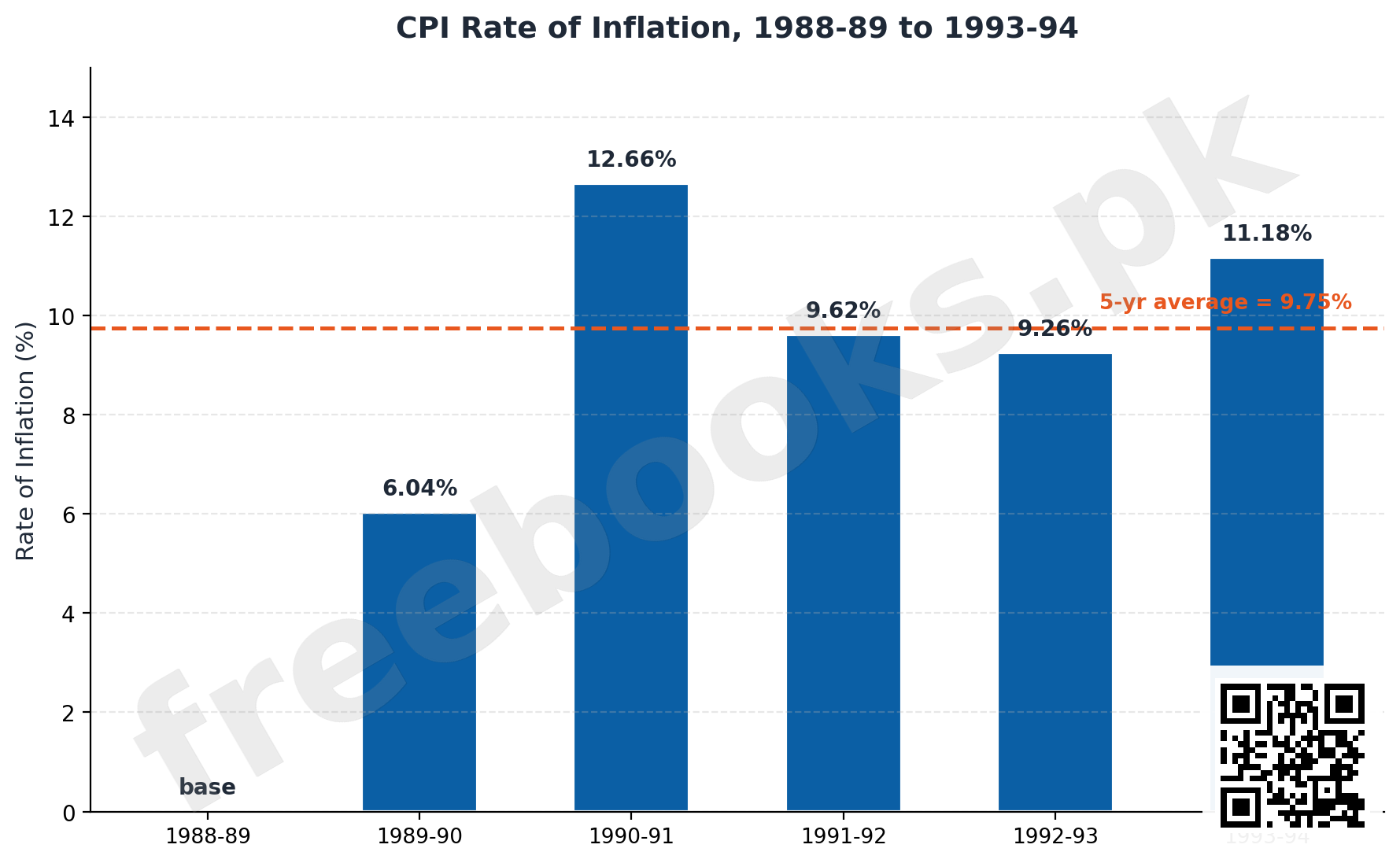
CPI Rate of Inflation, 1988-89 to 1993-94: A bar chart of Pakistan's annual inflation rate calculated from CPI values across six years (1988-89 through 1993-94), with the average annual rate of 9.75% marked as a reference line
Short Questions & Answers
Why is the base year's index number always 100?
Because the index number formula compares each year's value to the base year's own value, and any value divided by itself, expressed as a percentage, equals 100.
What is the key difference between a simple and a composite index number?
A simple index measures the change in a single variable, while a composite (aggregate) index measures the combined relative change across two or more variables.
Why do simple aggregate indices suffer from a 'units' problem?
Because they sum raw prices across different commodities, changing the units of measurement for any one commodity can distort the index, since the sum mixes quantities that aren't naturally comparable.
Why is a chain index mathematically equivalent to a fixed-base price relative?
Because multiplying each year's link relative by the accumulated chain index (and dividing by 100 each time) telescopes down to the same ratio as comparing each year directly back to the very first year.
Why does Laspeyre's index tend to overweight commodities with rising prices?
Because it fixes quantities at base year levels, ignoring that consumers typically buy less of a commodity once its price rises, so the calculation continues crediting the old, higher consumption level to price increases.
Why is Fisher's index called an 'ideal' index?
Because it takes the geometric mean of Laspeyre's and Paasche's indices, balancing Laspeyre's tendency to overweight price increases against Paasche's tendency to underweight them.
How is the annual rate of inflation calculated from CPI values?
By taking the percentage change from the previous year's CPI to the current year's CPI: [(current – previous) / previous] x 100.
Long Questions & Answers
Explain the difference between unweighted and weighted index numbers, describing the simple aggregate index, average relative index, Laspeyre's index, Paasche's index, and Fisher's ideal index.
What is the difference between unweighted and weighted index numbers?
Unweighted index numbers deliberately give every commodity in the basket equal importance, regardless of how significant that commodity actually is in real spending or production. Weighted index numbers correct this by assigning each commodity a weight proportional to its real importance, most commonly based on the quantity of that commodity bought, sold, or produced. The key question that then follows for weighted indices is whose quantities should be used as weights, and from which year — a question answered differently by the Laspeyre's, Paasche's, and Fisher's formulas.
What are the simple aggregate index and the average relative index?
The simple aggregate index sums the current-year prices of every commodity, sums their base-year prices separately, and expresses the ratio as a percentage. It is easy to calculate but flawed: it can be distorted simply by changing the unit of measurement for any one commodity. The average relative index avoids this by first calculating an individual price relative for each commodity — current price divided by base price — and only then averaging these already-unitless ratios, typically with the arithmetic mean. This solves the units problem but still gives every commodity equal weight.
What is Laspeyre's index, and what is its bias?
Laspeyre's index uses the base year's quantities as the weight for both base and current year prices. This is practically convenient, since base year quantities only need to be collected once and reused for every subsequent year. However, because real consumers typically buy less of a commodity once its price rises significantly, continuing to use the old, pre-price-increase quantities as weights tends to systematically overstate the true impact of price increases on the overall index.
What is Paasche's index, and how does Fisher's ideal index combine the two approaches?
Paasche's index takes the opposite approach to Laspeyre's, using current year quantities as the weight. This corrects Laspeyre's overweighting problem, since it reflects how consumption has actually adjusted to new prices, but it introduces the opposite bias, tending to understate the true impact of price increases. Fisher's ideal index resolves this tension by simply taking the geometric mean of Laspeyre's and Paasche's indices, landing at a value between them that is widely regarded as a more balanced measure of overall price change than either formula alone.
Explain how the Consumer Price Index (CPI) is constructed, how it is used to measure inflation and purchasing power, and how it differs from the Sensitive Price Indicator (SPI) and Wholesale Price Index (WPI).
What are the first two steps in constructing a Consumer Price Index?
The first step is deciding exactly which category of people the index is meant to represent — industrial workers, clerks, a particular income bracket, or some other defined group — since spending patterns vary enormously across population segments. Once the target group is defined, a family budget inquiry is carried out, typically through random sampling of an adequate number of households from that group during a normal, non-crisis period. This inquiry reveals what quantities and qualities of goods people actually consume, across categories such as food, clothing, housing, and fuel, along with the prices they pay.
What are the remaining steps in constructing a CPI, from selecting items to choosing weights?
The third step selects which items to include: only items widely used by the target group and not subject to extreme, erratic swings in quantity, supply, or price are chosen. The fourth step collects price quotations, which must be retail prices actually paid by consumers, gathered from real shops across the relevant area, rather than wholesale prices. Finally, weights are chosen to reflect each category's importance to the household budget, most commonly through the Aggregative Expenditure Method (Laspeyre's index using base year quantities) or the Family Budget Method (a weighted average of price relatives).
How is the CPI used to measure inflation?
Once constructed, the CPI's primary practical use is measuring inflation. The annual rate of inflation for any given year is calculated as the percentage change from the previous year's CPI value to the current year's CPI value. An average inflation rate spanning several years can then be found simply by averaging these individual year-over-year rates. This makes the CPI the standard tool governments and economists use to track how the cost of everyday life changes over time for ordinary consumers.
How is the CPI used to measure the purchasing power of money?
A second major practical use of the CPI follows directly from its own construction: because the CPI's base period is always fixed at exactly 100, and currency typically subdivides into 100 smaller units, the purchasing power of money at any later point can be estimated as one hundred divided by the current CPI, multiplied by one hundred. This effectively shows how many of the original 100 base-period units of buying power remain, giving a direct sense of how far money now stretches compared to the base period.
How do the SPI and WPI differ from the CPI?
The Sensitive Price Indicator (SPI) is calculated identically to the CPI, but rather than tracking the full basket of several hundred consumption items, it tracks only a small handful of essential commodities, making it a faster, more responsive gauge of short-term price movements in daily necessities. The Wholesale Price Index (WPI), despite its name, does not measure wholesale prices at all — it measures changes in producers' own selling prices, with weights derived from the value of each commodity's marketable surplus, using the same underlying formulas as the CPI but applied to a different stage of the supply chain.
Multiple Choice Questions (MCQs)
An index number is best described as: (A) A single fixed price (B) A ratio or average of ratios expressed as a percentage (C) A type of frequency distribution (D) A measure of central tendency
Correct answer: (B) A ratio or average of ratios expressed as a percentage. An index number is a ratio or an average of ratios, usually expressed as a percentage, measuring relative change over time.
The index number for the base year is always: (A) 0 (B) 50 (C) 100 (D) It varies each time
Correct answer: (C) 100. By definition and convention, the base year's own index number is always 100.
A composite (aggregate) index number differs from a simple index number in that it: (A) Uses only one commodity (B) Measures relative change across two or more variables at once (C) Cannot be expressed as a percentage (D) Ignores the base year
Correct answer: (B) Measures relative change across two or more variables at once. A composite/aggregate index measures relative change in two or more variables together, unlike a simple index which tracks just one.
The main weakness of a simple aggregate index is that it: (A) Cannot be calculated by hand (B) Is distorted by changes in measuring units and ignores relative importance (C) Always equals exactly 100 (D) Only applies to quantities, never prices
Correct answer: (B) Is distorted by changes in measuring units and ignores relative importance. Simple aggregate indices are sensitive to units of measurement and treat every commodity as equally important.
Laspeyre's index uses which year's quantities as weights? (A) Current year (B) Base year (C) The average of all years (D) It uses no quantities at all
Correct answer: (B) Base year. Laspeyre's index uses base year quantities as weights for both the base and current year prices.
Paasche's index uses which year's quantities as weights? (A) Base year (B) Current year (C) A randomly chosen year (D) It doesn't use quantities
Correct answer: (B) Current year. Paasche's index uses current year quantities as weights, unlike Laspeyre's which uses base year quantities.
Fisher's ideal index is calculated as: (A) The sum of Laspeyre's and Paasche's index (B) The arithmetic mean of Laspeyre's and Paasche's index (C) The geometric mean of Laspeyre's and Paasche's index (D) Laspeyre's index divided by Paasche's index
Correct answer: (C) The geometric mean of Laspeyre's and Paasche's index. Fisher's ideal index is the geometric mean (square root of the product) of Laspeyre's and Paasche's indices.
The Consumer Price Index (CPI) is also known as the: (A) Wholesale price index (B) Cost of living index (C) Sensitive price indicator (D) Value index
Correct answer: (B) Cost of living index. CPI is also called the cost of living index, since it tracks the changing cost of a fixed consumer basket.
The rate of inflation for a given year is calculated using: (A) The current year's CPI alone (B) The percentage change between current and previous year's CPI (C) The base year's index only (D) The Wholesale Price Index only
Correct answer: (B) The percentage change between current and previous year's CPI. Rate of inflation = [(current CPI – previous CPI) / previous CPI] x 100.
The Wholesale Price Index (WPI) actually measures: (A) Retail consumer prices (B) Producers' selling prices (C) Only import prices (D) Only export prices
Correct answer: (B) Producers' selling prices. Despite its name, the WPI measures changes in producers' selling prices, not literal wholesale prices.
Quick Revision Summary
- Index number In = (current year value / base year value) x 100; base year index is always 100
- Simple index = single variable; Composite/aggregate index = two or more variables combined
- Unweighted: Simple aggregate index (sum of prices ratio) and Average relative index (average of ratios)
- Link relative uses previous year as base; Chain index converts link relatives to a fixed-base-equivalent series
- Laspeyre's index: base year quantities as weights (tends to overweight price rises)
- Paasche's index: current year quantities as weights (tends to underweight price rises)
- Fisher's ideal index = geometric mean of Laspeyre's and Paasche's index
- CPI = cost of living index; constructed via 5 steps: category, budget inquiry, item selection, price quotations, weights
- Rate of inflation = % change in CPI year over year; Purchasing power of money = (100/CPI) x 100
- SPI = CPI formula but fewer essential items; WPI = measures producers' selling prices, not literal wholesale prices
Exam Tips
- Remember: base year index is ALWAYS 100 by definition — a very common quick-check on any calculation
- Laspeyre's = base year quantities; Paasche's = current year quantities; Fisher's = geometric mean of both
- For 'compare two commodities across time' word problems, check if quantities are given — if yes, it's likely a weighted index question
- Rate of inflation always compares CONSECUTIVE years' CPI, not a year against the fixed base
- Chain index and fixed-base price relative give the same final answer — don't be confused by the different-looking calculation steps
- CPI, SPI and WPI all use the same underlying formulas — what differs is only the basket of items and whose prices are tracked