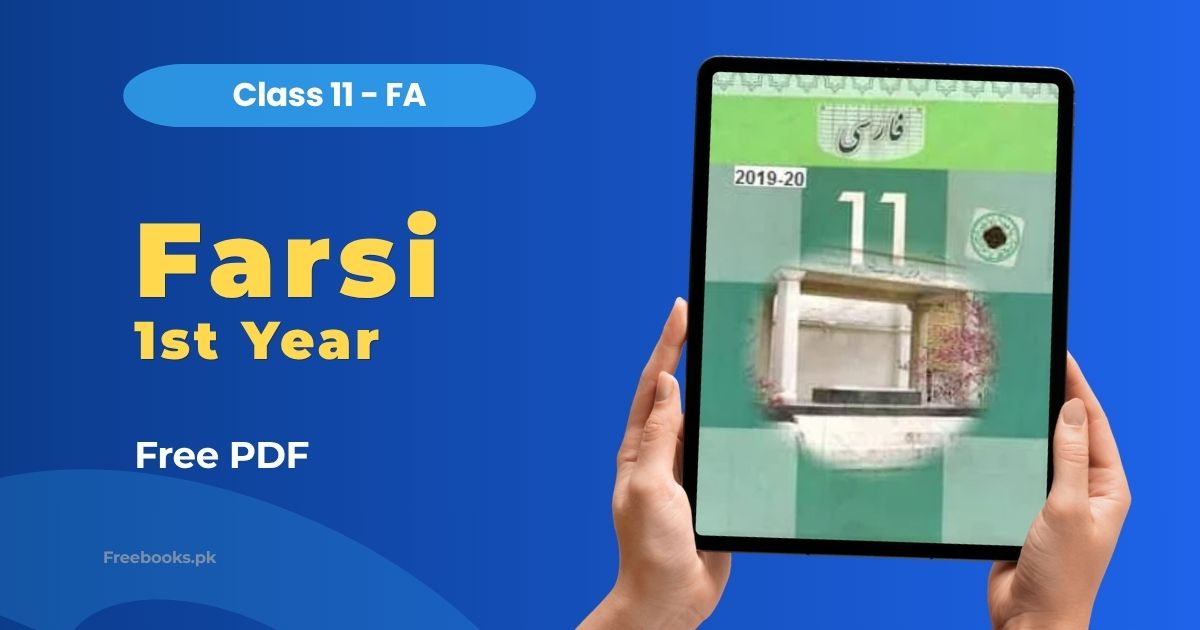
Farsi for 1st Year is the official Class 11 textbook published by the Punjab Curriculum and Textbook Board (PCTB), Lahore, for FA students. The book teaches the Persian language through Urdu translation and vocabulary notes, following the official Punjab Board syllabus.
For FA students, Farsi connects them to nearly a thousand years of subcontinent history, since Persian was the region’s literary and administrative language for centuries, and much of Allama Iqbal’s poetry was written in Farsi. This book brings together classical poets like Rumi, Hafez, and Nizami Ganjavi alongside modern writers, with translation exercises and vocabulary notes to help students prepare for their board exam.
Book Overview
- Class: 11 (1st Year, Intermediate Part 1)
- Subject: Farsi (Persian Language)
- Category: FA
- Board: Punjab Board (PCTB, Lahore)
- Authors: Dr. Khalida Aftab, Muhammad Khan Kaleem (Late), Nawazish Ali Sheikh (Late), Dr. Ghulam Moinuddin Nizami
- Reviewer: Prof. Dr. Aftab Asghar (Late)
- Publisher: Majid Book Depot, Lahore
- Edition: 1st Edition, November 2019
- Total Lessons: 30
- Medium: Persian (Farsi), with Urdu translation and notes
- Format: PDF
Chapter List
Lesson 1 – Translation of Surah Al-Fatiha (ترجمہ سورہ الحمد)
A word-by-word Persian translation of Surah Al-Fatiha, the opening chapter of the Holy Quran, with vocabulary notes and exercise questions.
Lesson 2 – Naat (نعت)
A devotional poem written in praise of the Holy Prophet Muhammad (peace be upon him).
Lesson 3 – Kalam-e-Khuda (کلامِ خدا)
Selected verses reflecting on the attributes and guidance of God.
Lesson 4 – Kitab, a Poem (کتاب – منظومہ)
A short poem titled “The Book,” reflecting on the value and role of books in life.
Lesson 5 – Syed Ali Hajveri: The Rightly Guided Caliphs (سید علی ہجویریے – خلفائے راشدین)
An account of the four Rightly Guided Caliphs (Khulafa-e-Rashideen), written by the renowned Sufi saint Syed Ali Hajveri (Data Ganj Bakhsh).
Lesson 6 – Farrukhi Sistani: In Praise of the Royal Stable, a Poem (فرخی سیستانی – در وصف داغگاہ)
A classical Persian poem by the court poet Farrukhi Sistani, describing a royal stable.
Lesson 7 – Imam Ghazali: Letter to Sultan Sanjar Seljuqi (امام غزالیے – نامہ بہ سلطان سنجر سلجوقی)
A letter written by Imam Ghazali advising Sultan Sanjar of the Seljuk empire.
Lesson 8 – Masud Sa’d Salman Lahori, a Poem (مسعود سعد سلمان لاہوری)
A classical poem by Masud Sa’d Salman, the Lahore-based Persian poet of the Ghaznavid era.
Lesson 9 – Sayyid al-Din Muhammad Aufi: Jawami al-Hikayat (سیدالدین محمد عوفی – جوامع الحکایات)
A selection from Aufi’s famous collection of moral stories and anecdotes.
Lesson 10 – Nizami Ganjavi: Advice, and the Lion’s Grief, Poems (نظامی گنجوی – پندہا و تنہا ماندن)
Two short poems by the celebrated Persian poet Nizami Ganjavi, one offering life advice and one describing grief and separation.
Lesson 11 – Maulana Jalaluddin Rumi: Moses and the Shepherd, a Poem (مولانا جلال الدین رومی – موسیٰ و شبان)
Rumi’s famous Masnavi story of Prophet Moses (peace be upon him) and a humble shepherd, teaching a lesson about sincerity in worship.
Lesson 12 – Hasan Sijzi Dehlavi: Sayings of Khwaja Nizamuddin Auliya (حسن سجزی دہلوی – سخنانِ خواجہ نظام الدین اولیاء)
A collection of the teachings and sayings of the Sufi saint Khwaja Nizamuddin Auliya, recorded by his disciple Hasan Sijzi Dehlavi.
Lesson 13 – Amir Khusrau: Ghazals of Khusrau (امیر خسرو – غزلہای خسرو)
Selected ghazals by Amir Khusrau, the renowned Indo-Persian poet and Sufi musician.
Lesson 14 – Ziauddin Nakhshabi: Pearls from the Path of Sulook (ضیاء الدین نخشبی – مرواریدہایی از سلک السلوک)
A selection of spiritual sayings from Nakhshabi’s work on the Sufi path.
Lesson 15 – Khwaja Hafez Shirazi: Ghazals of Hafez (خواجہ حافظ شیرازی – غزلیاتِ حافظ)
Selected ghazals of Hafez Shirazi, one of the greatest classical Persian poets.
Lesson 16 – Maulana Jami: Selection from Baharistan (مولانا جامی – گزیدہ ای از بہارستان)
An excerpt from Jami’s “Baharistan” (Abode of Spring), a classic work of Persian prose and poetry.
Lesson 17 – Nuruddin Muhammad Jahangir: Selection from Tuzk-e-Jahangiri (نورالدین محمد جہانگیر – گزیدہ ای از توزکِ جہانگیری)
An excerpt from the memoirs of Mughal Emperor Jahangir, originally written in Persian.
Lesson 18 – Hazrat Sachal Sarmast (حضرت سچل سرمست)
A piece introducing the life and Sufi poetry of Hazrat Sachal Sarmast.
Lesson 19 – Malik-ul-Shu’ara Bahar (ملک الشعراء بہار)
An introduction to the modern Iranian poet Malik-ul-Shu’ara Bahar and his work.
Lesson 20 – Salutation to Pakistan, a Ghazal, and In the Classroom, a Dialogue (درود بر پاکستان ، غزل ، در کلاس)
A poem in praise of Pakistan, a ghazal, and a classroom conversation piece for practicing spoken Farsi.
Lesson 21 – Advice to a Son, a Poem (نصیحت بہ فرزند)
A poem offering fatherly advice, written in the didactic tradition of Persian literature.
Lesson 22 – Fatima Jinnah (فاطمہ جناح)
A biographical piece on Fatima Jinnah, sister of Quaid-e-Azam Muhammad Ali Jinnah.
Lesson 23 – Allama Muhammad Iqbal: Dialogue Between God and Man, and Solitude, Poems (علامہ محمد اقبال – محاورہ مابین خدا و انسان ، تنہائی)
Two poems by Allama Iqbal, originally written in Farsi, reflecting his philosophical themes of divine dialogue and solitude.
Lesson 24 – Tale of Flight (داستانِ پرواز)
A prose narrative built around the theme of flight.
Lesson 25 – Nima Yooshij: Coming of Spring (نیما یوشیج – آمدِ بهاران)
A poem by Nima Yooshij, regarded as the father of modern Persian poetry.
Lesson 26 – Letter to My Son, a Poem (نامہ ای به پسرم)
A poem written as a letter of guidance from father to son.
Lesson 27 – Ghazal (غزل)
A selected ghazal continuing the classical poetic tradition covered earlier in the book.
Lesson 28 – Rashid Minhas, Nishan-e-Haider (راشد منهاس، نشانِ حیدر)
An account of Pakistan Air Force pilot Rashid Minhas, the youngest recipient of Pakistan’s highest military award, Nishan-e-Haider.
Lesson 29 – The Value of Exercise (ارزشِ ورزش)
A prose piece on the importance of physical exercise for health.
Lesson 30 – In the Library, a Dialogue (در کتابخانہ)
A dialogue-style lesson set in a library, for practicing conversational Farsi.
Download Farsi Class 11 FA Book PDF (PCTB)
Click the button below to download the complete Farsi Class 11 PDF for free. The file opens in a new tab and is ready to read or save on any device.
⬇ Download PDFWho Should Read This
FA students following the Punjab Board (PCTB) syllabus in Class 11 / 1st Year who have chosen Farsi as their language subject need this book. It also suits any Intermediate student learning Persian who wants to study classical and modern Persian literature with Urdu translation support.
Applicable Boards
PCTB (Punjab Curriculum and Textbook Board), Lahore, publishes this Farsi book mainly for Punjab Board students who choose Farsi as their language subject. Students from other boards offering Farsi as an elective can also use it, since the classical Persian literature it covers is common across syllabi.
FAQs
Is this Farsi book for FA students?
Yes. This is the official Class 11 (1st Year) Farsi book for FA students under the Punjab Board (PCTB) syllabus.
Can students from other groups use this book?
Yes. Any Intermediate student studying Farsi as their language elective can use this book, regardless of their FSc, ICS, or ICOM group.
Is this the latest edition?
Yes. This is the 1st edition, published in November 2019 by Majid Book Depot, Lahore, and is the current official PCTB Farsi textbook.
Is this book in Urdu or Persian?
This book teaches the Persian (Farsi) language, with Urdu translations and vocabulary notes provided for every lesson.
Does this book include exercises after each lesson?
Yes. Each of the 30 lessons ends with translation and vocabulary exercises to help students practice and prepare for exams.