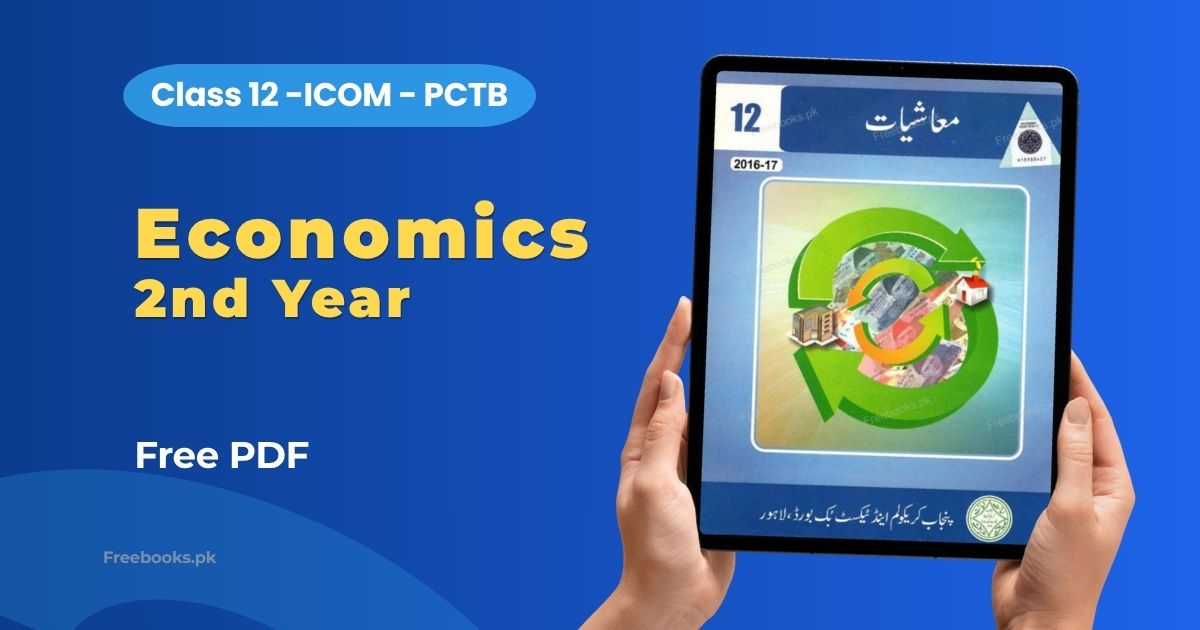
Economics 2nd Year (Class 12) is published by the Punjab Curriculum and Textbook Board (PCTB), Lahore. Approved by the Federal Ministry of Education, this is the standard ICOM Part 2 Economics textbook used in Punjab Board colleges. It covers thirteen chapters divided into two parts: general economic theory and economics of Pakistan.
For ICOM Part 2 students, Economics is one of the core subjects and this book covers the complete board exam syllabus. The first half deals with national income, money, banking, public finance, and international trade. The second half applies these concepts to Pakistan’s economy. The PDF makes it easy to revise theory, definitions, and diagrams before the final board exam.
Book Overview
| Class | 12 (ICOM Part 2 / Second Year) |
| Subject | Economics |
| Category | ICOM |
| Board | Punjab Board (PCTB, Lahore) |
| Medium | Urdu |
| Edition | 2016–17 |
| Total Chapters | 13 |
| Total Pages | 260 |
| Format |
Chapter List
Chapter 1 – National Income (قومی آمدنی)
This chapter defines National Income as the total money value of goods and services a country produces in one year, drawing on definitions by Marshall, Pigou, Fisher, Hicks, and Gardner Ackley. It explains six key concepts, GDP, GNP, NNP, National Income, Personal Income, and Disposable Personal Income, along with their formulas (e.g., GDP = C+I+G+X-M) and the Circular Flow of Income between households and firms. Students must also master three measurement methods (Product, Income, Expenditure), avoiding double counting, and concepts like APC, MPC, APS, MPS, saving, investment (autonomous vs induced), and equilibrium national income where aggregate demand equals aggregate supply (S=I), all central to board exam numericals and definitions.
Important Questions:
- What is meant by National Income? National Income is the total money value of all final goods and services produced by a country’s factors of production in one year, including net income from abroad, and excluding transfer payments.
- What is the difference between Gross Domestic Product (GDP) and Gross National Product (GNP)? GDP is the money value of goods and services produced within a country’s geographical boundaries in a year, while GNP equals GDP plus remittances/income received by the country’s nationals from abroad (GNP = GDP + income from abroad).
- What is the difference between Autonomous Investment and Induced Investment? Autonomous investment (e.g., building roads or dams) does not change with changes in income and stays constant, whereas induced investment rises when income rises and falls when income falls (e.g., spending on producing goods in a factory).
- Why are Transfer Payments not included when calculating National Income? Transfer payments, such as pensions, scholarships, zakat, and gifts, are received without any productive work being done in exchange, so they do not add to output and are excluded from National Income (though they are included in Personal Income).
Chapter 2 – Money (زر)
This chapter traces money’s origin from the barter system, which failed due to problems like lack of double coincidence of wants, no common measure of value, and indivisibility of goods. It covers money’s evolution through commodity, metallic, paper, and credit forms, and definitions by Walker, Morgan, Crowther, and J.M. Keynes. Key topics include money’s functions (medium of exchange, measure of value, transfer of value, government payments), kinds of money (standard, token, legal tender, near money), credit instruments (cheques, promissory notes, bills of exchange), Keynes’ three motives for demand for money, money supply factors, and Irving Fisher’s Quantity Theory equation PT=MV+M’V’.
Important Questions:
- What is meant by direct exchange (the Barter System)? Barter is an economic system in which goods are exchanged directly for other goods without using money; Professor Stanley described it as an economy where no single commodity has general acceptability.
- State J.M. Keynes’ definition of money. Keynes defined money as “that by delivery of which debt contracts and price contracts are discharged and in the shape of which a store of general purchasing power is held,” making his definition more comprehensive than Crowther’s since it also covers deferred payments.
- What is the difference between a bearer cheque and an order cheque? A bearer cheque can be cashed by anyone who presents it at the bank without identification, while an order cheque can only be cashed by the specific person named on it after the bank verifies their identity.
- What is the difference between convertible and inconvertible paper money? Convertible paper money is currency the government or central bank is bound to exchange for gold, silver, or approved foreign exchange on demand, whereas inconvertible paper money (also called legal tender) is issued without such a backing guarantee but must still be accepted in transactions.
Chapter 3 – Bank (بینک)
Chapter 3 explains a bank as a financial institution that holds people’s surplus savings as deposits and lends money to those in need, and it surveys the kinds of banks, central, commercial, agricultural, industrial, cooperative, saving, exchange, and mortgage banks. It details commercial bank functions such as accepting demand, time, saving, and profit-and-loss sharing deposits, and advancing loans through loan accounts, overdrafts, and bill discounting, then explains credit creation, where banks multiply an initial deposit into several times its value through successive lending, subject to limitations like the central bank’s cash reserve ratio. It also covers the central bank’s roles (note issue, banker’s bank, lender of last resort, controller of money market) and Pakistan’s interest-free banking system (Musharika, Modaraba, Qarz-e-Hasna), all essential exam topics.
Important Questions:
- What is meant by a bank? A bank is a financial institution that holds people’s surplus savings as safe deposits and provides loans to those who need money at the time of need, essentially dealing in the business of money and credit.
- What is the difference between demand deposits and saving deposits? Demand deposits (current account) can be withdrawn at any time and earn no interest since the bank cannot lend or invest them, while saving deposits earn a fixed rate of interest but can only be withdrawn a limited number of times (once or twice a week) up to a set amount.
- What conditions are necessary for commercial banks to create credit? Credit creation depends on factors such as the quantity of money in circulation, public demand for cash versus cheques, availability of willing borrowers, general economic conditions, the cash reserve ratio fixed by the central bank, availability of security assets for loans, cooperation among banks, and the central bank’s monetary policy.
- Why is the central bank called the “bank of banks”? The central bank heads the country’s entire banking system: it rediscounts commercial banks’ bills to lend them money, must approve their new branches, holds a portion of their reserves as deposits, and receives their regular business reports, so all commercial banks operate under its rules and guidance.
Chapter 4 – Public Finance (سرکاری مالیات)
Chapter 4, Public Finance, explains how government manages public income and expenditure through taxes, borrowing, and spending to direct economic activity, contrasting it with private finance managed by individuals for personal needs. It covers similarities and differences between public and private finance (budget period, balance, deficit policy, currency issuance), sources of public revenue (tax and non-tax, such as fees, prices, interest, special assessment), Adam Smith’s four canons of taxation plus other canons (productivity, elasticity, simplicity, diversity), direct versus indirect taxes with their advantages and disadvantages, and Pakistan’s tax system, including its reliance on regressive indirect taxes and low tax-to-GDP ratio.
Important Questions:
- What is the difference between public finance and private finance? Public finance is the government’s arrangement and management of public income (taxes, borrowing) and expenditure, with a fixed one-year budget in which expenditure is estimated before revenue; private finance is an individual’s management of personal income and spending based on need, with no fixed budget period and income earned before expenses are incurred.
- What is meant by “deficit policy”? When government expenditure exceeds its revenue, it must adopt a deficit policy, covering the shortfall by printing new currency notes, imposing new taxes, or obtaining foreign loans.
- Name the first four canons of taxation given by Adam Smith. Canon of Equality, Canon of Certainty, Canon of Convenience, and Canon of Economy.
- What is the difference between direct and indirect taxes? A direct tax (e.g., income tax, wealth tax) is paid by the same person on whom it is levied and its burden cannot be shifted to anyone else; an indirect tax (e.g., customs duty, excise duty, sales tax) is collected through an intermediary such as a trader and its burden can be passed on, usually falling on the final consumer.
Chapter 5 – International Trade (بین الاقوامی تجارت)
Chapter 5, International Trade, explains why no country is self-sufficient and distinguishes domestic trade (exchange within a country’s borders) from international trade (exchange between countries), highlighting differences in labour/capital mobility, currency exchange rates, trade restrictions, and resource availability. It covers the advantages (cheap goods, specialization, large-scale production, disposal of surplus output) and disadvantages of international trade, the Classical Theory built on Adam Smith’s Absolute Advantage and David Ricardo’s Comparative Cost theory with numerical examples, plus Balance of Trade versus Balance of Payments (current and capital accounts), Globalization, Multinational and Transnational Corporations, and the WTO, established 1 January 1995.
Important Questions:
- What is meant by international trade? International trade, also called foreign trade, is the exchange of goods and services between one country and another, where the buyer and seller belong to different countries; a country imports goods it cannot produce itself or that cost relatively more to produce domestically.
- Define domestic trade. Domestic trade is the exchange of goods and services between individuals, institutions, cities, and towns within the geographical boundaries of a single country, where both buyers and sellers are residents of that same country.
- What is meant by comparative advantage (the theory of comparative cost)? Proposed by David Ricardo, it states that a country benefits from specializing in producing the good in which it has the greatest comparative advantage (or least comparative disadvantage), even if it could produce both goods more cheaply than another country.
- What is the difference between the current account and the capital account in the balance of payments? The current account records a year’s trade in visible and invisible goods and services (exports/imports, transport costs, war supplies, gifts/grants), while the capital account records the inflow and outflow of capital such as foreign loans, grants, and foreign investment, and is used to cover any current account deficit.
Chapter 6 – Introduction to Pakistan’s Economy (پاکستان کی معیشت کا تعارف)
This chapter introduces the structure of Pakistan’s economy across its major sectors. It covers agriculture (about 61% of the population is rural, with roughly 43.5% linked to farming, contributing 20.9% of GDP), industry (20.30% of GDP, including textiles, automobiles, fertilizer, paint/varnish, and cement), and small and medium enterprises supported by SMEDA. It also discusses foreign trade (major exports and imports, trade deficit), the three stock exchanges (Karachi, Lahore, Islamabad), and the education and health sectors, including literacy rates and healthcare shortages. Students should know key statistics, sector shares of GDP, and institutional names for exams.
Important Questions:
- What percentage of Pakistan’s total land area is covered by forests, and what percentage is cultivable? About 3.5% of Pakistan’s total area is under forests, while 25.2% of the land is cultivable (with a further 10% semi-cultivated).
- What share of Pakistan’s GDP comes from agriculture, and what share comes from the industrial sector? Agriculture contributes about 20.9% of GDP, while the industrial sector contributes about 20.30% of GDP.
- Which is Pakistan’s most important industry, and what share of national exports does it account for? The textile industry is Pakistan’s most important industry, accounting for about 54% of the country’s exports and employing about 38% of the industrial labor force.
- Name the three stock exchanges operating in Pakistan and state when the Islamabad Stock Exchange was established. The three stock exchanges are the Karachi Stock Exchange, the Lahore Stock Exchange, and the Islamabad Stock Exchange; the Islamabad Stock Exchange was established in August 1992.
Chapter 7 – National Income of Pakistan (پاکستان کی قومی آمدنی)
Chapter 7 examines Pakistan’s national income since independence, covering Gross National Product (GNP) growth across decades, the changing sectoral composition of GNP (agriculture’s share falling from about 40% to 20.9% while industry rose to around 20.3%), and the methods used to measure income (product, income, and expenditure methods) at current and constant prices. It details ten difficulties in measuring national income, fifteen causes of Pakistan’s low per capita income (USD 1,512), thirteen measures to raise it, and Pakistan’s tax culture, including direct/indirect taxes and the low 9.2% tax-to-GDP ratio, key concepts for exam preparation.
Important Questions:
- What is meant by per capita income, and what are the reasons for low per capita income in Pakistan? Per capita income is a country’s total national income divided by its total population; Pakistan’s low per capita income (about USD 1,512) is caused by factors such as scarcity of natural resources, heavy dependence on agriculture, shortage of capital, industrial backwardness, overpopulation, and the burden of foreign debt.
- What difficulties are faced in the measurement of national income in Pakistan? Key difficulties include a lack of trained and responsible staff, non-cooperation from the public, unpaid domestic services not being counted, lack of data on cottage industries, illiteracy, smuggling, and people not keeping proper accounts (book-keeping).
- Describe the share of various sectors in Pakistan’s national income (GNP). Agriculture’s share of GNP fell from about 40% in 1969-70 to 20.9% in 2014-15, while industry’s share rose from around 16% during the Ayub Khan era to about 20.3% in 2014-15, with transport, trade, and services making up most of the remaining share.
- What is meant by “tax culture,” and what measures did the Government of Pakistan take in 2002 to promote it? Tax culture means a simple, fair system in which citizens willingly pay taxes as a national duty; in 2002 Pakistan’s government ended tax amnesties for whitening black money, conducted a tax survey and documentation drive, abolished the wealth tax, and introduced a self-assessment scheme, though the tax-to-GDP ratio remained low at 9.2%.
Chapter 8 – Economic Development and Planning (معاشی ترقی و منصوبہ بندی)
Chapter 8 explains economic development as a long-term process defined by economists such as Arthur Lewis, H.F. Williamson, and Meier and Baldwin, in which real national income and per capita income rise steadily, improving living standards, education, health, and employment. It covers indicators for measuring development, fifteen problems facing underdeveloped economies like low per capita income, foreign debt, and rapid population growth, plus economic, socio-cultural, and political factors driving growth. It also traces Pakistan’s economic planning history from the 1948 Development Board and Colombo Plan through eight Five-Year Plans, alongside agricultural and industrial sector problems and their solutions.
Important Questions:
- According to Meier and Baldwin, how is economic development defined? Economic development is a process in which an economy’s real national income increases over a long period of time, and if the rate of development exceeds the population growth rate, per capita real income also rises.
- What three types of factors affect the process of economic development? Economic development is influenced by economic factors (natural resources, social/human capital, capital formation, entrepreneurship), socio-cultural factors, and political factors such as political stability.
- What is meant by economic planning? Economic planning is a systematic method of surveying a country’s resources and putting them to practical use to achieve specific, pre-determined objectives, solve an economy’s basic problems, and raise people’s standard of living.
- State four major problems faced by Pakistan’s agricultural sector. Key problems include inefficient use of cultivable land, inadequate irrigation facilities, lack of agricultural credit and inputs, and waterlogging and salinity that render land unfit for cultivation.
Chapter 9 – Communications, Transport and Human Resource Development (مواصلات، ذرائع آمدورفت اور انسانی ذرائع کی ترقی)
This chapter examines how communication and transportation shape Pakistan’s economic and social development, covering roads (carrying 92% of passengers and 56% of goods), Pakistan Railways’ decline (from 70% to 9% passenger share) under the National Highway Authority, motorways (M-1 to M-9), and dry ports established since 1973. It explains modern IT developments like e-government, PSEB, and ATMs, factors raising labour productivity (health, education, wages, management), and types of labour mobility (occupational, geographical, social, horizontal, vertical). It also covers population growth problems, Pakistan’s labour force (60.09 million, ~6% unemployed), and causes/remedies for unemployment, key exam topics.
Important Questions:
- State the importance of means of communication and transportation. Better communication and transport reduce production costs, expand domestic and international trade, link remote areas to major markets, increase production, improve mobility of factors of production (especially labour), and support human resource development, balanced regional growth, national defense, and social integration.
- Write three important problems of Pakistan Railways. Pakistan Railways suffers from corruption (including black-marketing of tickets and pilferage of goods), uneconomical/loss-making routes run for political reasons, and issues like unhealthy trade union activity, excessive government interference, and unnecessary recruitment.
- What is meant by a dry port? A dry port is an inland facility (Pakistan has established eight) set up to make it easier to transport goods between seaports/border areas and remote regions and to give traders import-export facilities away from the seacoast; the first was established in Lahore in 1973.
- What is meant by labour force? Labour force refers to the people in a country who are working or available to work; in Pakistan it totals about 60.09 million (roughly 61% rural, 39% urban), making up about 33% of the total population.
Chapter 10 – Banking System of Pakistan (پاکستان کا بینکاری نظام)
Chapter 10 covers Pakistan’s banking system, from the weak structure inherited at independence to the State Bank of Pakistan’s founding on 1 July 1948. It explains commercial banks and their 1974 nationalization into five major banks, plus specialized institutions, National Bank of Pakistan, Zarai Taraqiati Bank Limited (short, medium, and long-term agricultural loans), and Industrial Development Bank of Pakistan, that finance trade, agriculture, and industry. It details the State Bank’s role in economic development, including capital market formation via the Karachi and Lahore Stock Exchanges, the money market and capital market, e-commerce, and inflation, its types, causes, and control measures, all key exam topics.
Important Questions:
- Which institution has the authority to issue currency notes in Pakistan? The central bank, the State Bank of Pakistan, holds the authority to issue currency notes.
- In which year were Pakistan’s commercial banks nationalized, and into how many major banks were they consolidated? Commercial banks were nationalized in 1974 under the Banks Nationalization Ordinance, consolidating them into five major banks: National Bank of Pakistan, Habib Bank Limited, Muslim Commercial Bank Limited, Allied Bank Limited, and United Bank Limited.
- What kinds of loans does Zarai Taraqiati Bank Limited provide to farmers, and for what purposes? It provides short-term loans for immediate farming needs like seeds, fertilizer, and medicine; medium-term loans (up to 5 years) for equipment such as tube wells; and long-term loans (5-10 years) for tractors, threshers, warehouses, and cold storage construction.
- When and why did the State Bank of Pakistan establish the Karachi Stock Exchange? The State Bank established the Karachi Stock Exchange in 1949 to organize Pakistan’s capital market, later followed by the Lahore Stock Exchange in 1971, enabling systematic buying and selling of company shares and securities.
Chapter 11 – Public Finance of Pakistan (حکومتِ پاکستان کے مالیات)
This chapter examines Pakistan’s public finance system: how federal, provincial, and local governments raise and spend money under the 1973 Constitution. It covers direct taxes (income, property, gift tax) versus indirect taxes (customs duty, excise duty, sales tax), and tax types by rate structure, proportional, progressive, regressive, and value-added tax. It details federal revenue sources (customs duty, income/corporate tax, sales tax) and expenditure heads (defence, debt servicing, subsidies), the NFC Award’s revenue-sharing formula between provinces, and Islamic instruments, Zakat, Usher, and Infaq-fi-Sabilillah, as tools for revenue collection and social justice, key exam topics.
Important Questions:
- Which of these is NOT a source of provincial government revenue: motor vehicle tax, Abiana (water rate), entertainment tax, or income tax? Income tax is not a provincial revenue source; it is collected by the federal government, while motor vehicle tax, Abiana, and entertainment tax are provincial sources.
- Which head takes up the largest share of federal government expenditure? According to the chapter, administration takes about 18% and defence about 17.2% of federal expenditure, with debt servicing on foreign loans also being one of the largest expenditure items.
- In which case can the burden of a tax be shifted onto others? The burden of an indirect tax can be shifted onto others, since it is added to the price of goods and ultimately paid by consumers.
- What is the literal meaning of Zakat, and what is Usher? Zakat literally means purity and growth; Usher means “one-tenth” and refers to the zakat charged on agricultural produce, collected at 10% on naturally irrigated land and 5% on artificially irrigated land, distributed among the needy.
Chapter 12 – Foreign Trade of Pakistan (پاکستان کی تجارتِ خارجہ)
This chapter examines Pakistan’s foreign trade, explaining why international trade matters for a developing country, access to goods difficult to produce locally, economies of scale, technology transfer, and higher national income. It covers major exports (cotton and cotton products, rice, leather, carpets, surgical instruments, sports goods, hosiery) and major imports (petroleum products, machinery, chemicals, food items). Students must understand Balance of Payments, the record of a country’s transactions with the world, and why Pakistan’s balance has stayed unfavourable due to rising imports, low export prices, and quota restrictions. It covers ECO, SAARC, WTO, and fixed versus flexible exchange rate systems.
Important Questions:
- What are Pakistan’s major imports? Pakistan’s major imports include petroleum products, machinery (power-generating, textile, construction, and agricultural machinery), chemicals and medicines, and food items such as edible oil, dry milk, tea, and pulses.
- What are Pakistan’s major exports? Pakistan’s major exports include cotton and cotton products (raw cotton, cotton yarn, cotton cloth), rice, leather and leather products, carpets, fish products, fruits and vegetables, surgical instruments, sports goods, and hosiery/ready-made garments.
- What is meant by Balance of Payments? Balance of Payments is a comprehensive record of all economic transactions between the residents of a country and the rest of the world during a particular year, covering both visible (goods) and invisible items.
- When is a country’s Balance of Payments considered favourable? A country’s Balance of Payments is favourable when its total receipts from other countries exceed its total payments to them; it is unfavourable when payments exceed receipts, as has generally been the case for Pakistan.
Chapter 13 – Islamic Economic System (اسلام کا معاشی نظام)
Chapter 13 explains the Islamic economic system as a balanced framework resting on values like taqwa, adl (justice), ihsan (beneficence), equality, and moderation. It covers private ownership as a trust from Allah (not absolute), earning and spending only through halal means, the prohibition of riba (interest) and its moral, social, and economic harms, and interest-free banking based on Musharakah and Mudarabah (profit-and-loss sharing), including Pakistan’s 1979-1985 Islamic banking reforms. It also examines circulation of wealth via zakat and sadaqah, bans on hoarding and ostentatious spending, the welfare state’s economic role, and a comparison with Capitalism and Socialism.
Important Questions:
- What is the Islamic concept of ownership of wealth? In Islam, Allah is the ultimate owner of everything; He grants humans the right of private ownership as a trust (since man is His vicegerent on earth), so this right is not absolute but bound by social obligations toward relatives, neighbors, and the needy.
- What is meant by moderation (I’tidal) in spending wealth? It means spending one’s lawfully earned wealth only on halal things and genuine needs, avoiding both extravagance (israf) and miserliness (bukhl), keeping a balanced course between the two as described in the Quran (Surah Al-Furqan).
- What are the harms of concentration of wealth (Irtikaz-e-Daulat)? When wealth accumulates in a few hands, effective demand falls, production shifts toward luxury goods instead of necessities, and economic imbalance and social disorder result; the Quran warns of painful punishment for those who hoard wealth and do not spend it on the needy.
- What is the economic role of an Islamic welfare state? After establishing the system of worship and a zakat-based economy, the Islamic state is responsible for ensuring every citizen’s basic needs (food, clothing, shelter, education, health), first the individual, then society, and finally the state as the last resort, as reflected in the hadith that the ruler is the guardian of one who has no guardian.
Download Economics Class 12 Book PDF
Click the button below to open the complete Economics Class 12 book PDF. It opens in a new tab and is ready to read or save on any device.
⬇ Download PDFWho Should Read This
This book is for ICOM Part 2 (Second Year) students preparing for the Punjab Board annual Economics exam. It is also useful for FA students who study Economics as an elective subject. Students planning to pursue BBA, B.Com, or Economics at university level will find this book a strong foundation for higher studies.
Applicable Boards
This textbook is published by PCTB and is used in Punjab Board ICOM colleges. Students from the Federal Board (FBISE) and AJK Board can also use it for reference, as the ICOM Economics syllabus is largely the same. Students from other provincial boards will find most chapters relevant.
FAQs
Is this the Economics book for ICOM Part 2 Punjab Board?
Yes. It is the official PCTB Economics textbook for ICOM Part 2 (Class 12), approved by the Federal Ministry of Education.
How many chapters are in Economics Class 12?
There are 13 chapters covering economic theory (national income, money, banking, public finance, international trade) and applied economics of Pakistan.
Does this book cover Islamic Economics?
Yes. Chapter 13 covers the Islamic Economic System including the prohibition of Riba, Zakat, and the principles of Islamic finance.
Can FA students use this Economics book?
Yes. FA students who have chosen Economics as an elective subject can use the same book, as the syllabus is the same.
Can Federal Board students use this book?
Yes. The ICOM Economics syllabus is very similar for Punjab and Federal boards. Federal Board students can use this book for additional practice and reference.
Is the PDF free to download?
Yes. The Economics Class 12 ICOM book PDF is completely free to download and read on any device.
Does this book cover Pakistan’s banking system and public finance?
Yes. Chapters 10 and 11 cover the banking system of Pakistan (State Bank of Pakistan, commercial banks, specialised institutions) and Pakistan’s public finance system (federal and provincial revenue, taxation, and the NFC Award) in detail.
Related Books
- Economics 1st Year ICOM Book
- Economics 2nd Year FA Book
- Economics 1st Year FA Book
- Accounting 2nd Year ICOM Book
- Statistics 2nd Year ICOM Book
- Accounting 1st Year ICOM Book
Study Resources for Economics 2nd Year
Free exam-preparation resources for Economics 2nd Year from the Freebooks.pk Editorial Team — the free PDF textbook, chapter-wise notes (definitions, short & long questions and MCQs), the latest paper pairing scheme. Study online or download.
© Copyright Policy
Freebooks.pk is an educational resource for students in Pakistan. Textbooks and other books belong to their respective boards, authors and publishers, and all rights remain with them. If you are the copyright holder of any material on this page and want it changed or removed, please contact us or file a request under our DMCA policy. We review every request and remove reported content promptly.