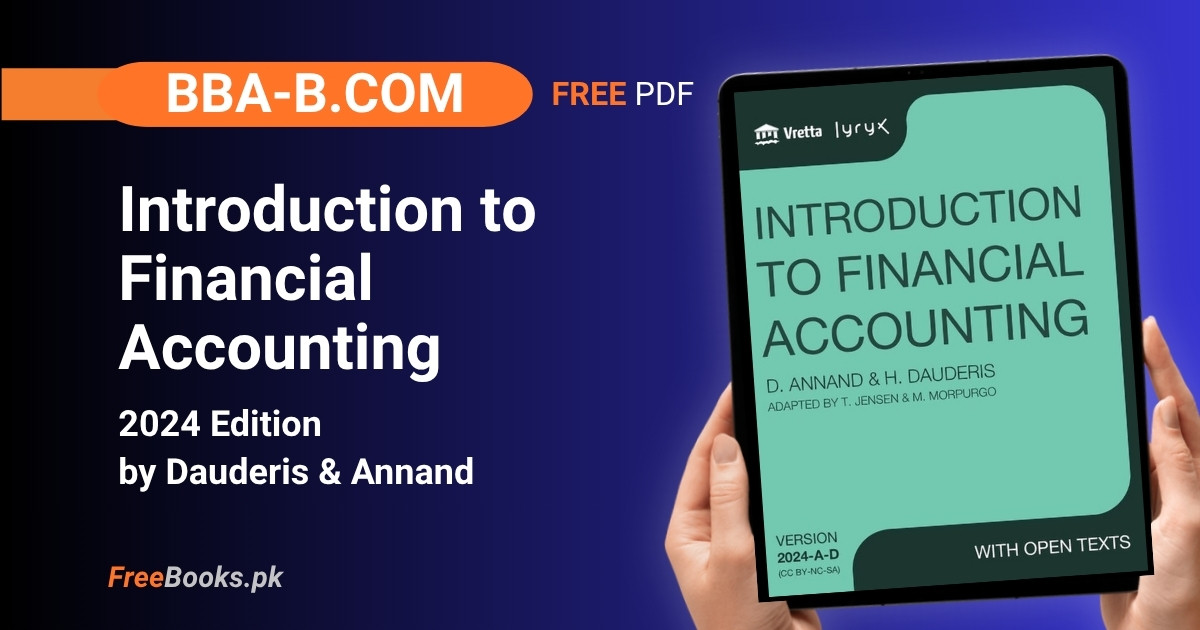
Introduction to Financial Accounting is a free open textbook by Henry Dauderis and David Annand, adapted by T. Jensen and M. Morpurgo and published by Vretta-Lyryx Inc. of Toronto. This page covers Distribution Version 2024, Revision A-D (7 February 2024), a 387-page PDF with 13 chapters. It runs from the accounting equation and the accounting cycle through merchandising, inventory, receivables, long-lived assets, liabilities and shares to the statement of cash flows, ratio analysis, proprietorships and partnerships.
It is written for the first financial accounting course, so it suits BBA and B.Com students who are meeting debits and credits for the first time. The book follows IFRS for publicly accountable enterprises and teaches it through one running example, Big Dog Carworks Corp. This page gives a summary, key points, a tip, a common mistake and two practice questions for every chapter, plus a study plan, so you know what to read first before you open the official book.
Book Overview
| Course | Financial Accounting (first university accounting course) |
| Degree Programs | BBA and B.Com (BS Commerce) |
| Level | University, introductory |
| Authors | Henry Dauderis and David Annand; adapted by T. Jensen and M. Morpurgo |
| Publisher | Vretta-Lyryx Inc., Toronto, Ontario, Canada |
| Edition | Distribution Version 2024, Revision A-D (publication date 7 February 2024) |
| Structure | 13 chapters; the book declares no parts, so this page gives one block per chapter, with the chapter appendices covered inside their chapters |
| Exercises | The PDF has no exercise sets or answer key; each chapter opens with a Concept Self-Check list (no solutions given) and ends with a summary of its learning objectives |
| Framework | IFRS for publicly accountable enterprises; the book also mentions ASPE for private enterprises (Canadian context) |
| Language | English |
| License | Creative Commons BY-NC-SA (CC BY-NC-SA); the book’s licence page links to version 3.0 |
| Format | PDF edition of 387 pages, with a video link marker on each section |
Chapter List
Chapter 1: Introduction to Financial Accounting
Difficulty: Easy · Key topics: internal and external users, managerial and financial accounting, proprietorship, partnership, corporation, PAE and PE, IFRS and ASPE, qualitative characteristics, GAAP principles, four financial statements, accounting equation, transaction analysis, fiscal year
The chapter defines accounting as identifying, measuring, recording and communicating a business’s economic activity to users, and separates managerial accounting for insiders from financial accounting for outsiders. It compares proprietorships, partnerships and corporations, explains that Canadian GAAP for publicly accountable enterprises follows IFRS while private enterprises may choose ASPE, and lists the qualitative characteristics and nine supporting principles. A running example, Big Dog Carworks Corp., introduces the four financial statements, and ten January transactions show how the accounting equation stays in balance.
Key Points:
- Internal users work for the organization; external users such as investors, creditors, labour unions and customers do not.
- A proprietorship or partnership is not a separate legal entity and has unlimited liability; a corporation is separate and its shareholders have limited liability.
- GAAP has six qualitative characteristics (relevance, faithful representation, comparability, verifiability, timeliness, understandability) and nine principles, including matching, cost, going concern and materiality.
- The four statements are the income statement, statement of changes in equity, balance sheet and statement of cash flows.
- Cash flows are grouped into operating, investing and financing activities.
- Assets = Liabilities + Equity, and equity consists of share capital and retained earnings.
Memory Tip: Read the accounting equation as “what the business has equals who has a claim on it”: assets on the left, creditors and owners on the right.
Common Mistake: Treating dividends as an expense. They are profit paid out to owners, so they reduce retained earnings and never appear on the income statement.
Important Questions:
- What is the difference between financial and managerial accounting? Financial accounting reports to external users such as investors and creditors through the financial statements; managerial accounting serves the decisions of managers and others inside the organization.
- What are the three types of business activities? Operating activities are the day-to-day work of selling goods or services, investing activities are buying the assets needed to earn revenue, and financing activities are raising money from shareholders or lenders.
Chapter 2: The Accounting Process
Difficulty: Medium · Key topics: accounts, debits and credits, T-account, normal balance, chart of accounts, double-entry, trial balance, general journal, general ledger, posting, special journals, subledgers, accounting cycle
Chapter 2 turns the Chapter 1 transactions into the debit and credit system. It describes asset, liability and equity accounts, the T-account, normal balances and the chart of accounts, then runs the Big Dog transactions through T-accounts. The trial balance is introduced as a check that total debits equal total credits, and statements are prepared from it. The chapter then moves to the general journal and general ledger with the posting steps, shows special journals and subledgers that feed a control account, and names the first steps of the accounting cycle.
Key Points:
- Debits go on the left of a T-account and credits on the right.
- Increases in assets, dividends and expenses are debits; increases in liabilities, share capital and revenues are credits.
- Every transaction affects at least two accounts, and total debits always equal total credits.
- A normal balance is the side on which increases are recorded: cash is normally a debit, accounts payable a credit.
- The journal is the book of original entry and the ledger the book of final entry; posting moves amounts between them.
- Special journals (sales, purchases, cash receipts, cash disbursements) post monthly totals, and subledgers by customer or supplier must agree with the control account.
Memory Tip: Remember DEAD for the accounts that increase with a debit: Dividends, Expenses, Assets. Liabilities, share capital and revenues increase with a credit.
Common Mistake: Believing a balanced trial balance proves the books are right. A transaction recorded in the wrong account, left out, or recorded twice still leaves debits equal to credits.
Important Questions:
- Why do the debits in a trial balance always equal the credits? Double-entry accounting records every transaction with equal debits and credits, a rule that comes from the accounting equation.
- What is the difference between a general journal and a general ledger? The journal lists each transaction in date order; the ledger collects the same amounts by account, and posting transfers them from one to the other.
Chapter 3: Financial Accounting and Adjusting Entries
Difficulty: Hard · Key topics: operating cycle, recognition, matching, accrual accounting, five adjusting entries, accumulated depreciation, contra account, adjusted trial balance, accounting cycle, closing entries, income summary, post-closing trial balance
Chapter 3 explains why account balances need adjusting before statements are prepared. It begins with the operating cycle and the recognition and matching ideas behind accrual accounting, showing revenue and expenses recorded before, with and after cash. It then covers the five adjusting entries, with straight-line depreciation, accrued interest and accrued income tax as worked cases, followed by the adjusted trial balance and the statements built from it. The chapter ends with the eight steps of the accounting cycle, the four closing entries through the income summary and the post-closing trial balance.
Key Points:
- Accrual accounting records revenue when earned and expenses when incurred, whenever the cash moves.
- The five adjustments are prepaid expenses, depreciation, unearned revenues, accrued revenues and accrued expenses.
- Depreciation is credited to Accumulated Depreciation, a contra asset account; cost less accumulated depreciation is the carrying amount, and land is not depreciated.
- Straight-line depreciation = (cost – residual value) / estimated useful life.
- Interest for a term in days = principal x annual rate x days / 365.
- Closing entries move revenues and expenses to the Income Summary, then the Income Summary and dividends to Retained Earnings; the post-closing trial balance holds only permanent accounts.
Memory Tip: An adjusting entry never touches cash. Each one pairs a balance sheet account with a revenue or expense account.
Common Mistake: Closing dividends through the Income Summary. Dividends are not an expense, so the fourth closing entry sends them straight to Retained Earnings.
Important Questions:
- Why is Accumulated Depreciation credited instead of the asset account? A truck or building is not used up and does not disappear like a prepaid item, so the original cost stays visible and the contra account shows how much has been expensed.
- What are the four closing entries? Close revenues to the Income Summary, close expenses to the Income Summary, close the Income Summary to Retained Earnings, and close dividends to Retained Earnings.
Chapter 4: The Classified Balance Sheet and Related Disclosures
Difficulty: Easy · Key topics: disclosure, cost-benefit, materiality, classified balance sheet, current and non-current, liquidity, PPE, intangible assets, notes to the statements, audit, unqualified report, management responsibility
Chapter 4 moves from recording to presentation. It explains why accountants measure wealth only through completed transactions, and how cost-benefit and materiality judgments decide what gets disclosed. It then groups accounts into a classified balance sheet: current assets listed by liquidity, property, plant and equipment, long-term investments, intangibles, current and long-term liabilities and equity, in account form or report form. The remaining sections show a sample set of notes, the parts of an unqualified auditor’s report, and the statement in which management accepts responsibility for the financial statements.
Key Points:
- Accountants record changes in wealth only from actual transactions, so market-value gains on an unsold asset are not recorded.
- Current items are due or used within one year or the operating cycle, whichever is longer; current assets are listed from most to least liquid, with cash first.
- Non-current assets include property, plant and equipment, long-term investments and intangible assets.
- The part of a long-term debt due within a year is shown as a current liability.
- Notes give the policies and details that the statements themselves leave out, such as asset lives and loan terms.
- An audit gives reasonable assurance, not certainty; management prepares the statements and the independent auditor gives an opinion.
Memory Tip: Order the current assets by how fast they can become cash: cash, short-term investments, receivables, inventory, then prepaid items.
Common Mistake: Thinking the auditor prepares or guarantees the statements. Preparation is management’s job, and the auditor only reports an opinion.
Important Questions:
- What is the difference between current and non-current assets? Current assets will be turned into cash or used within one year or the operating cycle, whichever is longer; non-current assets benefit the business for longer than that.
- What does an unqualified auditor’s report tell users? It says the auditor found the statements present the business fairly in all material respects, which gives investors and creditors some assurance that they can trust them.
Chapter 5: Accounting for the Sale of Goods
Difficulty: Medium · Key topics: merchandiser, cost of goods sold, gross profit, perpetual and periodic systems, purchase returns and discounts, FOB terms, sales returns and discounts, shrinkage, multiple-step income statement, closing entries
Chapter 5 moves from service firms to merchandisers that buy and resell goods. It introduces cost of goods sold and gross profit and compares perpetual and periodic inventory systems. Under the perpetual system it records purchases with returns, allowances, discounts and freight (FOB shipping point versus destination), credit sales with their two entries, sales returns and sales discounts such as 2/10, n30. It then covers the shrinkage adjustment after a physical count, the classified multiple-step income statement, closing entries for a merchandiser, and an appendix on the periodic system.
Key Points:
- Cost of goods sold is the cost of the goods actually sold; gross profit is net sales less cost of goods sold.
- The perpetual system keeps Merchandise Inventory and Cost of Goods Sold up to date; the periodic system sets them only after a physical count.
- Under FOB shipping point the buyer pays freight; under FOB destination the seller does.
- Purchase returns, allowances and discounts reduce Merchandise Inventory; sales returns, allowances and discounts reduce revenue through contra accounts.
- Shrinkage is the gap between the ledger balance and the physical count, and it is adjusted through Cost of Goods Sold.
- A periodic system uses Purchases, Purchase Returns and Allowances, Purchase Discounts and Transportation-in accounts instead.
Practice Tip: Write one sale of $500 for goods that cost $300. You will need two entries, one for the sale and one for the cost, and the difference of $200 is the gross profit.
Common Mistake: Forgetting the second entry for a sale under the perpetual system. Inventory then stays too high and cost of goods sold too low.
Important Questions:
- What two entries record a credit sale in a perpetual system? One debits Accounts Receivable and credits Sales; the other debits Cost of Goods Sold and credits Merchandise Inventory for the cost of the goods.
- What is shrinkage and how is it recorded? It is the difference between the inventory balance in the ledger and the physical count, caused by theft or deterioration, and it is recorded by debiting Cost of Goods Sold and crediting Merchandise Inventory.
Chapter 6: Assigning Costs to Merchandise
Difficulty: Hard · Key topics: cost flow assumptions, specific identification, FIFO, weighted average, inventory errors, lower of cost and net realizable value, gross profit method, retail inventory method, inventory turnover, periodic cost flows
Chapter 6 asks how the cost of goods available for sale is split between cost of goods sold and ending inventory when purchase prices change. Using one product bought five times in a month, it applies specific identification, FIFO and weighted average under the perpetual system, compares their effects on the statements, and shows that an inventory error in one year reverses in the next. It then covers the lower of cost and net realizable value, estimating inventory with the gross profit and retail methods, the inventory turnover ratio, and an appendix repeating the three methods under the periodic system.
Key Points:
- Cost of goods available for sale = cost of goods sold + ending inventory.
- The book covers three cost flow assumptions: specific identification, FIFO and weighted average.
- FIFO puts the newest costs in ending inventory; weighted average smooths price changes.
- The chosen method must be disclosed in the notes and used consistently from period to period.
- Inventory is reported at the lower of its laid-down cost and its net realizable value.
- Inventory turnover = cost of goods sold / average merchandise inventory, and a higher figure means faster sales.
Memory Tip: With FIFO, the oldest costs leave first, so the costs still sitting on the balance sheet are the newest ones.
Common Mistake: Assuming weighted average gives the same answer in both systems. The perpetual system averages at the time of each sale, while the periodic system averages once for the whole period.
Important Questions:
- How does an error in ending inventory affect the statements? It misstates inventory, equity, cost of goods sold and net income for that period and the next, and then reverses itself in the following period.
- What is the lower of cost and net realizable value rule? Inventory is valued at the smaller of its cost and the amount it can likely be sold for, and an adjustment is recorded when net realizable value is below cost.
Chapter 7: Cash and Receivables
Difficulty: Medium · Key topics: internal control, petty cash, bank reconciliation, NSF cheque, allowance for doubtful accounts, bad debt expense, aging, write-off and recovery, notes receivable, acid-test ratio, receivables turnover
Chapter 7 deals with the most liquid assets. It begins with internal control over cash and its limits, then the petty cash fund and how it is set up and replenished. The bank reconciliation section sorts items that change the bank balance from those that change the book balance and ends with the adjusting entry. The receivables sections use the allowance approach to estimate bad debts by the income statement method or the balance sheet method, with write-offs and recoveries, then promissory notes and interest. Two appendices add the acid-test ratio and receivables turnover.
Key Points:
- Internal control protects assets, and its strength is limited by human error and fraud.
- A petty cash fund pays small, irregular amounts, with one custodian and receipts to support each payment.
- Outstanding deposits and cheques and bank errors adjust the bank balance; NSF cheques, bank charges and collections made by the bank adjust the book balance.
- The allowance approach records Bad Debt Expense against the Allowance for Doubtful Accounts in the period of the sale.
- The income statement method uses a percentage of credit sales; the balance sheet method uses an aging of receivables.
- Acid-test ratio = quick assets / current liabilities, and receivables turnover = net credit sales / average net receivables.
Memory Tip: For a bank reconciliation, ask two questions about each item: does the bank know about it yet, and do my books know about it yet? The answer shows which side to adjust.
Common Mistake: Recording a write-off as a new expense. The expense was already recorded when the bad debts were estimated, so the write-off only removes the account from receivables and the allowance.
Important Questions:
- Why can the bank balance differ from the cash balance in the books? Some transactions are recorded by the company before the bank sees them, such as outstanding cheques, and others by the bank before the company does, such as service charges.
- How do the income statement method and the balance sheet method differ? The first estimates bad debt expense as a percentage of credit sales; the second estimates the total uncollectible balance from an aging analysis and adjusts the allowance to it.
Chapter 8: Long-lived Assets
Difficulty: Hard · Key topics: capital and revenue expenditures, cost of PPE, units-of-production, straight-line, double-declining balance, partial-year depreciation, revised depreciation, impairment, derecognition, trade-in, intangible assets, goodwill, disclosure
Chapter 8 follows long-lived assets from purchase to disposal. It explains what is included in the cost of property, plant and equipment and how capital expenditures differ from revenue expenditures. It compares units-of-production, straight-line and double-declining balance depreciation, then partial-year approaches such as the half-year rule and revised depreciation when life or residual value changes. It also covers impairment against the recoverable amount, derecognition with gain or loss including trade-ins, intangible assets and their amortization, goodwill from buying another company, and the note disclosures.
Key Points:
- A capital expenditure is added to an asset account; a revenue expenditure with no benefit beyond one year is expensed.
- Depreciation allocates cost over the periods that benefit; units-of-production is usage-based, while straight-line and double-declining balance are time-based.
- Carrying amount (net book value) = cost – accumulated depreciation.
- A change in estimated life or residual value is applied going forward, and depreciation already recorded is not changed.
- Impairment is recorded when the recoverable amount falls below the carrying amount.
- On disposal, a gain or loss is the difference between the proceeds and the carrying amount; goodwill appears under its own heading and is not treated as an intangible asset.
Practice Tip: Take one asset and calculate the first-year expense under straight-line and double-declining balance side by side. Seeing the two numbers makes the difference between the methods obvious.
Common Mistake: Thinking depreciation tracks market value. It only spreads the original cost over the years of use, so the carrying amount can be very different from what the asset would sell for.
Important Questions:
- How is the gain or loss on disposing of equipment calculated? Update depreciation to the disposal date, then compare the proceeds with the carrying amount: proceeds above it give a gain, and proceeds below it give a loss.
- What is goodwill? It is the excess a buyer pays over the fair value of the net assets of the company acquired, and it is reported under its own heading because its parts cannot be separately identified.
Chapter 9: Debt Financing: Current and Long-term Liabilities
Difficulty: Hard · Key topics: current and long-term liabilities, payroll deductions, CPP and EI, GST and PST, warranties, income taxes, contingent liabilities, bonds at par, discount and premium, loans, present value, effective interest method
Chapter 9 sorts debt into current and long-term and shows how each kind is recorded. Known current liabilities include payroll withholdings under the Canadian system, the employer’s own contributions and sales taxes. Estimated liabilities such as warranties and income taxes are followed by contingent liabilities, which are disclosed but not recorded. Long-term debt covers bonds issued at par, at a discount or at a premium, and bank loans repaid in blended payments. Appendices give present value calculations, more payroll entries and the effective interest method for bonds.
Key Points:
- A liability is current when it is due within the longer of one year or the operating cycle; the next year’s part of a long-term debt moves to current.
- Known liabilities have a known payee, amount and timing; employers withhold income tax, CPP and EI from gross pay and remit them.
- Estimated liabilities, such as product warranties, are recorded when the amount can be estimated.
- A contingent liability that is not probable or cannot be reliably estimated is only disclosed in the notes.
- A bond sells at par when the market rate equals its stated rate, at a discount when the market rate is higher and at a premium when it is lower.
- A loan is usually repaid in equal blended payments that contain both interest and principal.
Memory Tip: If the market pays investors more than your bond does, your bond must sell for less than face value. That is a discount.
Common Mistake: Treating payroll deductions as the employer’s expense. The amounts withheld from employees are a liability to the government; only the employer’s own share of CPP and EI is an expense.
Important Questions:
- When is a bond issued at a discount? When the market interest rate is higher than the bond’s stated rate, so investors pay less than face value, and the discount is later amortized into interest expense.
- How does an estimated liability differ from a contingent liability? An estimated liability exists and its amount can be estimated, so it is recorded; a contingent liability depends on a future event or cannot be measured reliably, so it is only disclosed.
Chapter 10: Equity Financing
Difficulty: Medium · Key topics: share capital, retained earnings, common and preferred shares, authorized, issued and outstanding shares, share issuance, share split, repurchase and treasury shares, cash dividends, dividends in arrears, share dividends, book value per share
Chapter 10 looks at raising money by issuing shares. It explains the corporate structure, the difference between common and preferred shares, and authorized, issued and outstanding shares. It records share issues for cash or other assets, organization costs, share splits and repurchases that are either cancelled or held in treasury. Cash dividends are followed through their three dates, including cumulative preferred shares and dividends in arrears, and share dividends are compared with them. The chapter ends with book value per share and a short appendix on reporting several classes of shares.
Key Points:
- A corporation is a separate legal entity with an indefinite life, and it pays income tax on its own earnings.
- Preferred shares are usually non-voting and have first claim on dividends; common shares carry voting rights.
- Treasury shares are issued but not outstanding.
- A share split changes the number of shares but not any dollar amount, so it needs only a memorandum entry.
- A cash dividend has a declaration date, a record date and a payment date, and the record date needs no entry.
- A share dividend moves an amount from retained earnings to share capital without changing total equity.
Memory Tip: For a cash dividend, remember “declare: entry, record: no entry, pay: entry.”
Common Mistake: Recording a journal entry for a share split. Only the number of shares changes, so a memorandum note is enough.
Important Questions:
- How does a share dividend differ from a cash dividend? A share dividend pays out new shares instead of cash, so assets do not change and no cash leaves the company; it only moves an amount from retained earnings to share capital.
- What are dividends in arrears? They are undeclared dividends on cumulative preferred shares, which must be paid before any dividend goes to common shareholders.
Chapter 11: The Statement of Cash Flows
Difficulty: Hard · Key topics: operating, investing and financing activities, indirect method, non-cash items, changes in working capital, gains and losses on disposal, interpreting cash flows, continuing operations, earnings per share, direct method
Chapter 11 explains why a profitable business can still run short of cash and how the statement of cash flows shows where cash came from and where it went. The main text builds the statement with the indirect method: it starts from net income, adds back depreciation, adjusts for gains and losses and changes in current assets and liabilities, and then lists investing and financing flows. It shows how to read the three sections together, including the quality of earnings. Two appendices combine all the statements for one company, with continuing operations and earnings per share, and rebuild the operating section with the direct method.
Key Points:
- The statement explains the change in cash and cash equivalents through operating, investing and financing activities.
- Operating cash flow must convert accrual net income into a cash figure.
- Depreciation is added back because it was deducted in net income without using cash.
- Gains and losses on selling non-current assets are removed from operating activities; the cash proceeds belong in investing.
- Loans, share issues, share repurchases and dividend payments appear in financing activities.
- Net income far above operating cash flow can warn of cash trouble, for example when inventory is building up.
Memory Tip: Profit is not cash. In the operating section, start with the profit figure and undo every accrual that did not move cash.
Common Mistake: Treating depreciation as a source of cash. It is added back only to cancel an expense that never used cash.
Important Questions:
- Why can net income differ from cash from operations? Accrual accounting counts revenue and expenses when they are earned or incurred, so credit sales, unpaid bills, depreciation and inventory changes affect income without matching cash.
- Where do equipment purchases and dividend payments appear? Buying equipment is an investing outflow, and paying dividends is a financing outflow.
Chapter 12: Financial Statement Analysis
Difficulty: Medium · Key topics: ratio analysis, liquidity ratios, profitability ratios, leverage ratios, market ratios, earnings per share, price-earnings ratio, horizontal analysis, vertical analysis, common-size statements
Chapter 12 shows how users judge a company from its statements. It introduces ratios as a way to compare numbers with earlier years and with similar firms, then works through four families using three years of Big Dog data: liquidity (current ratio, acid-test, collection period, days of sales in inventory), profitability (gross, operating and net profit, return on assets and equity), leverage (debt ratio, equity ratio, debt to equity, times interest earned) and market ratios (earnings per share, price-earnings, dividend yield). It closes with horizontal and vertical trend analysis and common-size statements.
Key Points:
- Current ratio = current assets / current liabilities; a 2:1 rule of thumb is not right for every industry.
- Two firms with the same current ratio can differ in short-term strength if one holds more liquid current assets.
- Gross profit ratio = gross profit / net sales; it shows what is left of each sales dollar after cost of goods sold.
- Debt ratio = total liabilities / total assets, and the debt and equity ratios always add up to 100%.
- Earnings per share = (net income – preferred dividends) / common shares outstanding.
- Horizontal analysis compares each year with a base year set at 100%; vertical analysis expresses items as percentages of a base such as sales or total assets.
Memory Tip: Ask one question per ratio family: can it pay its short-term bills, does it earn a profit, how much is borrowed, and what do investors get?
Common Mistake: Judging a single ratio on its own. A ratio only means something when compared with earlier years, with competitors and with the make-up of the underlying accounts.
Important Questions:
- What does the debt ratio tell you? It shows the share of total assets financed by debt; a rising ratio means more risk because principal and interest must be paid.
- What is the difference between horizontal and vertical analysis? Horizontal analysis tracks percentage changes against a base year over time, while vertical analysis restates one year’s statement as percentages of a base amount.
Chapter 13: Proprietorships and Partnerships
Difficulty: Easy · Key topics: proprietorship, owner’s capital, withdrawals, partnership agreement, limited liability partnership, mutual agency, income allocation, partners’ capital accounts
The last chapter takes the corporate accounting of Chapters 1 to 12 and shows what changes for unincorporated businesses. For a proprietorship, owner investments, withdrawals and net income all flow through one Owner’s Capital account instead of share capital, retained earnings and dividends. For a partnership, it covers the partnership agreement, unlimited liability, the limited liability partnership, limited life and mutual agency. Five worked examples allocate income or loss equally, by ratio, by capital, by salaries and by a mix of interest and salaries, and the statements show one capital account per partner.
Key Points:
- A proprietorship has one owner, is not a separate legal entity and has unlimited liability.
- Owner investments, withdrawals and net income are all closed to one Owner’s Capital account.
- A partnership agreement should set each partner’s duties, the sharing of income and losses, withdrawals and how disputes and ending the partnership are handled.
- Mutual agency means one partner can commit the whole partnership to a contract within its normal business.
- In a limited liability partnership the general partners manage the business and carry unlimited liability, while limited partners have limited liability and limited roles.
- Income can be shared equally, by a fixed ratio, by capital ratio, by salaries or by interest plus salaries with the remainder shared.
Memory Tip: Think of withdrawals as the partnership’s version of dividends: each partner has a capital account and a withdrawals account.
Common Mistake: Forgetting that a salary allocation can exceed the profit. The remainder after salaries is then negative and is shared out as a loss, reducing some partners’ capital.
Important Questions:
- How are the closing entries of a proprietorship different from a corporation’s? The first two are identical, but the Income Summary is closed to the Owner’s Capital account, and the withdrawals account is closed there too, instead of Retained Earnings.
- What is mutual agency? Each partner is an authorized agent of the partnership, so one partner can bind the others to a contract that falls within the business’s normal operations.
How to Study This Book
Introduction to Financial Accounting has 13 chapters and no declared parts, so this page gives one block per chapter. Appendix sections inside chapters (the periodic system in Chapter 5, ratio appendices in Chapters 6 and 7, present value, payroll and the effective interest method in Chapter 9, multiple share classes in Chapter 10, and the corporate statements and direct method in Chapter 11) are covered in the block of their chapter. Every chapter opens with learning objectives and a Concept Self-Check list, teaches through the running example of Big Dog Carworks Corp., and ends with a summary written objective by objective. Read the chapters in order.
Match the chapters to your course outline in six groups. Chapters 1 to 3 give the foundations: the statements, double-entry and the full accounting cycle. Chapter 4 covers how statements are presented and audited. Chapters 5 and 6 deal with merchandising and inventory, Chapters 7 and 8 with cash, receivables and long-lived assets, and Chapters 9 and 10 with debt and equity. Chapters 11 and 12 teach the cash flow statement and ratio analysis, and Chapter 13 shows how proprietorships and partnerships differ from corporations.
Do not skip Chapters 2 and 3. Everything later uses debits, credits, adjusting entries and closing entries, so practise a journal entry by hand until it feels routine. Chapter 5 builds on the closing process of Chapter 3, and Chapter 6 only makes sense after Chapter 5. Chapter 7 reuses the matching idea for bad debts, Chapter 8 extends the depreciation entry from Chapter 3, and Chapter 9 uses the interest formula from Chapter 3. Chapter 11 and Chapter 12 draw on almost every earlier chapter, so leave them for last. Chapter 13 can be read straight after Chapter 3 if your course covers proprietorships early.
Expect the hardest work in five places. Chapter 3 asks you to sort five kinds of adjusting entry, Chapter 6 repeats the same purchases under three cost flow methods and two inventory systems, Chapter 8 compares depreciation methods and then adds impairment and disposals, Chapter 9 brings bond pricing and present value with a financial calculator, and Chapter 11 asks you to reason about how each balance sheet change affects cash. For Chapter 6, build one comparison table using the same data for all three methods. Chapters 1, 4 and 13 read more easily. Check your course outline for the appendices, because the book marks them as appendix sections and some courses leave them out.
The PDF has no exercise sets, problems or answer key. For practice, answer each Concept Self-Check question at the start of a chapter in your own words once you have read it, and redo the book’s worked examples with the figures covered. The revision history mentions exercises and problems, but they are not in this PDF. If you want end-of-chapter questions, pair this book with Principles of Accounting, Volume 1: Financial Accounting.
Know the limits before you rely on it. The book follows IFRS for publicly accountable enterprises and mentions ASPE for private enterprises, so it does not teach LIFO. It is written for Canada: money is in dollars, Chapter 9 uses the Canadian payroll deductions CPP and EI and the sales taxes GST and PST, the auditor’s report in Chapter 4 refers to Canadian standards, and the tax tables are labelled as the rates in effect when the text was written (the sales tax table says July 2022). The book never mentions Pakistan or the rupee. The accounting method is not dated, but use your teacher’s notes for Pakistani tax, company law and reporting rules.
Used In These Programs
This book is used for the Financial Accounting course in BBA and BS Commerce (B.Com). Browse all Financial Accounting books, the wider Accounting tag or the whole BBA category in University Books.
Who Should Read This
Introduction to Financial Accounting is written for a student in the first financial accounting course of a BBA or B.Com program. It suits you if you have never seen a journal entry, want a single free book that runs from the first transaction to the cash flow statement and ratio analysis, or need an IFRS-based text next to your class notes. It also gives a clear read-ahead for ICOM students who plan to continue to a BBA or B.Com. ACCA students sometimes look for it too, but it is not an ACCA exam text, so they should use it only as background reading on the accounting cycle and statements. If you want a longer book with end-of-chapter questions, pair it with Principles of Accounting, Volume 1: Financial Accounting, and for cost accounting and budgeting continue to Volume 2: Managerial Accounting. It does not cover managerial accounting, auditing in depth or Pakistani tax law.
Applicable Universities
This book is useful for students at Pakistani universities offering BBA, B.Com and related business programs, including University of the Punjab, University of Karachi, Virtual University, COMSATS, Lahore School of Economics, IBA Karachi, and other HEC-recognized institutions.
Official Copy of Introduction to Financial Accounting
The book’s own attribution page names the Vretta-Lyryx page below as the place to view the text for free. Click the button to open it, and check there for the current PDF or online version.
→ Visit Official PageFAQs
Is Introduction to Financial Accounting by Dauderis and Annand free?
Yes, according to the book. Its cover and licence page say it is available under a Creative Commons BY-NC-SA licence and link to version 3.0 of that licence, which allows anyone to reuse, revise, remix and redistribute the text non-commercially if they give credit and share alike. The attribution page says the text can be viewed for free on the Vretta-Lyryx page linked in the Download section of this page.
Which edition is this, and is it up to date?
This is Distribution Version 2024, Revision A-D, with a publication date of 7 February 2024. The revision history lists minor content fixes in 2024 and a refresh of the years used in examples in 2023, so the accounting method is current. One narrow area has dated: Chapter 9 uses Canadian payroll deductions and a sales tax table labelled with the rates in effect in July 2022. The book is also Canadian throughout, so use your teacher’s notes for Pakistani tax, company law and reporting rules.
How many chapters does it have?
It has 13 chapters and no parts, preface, glossary or index. The chapters cover the accounting cycle (1 to 4), merchandising and inventory (5 and 6), cash, receivables and long-lived assets (7 and 8), liabilities and equity (9 and 10), the statement of cash flows and ratio analysis (11 and 12), and proprietorships and partnerships (13).
Does it include solved exercises or answers?
No. The PDF has no exercise sets, problems or answer key. Each chapter opens with a Concept Self-Check list, and the book says solutions are not provided for it. The chapters do contain worked examples with full journal entries, so use those to learn the method and pair the book with a text that has end-of-chapter questions for extra practice.
Is it good for complete beginners?
Yes. It starts from the meaning of accounting and builds one small business, Big Dog Carworks Corp., through every chapter. Chapters 2 and 3 need practice by hand, and Chapters 6, 8, 9 and 11 are the hardest. Its examples are Canadian, so add local Pakistani examples from your course.
Does it follow IFRS, and does it prepare me for ACCA?
It follows IFRS for publicly accountable enterprises and mentions ASPE for private enterprises, and it teaches inventory by specific identification, FIFO and weighted average only. It is not written for any ACCA exam and does not follow an ACCA syllabus, so ACCA students should use it only as background reading on the accounting cycle and the statements and rely on their approved ACCA materials.
Related Books
- Principles of Accounting, Volume 1: Financial Accounting PDF Download – OpenStax (a longer financial accounting book to pair with this one, useful next to every chapter)
- Principles of Accounting, Volume 2: Managerial Accounting PDF Download – OpenStax (the cost and budgeting side that this book does not cover)
- Principles of Finance PDF Download – OpenStax (bonds, stocks and ratios from Chapters 9, 10 and 12 in a finance course)
- Introduction to Business PDF Download – OpenStax (the business background behind forms of ownership, financing and reporting in Chapters 1 and 13)
Introduction to Financial Accounting gives BBA and B.Com students a complete, free guide from the accounting equation and the accounting cycle to inventory, liabilities, shares, the statement of cash flows and ratio analysis. Browse more BBA books or the whole University Books section.
Introduction to Financial Accounting, by Henry Dauderis and David Annand, adapted by T. Jensen and M. Morpurgo. Vretta-Lyryx Inc., Toronto, Ontario, Canada. Distribution Version 2024 – Revision A-D, publication date 7 February 2024. Available under a Creative Commons BY-NC-SA licence (the book links to version 3.0). View the text for free at https://lyryx.com/introduction-financial-accounting/
© Copyright Policy
Freebooks.pk is an educational resource for students in Pakistan. Textbooks and other books belong to their respective boards, authors and publishers, and all rights remain with them. If you are the copyright holder of any material on this page and want it changed or removed, please contact us or file a request under our DMCA policy. We review every request and remove reported content promptly.