Chemical reactivity describes how readily elements gain, lose, or share electrons to form compounds. Metals are electropositive elements (except hydrogen) that form cations by losing electrons, while non-metals are electronegative elements that form anions by gaining electrons. This unit examines the reactivity trends of metals — particularly alkali and alkaline earth metals — and non-metals, especially the halogens.
Topics covered include the classification of metals by reactivity, electropositive character and its relationship to ionization energy, a detailed comparison of alkali metals and alkaline earth metals, the inertness of noble metals like silver, gold, and platinum, the physical and chemical properties of non-metals, and the comparative reactivity and important reactions of the halogens.
Learning Objectives
- Relate the terms cation and anion to metals and non-metals respectively
- Explain why alkali metals are not found in the free state in nature
- Explain the differences in ionization energies of alkali and alkaline earth metals
- Describe the position of sodium in the periodic table along with its properties and uses
- Describe the position of calcium and magnesium in the periodic table along with their properties and uses
- Differentiate between soft and hard metals using iron and sodium as examples
- Describe the inertness of noble metals and identify the commercial value of silver, gold, and platinum
- Compile important reactions of the halogens
- Name elements that exist in nature in uncombined (free) form
Key Concepts
8.1 Metals
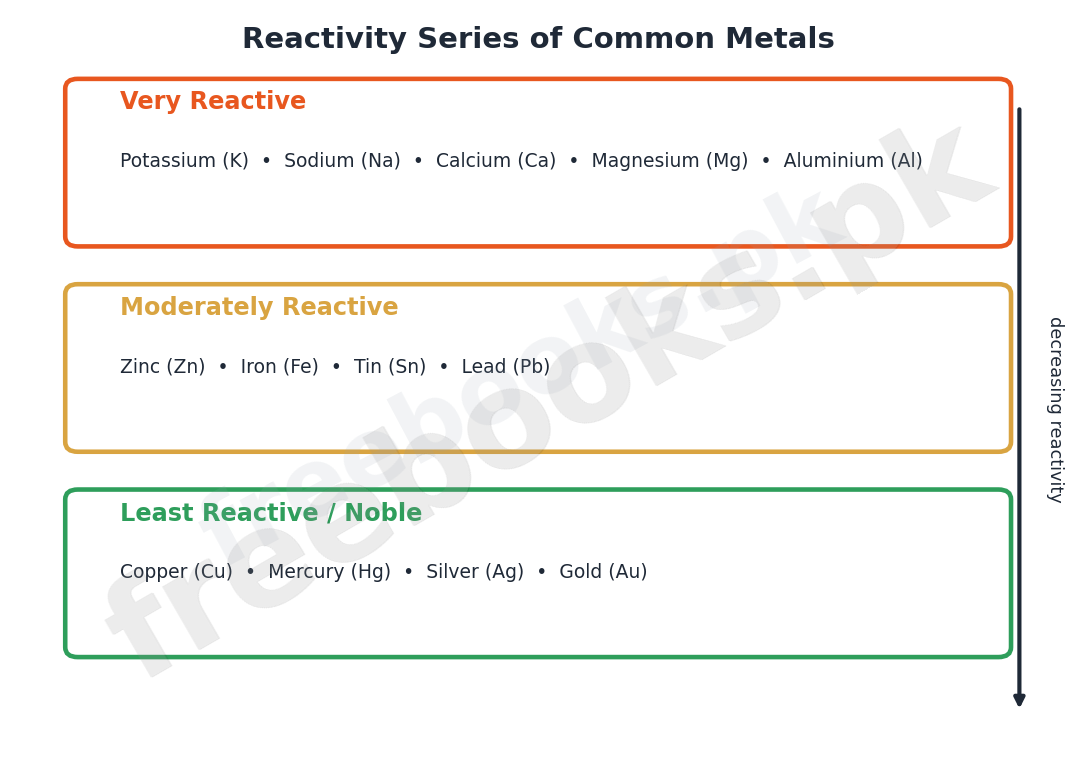
Metals are elements (except hydrogen) that are electropositive and form cations by losing electrons. They are classified by reactivity into three groups: very reactive (potassium, sodium, calcium, magnesium, aluminium), moderately reactive (zinc, iron, tin, lead), and least reactive or noble (copper, mercury, silver, gold). Important physical properties of metals include: almost all are solids except mercury; they have high melting and boiling points (except alkali metals); they possess metallic lustre and can be polished; they are malleable and ductile and give a ringing tone when struck; they are good conductors of heat and electricity; they have high densities; and they are hard except sodium and potassium.
Important chemical properties of metals: they easily lose electrons to form positive ions; they react with oxygen to form basic oxides; they usually form ionic compounds with non-metals; and they exhibit metallic bonding. Notable facts: aluminium is the most abundant metal, platinum the most precious, iron the most useable, cesium the most reactive, lithium the lightest (0.53 g/cm3), osmium the heaviest (22.5 g/cm3), lead the poorest heat conductor, and silver and gold the best conductors and the most ductile/malleable metals.
8.1.1 Electropositive Character
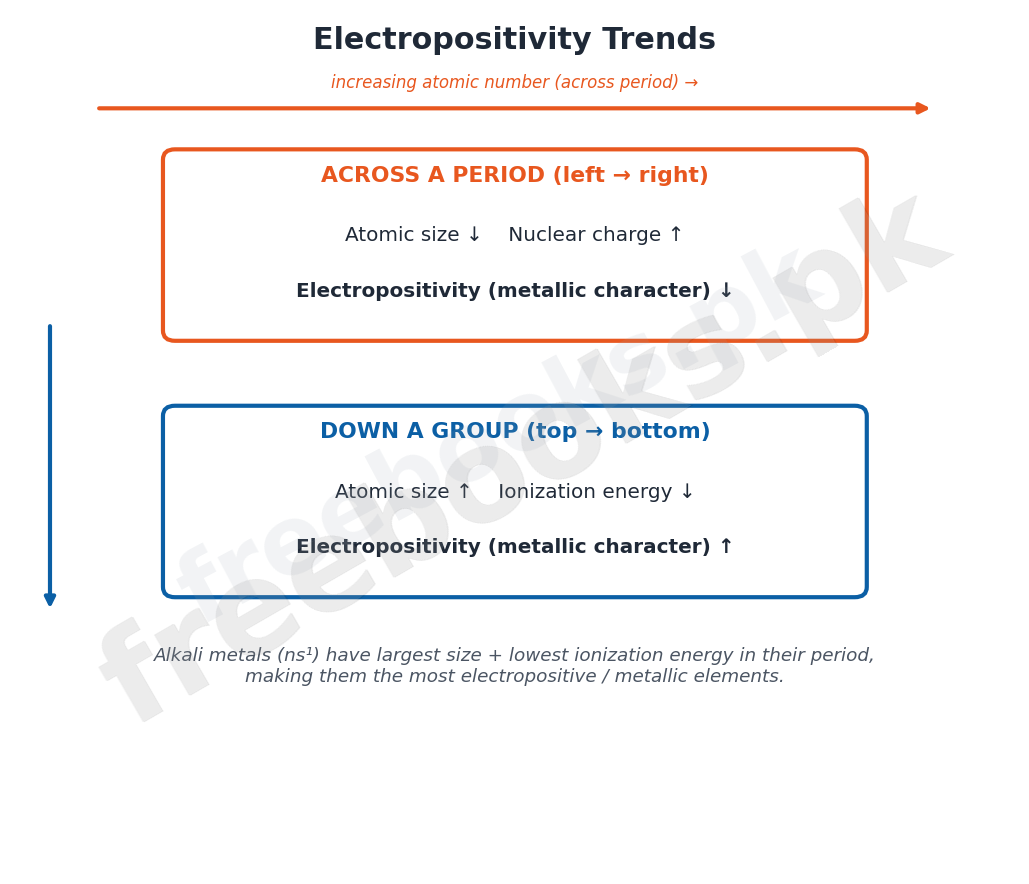
Electropositivity (metallic character) is a metal's tendency to lose its valence electrons — the more easily a metal loses electrons, the more electropositive it is. The number of electrons lost is the metal's valency; for example, sodium loses 1 electron (Na → Na+ + e−, valency 1) while zinc loses 2 electrons (Zn → Zn2+ + 2e−, valency 2). Electropositivity increases down a group (as atomic size increases, e.g. Li < Na < K) and decreases across a period from left to right (as atomic size decreases due to increasing nuclear charge).
Electropositivity depends on ionization energy, which in turn depends on atomic size and nuclear charge: small atoms with high nuclear charge have high ionization energy and are therefore less electropositive. Alkali metals have the largest atomic size and lowest ionization energy in their periods, giving them the highest metallic character. For example, sodium (atomic size 186 pm, IE 496 kJ/mol) is more electropositive than magnesium (atomic size 160 pm, IE1 738 kJ/mol) — and magnesium's second ionization energy (1450 kJ/mol) is far higher than its first, because removing an electron from the already-positive Mg+ ion against strong nuclear attraction is much harder.
8.1.2 Comparison of Alkali and Alkaline Earth Metals
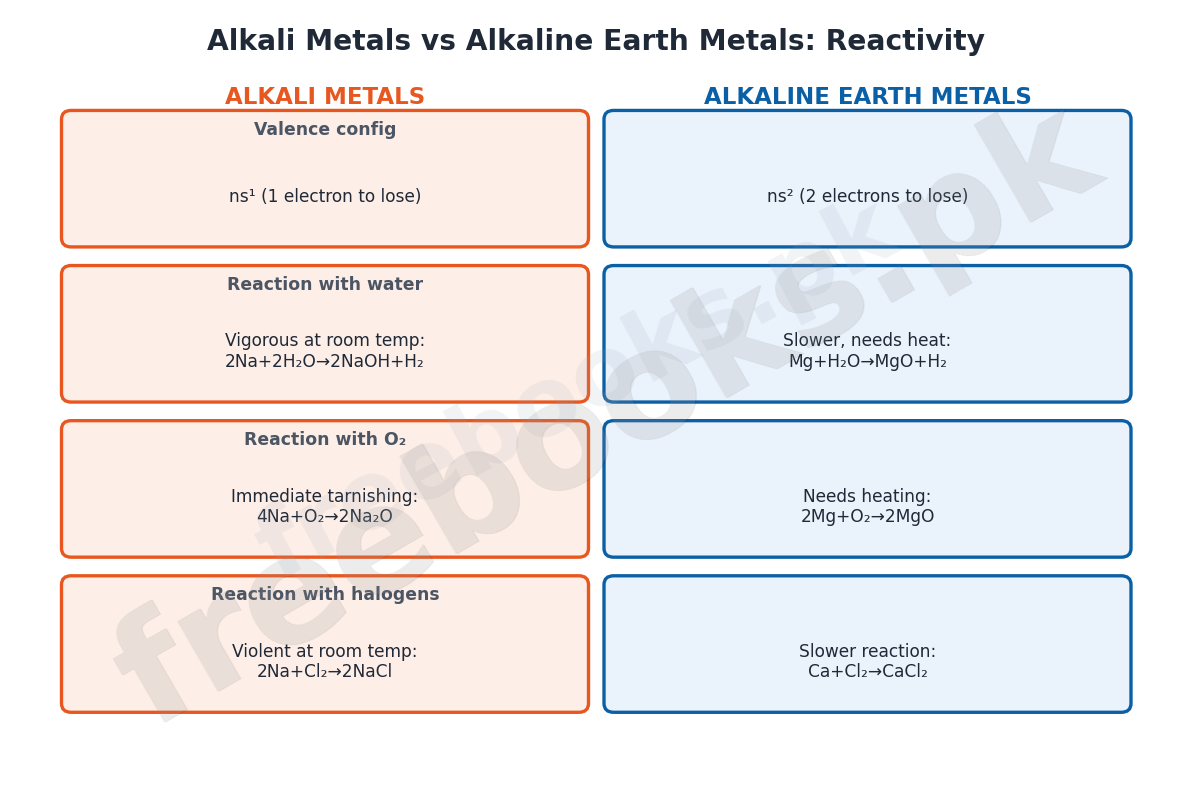
Group 1 elements are called alkali metals and Group 2 elements are called alkaline earth metals. Alkali metals have an ns1 valence configuration, so their single valence electron is easily lost, making them extremely reactive and always found in nature combined as +1 cations. Alkaline earth metal atoms are smaller with two valence electrons (ns2) and more nuclear charge, making them reactive but less so than alkali metals.
Comparing reactivity: alkali metals react vigorously with water at room temperature to give a strong alkaline solution and hydrogen gas (2Na + 2H2O → 2NaOH + H2), while alkaline earth metals react less vigorously and need heating to produce weaker bases (Mg + H2O → MgO + H2, then MgO + H2O → Mg(OH)2). Alkali metals tarnish immediately in air forming strongly alkaline oxides (4Na + O2 → 2Na2O), while alkaline earth metals need heating to react with oxygen (2Mg + O2 → 2MgO). Alkali metals react violently with halogens at room temperature (2Na + Cl2 → 2NaCl), while alkaline earth metals react more slowly (Ca + Cl2 → CaCl2). Alkali metals do not form nitrides or carbides directly, while alkaline earth metals form stable nitrides and carbides on heating (3Mg + N2 → Mg3N2; Ca + 2C → CaC2).
Sodium is used in sodium-potassium alloy as a nuclear reactor coolant, in sodium vapour lamps for yellow light, and as a reducing agent in extracting metals like titanium. Magnesium is used in flashbulbs and fireworks, in light alloys, in the thermite process, and as a sacrificial anode for corrosion prevention. Calcium is used to remove sulphur from petroleum products and as a reducing agent to produce chromium, uranium, and zirconium.
Inertness of Noble Metals
Transition metals (d-block elements) exhibit variable oxidation states; among Group 11, copper behaves like other active metals, but silver and gold are relatively inactive because they do not lose electrons easily. Silver is a white, lustrous, highly ductile and malleable metal, an excellent conductor of heat and electricity; a thin oxide/sulphide layer makes it relatively unreactive, though it tarnishes with sulphur-containing compounds like H2S. Being soft, it is alloyed with copper for coins, silverware, and ornaments, and used in photographic films, dental preparations, and mirrors.
Gold is a soft, yellow, extremely malleable and ductile metal (one gram can be drawn into a 1.5 km wire) that is essentially inert — unaffected by the atmosphere or by any single mineral acid or base. Its purity is measured in carats out of 24 (24 carat is pure gold); it is typically alloyed with copper, silver, palladium, nickel, or zinc for jewelry. Platinum is used in jewelry for its color, strength, and tarnish resistance, and (alloyed with palladium and rhodium) as a catalytic converter that converts toxic vehicle emissions (CO, NO2) into less harmful CO2, N2, and water vapour; it is also used in hard disk coatings, fibre optics, and LCD glass manufacturing.
8.2 Non-Metals
Non-metals form negative ions (anions) by gaining electrons, making them electronegative, and they form acidic oxides. Valency depends on the number of electrons accepted — chlorine accepts 1 electron (valency 1), oxygen accepts 2 (valency 2). Non-metallic character depends on electron affinity and electronegativity: small, high-nuclear-charge atoms are strongly electronegative, so non-metallic character decreases down a group and increases across a period up to the halogens; fluorine is the most non-metallic element. Non-metals occupy Group 14 (carbon), Group 15 (nitrogen, phosphorus), Group 16 (oxygen, sulphur, selenium), and Group 17 (the halogens).
Physical properties of non-metals: solid non-metals are brittle; they are bad conductors of heat and electricity (except graphite); they are dull, not shiny (except iodine, which is lustrous); they are generally soft (except diamond); they have low melting/boiling points (except silicon, graphite, and diamond); and they have low densities. Chemical properties: their valence shells are electron-deficient, so they readily accept electrons; they form ionic compounds with metals and covalent compounds with other non-metals; they usually do not react with water; and they do not react with dilute acids since they are themselves electron acceptors. Electronegativity decreases in the order F > O > Cl > N > Br > S > C > I > P.
8.2.1 & 8.2.2 Halogen Reactivity and Reactions
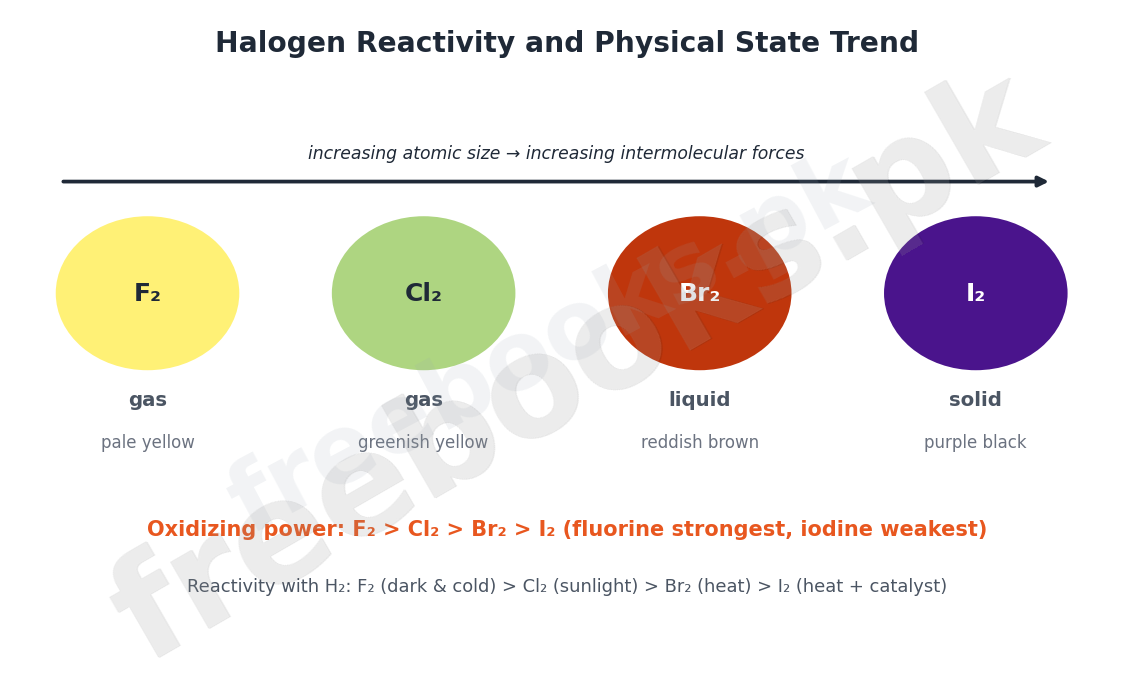
Group 17 (halogens: fluorine, chlorine, bromine, iodine, astatine) have valence configuration ns2np5, needing only one more electron to complete their octet — so they readily accept an electron from metals (forming ionic bonds) or share an electron with non-metals (forming covalent bonds). Fluorine and chlorine are diatomic gases at room temperature; as atomic size (and intermolecular forces) increases down the group, bromine is a liquid and iodine a solid.
All halogens are oxidizing agents, with strength decreasing down the group: fluorine is the strongest oxidizer, iodine the weakest. A more reactive halogen displaces a less reactive one from its salt solution — e.g. Cl2 + 2KBr → 2KCl + Br2 (solution turns reddish brown) and Br2 + 2KI → 2KBr + I2. All halogens combine with hydrogen to form hydrogen halides, but reactivity decreases down the group: fluorine reacts even in the dark and cold, chlorine needs sunlight, and bromine/iodine need heating (with iodine also needing a catalyst). Similarly, fluorine decomposes water in cold and dark conditions, chlorine needs sunlight, bromine reacts only under special conditions, and iodine does not react with water at all.
With methane, fluorine reacts violently even in the dark, while chlorine only reacts (violently) in bright sunlight, or slowly in diffused light giving a series of substitution products (CH3Cl, CH2Cl2, CHCl3, CCl4). Chlorine reacts with cold dilute NaOH to give sodium hypochlorite and sodium chloride (2NaOH + Cl2 → NaCl + NaOCl + H2O), and with hot concentrated NaOH to give sodium chloride and sodium chlorate (6NaOH + 3Cl2 → 5NaCl + NaClO3 + 3H2O).
8.2.3 Significance of Non-metals
Non-metals, though fewer than metals, are vital to life: oxygen is the most abundant element in the earth's crust (47%) and oceans (86%); about 96% of human body mass is made up of just four non-metals — oxygen (65%), carbon (18%), hydrogen (10%), and nitrogen (3%); O2 and CO2 are essential for respiration in animals and plants respectively; carbohydrates, proteins, fats, and water are all built from non-metals; and atmospheric nitrogen (78%) prevents uncontrolled combustion. Fossil fuels (coal, petroleum, gas) are composed of carbon and hydrogen, and everyday materials like natural/synthetic fibres, plastics, and agrochemicals are also built from non-metallic elements.
Important Definitions
Define metals in terms of ion formation.
Elements (except hydrogen) that are electropositive and form positive ions (cations) by losing electrons.
Define non-metals in terms of ion formation.
Elements that are electronegative and form negative ions (anions) by gaining electrons.
Define electropositivity (metallic character).
The tendency of a metal atom to lose its valence electrons; the more easily electrons are lost, the more electropositive the metal.
Define valency of a metal.
The number of electrons an atom of the metal loses to form a positive ion.
Define alkali metals.
The Group 1 elements, having an ns1 valence configuration, which are extremely reactive and always found combined in nature as +1 cations.
Define alkaline earth metals.
The Group 2 elements, having an ns2 valence configuration, which are reactive but less so than alkali metals.
Define noble metals.
Metals such as copper, mercury, silver, and gold that are the least reactive metals, resisting oxidation and corrosion.
Define carat (in the context of gold purity).
A unit indicating the number of parts by weight of pure gold present in 24 parts of an alloy; 24 carat gold is pure gold.
Define non-metallic character (electronegativity-related).
The tendency of an atom to attract and gain electrons, depending on its electron affinity and electronegativity.
Define halogens.
The Group 17 elements (fluorine, chlorine, bromine, iodine, astatine), which have an ns2np5 valence configuration and readily gain one electron to complete their octet.
Define oxidizing agent (in the context of halogens).
A species that oxidizes another substance by removing electrons from it; among halogens, fluorine is the strongest oxidizing agent and iodine the weakest.
Define malleability.
The property of a metal that allows it to be hammered or rolled into thin sheets without breaking.
Define ductility.
The property of a metal that allows it to be drawn into thin wires without breaking.
Define brittleness.
The tendency of a solid (typically non-metals) to break or shatter easily rather than deform.
Define transition metals.
Elements in which the d-orbitals are in the process of being filled, exhibiting variable oxidation states; they occupy the middle of periods 4, 5, and 6 of the periodic table.
Key Formulas
| Topic | Formula |
|---|---|
| Sodium losing an electron | Na(s) → Na⁺(g) + 1e⁻ (valency 1) |
| Zinc losing electrons | Zn(s) → Zn²⁺(g) + 2e⁻ (valency 2) |
| Chlorine gaining an electron | Cl + 1e⁻ → Cl⁻ (valency 1) |
| Oxygen gaining electrons | O + 2e⁻ → O²⁻ (valency 2) |
| Alkali metal + water | 2Na + 2H₂O → 2NaOH + H₂ |
| Alkaline earth metal + water | Mg + H₂O → MgO + H₂ (then MgO + H₂O → Mg(OH)₂) |
| Halogen displacement | Cl₂ + 2KBr → 2KCl + Br₂ |
Diagrams
Reactivity Series of Common Metals: Classification of common metals into very reactive, moderately reactive, and least reactive (noble) categories.
Electropositivity Trends: Summary of how electropositivity (metallic character) changes across a period and down a group in the periodic table.
Alkali Metals vs Alkaline Earth Metals: Reactivity: Side-by-side comparison of alkali and alkaline earth metal reactions with water, oxygen, and halogens.
Halogen Reactivity and Physical State Trend: Comparison of the four common halogens by physical state, colour, and oxidizing/hydrogen reactivity trend.
Short Questions & Answers
Why is sodium metal more reactive than magnesium metal?
Because sodium has a larger atomic size and a much lower ionization energy than magnesium, so it loses its single valence electron far more easily, making it more electropositive and reactive.
Why does the second ionization energy of magnesium far exceed its first?
Because after removing the first electron, the resulting Mg+ ion has a stronger effective nuclear attraction on its remaining electrons (and a smaller size), making it much harder to remove the second electron.
Why are alkali metals always found in combined form in nature rather than as free elements?
Because their single valence electron (ns1 configuration) is lost extremely easily, making them highly reactive; they readily combine with other elements to form stable compounds rather than existing as free, unreacted metal.
Why is gold considered a highly inert metal?
Because gold's electron configuration makes it very reluctant to lose electrons, so it resists reaction with atmospheric oxygen, moisture, and even individual mineral acids or bases under normal conditions.
Why is pure gold rarely used to make jewelry?
Because pure gold is too soft and easily damaged for practical, long-lasting jewelry, so it is alloyed with metals like copper, silver, palladium, nickel, or zinc to increase its hardness and durability.
Why do non-metals generally not react with dilute acids?
Because reacting with a dilute acid typically requires donating electrons to displace hydrogen, but non-metals are themselves electron acceptors (electronegative), so they lack the tendency to give up electrons in this way.
Why does fluorine react with hydrogen even in the dark and cold, while iodine needs heat and a catalyst?
Because chemical affinity for hydrogen decreases down the halogen group as atomic size increases and bond energies change, making fluorine far more reactive under mild conditions and iodine reactive only under forcing conditions.
Why is bromine a liquid and iodine a solid at room temperature, while fluorine and chlorine are gases?
Because intermolecular (van der Waals) forces of attraction increase down the halogen group as atomic and molecular size increases, making the heavier halogens more strongly attracted to each other and less volatile.
Why does the oxidizing power of halogens decrease from fluorine to iodine?
Because oxidizing power depends on the ability to attract and gain an electron, which is strongest for fluorine (smallest size, highest electronegativity) and progressively weaker for the larger, less electronegative halogens down the group.
Why is oxygen considered one of the most important non-metals for life?
Because oxygen is the most abundant element in the earth's crust and oceans, makes up a large fraction of human body mass, and is essential for respiration in animals — without it, life as we know it would not be possible.
Long Questions & Answers
Compare and contrast the properties and reactivity of alkali metals and alkaline earth metals.
How do the valence electron configurations of alkali and alkaline earth metals differ, and what effect does this have?
Alkali metals (Group 1) have an ns1 configuration with a single, easily-lost valence electron, making them extremely reactive and always found combined in nature. Alkaline earth metals (Group 2) have an ns2 configuration with two valence electrons and greater nuclear charge, making them reactive but noticeably less so than alkali metals.
How do the two groups differ in their reaction with water?
Alkali metals react vigorously with water even at room temperature, producing a strongly alkaline solution and hydrogen gas (e.g. 2Na + 2H2O → 2NaOH + H2). Alkaline earth metals react much less vigorously, typically requiring heat, and produce weaker bases (e.g. Mg + H2O → MgO + H2, followed by MgO + H2O → Mg(OH)2).
How do the two groups differ in their reaction with oxygen and halogens?
Alkali metals tarnish almost immediately in air, forming strongly alkaline oxides (4Na + O2 → 2Na2O), and react violently with halogens even at room temperature (2Na + Cl2 → 2NaCl). Alkaline earth metals need heating to react with oxygen (2Mg + O2 → 2MgO) and react more slowly with halogens (Ca + Cl2 → CaCl2).
How do the two groups differ in their reaction with nitrogen and carbon?
Alkali metals do not form nitrides or carbides directly under normal conditions. Alkaline earth metals, in contrast, form stable nitrides and carbides when heated with nitrogen or carbon respectively (e.g. 3Mg + N2 → Mg3N2 and Ca + 2C → CaC2), reflecting their comparatively different bonding behaviour despite both being highly reactive metal groups.
Discuss the inert character of silver and gold, and explain why they are valued as noble metals.
Why are silver and gold classified as noble (inert) metals?
Silver and gold, along with copper, belong to Group 11 of the transition metals, but unlike copper, silver and gold do not lose electrons easily. This reluctance to react makes them chemically inactive compared to most other metals, which is why they are described as noble or inert metals.
What specifically makes silver relatively unreactive, and where does it still react?
Silver forms a thin protective layer of oxide or sulphide on its surface, which makes it largely unaffected by normal atmospheric conditions. However, it does tarnish in the presence of sulphur-containing compounds such as hydrogen sulphide (H2S), showing that its inertness is not absolute.
How inert is gold compared to silver, and what practical consequence does this have?
Gold is even more inert than silver: it is not affected by the atmosphere and does not react with any single mineral acid or base under normal conditions. Because of this exceptional resistance to corrosion and tarnishing, gold retains its lustre and appearance indefinitely, making it highly prized for ornamental use and as a stable store of value.
Why must both silver and gold typically be alloyed before practical use?
Both metals are naturally very soft in their pure form, making them impractical for jewelry, coins, or tools on their own. Silver is commonly alloyed with copper, while gold is alloyed with copper, silver, or other metals (with purity expressed in carats out of 24), giving both metals the added hardness and durability needed for everyday and ornamental use while retaining their prized inertness and appearance.
Multiple Choice Questions (MCQs)
Metals can form ions carrying charges: (A) uni-positive (B) di-positive (C) tri-positive (D) all of these
Correct answer: (D) all of these. Different metals lose different numbers of electrons depending on their valency, so metals collectively can form uni-positive, di-positive, or tri-positive ions.
Which one of the following metals burns with a brick red flame? (A) sodium (B) magnesium (C) iron (D) calcium
Correct answer: (D) calcium. Calcium characteristically produces a brick red flame when burned, as noted in its comparison with sodium (golden yellow) and magnesium (brilliant white).
Sodium is an extremely reactive metal, but it does not react directly with: (A) hydrogen (B) nitrogen (C) sulphur (D) phosphorus
Correct answer: (B) nitrogen. Alkali metals like sodium do not form nitrides directly, unlike alkaline earth metals, which do form stable nitrides on heating with nitrogen.
Which one of the following is the lightest metal? (A) calcium (B) magnesium (C) lithium (D) sodium
Correct answer: (C) lithium. Lithium has the lowest density (0.53 g/cm3) among common metals, making it the lightest metal listed.
Pure alkali metals can be cut simply with a knife but iron cannot, because alkali metals have: (A) strong metallic bonding (B) weak metallic bonding (C) non-metallic bonding (D) moderate metallic bonding
Correct answer: (B) weak metallic bonding. Alkali metals have relatively weak metallic bonding due to their large atomic size and single valence electron, making them soft enough to cut with a knife, unlike strongly-bonded, hard metals like iron.
Which one of the following is less malleable? (A) sodium (B) iron (C) gold (D) silver
Correct answer: (B) iron. Iron is comparatively less malleable than the very soft alkali metal sodium and the exceptionally malleable noble metals gold and silver.
Metals lose their electrons easily because: (A) they are electronegative (B) they have electron affinity (C) they are electropositive (D) they are good conductors of heat
Correct answer: (C) they are electropositive. Metals are described as electropositive precisely because of their tendency to lose electrons and form positive ions, which is the underlying reason for this behaviour.
Which one of the following is brittle? (A) sodium (B) aluminium (C) selenium (D) magnesium
Correct answer: (C) selenium. Selenium, a non-metal, is brittle like most solid non-metals, unlike the metals sodium, aluminium, and magnesium, which are malleable.
Which one of the following non-metals is lustrous? (A) sulphur (B) phosphorus (C) iodine (D) carbon
Correct answer: (C) iodine. Iodine is unusual among non-metals in having a lustrous, shiny appearance similar to metals, despite being a non-metal.
Non-metals are generally soft, but which one of the following is extremely hard? (A) graphite (B) phosphorus (C) iodine (D) diamond
Correct answer: (D) diamond. Diamond, an allotrope of carbon, is an exception among non-metals, being one of the hardest known natural materials.
Quick Revision Summary
- Metals = electropositive, form cations (lose e⁻); Non-metals = electronegative, form anions (gain e⁻)
- Metal reactivity groups: very reactive (K,Na,Ca,Mg,Al) > moderately reactive (Zn,Fe,Sn,Pb) > noble (Cu,Hg,Ag,Au)
- Electropositivity: increases down a group, decreases across a period (opposite trend to non-metallic character)
- Electropositivity ∝ 1/ionization energy; alkali metals have lowest IE, highest metallic character
- Alkali metals (ns¹): very reactive, always combined in nature; Alkaline earth metals (ns²): reactive but less so
- Silver and gold are 'noble' — inert due to reluctance to lose electrons; gold most inert, doesn't react with acids/bases
- Gold purity in carats (24 = pure); both Ag and Au alloyed for hardness in jewelry/coins
- Non-metals: Group14 (C), Group15 (N,P), Group16 (O,S,Se), Group17 (halogens); non-metallic character ∝ electronegativity
- Halogens (ns²np⁵): oxidizing power F₂>Cl₂>Br₂>I₂; reactivity with H₂ and H₂O both decrease down the group
- Halogen physical state trend: F₂,Cl₂ gases; Br₂ liquid; I₂ solid (increasing intermolecular forces down group)
Exam Tips
- Memorize the three metal reactivity categories (very reactive / moderately reactive / noble) with example metals in each
- Be ready to explain the electropositivity-ionization energy relationship with the Na vs Mg comparison as a worked example
- Learn all six alkali vs alkaline earth metal reaction comparisons (water, O2, H2, halogens, N2, C) — these are exam favourites
- Know specific uses of sodium, magnesium, and calcium — short-answer questions often ask for these directly
- Understand WHY gold and silver are inert (electron-loss reluctance) rather than just memorizing that they are
- Memorize the halogen reactivity trends (oxidizing power, reaction with H2/H2O/methane) in the correct decreasing order
- Practice distinguishing metal vs non-metal properties side by side, since comparison questions are common in this unit