
A solution is a homogeneous mixture of two or more substances whose components cannot be visually distinguished from each other — it exists as a single phase. Solutions can be gaseous (air), liquid (sea water), or solid (alloys like brass), depending on the physical state of the solvent. Of the nine possible solute-solvent combinations, liquid solutions are the most common because water is the most widely available solvent.
This unit covers the definitions of solution, aqueous solution, solute, and solvent; the distinction between saturated, unsaturated, and supersaturated solutions and the meaning of dilution; the nine types of solutions by physical state; the various units used to express concentration (percentage forms and molarity), including worked numerical problems; the factors affecting solubility (the 'like dissolves like' principle, solute-solvent interaction, and temperature); and the comparison of true solutions, colloids, and suspensions.
Learning Objectives
- Define solution, aqueous solution, solute, and solvent, and give an example of each
- Explain the difference between saturated, unsaturated, and supersaturated solutions
- Describe the nine types of solutions formed from gas, liquid, and solid solutes and solvents, with examples
- Explain the concept of the concentration of a solution
- Define molarity and percentage solution, and solve numerical problems involving molarity
- Describe how dilute solutions are prepared from concentrated solutions of known molarity
- Apply the principle 'like dissolves like' to predict the solubility of one substance in another
- Explain the effect of temperature on the solubility of different solutes
- Compare solutions, colloids, and suspensions based on particle size, stability, and the Tyndall effect
Key Concepts
6.1 Solution, Aqueous Solution, Solute, and Solvent
A solution is a homogeneous mixture of two or more substances in which the boundaries of the components cannot be distinguished — it exists as a single phase. Examples include air (a solution of gases), brass (a solid solution of zinc and copper), and sugar dissolved in water (a liquid solution). Evaporation distinguishes a solution from a pure liquid: a pure liquid evaporates completely leaving no residue, while a solution leaves a residue behind. Alloys like brass are considered mixtures, not compounds, because they show the properties of their components and have variable composition.
An aqueous solution is formed by dissolving a substance in water, where water is present in the greater amount and acts as the solvent — for example, sugar in water or table salt in water. Water is called the universal solvent because it dissolves the majority of compounds found in the earth's crust. The solute is the component present in smaller quantity (e.g. salt in salt solution), while the solvent is the component present in larger quantity and always dissolves the solute(s) — in soft drinks, water is the solvent while sugar, salts, and CO2 are all solutes.
6.2 Saturated, Unsaturated, and Supersaturated Solutions
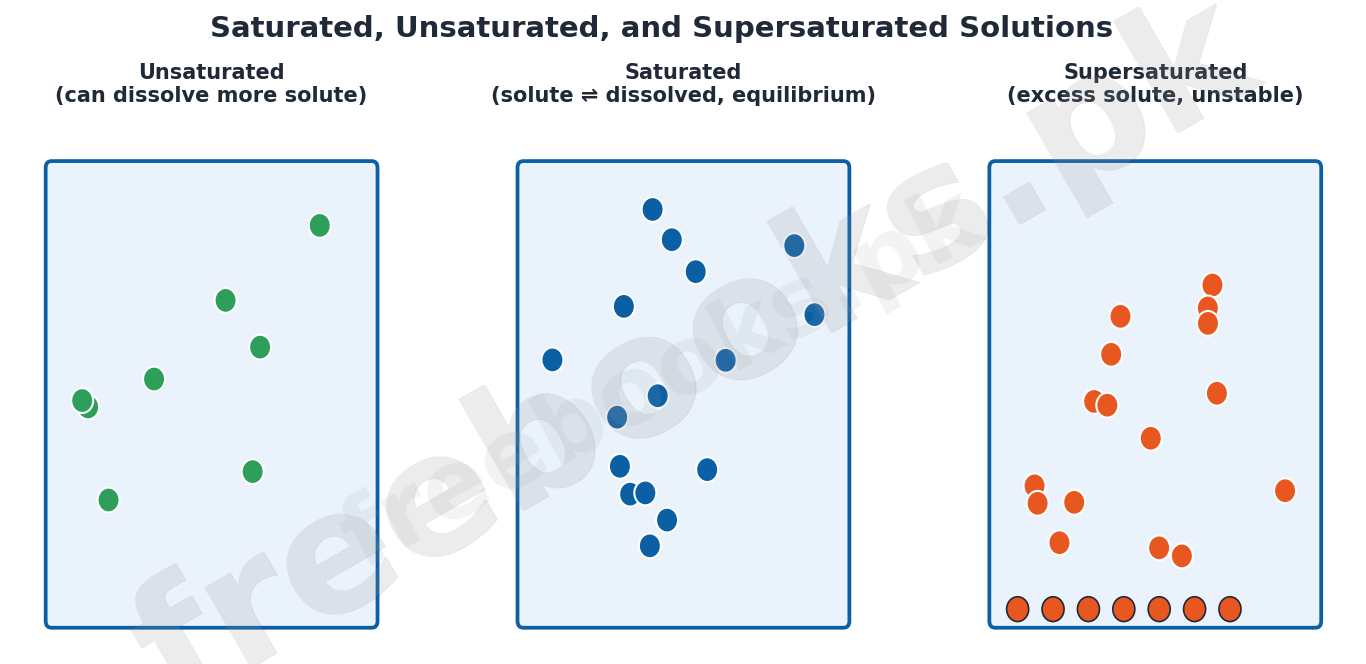
A saturated solution contains the maximum amount of solute that can dissolve at a given temperature; at the particle level, undissolved solute exists in dynamic equilibrium with dissolved solute (solute (crystallized) ⇌ solute (dissolved)) — dissolution and crystallization continue, but the net dissolved amount stays constant. An unsaturated solution contains less solute than is needed to saturate it at that temperature and can still dissolve more.
A supersaturated solution is more concentrated than a saturated solution and is prepared by dissolving solute in a saturated solution at high temperature, then carefully cooling it — such solutions are unstable. For example, a saturated solution of sodium thiosulphate (Na2S2O3) in water at 20°C contains 20.9 g of salt per 100 cm3 of water; less than this is unsaturated, and more is supersaturated at that temperature.
Solutions are also classified as dilute (relatively small amount of dissolved solute) or concentrated (relatively large amount), e.g. brine is a concentrated salt solution. Adding more solvent dilutes a solution and decreases its concentration.
6.3 Types of Solutions
Since solute and solvent can each be a gas, liquid, or solid, nine combinations of solutions are possible. Gas-in-gas: air, or H2/He mixtures in weather balloons. Gas-in-liquid: oxygen or carbon dioxide dissolved in water. Gas-in-solid: hydrogen adsorbed on palladium. Liquid-in-gas: mist, fog, liquid air pollutants. Liquid-in-liquid: alcohol in water, benzene in toluene. Liquid-in-solid: butter, cheese. Solid-in-gas: dust particles or smoke in air. Solid-in-liquid: sugar in water. Solid-in-solid: metal alloys like brass and bronze, and opals.
6.4 Concentration Units
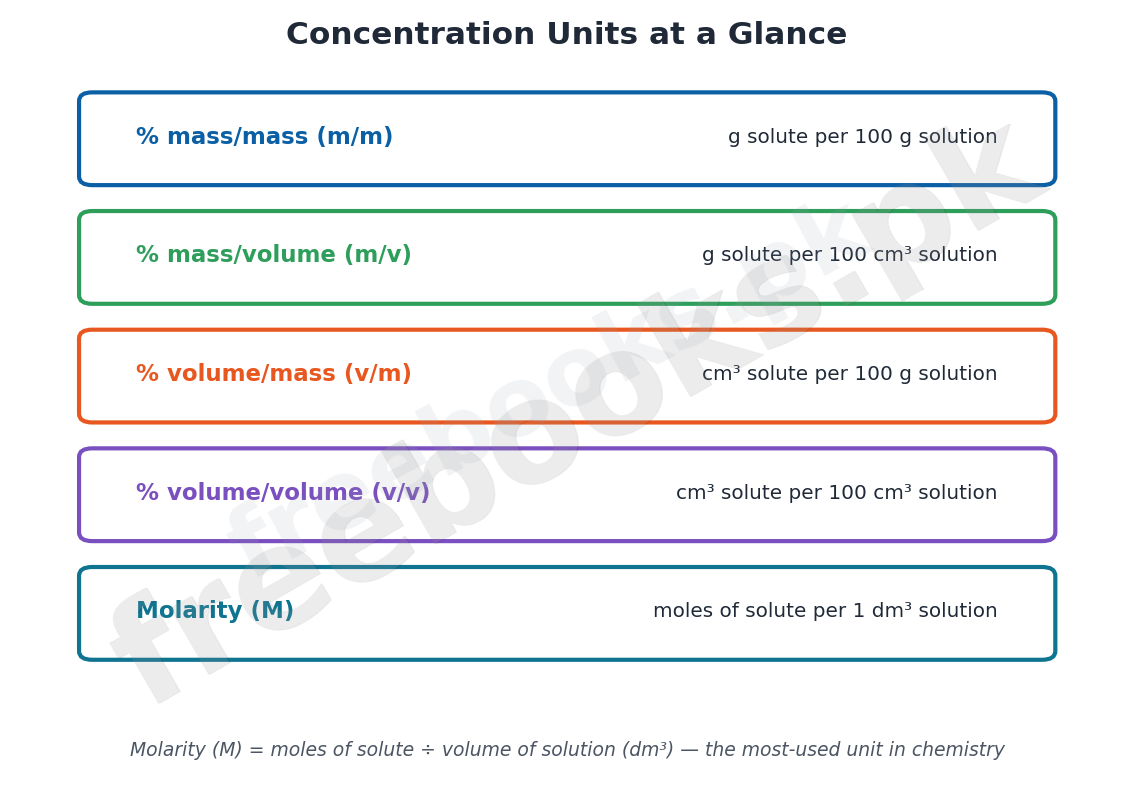
Concentration is the ratio of the amount of solute to the amount of solution (or solvent) and does not depend on the total volume or amount taken — a sample from a bulk solution has the same concentration as the whole. Percentage concentration can be expressed four ways: %mass/mass = (mass of solute ÷ mass of solution) × 100; %mass/volume = (mass of solute in g ÷ volume of solution in cm3) × 100; %volume/mass = (volume of solute in cm3 ÷ mass of solution in g) × 100; %volume/volume = (volume of solute ÷ volume of solution) × 100.
Molarity (M) is the number of moles of solute dissolved in one dm3 of solution — the concentration unit most used in chemistry: Molarity = mass of solute (g) ÷ [molar mass (g/mol) × volume of solution (dm3)]. A one-molar (1M) solution is prepared by dissolving one mole (the molar mass in grams) of solute in enough water to make the total volume 1 dm3 — for example, 1M NaOH is made by dissolving 40 g of NaOH and making the volume up to 1 dm3. A higher molarity means a more concentrated solution.
Dilute solutions of known molarity are prepared from concentrated ones using M1V1 = M2V2, where M1/V1 describe the concentrated solution and M2/V2 describe the diluted one. For example, to prepare 100 cm3 of 0.01M KMnO4 from a 0.1M stock solution: V1 × 0.1 = 0.01 × 100, giving V1 = 10 cm3 — so 10 cm3 of the 0.1M stock is measured out and diluted with water to 100 cm3.
6.5 Solubility
Solubility is the number of grams of solute that dissolve in 100 g of solvent to form a saturated solution at a given temperature; it equals the concentration of the saturated solution. The general principle governing solubility is 'like dissolves like': ionic and polar substances (KCl, Na2CO3, CuSO4, sugar, alcohol) dissolve in polar solvents like water; non-polar substances (ether, benzene, petrol) do not dissolve in water; non-polar substances (grease, paints, naphthalene) dissolve in non-polar solvents like ether or carbon tetrachloride.
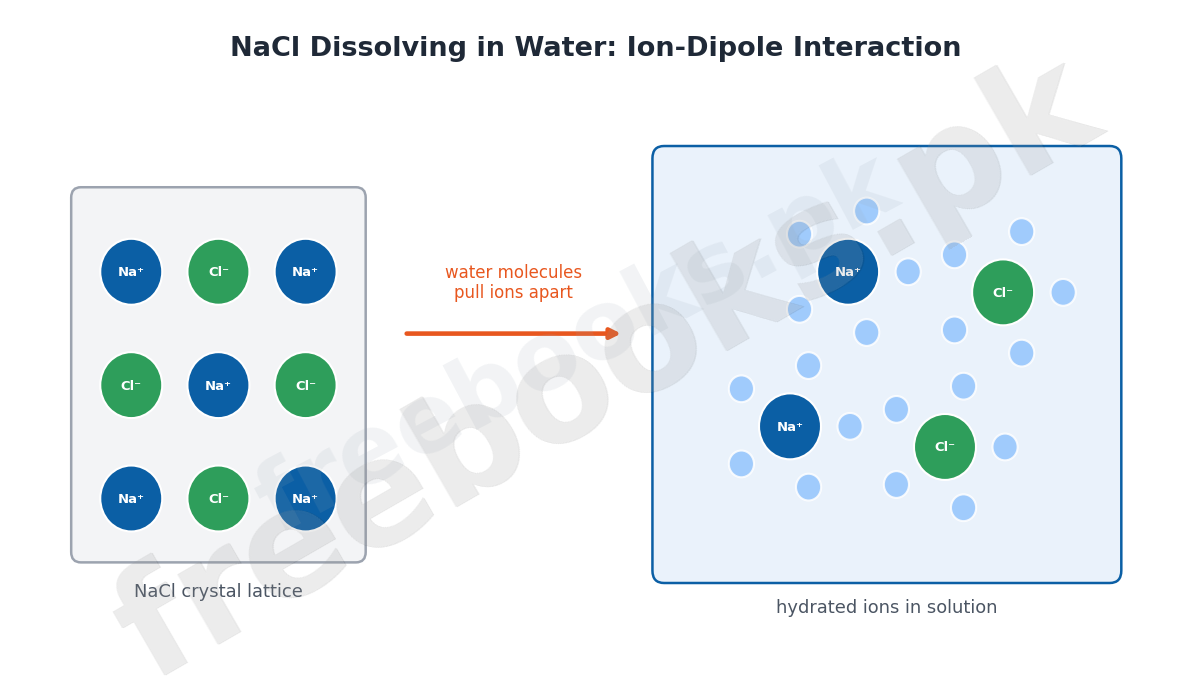
Dissolution requires three events: solute particles separate from each other, solvent particles separate to make room, and solute and solvent particles attract and mix. If solute-solvent attractive forces overcome solute-solute forces, the solute dissolves; if solute-solute forces are stronger, the solute remains undissolved. When NaCl dissolves in water, the positive end of water's dipole orients toward Cl⁻ ions and the negative end toward Na⁺ ions — these ion-dipole attractions are strong enough to pull the ions out of the crystal lattice.
Temperature affects solubility in three ways. When dissolving is endothermic (e.g. KNO3, NaNO3, KCl in water), heat is absorbed from the surroundings, the test tube feels cold, and solubility generally increases with temperature. When dissolving is exothermic (e.g. Li2SO4, Ce2(SO4)3 in water), heat is released, the test tube feels warm, and solubility decreases with increasing temperature. For some solutes (e.g. NaCl in water), there is negligible heat change and temperature has minimal effect on solubility.
6.6 Comparison of Solution, Colloid, and Suspension
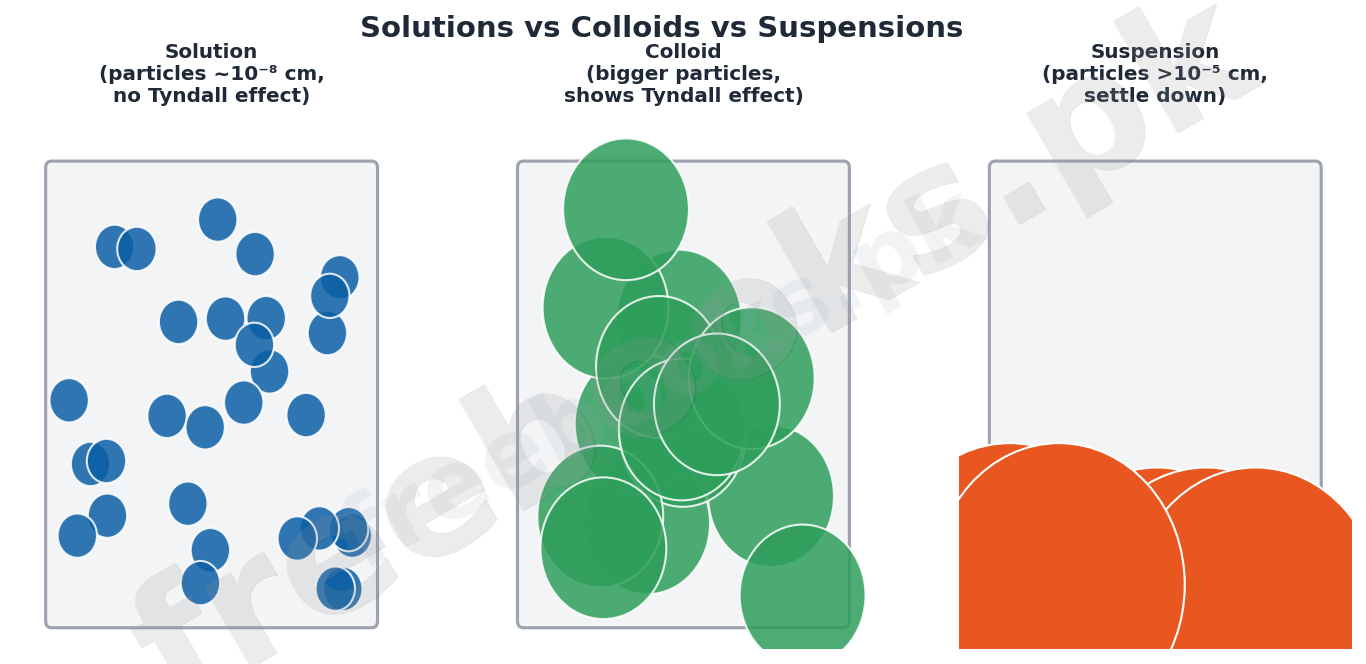
A true solution is a homogeneous mixture in which particles exist as individual molecules or ions (diameter about 10⁻⁸ cm); they dissolve uniformly, pass through filter paper, and do not scatter light (no Tyndall effect) — e.g. a drop of ink fully dissolved would give a true solution, and sugar or salt solutions are classic examples.
A colloid contains larger particles (many atoms/molecules/ions per particle) that appear homogeneous but are actually a heterogeneous 'false solution' — particles do not settle for a long time (making colloids stable) but are big enough to scatter light, producing the Tyndall effect, the key feature distinguishing colloids from true solutions. Examples include starch, albumin, soap solutions, blood, milk, ink, jelly, and toothpaste.
A suspension is a heterogeneous mixture of undissolved particles larger than 10⁻⁵ cm in diameter, big enough to see with the naked eye; these particles cannot pass through filter paper, block rather than scatter light, and settle down over time. Examples include chalk-in-water, paints, and milk of magnesia.
Important Definitions
Define solution.
A homogeneous mixture of two or more substances that exists as a single phase, with no visible boundaries between its components.
Define aqueous solution.
A solution formed by dissolving a substance in water, where water is present in the greater amount and acts as the solvent.
Define solute.
The component of a solution that is present in the smaller quantity.
Define solvent.
The component of a solution that is present in the larger quantity and dissolves the solute(s).
Define saturated solution.
A solution containing the maximum amount of solute that can dissolve at a given temperature, with undissolved and dissolved solute in dynamic equilibrium.
Define unsaturated solution.
A solution that contains less solute than is required to saturate it at a given temperature, and so can dissolve more solute.
Define supersaturated solution.
A solution more concentrated than a saturated solution, prepared by dissolving solute at high temperature and then carefully cooling the solution; it is unstable.
Define concentration.
The proportion of solute in a solution, expressed as the ratio of the amount of solute to the amount of solution or solvent.
Define molarity.
The number of moles of solute dissolved in one cubic decimetre (dm³) of solution, denoted M.
Define solubility.
The number of grams of solute that dissolve in 100 g of solvent to produce a saturated solution at a given temperature.
Define colloid.
A heterogeneous 'false solution' containing particles larger than in a true solution but too small to be seen with the naked eye; it exhibits the Tyndall effect and does not settle out.
Define suspension.
A heterogeneous mixture containing undissolved particles large enough to be seen with the naked eye, which settle down over time.
Define the Tyndall effect.
The scattering of a beam of light by the relatively large particles present in a colloid, making the light's path visible.
What does 'like dissolves like' mean?
The general principle that polar/ionic substances dissolve readily in polar solvents (like water), while non-polar substances dissolve in non-polar solvents (like ether or carbon tetrachloride).
Define dilution.
The process of adding more solvent to a solution, which decreases its concentration.
Key Formulas
| Topic | Formula |
|---|---|
| % mass/mass | (mass of solute (g) / mass of solution (g)) × 100 |
| % mass/volume | (mass of solute (g) / volume of solution (cm³)) × 100 |
| % volume/mass | (volume of solute (cm³) / mass of solution (g)) × 100 |
| % volume/volume | (volume of solute (cm³) / volume of solution (cm³)) × 100 |
| Molarity | M = mass of solute (g) / [molar mass (g/mol) × volume of solution (dm³)] |
| Dilution formula | M₁V₁ = M₂V₂ (concentrated → dilute solution) |
Diagrams
Saturated, Unsaturated, and Supersaturated Solutions: Visual comparison of the three saturation states, showing increasing dissolved solute and undissolved settled solute in the supersaturated case.
NaCl Dissolving in Water: Ion-Dipole Interaction: Illustration of the NaCl crystal lattice breaking apart as polar water molecules surround and pull away Na+ and Cl- ions to form a solution.
Concentration Units at a Glance: Summary of the five concentration units covered in this unit: %m/m, %m/v, %v/m, %v/v, and molarity, with their defining ratios.
Solutions vs Colloids vs Suspensions: Comparison of particle size and behaviour across true solutions, colloids, and suspensions, showing why only suspensions visibly settle.
Short Questions & Answers
Why is a solution considered a mixture rather than a compound?
Because it shows the properties of its individual components and has a variable composition, both of which are properties of mixtures, not compounds.
Why is water called the 'universal solvent'?
Because it dissolves the majority of compounds found in the earth's crust, more than any other single solvent.
Why do supersaturated solutions crystallize excess solute when cooled?
Because a supersaturated solution holds more solute than is stable at the lower temperature, so the excess solute comes out of solution as crystals, leaving behind a saturated solution.
Why does the concentration of a solution not depend on the total volume taken?
Because concentration is a ratio of solute to solution, and any sample taken from a well-mixed bulk solution has exactly the same ratio as the whole.
Why is molarity described as the practical unit of concentration in chemistry?
Because it directly relates the number of moles of solute (the amount used in chemical reactions) to a fixed volume of solution, making stoichiometric calculations straightforward.
Why does KNO3 make a test tube feel cold when it dissolves in water?
Because dissolving KNO3 is an endothermic process — the salt absorbs heat from the surrounding water and test tube to break its ionic lattice, lowering the temperature.
Why is ether, a non-polar solvent, unable to dissolve table salt?
Because table salt (NaCl) is an ionic solid, and ionic substances only dissolve well in polar solvents whose molecules can surround and stabilize the separated ions — non-polar ether cannot do this.
Why do colloids not settle down like suspensions?
Because colloidal particles, although larger than those in a true solution, are still small and light enough that random molecular collisions (Brownian motion) keep them dispersed rather than settling under gravity.
Why can suspension particles be removed by filtration but solution particles cannot?
Because suspension particles are large enough to be physically trapped by the pores of filter paper, while solute particles in a true solution are the size of individual molecules or ions and pass straight through.
Why does milk show the Tyndall effect while sugar solution does not?
Because milk is a colloid with particles large enough to scatter a beam of light, while sugar solution is a true solution whose particles are too small to scatter light at all.
Long Questions & Answers
Explain the concept of saturated, unsaturated, and supersaturated solutions, including how a supersaturated solution is prepared.
What is a saturated solution?
A saturated solution is one that contains the maximum amount of solute that can dissolve in the solvent at a given temperature. At the particle level, it represents a dynamic equilibrium in which undissolved solute continues to dissolve while dissolved solute continues to crystallize out, keeping the net dissolved amount constant.
What is an unsaturated solution?
An unsaturated solution contains less solute than the amount required to saturate it at that temperature. Because it has not reached its maximum capacity, an unsaturated solution can still dissolve additional solute until it becomes saturated.
What is a supersaturated solution, and why is it unstable?
A supersaturated solution contains more dissolved solute than a saturated solution normally would at that temperature, making it more concentrated. It is unstable because this extra solute is only held in solution under special conditions; any disturbance, such as adding a seed crystal or a temperature change, can cause the excess solute to rapidly crystallize out.
How is a supersaturated solution prepared in practice?
A saturated solution is first prepared at a high temperature, where more solute can dissolve. This hot saturated solution is then carefully and slowly cooled to a lower temperature; because solubility usually decreases with cooling, the solution now holds more solute than is stable at the lower temperature, making it supersaturated, until the excess eventually crystallizes out.
Explain how solute-solvent interaction determines whether a solute dissolves, using NaCl in water as an example.
What three events must occur for a solute to dissolve in a solvent?
First, solute particles must separate from each other. Second, solvent particles must separate to make room for the incoming solute particles. Third, the solute and solvent particles must attract one another and mix together to form a uniform solution.
What determines whether these events actually happen?
Dissolution depends on the relative strength of three types of attractive forces: solute-solute forces, solvent-solvent forces, and solute-solvent forces. If the new solute-solvent forces are strong enough to overcome the solute-solute forces holding the solid together, the solute dissolves; if the solute-solute forces are stronger, the solute remains undissolved.
How does this apply specifically to NaCl dissolving in water?
In solid NaCl, strong ionic attractions hold Na+ and Cl- ions in a rigid crystal lattice. When NaCl is added to water, the polar water molecules orient themselves so their negative (oxygen) end faces the Na+ ions and their positive (hydrogen) end faces the Cl- ions.
What is the outcome of these ion-dipole attractions?
These ion-dipole attractions between the water molecules and the Na+ and Cl- ions are strong enough to overcome the ionic forces holding the crystal together, pulling the ions out of their lattice positions one by one. The separated ions become surrounded by water molecules, and the solid NaCl fully dissolves into solution.
Multiple Choice Questions (MCQs)
Mist is an example of which type of solution? (A) liquid in gas (B) gas in liquid (C) solid in gas (D) gas in solid
Correct answer: (A) liquid in gas. Mist consists of tiny liquid water droplets dispersed in air (a gas), making it a liquid-in-gas solution.
Which one of the following is a 'liquid in solid' solution? (A) sugar in water (B) butter (C) opal (D) fog
Correct answer: (B) butter. Butter is a liquid (fat/water droplets) dispersed within a solid matrix, making it a liquid-in-solid solution.
Concentration is a ratio of: (A) solvent to solute (B) solute to solution (C) solvent to solution (D) both solute-to-solution and solvent-to-solution
Correct answer: (B) solute to solution. Concentration is defined as the ratio of the amount of solute to the amount of solution (or sometimes to the solvent).
Which one of the following solutions contains the most water (is most dilute) among equal volumes? (A) 2 M (B) 1 M (C) 0.5 M (D) 0.25 M
Correct answer: (D) 0.25 M. A 0.25 M solution has the least solute per unit volume among these choices, meaning it contains proportionally the most water/solvent.
A 5 percent (m/m) sugar solution means: (A) 5 g of sugar is dissolved in 90 g of water (B) 5 g of sugar is dissolved in 100 g of water (C) 5 g of sugar is dissolved in 105 g of water (D) 5 g of sugar is dissolved in 95 g of water
Correct answer: (D) 5 g of sugar is dissolved in 95 g of water. In %m/m, the mass of solute plus mass of solvent equals 100 g total, so 5 g sugar must be dissolved in 95 g of water to make 100 g of solution.
If solute-solute forces are stronger than solute-solvent forces, the solute: (A) dissolves readily (B) does not dissolve (C) dissolves slowly (D) dissolves and precipitates
Correct answer: (B) does not dissolve. When the solute's own internal attractive forces are stronger than the attraction offered by the solvent, the solvent cannot pull the solute apart, so it does not dissolve.
Which of the following will show negligible effect of temperature on its solubility? (A) KCl (B) KNO3 (C) NaNO3 (D) NaCl
Correct answer: (D) NaCl. Dissolving NaCl in water involves very little heat change, so its solubility is only minimally affected by temperature changes.
Which one of the following is a heterogeneous mixture? (A) milk (B) ink (C) milk of magnesia (D) sugar solution
Correct answer: (C) milk of magnesia. Milk of magnesia is a suspension of solid magnesium hydroxide particles in water, which is a heterogeneous mixture that settles over time, unlike milk and ink which behave as stable colloids here.
The Tyndall effect is caused by: (A) blockage of the beam of light (B) non-scattering of the beam of light (C) scattering of the beam of light (D) the beam of light passing straight through
Correct answer: (C) scattering of the beam of light. The Tyndall effect occurs because colloidal particles are large enough to scatter light in many directions as the beam passes through, making its path visible.
Molarity is the number of moles of solute dissolved in: (A) 1 kg of solution (B) 100 g of solvent (C) 1 dm³ of solvent (D) 1 dm³ of solution
Correct answer: (D) 1 dm³ of solution. By definition, molarity (M) is the number of moles of solute per 1 dm³ (one litre) of the total solution, not the solvent alone.
Quick Revision Summary
- Solution = homogeneous mixture; solute = smaller quantity; solvent = larger quantity
- Aqueous solution = water is the solvent; water is the 'universal solvent'
- Saturated: max solute at equilibrium; unsaturated: can dissolve more; supersaturated: unstable excess
- 9 solution types from combinations of gas/liquid/solid solute + solvent
- 4 percentage concentration types: %m/m, %m/v, %v/m, %v/v — know which quantity is 100 in each
- Molarity M = moles of solute ÷ volume of solution (dm³); practical unit in chemistry
- Dilution formula: M1V1 = M2V2 (concentrated → dilute)
- 'Like dissolves like': polar/ionic in polar solvents, non-polar in non-polar solvents
- Temperature effect on solubility: endothermic (KNO3, NaCl-ish neutral) increases with heat; exothermic (Li2SO4) decreases
- Solution (no Tyndall, ~10⁻⁸ cm) < Colloid (Tyndall effect, doesn't settle) < Suspension (settles, visible particles)
Exam Tips
- Memorize all four percentage formulas precisely — exams often test which quantity (solute/solution/solvent) forms the denominator in each
- Practice molarity numericals repeatedly: converting cm³ to dm³ is the most common calculation mistake
- Learn the dilution formula M1V1=M2V2 and practice identifying which values are 'concentrated' (1) vs 'dilute' (2)
- Be ready to classify a given example (mist, butter, brass, etc.) into one of the nine solution types
- Know at least 2-3 examples each of endothermic and exothermic dissolution for the temperature-solubility questions
- Practice distinguishing solution vs colloid vs suspension using the Tyndall effect and settling behaviour as the key tests
- Remember 'like dissolves like' with the specific example pairs given (NaCl in water; grease in CCl4/ether)