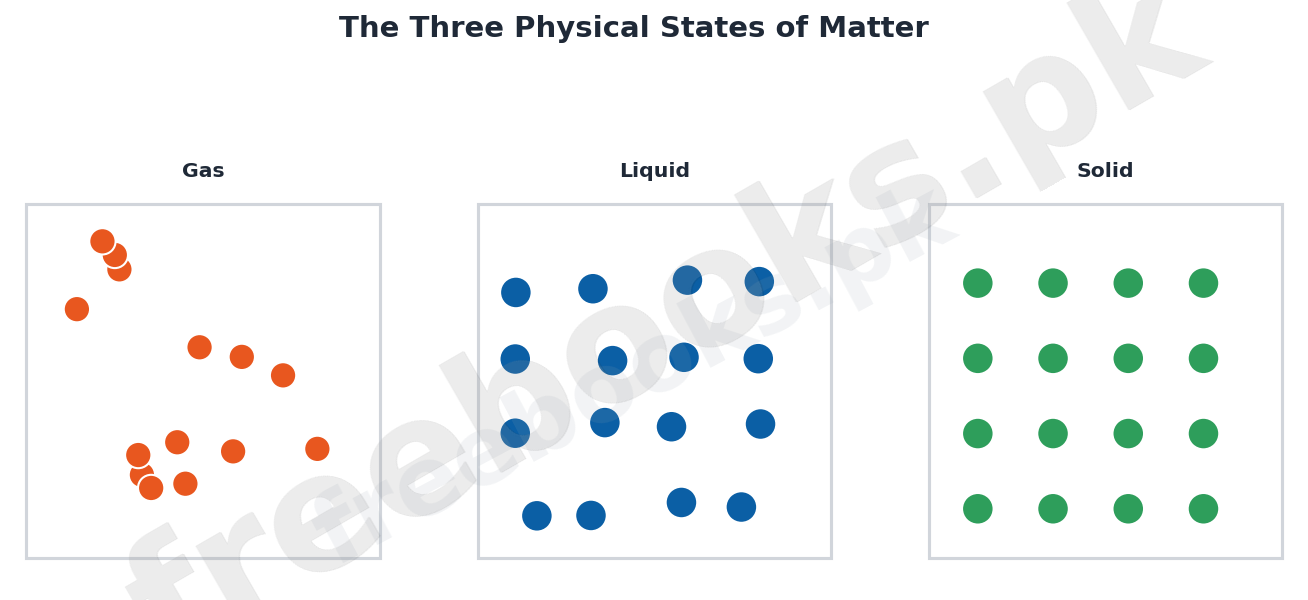
Matter exists in three physical states — gas, liquid, and solid — distinguished mainly by the strength of intermolecular forces between their particles. Gases have very weak intermolecular forces and no definite shape or volume; liquids have moderate forces, giving them a definite volume but no fixed shape; solids have strong forces, giving them both definite shape and volume.
This unit covers the typical properties of gases (diffusion, effusion, pressure, compressibility), the two gas laws (Boyle's Law and Charles's Law), the typical properties of liquids (evaporation, vapour pressure, boiling point, freezing point, diffusion, density), and the typical properties of solids (melting point, rigidity, density, amorphous vs crystalline solids, and allotropy).
Learning Objectives
- Describe the effect of pressure and temperature changes on the volume of a gas
- Compare the three physical states of matter with regard to intermolecular forces
- Account for pressure-volume changes in a gas using Boyle's Law
- Account for temperature-volume changes in a gas using Charles's Law
- Explain the properties of gases: diffusion, effusion, and pressure
- Explain the properties of liquids: evaporation, vapour pressure, and boiling point
- Explain the effect of temperature and external pressure on vapour pressure and boiling point
- Describe the physical properties of solids (melting point) and differentiate amorphous from crystalline solids
- Explain the allotropic forms of elements
Key Concepts
5.1 Typical Properties of Gases
Diffusion is the spontaneous mixing of gas molecules by random motion and collisions to form a homogeneous mixture; its rate depends on molecular mass, with lighter gases diffusing faster (H2 diffuses four times faster than O2). Effusion is the escape of gas molecules through a tiny hole into a region of lower pressure, and like diffusion, lighter gases effuse faster than heavier ones.
Pressure (P = Force/Area) is exerted by gas molecules constantly colliding with container walls; its SI unit is the Pascal (Pa = 1 N/m2). Standard atmospheric pressure is the pressure exerted by a 760 mm column of mercury at sea level: 1 atm = 760 mmHg = 760 torr = 101325 Pa. Gases are highly compressible (due to empty space between molecules), highly mobile (due to high kinetic energy), and have low density compared to liquids and solids — gas density is measured in g/dm3 (liquids/solids are 1000 times denser and measured in g/cm3), and gas density increases on cooling as volume decreases.
5.2.1 Boyle's Law
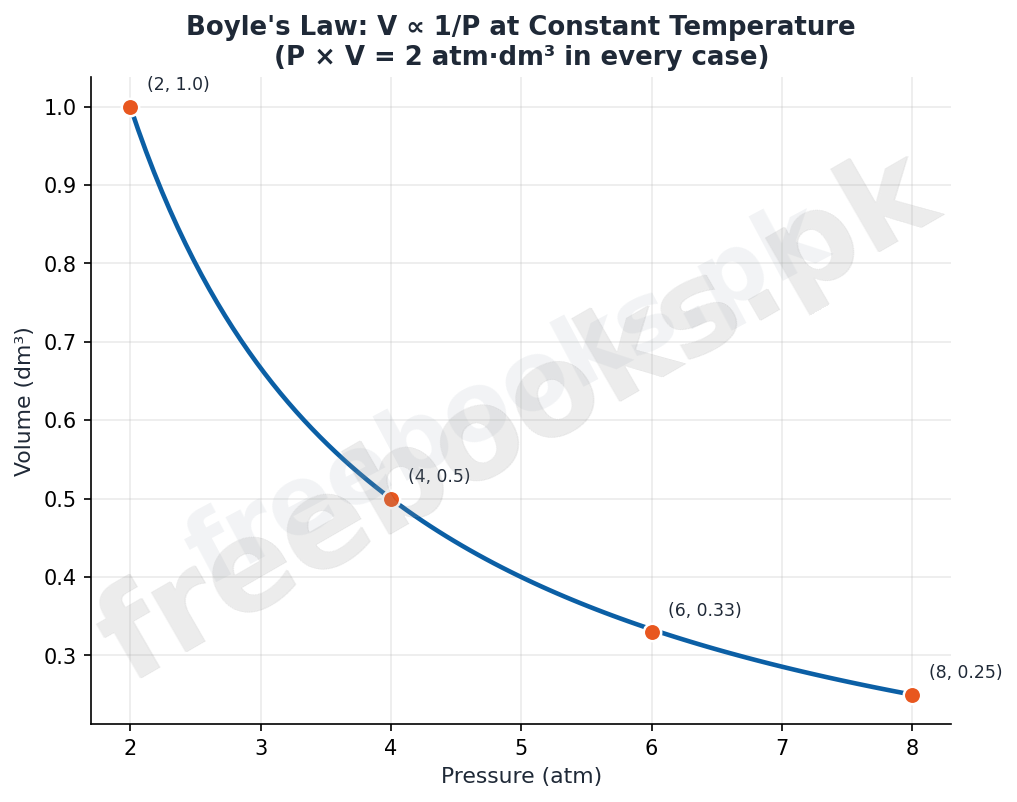
Boyle's Law (1662) states that the volume of a given mass of gas is inversely proportional to its pressure at constant temperature: V ∝ 1/P, or PV = k (a constant). For two states of the same gas sample, P1V1 = P2V2. This was verified experimentally by compressing a gas in a cylinder: at 2 atm the volume was 1 dm3, at 4 atm it was 0.5 dm3, at 6 atm it was 0.33 dm3, and at 8 atm it was 0.25 dm3 — in every case, the product P × V remained constant at 2 atm·dm3.
5.2.2 Absolute Temperature Scale and Charles's Law
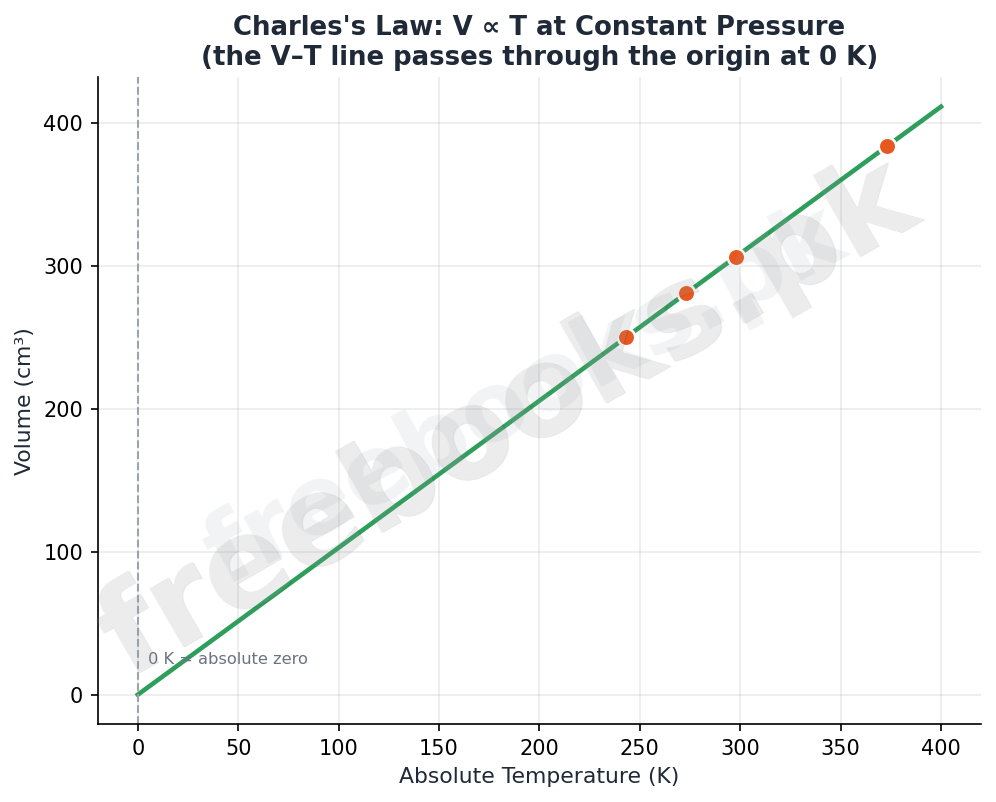
The Kelvin (absolute) scale starts at 0 K (-273.15°C), called absolute zero — the temperature at which an ideal gas would theoretically have zero volume. Conversion: K = °C + 273, and °C = K – 273. Charles's Law (1787) states that the volume of a given mass of gas is directly proportional to its absolute temperature at constant pressure: V ∝ T, or V/T = k. For two states, V1/T1 = V2/T2. This was verified experimentally: heating a gas from 25°C (V1 = 50 cm3) to 100°C increased its volume to about 62.5 cm3.
Physical States and Intermolecular Forces
In the gaseous state, molecules are far apart, so intermolecular forces are very weak. In the liquid state, molecules are much closer together, developing stronger intermolecular forces that affect diffusion, evaporation, vapour pressure, and boiling point — compounds with stronger intermolecular forces have higher boiling points. In the solid state, intermolecular forces dominate so strongly that molecules appear almost motionless, arranging in a regular pattern that makes solids denser than liquids or gases.
5.3 Typical Properties of Liquids
Evaporation is the endothermic process of a liquid changing into vapour (e.g. converting 1 mole of liquid water to vapour requires 40.7 kJ). It occurs because a fraction of molecules have more than average kinetic energy and escape the liquid surface; it is a cooling process (remaining molecules lose energy) and depends on surface area (more surface area, more evaporation), temperature (higher temperature, faster evaporation), and intermolecular forces (stronger forces, slower evaporation — e.g. alcohol evaporates faster than water).
Vapour pressure is the pressure exerted by a liquid's vapour when it is in dynamic equilibrium with the liquid (rate of evaporation = rate of condensation) at a given temperature. It depends on the nature of the liquid (polar liquids have lower vapour pressure than non-polar ones due to stronger intermolecular forces), the size of molecules (smaller molecules evaporate more easily, giving higher vapour pressure), and temperature (higher temperature increases vapour pressure).
Boiling point is the temperature at which a liquid's vapour pressure becomes equal to atmospheric (or external) pressure. It depends on the nature of the liquid (polar liquids have higher boiling points), intermolecular forces (stronger forces mean higher boiling points), and external pressure (higher external pressure raises the boiling point, as used in a pressure cooker). Freezing point is the temperature at which the vapour pressures of the liquid and solid phases become equal, and the two phases coexist in dynamic equilibrium.
Liquids also diffuse (much more slowly than gases), with diffusion depending on intermolecular forces (weaker forces diffuse faster), molecule size (bigger molecules diffuse slower, e.g. honey diffuses slower than alcohol in water), molecule shape (regular shapes diffuse faster), and temperature (higher temperature speeds up diffusion). Liquids are denser than gases because their molecules are closely packed with negligible space between them (e.g. water is 1.0 g/cm3 versus air at 0.001 g/cm3).
5.4 Typical Properties of Solids
The melting point is the temperature at which a solid, upon heating, coexists in dynamic equilibrium with its liquid state; ionic and covalent network solids (macromolecules) have very high melting points. Solids are rigid because their particles occupy fixed positions and can only vibrate, not move freely. Solids are the densest state of matter because their particles are closely packed with no empty space between them (e.g. aluminium 2.70 g/cm3, iron 7.86 g/cm3, gold 19.3 g/cm3).
5.5 Types of Solids: Amorphous and Crystalline
Amorphous solids (meaning 'shapeless') have particles that are not regularly arranged, so they lack a sharp melting point — examples include plastic, rubber, and glass. Crystalline solids have particles arranged in a definite, repeating three-dimensional pattern with well-defined faces meeting at fixed angles, giving them sharp melting points — examples include diamond and sodium chloride.
5.6 Allotropy
Allotropy is the existence of an element in more than one form within the same physical state, arising either from different numbers of atoms per molecule (e.g. oxygen O2 and ozone O3) or from different arrangements of atoms/molecules within a crystal (e.g. sulphur's S8 molecules arranged differently in rhombic vs monoclinic crystals). Allotropes of the same element always show different physical properties but identical chemical properties. The temperature at which one allotrope converts to another is called the transition temperature — for example, rhombic sulphur converts to monoclinic sulphur at 96°C, white phosphorus converts to red phosphorus at 250°C, and grey (cubic) tin converts to white (tetragonal) tin at 13.2°C.
Important Definitions
Define diffusion.
The spontaneous mixing up of molecules by random motion and collisions to form a homogeneous mixture.
Define effusion.
The escape of gas molecules through a tiny hole into a space of lesser pressure.
Define pressure and give its SI unit.
Pressure is force exerted per unit surface area (P = F/A); its SI unit is the Pascal (Pa), equal to 1 N/m2.
Define standard atmospheric pressure.
The pressure exerted by a mercury column of 760 mm height at sea level, equal to 1 atm = 760 mmHg = 101325 Pa.
State Boyle's Law.
The volume of a given mass of a gas is inversely proportional to its pressure at constant temperature (PV = constant).
State Charles's Law.
The volume of a given mass of a gas is directly proportional to its absolute temperature at constant pressure (V/T = constant).
What is absolute zero?
0 K or -273.15°C, the temperature at which an ideal gas would theoretically have zero volume.
Define evaporation.
The process of a liquid changing into a gas (vapour) phase; it is an endothermic (cooling) process.
Define vapour pressure.
The pressure exerted by the vapours of a liquid when they are in dynamic equilibrium with the liquid at a particular temperature.
Define boiling point.
The temperature at which the vapour pressure of a liquid becomes equal to the atmospheric (or external) pressure.
Define freezing point.
The temperature at which the vapour pressures of the liquid and solid states of a substance become equal, and the two phases coexist in dynamic equilibrium.
Define melting point.
The temperature at which a solid, upon heating, starts to melt and coexists in dynamic equilibrium with its liquid state.
Differentiate amorphous and crystalline solids in one line each.
Amorphous solids have irregularly arranged particles and no sharp melting point (e.g. glass); crystalline solids have a definite 3D particle arrangement and a sharp melting point (e.g. diamond).
Define allotropy.
The existence of an element in more than one form within the same physical state, showing different physical but identical chemical properties.
Define transition temperature.
The temperature at which one allotropic form of an element converts into another.
Key Formulas
| Topic | Formula |
|---|---|
| Pressure | P = Force (F) / Area (A); 1 Pascal (Pa) = 1 N m⁻² |
| Standard atmospheric pressure | 1 atm = 760 mmHg = 760 torr = 101325 Pa |
| Boyle's Law | P1 V1 = P2 V2 (constant temperature) |
| Kelvin-Celsius conversion | K = °C + 273; °C = K – 273 |
| Charles's Law | V1 / T1 = V2 / T2 (constant pressure) |
| Evaporation of water (per mole) | H2O(l) → H2O(g), ΔH°vap = +40.7 kJ mol⁻¹ |
Diagrams
Boyle's Law: V vs P: Graph of the experimental Boyle's Law data (2 atm/1 dm³, 4 atm/0.5 dm³, 6 atm/0.33 dm³, 8 atm/0.25 dm³) showing the inverse relationship between pressure and volume.
Charles's Law: V vs T: Graph showing volume increasing linearly with absolute temperature at constant pressure, extrapolating to zero volume at 0 K (absolute zero).
The Three Physical States of Matter: Molecular arrangement comparison of gas (far apart, random), liquid (close, can flow), and solid (fixed, regular pattern) showing increasing intermolecular force strength.
Short Questions & Answers
Why does hydrogen gas diffuse faster than oxygen gas?
Because diffusion rate depends on molecular mass, and hydrogen (lighter) diffuses about four times faster than the heavier oxygen molecule.
Why are gases highly compressible?
Because there is a large amount of empty space between gas molecules, allowing them to be pushed much closer together under pressure.
Why does the density of a gas increase on cooling?
Because cooling reduces the gas's volume while its mass stays the same, so density (mass/volume) increases.
According to Boyle's Law, what happens to volume if pressure is doubled at constant temperature?
The volume is halved, since volume is inversely proportional to pressure at constant temperature.
Why is evaporation considered a cooling process?
Because the molecules with the highest kinetic energy escape the liquid, leaving behind molecules with lower average kinetic energy, which lowers the liquid's (and its surroundings') temperature.
Why does alcohol evaporate faster than water?
Because alcohol has weaker intermolecular forces than water, so its molecules can more easily overcome those forces and escape into vapour.
Why does increasing external pressure raise a liquid's boiling point?
Because the liquid's vapour pressure must rise to a higher value to match the increased external pressure before boiling can begin, requiring a higher temperature.
Why are solids denser than liquids and gases?
Because solid particles are closely packed with no empty spaces between them, unlike the more spread-out particles in liquids and especially gases.
Why do amorphous solids not have a sharp melting point?
Because their particles are not arranged in a regular repeating pattern, so different parts of the solid melt at slightly different temperatures rather than all at once.
Why do oxygen (O2) and ozone (O3) count as allotropes?
Because they are two different molecular forms of the same element, oxygen, existing in the same physical state (gas) but with a different number of atoms per molecule.
Long Questions & Answers
State Boyle's Law and Charles's Law, and explain how each was experimentally verified.
What does Boyle's Law state, and how is it expressed?
Boyle's Law states that the volume of a given mass of a gas is inversely proportional to its pressure at constant temperature: V ∝ 1/P, or PV = k (a constant). For two states of the same gas, this gives P1V1 = P2V2.
How was Boyle's Law experimentally verified?
A fixed mass of gas was compressed in a cylinder with a movable piston: at 2 atm the volume was 1 dm3, at 4 atm it fell to 0.5 dm3, at 6 atm to 0.33 dm3, and at 8 atm to 0.25 dm3. In every case, the product of pressure and volume remained constant at 2 atm·dm3, confirming the law.
What does Charles's Law state, and how is it expressed?
Charles's Law states that the volume of a given mass of a gas is directly proportional to its absolute temperature at constant pressure: V ∝ T, or V/T = k. For two states, this gives V1/T1 = V2/T2.
How was Charles's Law experimentally verified?
A fixed mass of gas enclosed in a cylinder with a movable piston had an initial volume of 50 cm3 at 25°C; when heated to 100°C, its volume increased to about 62.5 cm3, demonstrating that volume increases proportionally with absolute temperature at constant pressure.
Explain vapour pressure and boiling point, and describe the factors that affect each.
What is vapour pressure, and when does it apply?
Vapour pressure is the pressure exerted by a liquid's vapour when the liquid and its vapour are in dynamic equilibrium at a given temperature — that is, when the rate of evaporation equals the rate of condensation.
What factors affect vapour pressure?
Vapour pressure depends on the nature of the liquid (polar liquids have lower vapour pressure than non-polar liquids due to stronger intermolecular forces), the size of the molecules (smaller molecules evaporate more easily, giving higher vapour pressure), and temperature (vapour pressure increases as temperature rises).
What is boiling point, and how does it relate to vapour pressure?
Boiling point is the temperature at which a liquid's vapour pressure becomes equal to the atmospheric (or external) pressure — at this point, vapourization occurs throughout the liquid, not just at its surface.
What factors affect boiling point?
Boiling point depends on the nature of the liquid (polar liquids generally have higher boiling points), intermolecular forces (stronger forces require a higher temperature to reach the necessary vapour pressure, giving a higher boiling point), and external pressure (increasing external pressure raises the boiling point, which is the principle behind a pressure cooker).
Multiple Choice Questions (MCQs)
How many times are liquids denser than gases (approximately)? (A) 100 times (B) 1000 times (C) 10,000 times (D) 100,000 times
Correct answer: (B) 1000 times. Liquids and solids are approximately 1000 times denser than gases, which is why their densities are measured in different units (g/cm3 vs g/dm3).
Gas densities are typically expressed in units of: (A) mg cm⁻³ (B) g cm⁻³ (C) g dm⁻³ (D) kg dm⁻³
Correct answer: (C) g dm⁻³. Because gases are much less dense than liquids or solids, their densities are conventionally expressed in grams per cubic decimetre (g dm⁻³).
At the freezing point, which of the following coexist in dynamic equilibrium? (A) gas and solid (B) liquid and gas (C) liquid and solid (D) all of these
Correct answer: (C) liquid and solid. At the freezing point, the liquid and solid phases of a substance coexist in dynamic equilibrium.
Solid particles possess which type of motion? (A) rotational motion only (B) vibrational motion (C) translational motion only (D) both translational and vibrational motion
Correct answer: (B) vibrational motion. Solid particles are fixed in position and can only vibrate about their mean position; they cannot move translationally.
Which one of the following is NOT an amorphous solid? (A) rubber (B) plastic (C) glass (D) glucose
Correct answer: (D) glucose. Glucose is a crystalline solid with a definite, regular particle arrangement and a sharp melting point, unlike rubber, plastic, and glass.
One standard atmospheric pressure is equal to how many Pascals? (A) 101325 (B) 10325 (C) 106075 (D) 10523
Correct answer: (A) 101325. 1 atm = 101325 Pa, by definition of the standard atmosphere.
Which one of the following gases diffuses fastest? (A) hydrogen (B) helium (C) fluorine (D) chlorine
Correct answer: (A) hydrogen. Hydrogen has the lowest molecular mass of the choices, so it diffuses fastest according to the relationship between diffusion rate and molecular mass.
Which one of the following does NOT affect a liquid's boiling point? (A) intermolecular forces (B) external pressure (C) nature of the liquid (D) initial temperature of the liquid
Correct answer: (D) initial temperature of the liquid. Boiling point depends on intermolecular forces, external pressure, and the nature of the liquid, but not on what temperature the liquid started at before heating.
The density of a gas increases when its: (A) temperature is increased (B) pressure is increased (volume decreases) (C) volume is increased (D) none of these
Correct answer: (B) pressure is increased (volume decreases). Increasing pressure at constant temperature decreases a gas's volume, which increases its density (mass/volume).
The vapour pressure of a liquid increases with: (A) increase of external pressure (B) increase of temperature (C) increase of intermolecular forces (D) increase of polarity of molecules
Correct answer: (B) increase of temperature. Vapour pressure rises as temperature increases, because more molecules gain enough kinetic energy to escape into the vapour phase.
Quick Revision Summary
- 3 states of matter differ mainly by intermolecular force strength: gas (weakest) < liquid < solid (strongest)
- Diffusion/effusion rate depends on molecular mass — lighter gases move faster
- Pressure: P = F/A; 1 Pa = 1 N/m²; 1 atm = 760 mmHg = 101325 Pa
- Boyle's Law: PV = constant (T fixed) — P1V1 = P2V2
- Charles's Law: V/T = constant (P fixed) — V1/T1 = V2/T2; always convert °C to K first (K = °C + 273)
- Evaporation is endothermic/cooling; depends on surface area, temperature, intermolecular forces
- Vapour pressure = pressure of vapour in dynamic equilibrium with its liquid
- Boiling point = temperature where vapour pressure equals external pressure
- Solids: amorphous (no sharp m.p., e.g. glass) vs crystalline (sharp m.p., e.g. diamond, NaCl)
- Allotropy = same element, different forms, same state (e.g. O2/O3, rhombic/monoclinic sulphur)
Exam Tips
- Always convert temperature to Kelvin (K = °C + 273) before using Charles's Law in any calculation
- Practice unit conversions between atm, mmHg, torr, and Pa — these appear frequently in numerical questions
- Memorise the exact wording of Boyle's Law and Charles's Law, including which variable is held constant in each
- Be ready to explain WHY evaporation causes cooling — a common short-question topic
- Learn the three factors affecting vapour pressure/boiling point (nature of liquid, intermolecular forces, temperature/pressure) and be ready to apply them to a specific example
- Practice distinguishing amorphous vs crystalline solids with the correct examples (glass/rubber/plastic vs diamond/NaCl)
- Know at least one worked example of allotropy (sulphur, phosphorus, or tin) with its transition temperature