Atoms combine with each other to form molecules because every atom has a natural tendency to become more stable by attaining the electronic configuration of the nearest noble gas — 2 electrons in the valence shell (duplet rule) or 8 electrons (octet rule). The force of attraction that holds atoms together once they combine is called a chemical bond.
This unit covers the four types of chemical bonds — ionic, covalent (single, double, triple, and dative/coordinate), and metallic — along with intermolecular forces such as dipole-dipole interactions and hydrogen bonding, and finally how the nature of bonding in a compound determines its physical properties (melting point, conductivity, solubility, and more).
Learning Objectives
- Find the number of valence electrons in an atom using the Periodic Table
- State the octet and duplet rule and explain how elements attain stability
- Describe the formation of cations from metal atoms and anions from non-metal atoms
- Describe the characteristics of an ionic bond and identify properties of ionic compounds
- Describe the formation of a covalent bond, and distinguish single, double and triple covalent bonds with examples
- Explain dative (coordinate) covalent bonding, and polar vs non-polar covalent bonds
- Describe the formation of a metallic bond and explain the properties of metals
- Describe intermolecular forces (dipole-dipole, hydrogen bonding) and relate bonding type to compound properties
Key Concepts
4.1 Why Do Atoms Form Chemical Bonds?
Atoms achieve stability by attaining the electronic configuration of the nearest noble gas — 2 electrons in the valence shell (the duplet rule, for elements like H and He with only an s-subshell) or 8 electrons (the octet rule). Noble gases already have completely filled valence shells, so they neither gain, lose, nor share electrons, making them non-reactive; every other atom bonds with others in an attempt to copy this stable arrangement.
An atom can complete its valence shell in three ways: by giving away valence electrons (if it has fewer than 3), by gaining electrons from another atom (if it has 5 or more), or by sharing valence electrons with another atom. An atom's group number in the Periodic Table (based on its valence electron count) predicts which of these three routes it will take.
4.2 The Chemical Bond
A chemical bond is the force of attraction between atoms that holds them together in a substance. When two atoms approach each other, both attractive and repulsive forces act between them; if the net attractive forces dominate, the system's energy is lowered and a stable bond (and molecule) forms. If repulsive forces dominate instead, no bond forms. Bond formation between ions is due to electrostatic attraction; between similar (or comparably electronegative) atoms, it happens through the sharing of electrons.
4.3.1 Ionic Bond
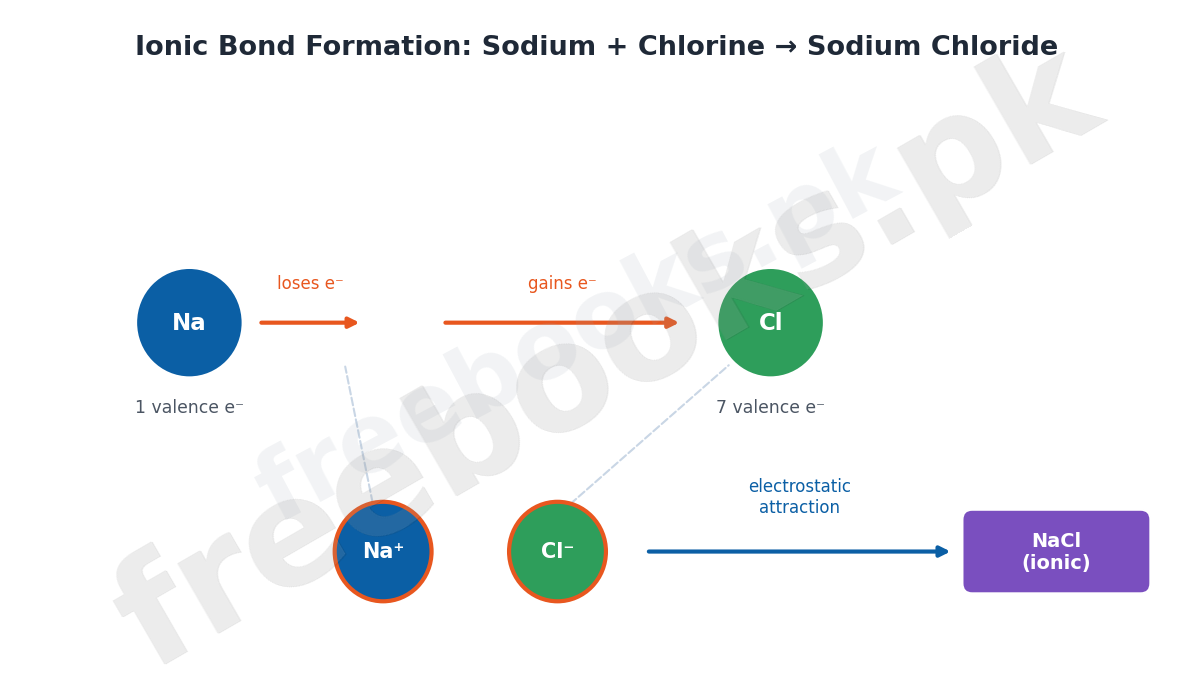
Group 1 and 2 metals tend to lose their valence electrons to form positively charged cations, while Group 15-17 non-metals (electronegative, high electron affinity) tend to gain electrons to form negatively charged anions. An ionic bond forms when there is a complete transfer of one or more electrons from a metal atom to a non-metal atom, and the resulting oppositely charged ions are held together by electrostatic attraction.
In sodium chloride formation, sodium (1s2 2s2 2p6 3s1) loses its single valence electron to become Na+ (with a stable 8-electron outer shell), and chlorine (1s2 2s2 2p6 3s2 3p5) gains that electron to become Cl- (also 8 electrons outermost): Na+ + Cl- → NaCl. Only valence electrons take part in ionic bonding, and heat is usually released during the reaction. Compounds formed this way are called ionic compounds.
4.3.2 Covalent Bond and Its Types
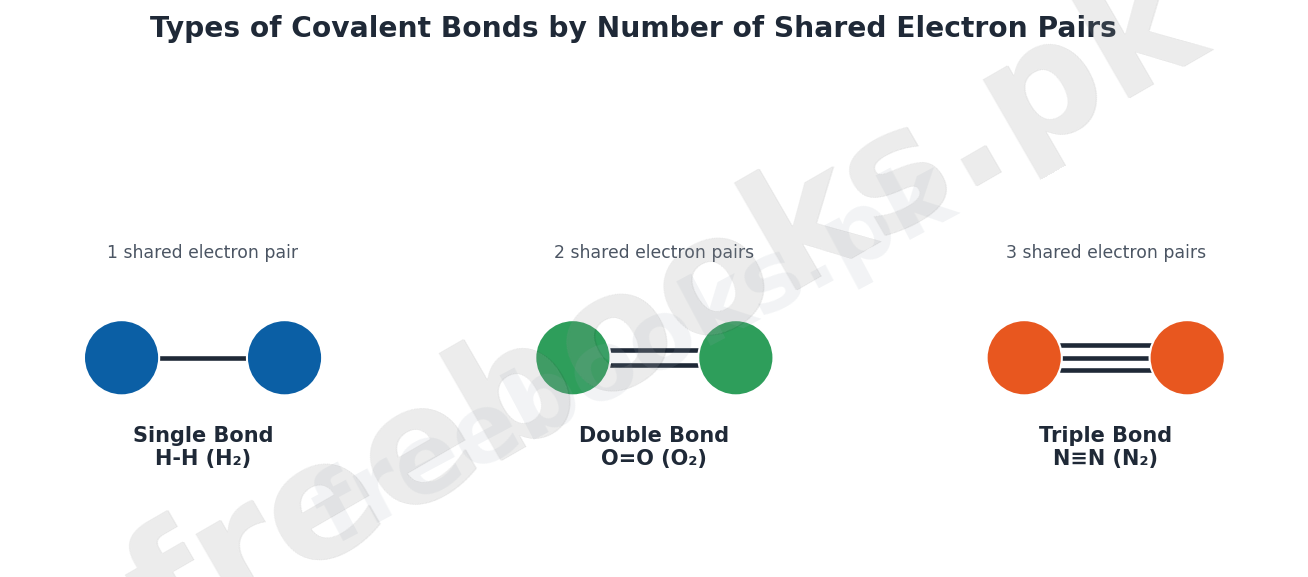
Elements of Groups 13-17 typically form bonds with each other by mutually sharing valence electrons rather than transferring them — this is a covalent bond. The shared electrons are called bond pair electrons, and covalent bonds are classified by how many bond pairs are shared: a single covalent bond (one shared pair, e.g. H2, Cl2), a double covalent bond (two shared pairs, e.g. O2, C2H4/ethene), and a triple covalent bond (three shared pairs, e.g. N2, C2H2/ethyne). By sharing electrons this way, each atom attains an octet (or duplet) configuration. Lewis structures use dots or crosses around an element's symbol to represent valence electrons and bonding.
4.3.3 Dative (Coordinate) Covalent Bond
In a dative or coordinate covalent bond, the shared electron pair is contributed entirely by one atom (the donor), while the other atom (the acceptor) contributes none; a small arrow pointing from donor to acceptor represents this bond. A lone pair (a non-bonded electron pair, such as the one on nitrogen in ammonia, NH3) can be donated — for example, when H+ approaches NH3, nitrogen donates its lone pair to form the ammonium ion, NH4+. Boron trifluoride (BF3) is electron-deficient (short of 2 electrons in boron's outer shell even after normal covalent bonding), so it readily accepts a lone pair from a donor molecule like ammonia to form a coordinate covalent bond.
4.3.4 Polar and Non-Polar Covalent Bonds
When a covalent bond forms between two identical atoms (e.g. H2, Cl2), the shared electron pair is attracted equally by both, producing a non-polar (pure) covalent bond. When it forms between two different atoms with different electronegativities, the more electronegative atom pulls the shared pair more strongly, creating a partial negative charge (delta-minus) on itself and a partial positive charge (delta-plus) on the other atom — this is a polar covalent bond (e.g. water, HF, HCl). As a rule of thumb, if the electronegativity difference between two bonding atoms exceeds 1.7, the bond is predominantly ionic; if it is less than 1.7, the bond is predominantly covalent.
4.3.5 Metallic Bond
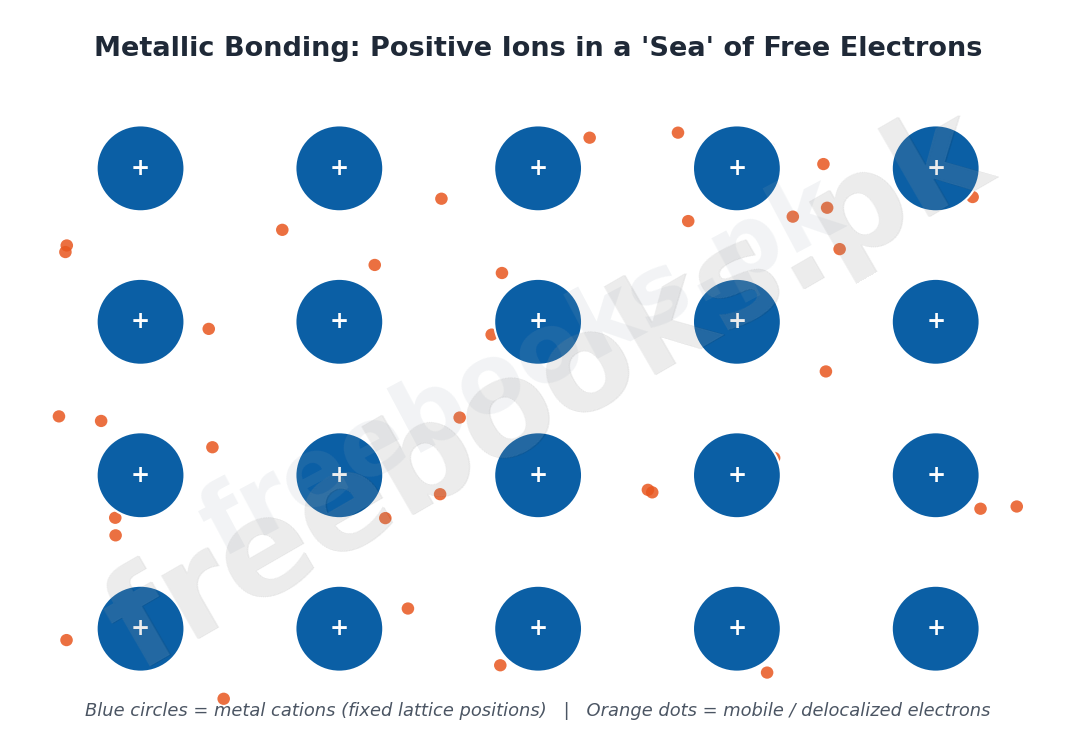
A metallic bond forms between metal atoms through mobile ('free') electrons. Because metal atoms are relatively large with more shells between the nucleus and valence electrons, and because they have low ionization energies, their outermost electrons detach easily and move freely throughout the metal rather than staying attached to any one atom. This creates a 'sea' of delocalized electrons surrounding a lattice of positive metal ions (nuclei), and it is this mobile electron sea that holds the metal atoms together and explains metals' characteristic properties — electrical/thermal conductivity, malleability, ductility, and metallic luster.
4.4 Intermolecular Forces: Dipole-Dipole and Hydrogen Bonding
In addition to the strong chemical bonds within a molecule, weaker intermolecular forces (collectively called van der Waals forces) act between molecules. For example, breaking the intermolecular forces between liquid HCl molecules takes only about 17 kJ/mol, while breaking the H-Cl chemical bond itself takes about 430 kJ/mol — intermolecular forces are far weaker than chemical bonds. Dipole-dipole interaction occurs when the partial positive end of one polar molecule (like HCl) is attracted to the partial negative end of a neighbouring molecule.
Hydrogen bonding is a special, stronger dipole-dipole attraction that occurs when a hydrogen atom is covalently bonded to a small, highly electronegative atom with lone pairs (N, O, or F) in one molecule, and is then attracted to a similar electronegative atom in a neighbouring molecule. Hydrogen bonding significantly raises boiling points (water's 100°C boiling point vs alcohol's 78°C is due to stronger/more hydrogen bonding in water) and explains why ice floats: as water freezes, hydrogen bonds arrange the molecules into an open, expanded structure, making ice (0.917 g/cm3) less dense than liquid water (1.00 g/cm3).
4.5 Nature of Bonding and Properties of Compounds
Ionic compounds consist of ions (not molecules) arranged in an orderly crystal lattice held by strong electrostatic forces. They are mostly crystalline solids with high melting/boiling points (e.g. NaCl melts at 800°C), show negligible electrical conductivity as solids but conduct well when molten or dissolved (due to free-moving ions), and dissolve readily in polar solvents like water.
Covalent compounds consist of molecules formed by shared electrons; the covalent bond is generally weaker than the ionic bond. They usually have low melting/boiling points, are usually poor conductors of electricity (except when a polar covalent compound dissolves in a polar solvent), are usually insoluble in water but soluble in non-aqueous solvents (benzene, ether, alcohol), and large 3D-bonded covalent crystals can be very hard with very high melting points. Non-polar covalent compounds generally do not dissolve in water or conduct electricity, while polar covalent compounds usually dissolve in water and their aqueous solutions can conduct electricity.
Metals show metallic luster, are malleable (can be rolled into sheets) and ductile (can be drawn into wires), usually have high melting/boiling points, form cations easily due to low ionization energy, and are good conductors of heat and electricity in both solid and liquid states because of their mobile electrons.
Important Definitions
What is the octet rule?
The tendency of an atom to attain 8 electrons in its outermost (valence) shell, either by losing, gaining, or sharing electrons, to achieve the stable electronic configuration of the nearest noble gas.
What is the duplet rule?
The tendency of an atom (such as hydrogen or helium, which has only an s-subshell) to attain 2 electrons in its valence shell for stability.
Define a chemical bond.
A force of attraction between atoms that holds them together in a substance.
Define an ionic bond.
A chemical bond formed by the complete transfer of one or more electrons from one atom (usually a metal) to another (usually a non-metal), producing oppositely charged ions held together by electrostatic attraction.
Define a covalent bond.
A chemical bond formed by the mutual sharing of valence electrons between two atoms, usually non-metals.
What is a bond pair?
A pair of electrons shared between two atoms that forms a covalent bond.
What is a lone pair?
A pair of valence electrons on an atom that is not involved in bonding, such as the lone pair on nitrogen in ammonia.
Define a dative (coordinate) covalent bond.
A covalent bond in which the shared electron pair is contributed entirely by one atom (the donor) and accepted by the other atom (the acceptor).
What is a polar covalent bond?
A covalent bond formed between two different atoms with different electronegativities, resulting in a partial positive charge on one atom and a partial negative charge on the other.
Define a metallic bond.
A bond formed between metal atoms (positive ions) held together by a 'sea' of mobile, delocalized electrons.
What are intermolecular forces?
Relatively weak forces of attraction that exist between molecules, in addition to the stronger chemical bonds within them.
Define hydrogen bonding.
A strong type of dipole-dipole intermolecular attraction that occurs when a hydrogen atom bonded to a small, highly electronegative atom (N, O or F) is attracted to a similar electronegative atom in a neighbouring molecule.
What is malleability?
The property of a metal that allows it to be rolled or hammered into thin sheets.
What is ductility?
The property of a metal that allows it to be drawn into thin wires.
Key Formulas
| Topic | Formula |
|---|---|
| Ionic bond formation (NaCl) | Na+ + Cl- → NaCl |
| Sodium electron loss | Na (1s2 2s2 2p6 3s1) → Na+ (1s2 2s2 2p6) + e- |
| Chlorine electron gain | Cl (1s2 2s2 2p6 3s2 3p5) + e- → Cl- (1s2 2s2 2p6 3s2 3p6) |
| Ionic vs covalent bond rule | Electronegativity difference > 1.7 → predominantly ionic; < 1.7 → predominantly covalent |
| Intermolecular force vs bond energy (HCl) | Intermolecular force ≈ 17 kJ/mol; H-Cl chemical bond ≈ 430 kJ/mol |
| Density comparison (water vs ice) | Liquid water at 0°C = 1.00 g/cm³; Ice at 0°C = 0.917 g/cm³ |
Diagrams
Ionic Bond Formation: Na + Cl → NaCl: Electron transfer from sodium to chlorine, producing Na+ and Cl- ions held together by electrostatic attraction.
Types of Covalent Bonds: Single (H2), double (O2) and triple (N2) covalent bonds shown by the number of shared electron pairs.
Metallic Bonding: Sea of Free Electrons: Positive metal ions arranged in a lattice, surrounded by mobile, delocalized electrons that hold the metal together.
Short Questions & Answers
Why do atoms react with other atoms?
Atoms react to attain a stable electronic configuration, similar to that of the nearest noble gas, by losing, gaining, or sharing valence electrons.
Why does sodium form Na+ and not Na2+ or Na-?
Sodium has only 1 valence electron; losing that single electron gives it the stable, completely filled configuration of neon (8 electrons in its new outermost shell), so it forms Na+.
What distinguishes a single, double, and triple covalent bond?
A single bond has 1 shared electron pair (e.g. H2), a double bond has 2 shared pairs (e.g. O2), and a triple bond has 3 shared pairs (e.g. N2).
Why is BF3 described as electron-deficient?
Even after forming three covalent bonds with fluorine, boron's outermost shell has only 6 electrons, 2 short of a full octet, making it eager to accept a lone pair from a donor atom.
Why is HCl a polar molecule?
Because chlorine is more electronegative than hydrogen, it attracts the shared electron pair more strongly, creating a partial negative charge on chlorine and a partial positive charge on hydrogen.
Why do metals conduct electricity well?
Because metal atoms release their outermost electrons into a mobile 'sea' of delocalized electrons that can move freely throughout the metal, carrying electric charge.
Why are intermolecular forces much weaker than chemical bonds?
Intermolecular forces arise from temporary or partial charge attractions between molecules, while chemical bonds involve actual transfer or sharing of electrons between atoms — for HCl, breaking the intermolecular force takes ~17 kJ/mol versus ~430 kJ/mol to break the chemical bond.
Why does ice float on water?
Hydrogen bonds arrange water molecules into an open, expanded structure as they freeze, making solid ice less dense (0.917 g/cm3) than liquid water (1.00 g/cm3).
Why do ionic compounds conduct electricity only when molten or dissolved?
In the solid state, ions are fixed in a rigid crystal lattice and cannot move, but when molten or dissolved, the ions become free to move and carry electric current.
Why are covalent compounds usually poor conductors of electricity?
Because they consist of neutral molecules rather than free-moving charged ions or electrons, so they generally have no charge carriers available to conduct current.
Long Questions & Answers
Define an ionic bond and describe, with a worked example, how it forms between two atoms.
What is an ionic bond?
An ionic bond is a chemical bond formed by the complete transfer of one or more electrons from one atom (typically a metal with few valence electrons) to another atom (typically a non-metal with many valence electrons), producing oppositely charged ions that are held together by electrostatic attraction.
How does sodium change during ionic bond formation?
Sodium (11Na, configuration 1s2 2s2 2p6 3s1) has just 1 electron in its valence shell. By losing this single electron, sodium attains the stable configuration of neon (8 electrons in its new outermost shell) and becomes a positively charged Na+ ion.
How does chlorine change during ionic bond formation?
Chlorine (17Cl, configuration 1s2 2s2 2p6 3s2 3p5) has 7 electrons in its valence shell. By gaining 1 electron from sodium, chlorine completes its octet (8 electrons) and becomes a negatively charged Cl- ion.
How do the resulting ions form the final compound?
Once formed, the oppositely charged Na+ and Cl- ions attract each other strongly through electrostatic force, combining as Na+ + Cl- → NaCl. Only valence-shell electrons take part in this process, and heat is usually released, forming a stable ionic compound.
Explain the three main types of covalent bonds and the dative covalent bond, with one example of each.
What is a single covalent bond?
A single covalent bond forms when each bonded atom contributes one electron, creating one shared (bond) pair, shown as a single line between atoms. Hydrogen gas (H2, H-H) is a classic example.
What is a double covalent bond?
A double covalent bond forms when each bonded atom contributes two electrons, creating two shared pairs, shown as a double line between atoms. Oxygen gas (O2, O=O) is an example.
What is a triple covalent bond?
A triple covalent bond forms when each bonded atom contributes three electrons, creating three shared pairs, shown as a triple line between atoms. Nitrogen gas (N2, N≡N) is an example.
What is a dative (coordinate) covalent bond, and how does it differ from the others?
In a dative covalent bond, only one atom (the donor) contributes both electrons of the shared pair, while the other atom (the acceptor) contributes none — unlike ordinary covalent bonds where both atoms contribute one electron each. For example, nitrogen's lone pair in ammonia (NH3) is donated to H+ to form the ammonium ion (NH4+), and ammonia can similarly donate its lone pair to electron-deficient BF3.
Multiple Choice Questions (MCQs)
Atoms react with each other because: (A) they are attracted to each other (B) they are short of electrons (C) they want to attain stability (D) they want to disperse
Correct answer: (C) they want to attain stability. Atoms react in order to attain a stable, noble-gas-like electronic configuration.
An atom having six electrons in its valence shell will achieve noble gas configuration by: (A) gaining one electron (B) losing all electrons (C) gaining two electrons (D) losing two electrons
Correct answer: (C) gaining two electrons. An atom with 6 valence electrons needs 2 more to complete its octet, so it gains 2 electrons.
The octet rule refers to: (A) a description of eight electrons (B) a picture of electronic configuration (C) a pattern of electronic configuration (D) the attaining of eight electrons in the valence shell
Correct answer: (D) the attaining of eight electrons in the valence shell. The octet rule refers to an atom attaining 8 electrons in its outermost (valence) shell for stability.
Transfer of electrons between atoms results in: (A) metallic bonding (B) ionic bonding (C) covalent bonding (D) coordinate covalent bonding
Correct answer: (B) ionic bonding. Complete transfer of electrons between atoms produces an ionic bond.
When an electronegative element combines with an electropositive element, the bonding type is: (A) covalent (B) ionic (C) polar covalent (D) coordinate covalent
Correct answer: (B) ionic. A large electronegativity difference between an electropositive metal and an electronegative non-metal produces an ionic bond.
A bond formed between two non-metals is expected to be: (A) covalent (B) ionic (C) coordinate covalent (D) metallic
Correct answer: (A) covalent. Two non-metals with comparable electronegativities typically form a covalent bond by sharing electrons.
A bond pair in covalent molecules usually consists of: (A) one electron (B) two electrons (C) three electrons (D) four electrons
Correct answer: (B) two electrons. A bond pair is a shared pair of two electrons between two bonded atoms.
Ice floats on water because: (A) ice is denser than water (B) ice is crystalline in nature (C) water is denser than ice (D) water molecules move randomly
Correct answer: (C) water is denser than ice. Liquid water (1.00 g/cm3) is denser than ice (0.917 g/cm3) due to the open, expanded hydrogen-bonded structure of ice.
A triple covalent bond involves how many shared electrons in total? (A) eight (B) six (C) four (D) only three
Correct answer: (B) six. A triple covalent bond involves 3 shared pairs of electrons, totalling 6 electrons.
Which one of the following is the weakest force among the choices given? (A) ionic force (B) metallic force (C) intermolecular force (D) covalent force
Correct answer: (C) intermolecular force. Intermolecular forces are much weaker than ionic, metallic, or covalent chemical bonds.
Quick Revision Summary
- Atoms bond to attain noble gas configuration: duplet rule (2 e-, H/He) or octet rule (8 e-, most elements)
- Ionic bond = complete electron transfer (metal → non-metal), held by electrostatic attraction, e.g. NaCl
- Covalent bond = mutual sharing; single (1 pair), double (2 pairs), triple (3 pairs) bonds
- Dative/coordinate covalent bond = both shared electrons come from ONE atom (the donor), e.g. NH3 → NH4+
- Polar covalent bond forms when electronegativity difference exists; ionic if difference > 1.7, covalent if < 1.7
- Metallic bond = positive metal ions held together by a 'sea' of mobile, delocalized electrons
- Intermolecular forces (dipole-dipole, hydrogen bonding) are much weaker than chemical bonds
- Hydrogen bonding explains water's high boiling point and why ice floats (less dense than liquid water)
- Ionic compounds: high melting/boiling points, conduct only when molten/dissolved, soluble in water
- Covalent compounds: low melting/boiling points, usually poor conductors, often insoluble in water
Exam Tips
- Practice drawing Lewis (dot-and-cross) structures for common molecules: H2, O2, N2, NH3, CH4, H2O
- Memorise which groups tend to lose electrons (1, 2) and which tend to gain electrons (15-17)
- Learn the 1.7 electronegativity-difference rule for predicting ionic vs covalent bonding — a common numerical-reasoning question
- Be ready to explain the exact process of ionic bond formation for a given pair of elements, step by step (electron loss, electron gain, then attraction)
- Understand the donor/acceptor concept for dative bonds — a frequently confused topic; remember only ONE atom contributes both electrons
- Connect bonding type to properties: if asked why a compound has a certain property (high melting point, poor conductivity, etc.), trace it back to the type of bond present