
Nineteenth-century chemists searched for a systematic way to organise the known elements. Early attempts — Dobereiner's triads, Newlands' law of octaves, and finally Mendeleev's periodic table based on atomic mass — gradually converged on the periodic law. In 1913, Moseley's discovery of atomic number replaced atomic mass as the true basis for arranging elements, giving us the modern periodic table.
This unit covers the structure of the modern (long form) periodic table — its periods, groups, and s/p/d/f blocks — and then examines periodicity: how atomic size, shielding effect, ionization energy, electron affinity, and electronegativity change in predictable trends across a period and down a group.
Learning Objectives
- Distinguish between a period and a group in the Periodic Table
- State the periodic law in both its original (Mendeleev) and modern (Moseley) forms
- Classify elements into periods and groups according to their outermost electron configuration
- Determine the demarcation of the periodic table into s-block, p-block, d-block and f-block
- Explain the shape and salient features of the long form periodic table
- Recognise the similarity in physical and chemical properties of elements in the same family
- Explain how the shielding effect influences periodic trends
- Describe how atomic radius, ionization energy, electron affinity and electronegativity change across a period and down a group
Key Concepts
3.1.1 Early Attempts: Dobereiner, Newlands, Mendeleev
Dobereiner grouped elements into triads of three, where the middle element's atomic mass was the average of the other two (e.g. calcium 40, strontium 88, barium 137) — but only a few elements fit this pattern. Newlands' 1864 'law of octaves' noted that chemical properties repeated every eighth element when arranged by increasing atomic mass, but left no room for undiscovered elements or the not-yet-known noble gases.
Mendeleev arranged the 63 known elements in order of increasing atomic mass into horizontal periods, placing elements of similar properties in the same vertical group, and stated the periodic law as 'properties of the elements are periodic functions of their atomic masses'. His table's major achievement was predicting the properties of undiscovered elements, though it had demerits: it could not explain the position of isotopes, and the atomic-mass ordering placed a few elements out of their correct order.
3.1.2 Periodic Law and the Modern Periodic Table
In 1913, H. Moseley discovered atomic number and showed it — not atomic mass — should determine an element's position, amending the periodic law to: 'properties of the elements are periodic functions of their atomic numbers'. Atomic number is more fundamental than atomic mass because it is fixed for every element and increases regularly by exactly 1 from element to element; no two elements share an atomic number.
The modern periodic table arranges elements by increasing atomic number. Properties repeat at regular intervals — every eighth element initially (e.g. sodium, Z=11, resembles lithium, Z=3), and every eighteenth element after Z=18 — so the long row of elements is cut into rows and stacked to form a table of periods (horizontal rows) and groups (vertical columns, numbered 1 to 18).
3.1.3 Periods, Groups and Blocks
A period's elements have continuously increasing atomic number and continuously changing electronic configuration, so their properties change steadily across the period; the number of valence electrons decides an element's position (1 valence electron = leftmost/alkali metals, 8 valence electrons = rightmost/noble gases). A group's elements do NOT have continuously increasing atomic numbers, but they do share the same number of valence electrons and therefore similar chemical properties — which is why a group is also called a family.
The long form periodic table has 7 periods and 18 groups. Period 1 is a short period (2 elements: H, He). Periods 2 and 3 are normal periods (8 elements each). Periods 4 and 5 are long periods (18 elements each). Periods 6 and 7 are very long periods (32 elements each, though period 7 remains incomplete); their 14-element lanthanide and actinide series are placed separately below the main table to keep it a manageable size.
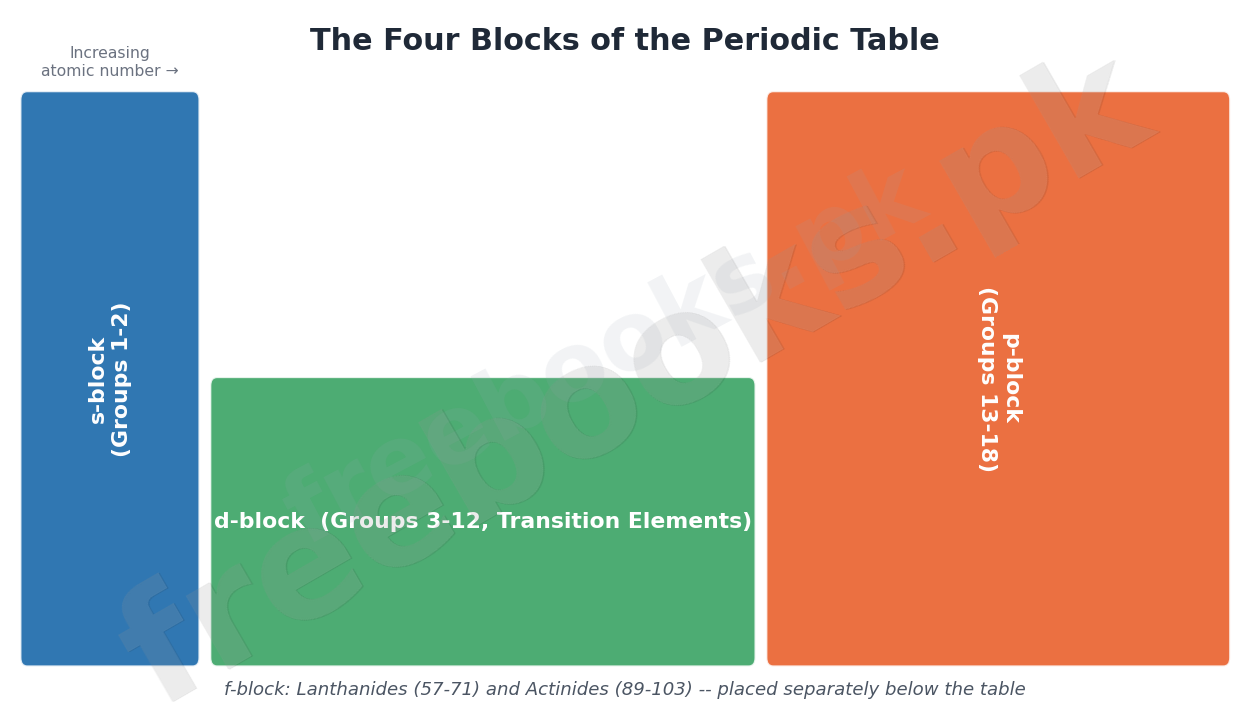
Elements are also classified into four blocks by which subshell receives the last electron: s-block (groups 1-2, valence electrons in an s subshell), p-block (groups 13-18, valence electrons in a p subshell), d-block (groups 3-12, transition elements, filling a d subshell), and f-block (lanthanides and actinides, filling an f subshell).
3.2.1 Atomic Size (Atomic Radius)
Since atoms have no fixed boundary, atomic radius is defined as half the distance between the nuclei of two bonded atoms of the same element (e.g. two carbon atoms are 154 pm apart, so carbon's atomic radius is 77 pm). Moving left to right across a period, atomic size decreases (e.g. Li 152 pm down to Ne 69 pm) because each added proton increases the effective nuclear charge while electrons keep filling the same shell, pulling the shell in tighter. Moving down a group, atomic size increases because a new electron shell is added at each period, and this greater distance and shielding outweighs the increase in nuclear charge.
3.2.2 Shielding Effect
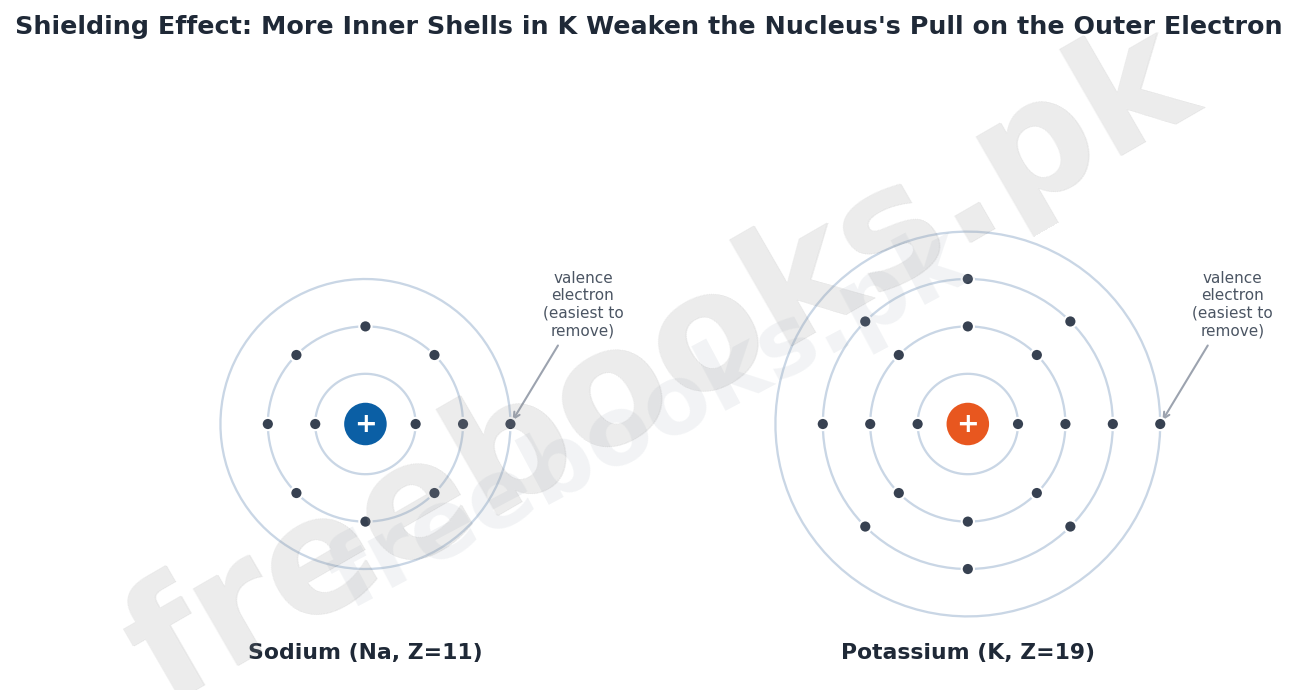
Inner-shell electrons partially block ('shield') the nucleus's pull on the outermost (valence) electrons, so a valence electron feels a reduced, effective nuclear charge (Zeff) rather than the full nuclear charge. This is called the shielding effect. It increases down a group as more electrons and shells are added (e.g. potassium, Z=19, has a stronger shielding effect than sodium, Z=11, so it is easier to remove an electron from potassium). Shielding effect decreases across a period from left to right, since electrons are added to the same shell rather than a new one.
3.2.3 Ionization Energy
Ionization energy is the energy required to remove the most loosely bound electron from an isolated gaseous atom (e.g. Na → Na+ + e-, ΔH = +496 kJ/mol for sodium's first ionization energy). Removing further electrons requires progressively more energy (second, third ionization energy, etc.). Ionization energy increases across a period left to right (e.g. Li 520 to Ne 2081 kJ/mol) because atoms get smaller and valence electrons are held more tightly by the increasing nuclear charge. It decreases down a group (e.g. Li 520 down to Cs 377 kJ/mol) because additional inner shells increase shielding and distance, making valence electrons easier to remove.
3.2.4 Electron Affinity
Electron affinity is the energy released when an electron is added to the outermost shell of an isolated gaseous atom (e.g. F + e- → F-, ΔH = -328 kJ/mol). It increases (becomes more negative/more energy released) across a period left to right, because decreasing atomic size means the nucleus attracts the incoming electron more strongly. It decreases down a group, because increasing atomic size and shielding effect weaken the nucleus's pull on the incoming electron (e.g. iodine's electron affinity is smaller in magnitude than chlorine's).
3.2.5 Electronegativity
Electronegativity is an atom's ability to attract the shared pair of electrons toward itself within a covalent bond — important when analysing covalent bonding. Its trend matches ionization energy and electron affinity: electronegativity increases across a period left to right (e.g. Li 1.0 up to F 4.0) because a higher effective nuclear charge pulls the shared electron pair closer, and it decreases down a group (e.g. F 4.0 down to I 2.7) because increasing atomic size weakens the atom's pull on the shared electrons.
Important Definitions
State the (modern) periodic law.
The properties of the elements are periodic functions of their atomic numbers.
What is a period in the Periodic Table?
A horizontal row of elements with continuously increasing atomic number and continuously changing electronic configuration and properties.
What is a group in the Periodic Table?
A vertical column of elements that share the same number of valence electrons and therefore similar chemical properties; also called a family.
What is a block of elements?
A set of elements classified by which type of subshell (s, p, d or f) receives the last electron in their electronic configuration.
Define atomic radius.
Half of the distance between the nuclei of two bonded atoms of the same element.
What is effective nuclear charge (Zeff)?
The actual nuclear charge felt by a valence electron after accounting for the shielding effect of inner-shell electrons.
Define the shielding effect.
The reduction in the nuclear charge felt by valence electrons due to the presence of electrons in the inner shells between them and the nucleus.
Define ionization energy.
The amount of energy required to remove the most loosely bound electron from the valence shell of an isolated gaseous atom.
Define electron affinity.
The amount of energy released when an electron is added to the outermost shell of an isolated gaseous atom.
Define electronegativity.
The ability of an atom to attract the shared pair of electrons toward itself within a molecule.
What are transition elements?
Elements of groups 3 to 12, in which the d subshell is in the process of being filled with electrons.
What are the lanthanides and actinides?
Two series of 14 elements each, starting after Lanthanum (Z=57) and Actinium (Z=89), placed separately below the main periodic table and together forming the f-block.
Key Formulas
| Topic | Formula |
|---|---|
| Ionization energy example (sodium) | Na → Na+ + e-, ΔH = +496 kJ mol⁻¹ |
| Electron affinity example (fluorine) | F + e- → F-, ΔH = -328 kJ mol⁻¹ |
| Atomic size trend | Decreases across a period (left→right); increases down a group |
| Ionization energy trend | Increases across a period (left→right); decreases down a group |
| Electron affinity trend | Increases (more negative) across a period; decreases down a group |
| Electronegativity trend | Increases across a period (left→right); decreases down a group |
| Number of periods / groups | 7 periods, 18 groups in the modern long-form Periodic Table |
Diagrams
The Four Blocks of the Periodic Table: s-block, p-block, d-block and f-block shown by which subshell type receives the last electron in each element group.
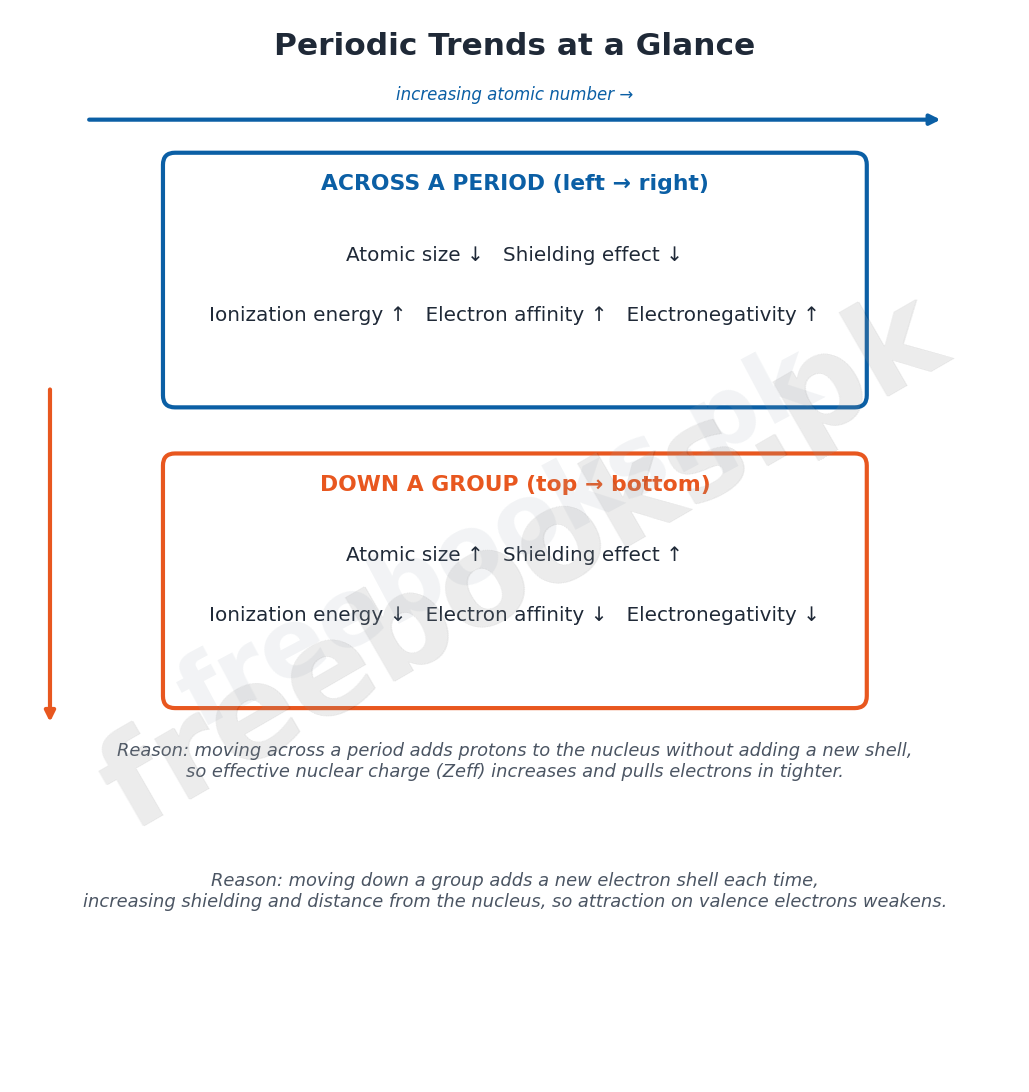
Periodic Trends at a Glance: Summary of how atomic size, shielding, ionization energy, electron affinity and electronegativity change across a period and down a group.
Shielding Effect: Sodium vs Potassium: Electron-shell diagrams comparing sodium and potassium, showing how potassium's extra inner shell increases shielding and makes its valence electron easier to remove.
Short Questions & Answers
What was the main achievement of Mendeleev's periodic table, despite its demerits?
It successfully predicted the properties of elements that had not yet been discovered at the time.
Why is atomic number considered more fundamental than atomic mass for arranging elements?
Because atomic number is fixed for every element and increases regularly by exactly 1 from element to element, while no two elements can share the same atomic number.
How many elements are in period 1, and why is it called a short period?
Period 1 has only 2 elements, hydrogen and helium, because the first shell (K) can hold a maximum of only 2 electrons.
Why do elements in the same group have similar chemical properties?
Because elements in the same group have the same number of valence electrons, even though their atomic numbers increase with irregular gaps.
Which block do group 1 and group 2 elements belong to, and why?
They belong to the s-block, because their valence electrons occupy an s subshell.
Why does atomic size decrease across a period from left to right?
Because the effective nuclear charge increases as protons are added to the nucleus, while electrons keep filling the same shell, pulling the shell inward.
Why is potassium's valence electron easier to remove than sodium's?
Because potassium has an additional inner shell compared to sodium, giving it a greater shielding effect that weakens the nucleus's pull on its outermost electron.
Why does ionization energy decrease down a group?
Because additional electron shells increase both the atomic size and the shielding effect, so the valence electron is held less tightly and is easier to remove.
Why does electron affinity increase across a period from left to right?
Because atomic size decreases across a period, so the nucleus attracts an incoming electron more strongly, releasing more energy.
Which element in period 2 has the highest electronegativity, and why?
Fluorine has the highest electronegativity in period 2 (4.0), because it has the smallest atomic size and highest effective nuclear charge among period 2 elements, giving it the strongest pull on a shared electron pair.
Long Questions & Answers
Trace the historical development of the periodic table from Dobereiner to the modern periodic law.
What did Dobereiner and Newlands contribute?
Dobereiner grouped elements into triads of three, where the middle element's atomic mass was the average of the outer two, but this pattern held for only a few elements. Newlands proposed the 'law of octaves' in 1864, noting that chemical properties repeated every eighth element when ordered by increasing atomic mass, comparing it to musical notes — but his scheme left no room for undiscovered elements or the noble gases.
What did Mendeleev achieve, and what were his table's demerits?
Mendeleev arranged the 63 known elements by increasing atomic mass into periods and groups, stating the periodic law as 'properties of elements are periodic functions of their atomic masses'. His table's major strength was predicting the properties of undiscovered elements. Its demerits were that it could not explain the position of isotopes, and a few elements were placed out of correct order when strictly following atomic mass.
What change did Moseley bring, and why was it significant?
In 1913, Moseley discovered atomic number and showed that it, not atomic mass, should determine an element's position in the table. This amended the periodic law to 'properties of elements are periodic functions of their atomic numbers' — atomic number is more fundamental because it is fixed and increases by exactly 1 for each successive element, with no two elements sharing a value.
How did this lead to the modern periodic table?
Arranging elements by increasing atomic number showed that properties repeat at regular intervals (electronic configuration is directly tied to atomic number), so long rows of elements could be cut and stacked into periods and groups, producing the modern long-form periodic table with its s, p, d and f blocks.
Explain how atomic size, ionization energy and electronegativity vary across a period and down a group, and why.
How and why does atomic size change?
Atomic size decreases across a period from left to right, because each added proton increases the effective nuclear charge while electrons continue filling the same shell, pulling the shell inward (e.g. Li 152 pm down to Ne 69 pm). It increases down a group because a new electron shell is added at each successive period, increasing both distance from the nucleus and shielding effect.
How and why does ionization energy change?
Ionization energy increases across a period from left to right, because decreasing atomic size means valence electrons are held more tightly by a stronger effective nuclear charge (e.g. Li 520 up to Ne 2081 kJ/mol). It decreases down a group, because additional inner shells increase shielding and distance from the nucleus, making the valence electron easier to remove (e.g. Li 520 down to Cs 377 kJ/mol).
How and why does electronegativity change?
Electronegativity increases across a period from left to right, following the same reasoning as ionization energy: a higher effective nuclear charge pulls a shared pair of electrons more strongly toward the atom (e.g. Li 1.0 up to F 4.0). It decreases down a group because increasing atomic size places the shared electron pair farther from the nucleus, weakening the atom's pull on it (e.g. F 4.0 down to I 2.7).
What single underlying factor connects all three trends?
All three trends are governed by the same balance between effective nuclear charge and atomic size/shielding: across a period, nuclear charge increases while shielding stays roughly constant, strengthening the nucleus's pull; down a group, an added shell increases both size and shielding faster than nuclear charge grows, weakening the nucleus's pull on outer electrons.
Multiple Choice Questions (MCQs)
The atomic radii of the elements in the Periodic Table: (A) increase from left to right in a period (B) increase from top to bottom in a group (C) do not change from left to right in a period (D) decrease from top to bottom in a group
Correct answer: (B) increase from top to bottom in a group. Atomic radii increase from top to bottom in a group because a new electron shell is added at each period.
The amount of energy given out when an electron is added to an atom is called: (A) lattice energy (B) ionization energy (C) electronegativity (D) electron affinity
Correct answer: (D) electron affinity. Electron affinity is defined as the energy released when an electron is added to an isolated gaseous atom.
Mendeleev's Periodic Table was based upon the: (A) electronic configuration (B) atomic mass (C) atomic number (D) completion of a subshell
Correct answer: (B) atomic mass. Mendeleev arranged elements in order of increasing atomic mass.
The long form of the Periodic Table is constructed on the basis of: (A) Mendeleev's postulate (B) atomic number (C) atomic mass (D) mass number
Correct answer: (B) atomic number. The modern long form periodic table is arranged according to increasing atomic number.
The 4th and 5th periods of the long form Periodic Table are called: (A) short periods (B) normal periods (C) long periods (D) very long periods
Correct answer: (C) long periods. Periods 4 and 5 are called long periods, each containing 18 elements.
Which one of the following halogens has the lowest electronegativity? (A) fluorine (B) chlorine (C) bromine (D) iodine
Correct answer: (D) iodine. Electronegativity decreases down group 17, so iodine has the lowest electronegativity among these halogens.
Along a period (left to right), which one of the following decreases? (A) atomic radius (B) ionization energy (C) electron affinity (D) electronegativity
Correct answer: (A) atomic radius. Atomic radius decreases across a period, while ionization energy, electron affinity and electronegativity all increase.
Transition elements are: (A) all gases (B) all metals (C) all non-metals (D) all metalloids
Correct answer: (B) all metals. All transition elements (groups 3-12, d-block) are metals.
Which of the following statements about ionization energy is incorrect? (A) it is measured in kJ/mol (B) it involves absorption of energy (C) it decreases across a period (D) it decreases down a group
Correct answer: (C) it decreases across a period. Ionization energy increases (not decreases) across a period from left to right.
Which of the following statements about electron affinity is incorrect? (A) it is measured in kJ/mol (B) it involves release of energy (C) it decreases across a period (D) it decreases down a group
Correct answer: (C) it decreases across a period. Electron affinity increases (not decreases) across a period from left to right.
Quick Revision Summary
- Periodic law: properties of elements are periodic functions of their atomic numbers (Moseley, 1913)
- Modern periodic table: 7 periods (horizontal rows), 18 groups (vertical columns)
- Period 1 = short (2 elements); periods 2-3 = normal (8 each); periods 4-5 = long (18 each); periods 6-7 = very long (32 each)
- 4 blocks: s-block (groups 1-2), p-block (groups 13-18), d-block (groups 3-12, transition), f-block (lanthanides/actinides)
- Across a period (left→right): atomic size ↓, shielding ↓, ionization energy ↑, electron affinity ↑, electronegativity ↑
- Down a group (top→bottom): atomic size ↑, shielding ↑, ionization energy ↓, electron affinity ↓, electronegativity ↓
- Shielding effect = inner electrons reduce the nuclear pull felt by valence electrons; increases down a group
Exam Tips
- Memorise the periodic law in both forms (Mendeleev's atomic-mass version and the modern atomic-number version) and be ready to explain why the modern version replaced it
- Learn the period names (short, normal, long, very long) with their exact element counts — a common short-question topic
- Practice identifying which block (s, p, d, f) a given group number belongs to
- Build a single mental table of all 5 periodic trends (atomic size, shielding, ionization energy, electron affinity, electronegativity) and their direction across periods vs down groups — this connects many exam questions
- Be ready to explain WHY a trend occurs, not just state it — effective nuclear charge and shielding effect are the two reasons behind every trend in this unit
- Practice numerical examples using real values (e.g. period 2 atomic radii, ionization energies) since board exams often ask you to explain a specific given data trend