
For most of the 19th century, Dalton's atomic theory held that atoms were indivisible, solid spheres. Experiments by Goldstein, J.J. Thomson, Rutherford and Chadwick between 1886 and 1932 overturned this idea, revealing that atoms are built from three subatomic particles — electrons, protons and neutrons — and are mostly empty space around a tiny, dense, positively charged nucleus.
This unit traces that discovery through the cathode-ray and canal-ray experiments, Rutherford's gold-foil experiment and planetary model, and Bohr's quantum-based model of fixed-energy orbits. It then covers how electrons are arranged into shells and subshells (electronic configuration) for the first 18 elements, and closes with isotopes — atoms of the same element with different numbers of neutrons — and their real-world uses in medicine, power generation, and dating fossils.
Learning Objectives
- Describe the discovery of the electron, proton and neutron, and the experiments behind each
- Describe Rutherford's gold-foil experiment, his planetary atomic model, and its defects
- Explain how Bohr's atomic theory improved upon Rutherford's model using quantized energy levels
- Distinguish between shells and subshells, and state the maximum electron capacity of each
- Write the electronic configuration of the first 18 elements of the Periodic Table
- Define isotopes and compare the isotopes of hydrogen, carbon, chlorine and uranium
- State the importance and real-world uses of isotopes in medicine, power generation, and dating
Key Concepts
2.1.1 Discovery of the Electron (Cathode Rays)
In 1897, J.J. Thomson identified negatively charged particles — electrons — while studying cathode rays produced in a discharge tube by Sir William Crookes in 1895. When high-voltage current passed through gas at very low pressure, shiny rays travelled from the cathode toward the anode. These cathode rays travel in straight lines, cast sharp shadows of opaque objects, deflect toward the positive plate in an electric field (proving they are negatively charged), raise the temperature of objects they strike, and are identical regardless of which gas or cathode material is used — proving electrons are fundamental particles present in all matter. Thomson proposed the 'plum pudding' model: a solid sphere of positive charge with negative electrons embedded inside it, like plums in a pudding.
2.1.2 Discovery of the Proton (Canal Rays)
In 1886, Goldstein discovered a second type of ray in the discharge tube, travelling opposite to the cathode rays through holes in a perforated cathode — he called these 'canal rays'. Canal rays deflect in electric and magnetic fields toward the negative plate (proving they are positively charged), and unlike cathode rays, their nature depends on the gas used in the tube. They form when cathode-ray electrons collide with and ionise residual gas molecules (M + e⁻ → M⁺ + 2e⁻). The lightest gas, hydrogen, produces the lightest positive particles — protons — whose mass is about 1840 times that of an electron.
2.1.3 Discovery of the Neutron
Rutherford predicted in 1920 that atomic mass could not be explained by protons and electrons alone, so a neutral particle with a mass close to that of a proton must also exist. In 1932, Chadwick confirmed this by bombarding alpha particles onto a beryllium target (⁹Be + ⁴He → ¹²C + ¹n), producing highly penetrating, uncharged radiation — the neutron. Neutrons carry no charge, are highly penetrating, and have a mass nearly equal to that of a proton.
2.1.4 Rutherford's Atomic Model
Rutherford bombarded alpha particles (helium nuclei, He²⁺) at an extremely thin (0.00004 cm) gold foil and observed the scattering pattern on a zinc-sulphide screen. Almost all particles passed straight through undeflected, but a few were deflected at large angles, and a very few bounced straight back. From this, Rutherford concluded: most of an atom's volume is empty space; there is a tiny, dense, positively charged centre called the nucleus; electrons revolve around the nucleus; and since an atom is neutral overall, the number of electrons equals the number of protons. Except for electrons, all fundamental particles within the nucleus are called nucleons.
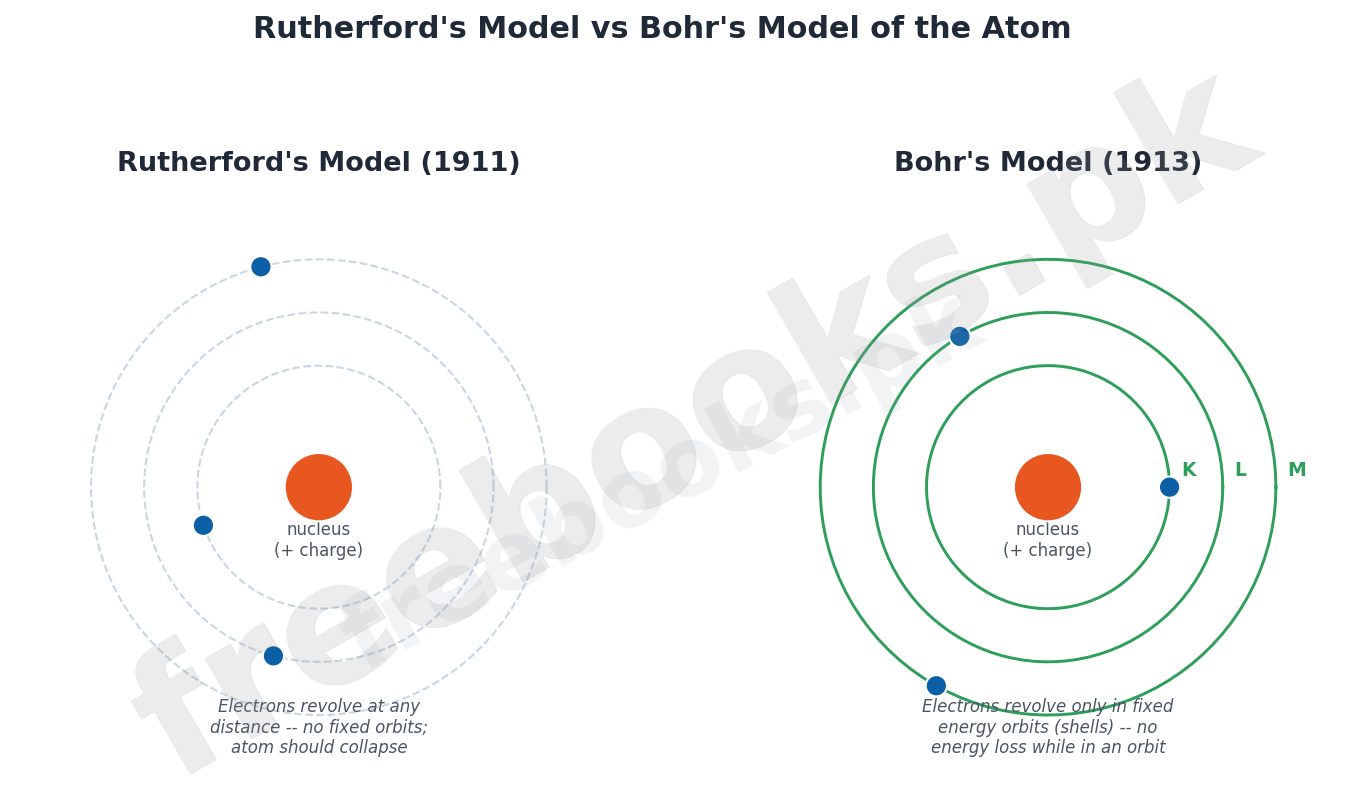
Rutherford's model had two defects: classical theory predicted that revolving (charged) electrons should continuously emit energy and eventually spiral into the nucleus, meaning atoms should collapse — but they do not; and continuously emitting electrons should produce a continuous spectrum, but atoms actually produce a line spectrum. These unresolved questions — why atoms are stable, and why they give a line spectrum — set the stage for Bohr's model.
2.1.5 Bohr's Atomic Theory
In 1913, Neils Bohr proposed a model built on Max Planck's Quantum Theory. Its key postulates: electrons revolve only in fixed circular orbits of specific ('quantized') energy, called energy levels; while in a given orbit, an electron neither emits nor absorbs energy; energy is absorbed when an electron jumps to a higher orbit and radiated when it jumps to a lower orbit, following Planck's equation ΔE = E2 – E1 = hν (h = Planck's constant, 6.63×10⁻³⁴ Js); and an electron can only occupy orbits where its angular momentum equals a whole-number multiple of h/2π: mvr = nh/2π, where n (1, 2, 3…) is the orbit or quantum number. Bohr's model explained both why atoms are stable (electrons don't lose energy while in an orbit) and why atoms produce a line spectrum (energy is only absorbed/released in fixed jumps).
2.2.1 Shells and Subshells
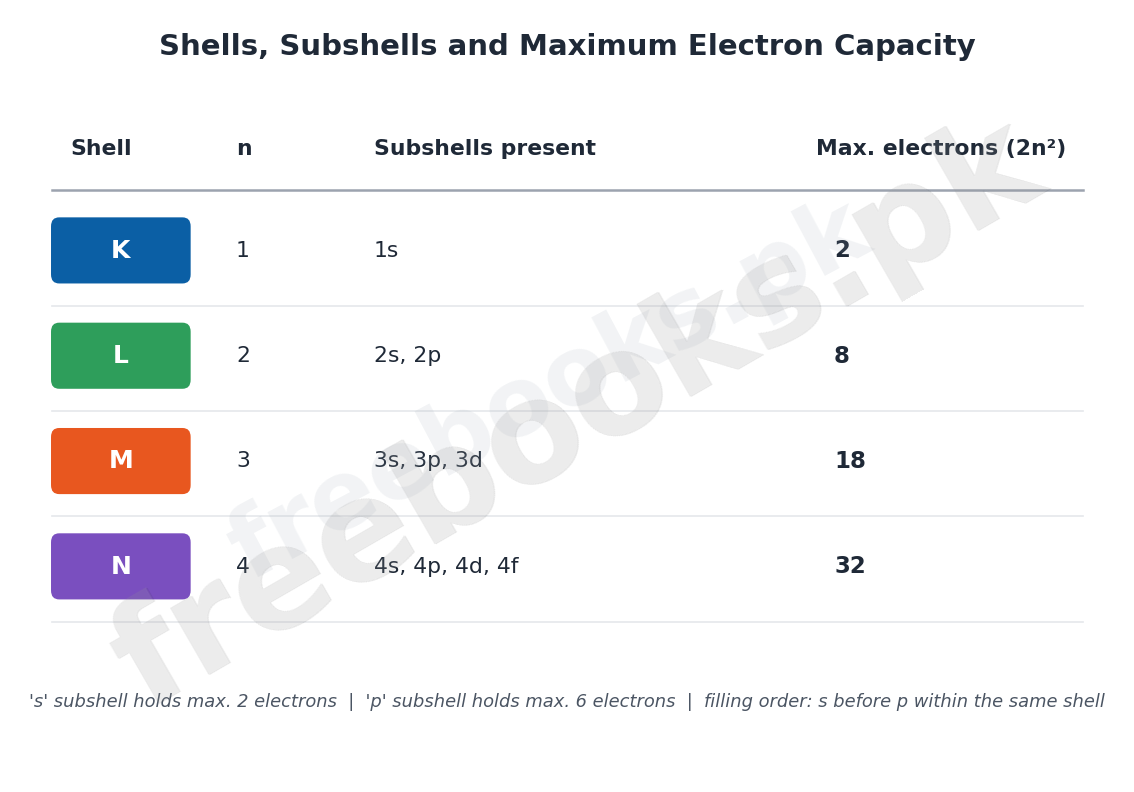
Electrons revolve around the nucleus in shells (energy levels), numbered by 'n' (1, 2, 3…) and labelled K, L, M, N. The K shell, closest to the nucleus, has the lowest energy; energy increases outward. Each shell contains one or more subshells (s, p, d, f), and within a shell, the s subshell fills before the p subshell. An s subshell holds a maximum of 2 electrons; a p subshell holds a maximum of 6 electrons. The maximum electron capacity of a shell is 2n² — so K (n=1) holds 2, L (n=2) holds 8, M (n=3) holds 18, and N (n=4) holds 32 electrons.
2.2.2 Electronic Configuration of the First 18 Elements
To write an electron configuration, three things must be known: the total number of electrons in the atom (equal to its atomic number), the order in which shells and subshells fill by increasing energy, and the maximum capacity of each shell/subshell. Electrons fill in the sequence 1s2, 2s2, 2p6, 3s2, 3p6… — the number before each letter is the shell, the letter is the subshell, and the superscript is the number of electrons in it. For example, an atom with 11 electrons (sodium) fills K(2), L(8), leaving 1 electron for M, written simply as 2, 8, 1, or in full as 1s2 2s2 2p6 3s1. Ions adjust the electron count first: Cl⁻ has 17+1=18 electrons (2, 8, 8), matching the noble gas argon.
2.3 Isotopes: Definition and Examples
Isotopes are atoms of the same element that have the same atomic number but different mass numbers — meaning they have identical electronic configuration and proton count but a different number of neutrons. Because chemical properties depend on electronic configuration, isotopes of an element behave identically in chemical reactions, but because physical properties depend on mass, their physical properties (like density) differ.
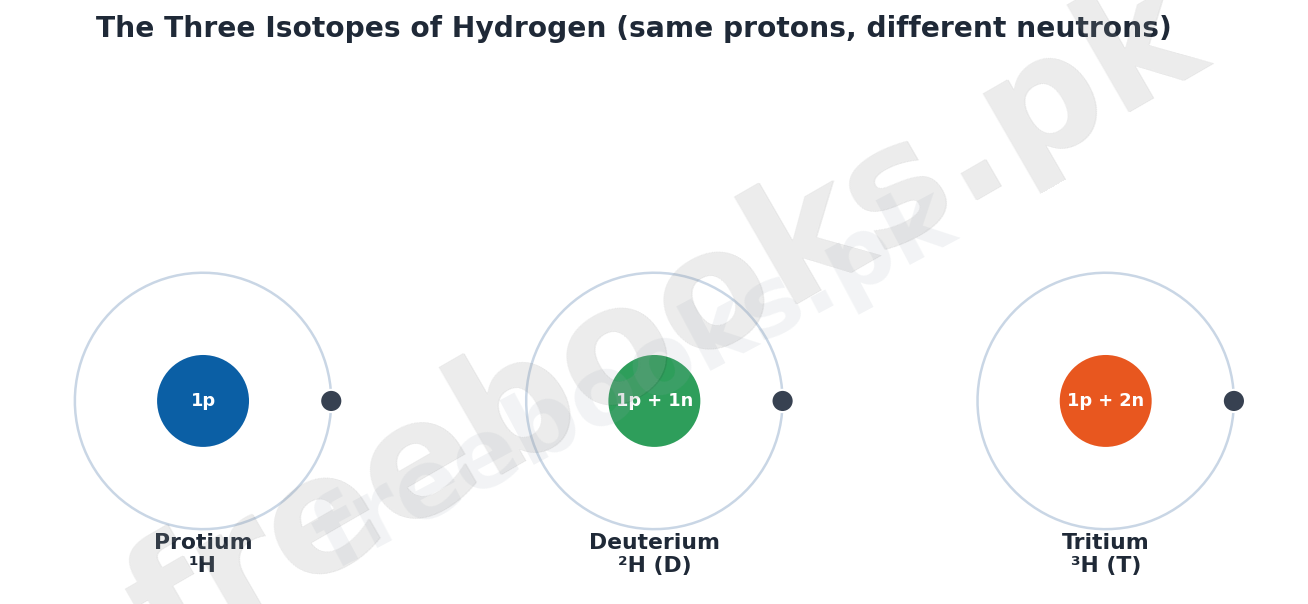
Hydrogen has three isotopes: protium (¹H, 0 neutrons), deuterium (²H or D, 1 neutron), and tritium (³H or T, 2 neutrons) — all with 1 proton and 1 electron. Carbon has three isotopes: ¹²C (98.9% abundant, stable), ¹³C (1.1% abundant, stable), and ¹⁴C (radioactive, used in carbon dating) — all with 6 protons. Chlorine has two isotopes, ³⁵Cl and ³⁷Cl (both with 17 protons). Uranium has three isotopes — ²³⁴U, ²³⁵U, and ²³⁸U (all with 92 protons) — with ²³⁸U making up nearly 99% of natural uranium.
2.3.3 Uses of Isotopes
Isotopes have wide-ranging real-world applications. In radiotherapy, P-32 and Sr-90 (which emit weakly penetrating beta radiation) treat skin cancer, while Co-60 (which emits strongly penetrating gamma rays) treats cancer deeper within the body. As tracers in medicine, Iodine-131 diagnoses goiter in the thyroid gland, and technetium monitors bone growth. In archaeology and geology, radioactive-isotope dating (such as radiocarbon dating using C-14) estimates the age of fossils and old carbon-containing objects. In chemical structure determination, C-14 labels CO2 to trace its path through photosynthesis into glucose. In power generation, controlled nuclear fission of U-235 (bombarded with slow neutrons, producing Barium-139, Krypton-94, and 3 neutrons plus energy) generates electricity in nuclear reactors.
Important Definitions
What is an atom, according to Dalton's original theory?
A very small, indivisible particle that makes up all matter; atoms of the same element are alike and combine in different ways to form compounds.
Define cathode rays.
Negatively charged rays that travel from the cathode toward the anode in a discharge tube at low pressure; their study led to the discovery of the electron.
Define canal rays.
Positively charged rays that travel opposite to cathode rays through a perforated cathode in a discharge tube; their study led to the discovery of the proton.
What is the nucleus of an atom?
The tiny, dense, positively charged centre of an atom, discovered by Rutherford, where nearly all of the atom's mass is concentrated.
Define a nucleon.
Any fundamental particle found within the nucleus of an atom (protons and neutrons), excluding electrons.
What is an energy level (shell)?
A fixed orbit of specific, quantized energy in which an electron revolves around the nucleus without emitting or absorbing energy, according to Bohr's model.
Define a subshell.
A division within a shell (labelled s, p, d, f) that holds a specific maximum number of electrons and has a slightly different energy from other subshells in the same shell.
What is the maximum electron capacity of a shell?
2n², where n is the shell number — so K holds 2, L holds 8, M holds 18, and N holds 32 electrons.
Define electronic configuration.
The distribution of electrons of an atom among its shells and subshells, written in order of increasing energy, e.g. 1s2 2s2 2p6.
Define isotopes.
Atoms of the same element having the same atomic number but different mass numbers, due to a different number of neutrons.
What is Planck's constant?
A fundamental constant, h = 6.63 x 10^-34 Js, relating the energy of a photon to its frequency in Planck's equation, ΔE = hν.
Define quantum.
The smallest, fixed amount of energy that can be emitted or absorbed as electromagnetic radiation.
What is radiocarbon (carbon) dating?
A method of estimating the age of old carbon-containing objects, such as fossils, by measuring the radioactivity of the isotope C-14 in them.
Define nuclear fission.
A reaction in which a heavy atomic nucleus (such as U-235) splits into two lighter nuclei upon bombardment with a neutron, releasing a large amount of energy.
Key Formulas
| Topic | Formula |
|---|---|
| Mass of proton relative to electron | Mass of a proton ≈ 1840 x mass of an electron |
| Ionisation producing canal rays | M + e⁻ → M⁺ + 2e⁻ |
| Discovery of neutron (Chadwick) | 9-4Be + 4-2He → 12-6C + 1-0n |
| Planck's energy equation | ΔE = E2 – E1 = hν (h = 6.63 x 10^-34 Js) |
| Bohr's quantized angular momentum | mvr = nh / 2π (n = 1, 2, 3, …) |
| Maximum electron capacity of a shell | Maximum electrons = 2n² (K=2, L=8, M=18, N=32) |
| Nuclear fission of U-235 | 235-92U + 1-0n → 139-56Ba + 94-36Kr + 3(1-0n) + energy |
Diagrams
Rutherford's Model vs Bohr's Model: Side-by-side comparison showing electrons at arbitrary distances in Rutherford's planetary model versus electrons confined to fixed-energy shells (K, L, M) in Bohr's quantized model.
Shells, Subshells and Maximum Electron Capacity: Table-style diagram of shells K, L, M, N with their subshells and maximum electron capacity (2n²).
The Three Isotopes of Hydrogen: Protium, deuterium and tritium shown with identical proton/electron counts but increasing numbers of neutrons.
Short Questions & Answers
What experiment led to the discovery of the electron, and who performed it?
J.J. Thomson's study of cathode rays produced in a discharge tube (originally built by Sir William Crookes) led to the discovery of the electron in 1897.
Why are canal rays also called positive rays?
Because they deflect toward the negative plate in an electric field, showing they carry a positive charge, and they are formed by ionisation of residual gas molecules.
What two observations led Rutherford to conclude that an atom is mostly empty space?
Almost all alpha particles passed straight through the gold foil undeflected, showing that most of an atom's volume must be empty, with only a tiny, dense nucleus present.
Why does classical theory predict that atoms should collapse, but they do not?
Classical theory predicts that revolving charged electrons should continuously lose energy and spiral into the nucleus, but Bohr's model resolved this by showing electrons in a fixed orbit do not emit energy at all.
What is the significance of Planck's equation, ΔE = hν, in Bohr's model?
It shows that an electron only absorbs or radiates energy in fixed amounts (quanta) when it jumps between orbits, explaining why atoms produce a line spectrum rather than a continuous one.
Why does the 's' subshell fill before the 'p' subshell in the same shell?
Because the 's' subshell has slightly lower energy than the 'p' subshell within the same shell, and electrons always occupy the lowest available energy first.
What is the electronic configuration of an atom with 15 electrons?
2, 8, 5, since K holds 2, L holds 8, and the remaining 5 electrons go into the M shell (element: phosphorus).
Why do isotopes of an element have identical chemical properties?
Because chemical properties depend on electronic configuration, and isotopes of the same element have the same number of electrons and the same configuration.
Name the three isotopes of hydrogen and their neutron counts.
Protium (0 neutrons), deuterium (1 neutron), and tritium (2 neutrons) — all with 1 proton and 1 electron.
Give one medical use of a radioactive isotope.
Iodine-131 is used as a tracer to diagnose goiter in the thyroid gland; Co-60 is used in radiotherapy to treat cancer within the body.
Long Questions & Answers
Describe the discovery of the electron, proton and neutron, including the experiments and scientists responsible for each.
How was the electron discovered?
J.J. Thomson identified the electron in 1897 while studying cathode rays, produced by passing high-voltage current through gas at low pressure in a discharge tube built by Sir William Crookes. These rays travelled from the cathode toward the anode, deflected toward the positive plate in an electric field (proving a negative charge), and were identical regardless of the gas or cathode material used, showing electrons are a fundamental part of all matter.
How was the proton discovered?
In 1886, Goldstein observed a second set of rays in the discharge tube, travelling opposite to the cathode rays through holes in a perforated cathode, which he named canal rays. These rays deflected toward the negative plate (proving a positive charge), and their properties depended on the gas used — the lightest gas, hydrogen, produced the lightest positive particles, called protons.
How was the neutron discovered?
Rutherford predicted in 1920 that a neutral particle must exist in the atom to account for atomic mass. In 1932, Chadwick confirmed this by bombarding alpha particles onto a beryllium target, producing highly penetrating, uncharged radiation that he identified as the neutron, with a mass nearly equal to that of a proton.
What do these three discoveries establish together?
Together, they proved that Dalton's idea of an indivisible atom was incomplete — an atom is actually built from three subatomic particles: negatively charged electrons, positively charged protons, and neutral neutrons, laying the foundation for Rutherford's and Bohr's atomic models.
Explain Rutherford's atomic model and how Bohr's atomic theory resolved its defects.
What did Rutherford's gold-foil experiment show?
Rutherford bombarded alpha particles at an extremely thin gold foil. Since almost all particles passed straight through, he concluded that most of an atom's volume is empty space; since a few particles deflected at large angles or bounced back, he concluded that there is a tiny, dense, positively charged nucleus at the atom's centre, around which electrons revolve.
What were the defects of Rutherford's model?
According to classical theory, a revolving charged electron should continuously emit energy and eventually spiral into the nucleus, meaning atoms should collapse — but they clearly do not. Also, continuously emitting electrons should produce a continuous spectrum, but atoms are observed to produce a line spectrum instead.
What did Bohr propose to fix these defects?
In 1913, Bohr proposed that electrons revolve only in fixed, quantized orbits of specific energy (energy levels), and that as long as an electron stays in one orbit, it neither absorbs nor emits energy — resolving the collapse problem. Energy is only absorbed or released in a fixed amount, ΔE = hν, when an electron jumps between orbits, explaining the line spectrum.
What rule governs which orbits an electron can occupy?
Bohr proposed that an electron can only occupy orbits where its angular momentum is a whole-number multiple of h/2π, expressed as mvr = nh/2π, where n is the orbit or quantum number (1, 2, 3…). This quantization rule explains why only certain fixed orbits, and not any arbitrary distance from the nucleus, are allowed.
Multiple Choice Questions (MCQs)
Which one of the following results in the discovery of the proton? (A) cathode rays (B) canal rays (C) X-rays (D) alpha rays
Correct answer: (B) canal rays. Canal rays, discovered by Goldstein in 1886, were found to be positively charged and led to the discovery of the proton.
Which one of the following is the most penetrating? (A) protons (B) electrons (C) neutrons (D) alpha particles
Correct answer: (C) neutrons. Neutrons, being neutral and highly penetrating, pass through matter more easily than charged protons, electrons or alpha particles.
The concept of fixed-energy orbits was introduced by: (A) J.J. Thomson (B) Rutherford (C) Bohr (D) Planck
Correct answer: (C) Bohr. Neils Bohr introduced the concept of fixed, quantized energy orbits in his 1913 atomic model.
Which one of the following shells consists of three subshells (s, p, d)? (A) K shell (B) L shell (C) M shell (D) N shell only up to p
Correct answer: (C) M shell. The M shell (n=3) contains three subshells: 3s, 3p and 3d.
Which radioisotope is used for the diagnosis of a tumor/goiter in the body? (A) cobalt-60 (B) iodine-131 (C) strontium-90 (D) phosphorus-32
Correct answer: (B) iodine-131. Iodine-131 is used as a tracer to diagnose goiter in the thyroid gland.
When U-235 undergoes fission, it produces: (A) only electrons (B) neutrons, along with Ba-139 and Kr-94 (C) only protons (D) no particles
Correct answer: (B) neutrons, along with Ba-139 and Kr-94. The fission of U-235 with a slow neutron produces Barium-139, Krypton-94, three neutrons, and a large amount of energy.
The p subshell can hold a maximum of: (A) 2 electrons (B) 6 electrons (C) 8 electrons (D) 10 electrons
Correct answer: (B) 6 electrons. A p subshell can accommodate a maximum of 6 electrons.
Deuterium is used to make: (A) light water (B) heavy water (C) soft water (D) hard water
Correct answer: (B) heavy water. Deuterium (²H) combines with oxygen to form heavy water (D2O).
The isotope C-12 is present in nature in an abundance of approximately: (A) 96.9% (B) 97.6% (C) 98.9% (D) 99.9%
Correct answer: (C) 98.9%. Carbon-12 makes up about 98.9% of naturally occurring carbon.
Who is credited with discovering the proton? (A) Goldstein (B) J.J. Thomson (C) Neils Bohr (D) Rutherford
Correct answer: (A) Goldstein. Goldstein discovered canal rays in 1886, which were later shown to be made of protons.
Quick Revision Summary
- Cathode rays (Crookes/Thomson) -> discovery of the electron (negative charge)
- Canal rays (Goldstein) -> discovery of the proton (positive charge, depends on gas used)
- Chadwick (1932): alpha particles + beryllium -> discovery of the neutron (no charge)
- Rutherford's gold-foil experiment: mostly empty space + tiny dense positive nucleus
- Rutherford's defects: atom should collapse; should show continuous spectrum (it doesn't)
- Bohr (1913): electrons revolve in fixed, quantized-energy orbits; ΔE = hν between orbits
- Shell capacity = 2n² -> K=2, L=8, M=18, N=32; 's' subshell fills before 'p' in the same shell
- Isotopes = same atomic number, different mass number (different neutrons); same chemical, different physical properties
- H has 3 isotopes (protium, deuterium, tritium); C has 3 (12C, 13C, 14C); Cl has 2; U has 3
Exam Tips
- Memorise which scientist is linked to which discovery/model: Goldstein (proton), Thomson (electron), Rutherford (nucleus), Bohr (energy levels), Chadwick (neutron)
- Practice writing electronic configurations for atomic numbers 1-18 and for common ions (Na+, Cl-, Al3+, Mg2+)
- Be ready to state at least 2 defects of Rutherford's model and how Bohr's model resolved each one
- Learn the shell capacity formula 2n² and be able to apply it to K, L, M, N shells
- Practice the isotopes table for H, C, Cl and U (atomic number, mass number, protons, neutrons) — a common short-question topic
- Know at least one real-world use of isotopes in each field: medicine, radiotherapy, dating, and power generation